

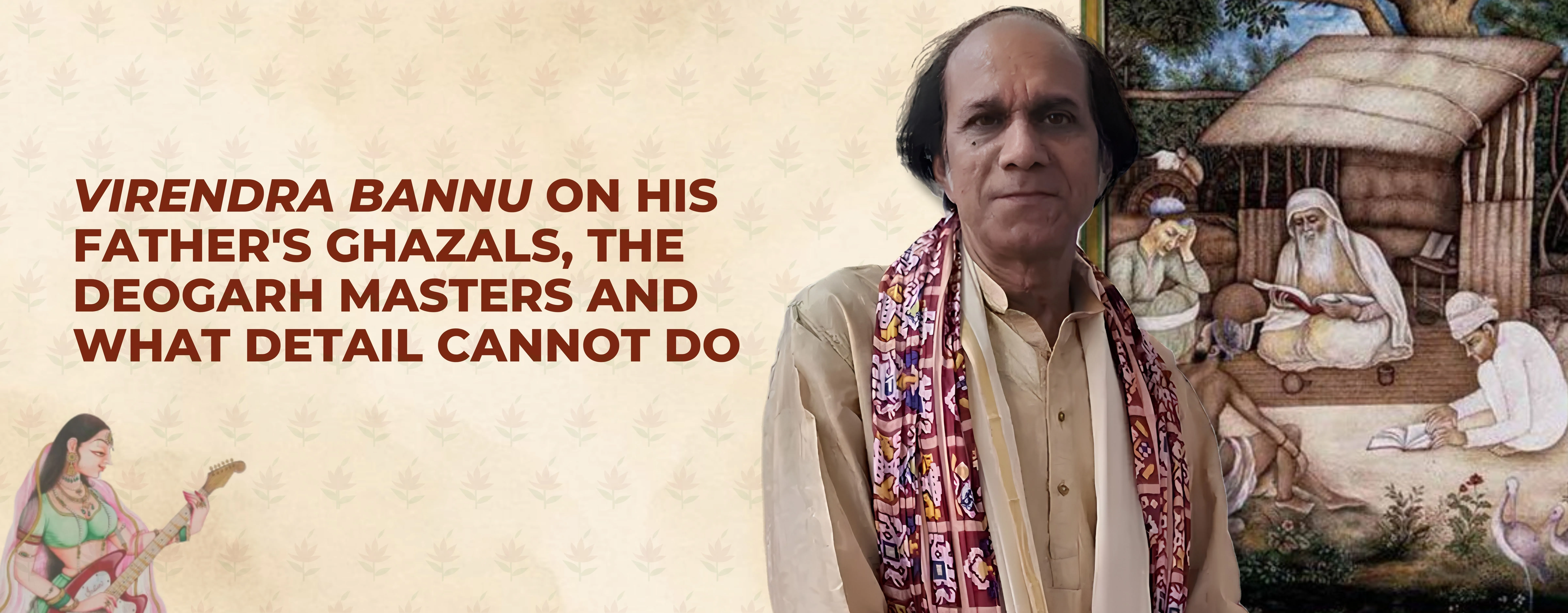
Virendra Bannu on His Legacy
Virendra Bannu on his father's ghazals, the Deogarh masters and what detail cannot do
The seventh-generation Jaipur miniature painter Virendra Banu talks candidly about how art can achieve what even masters cannot, in a heartfelt conversation with Rooftop.

Rooftop
Author
Rooftop sent Virendra Bannu its questions in Hindi. He answered by hand, in English, on three sheets of paper from Jaipur. His answers appear here as reported speech, lightly edited for flow, with nothing added to what he said. They include his account of the conversations in his father's studio, his reading of the Deogarh painters Bagta and Chokha, and his own list of what separates his painting from his brother Shammi's.
Everyone who studied with Ved Pal Sharma, the Jaipur master known as Bannu ji, describes the same teacher. He did not explain. Molly Emma Aitken, sent to him from Harvard, walked to his door almost every day for a year. She wrote of a man who corrected her exercises with a sigh and a brush and very few words. His younger son, Shammi, says his father never sat him down to teach technique.
Virendra Bannu, the elder son, remembers the same room another way. During his apprenticeship at home, he writes, he and his father often talked about life and its ups and downs. Bannu ji told his sons about his experiences as an artist. He also taught them through music, through the ghazals he always played while he worked.
The two accounts can both be true. The brushwork was taught to the eye, in silence. Something else was taught to the ear, and most of it had nothing to do with painting.
What Virendra remembers best is a saying. His father always told them to be good human beings. Practice makes an artist, he said, and practice makes a good miniature artist. Being a good human being is different, because only self-practice gets you there. In Bannu ji's telling, that second practice is the one that brings fame. It also brings the vision to make a painting that can last for centuries.
Virendra Bannu is a seventh-generation Jaipur miniature painter with a master's degree in painting. His answers keep coming back to one idea: the hand is the easy part.
First, a correction: Jaipur, not Deogarh
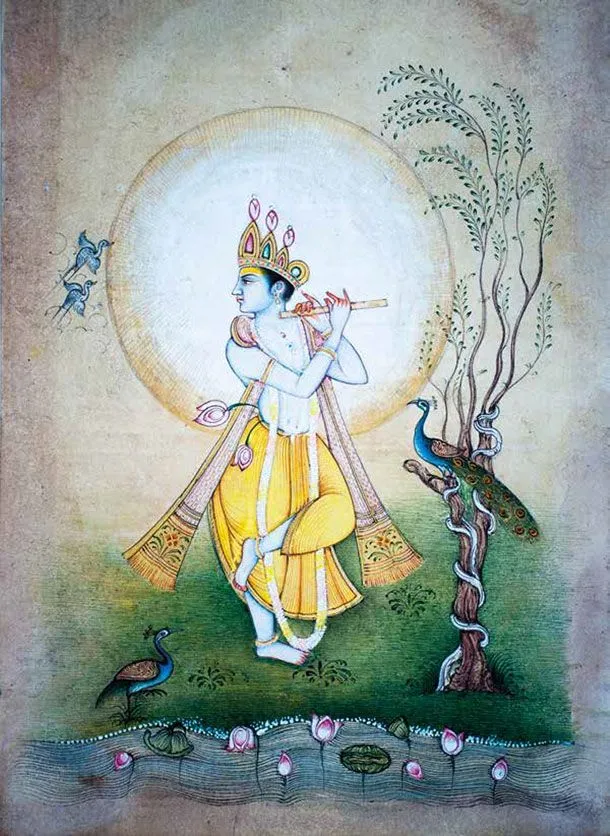
Virendra Bannu's Jaipur Collection Source - Forms of Devotion
Rooftop's questions addressed him as Virendra Bannu of Devgarh. He corrected that before he answered anything else. He belongs to Jaipur, he wrote, and Jaipur is where he was born.
The mistake has a traceable source, and it is ours. His artist page on Rooftop describes him as a Deogarh miniature artist, because the Deogarh school is what he teaches. The family has been in Jaipur since about 1840. That year Chanderji Mussavvir came from Aligarh to join the Surat Khana, the palace painting workshop of Maharaja Sawai Ram Singh II. The full chain from that court painter to Bannu ji and his sons is set out in Rooftop's account of Ved Pal Sharma, the man Harvard's curator called a university.
For the rest of his biography, he pointed us to the bio-data he has sent many times. The essentials are already on record. He studied painting at the University of Rajasthan through to an MA. He received the Rajasthan Lalit Kala Akademi's state award for painting in 1990. In April 2015, Prime Minister Narendra Modi presented his painting of Guru Nanak Dev with Bhai Mardana and Bhai Bala to the Canadian prime minister, Stephen Harper. That painting was made on handmade paper with mineral colours, which is how he still works.
Basawan, and then his father
Asked which miniature painters he admires, he named one master from the Mughal court and then set him aside. He likes Basawan, one of the Indian painters in Akbar's studio who worked on the Hamzanama. For every reason, though, the works he likes and adores are his father's.
His reasons are specific. Bannu ji developed his own style in a crowd of Indian schools. He reached a signature that most people in the art world recognise by its particular Indian qualities. He also developed what Virendra calls saundarya, beauty, within Indian belief and aesthetics. Many Americans, Virendra adds, called his father the father of modern Indian miniatures.
There is outside evidence for that regard, if not for the exact title. Stuart Cary Welch, of Harvard and the Metropolitan Museum, said Bannu was a university and he was its student. The style Virendra describes is also well documented. Bannu ji spent years restoring damaged paintings from every school. He then built a manner of his own from what he had learned inside them: Mughal workmanship, Rajput colour, the eyes and sharp features of Kishangarh, the bold composition of Basohli and the delicacy of Kangra.
A son naming his father as his favourite painter is no surprise. The reason he gives is what stands out. He values the fact that people in the art world can identify a Bannu painting by its qualities alone.
Why detail alone does not make a miniature beautiful
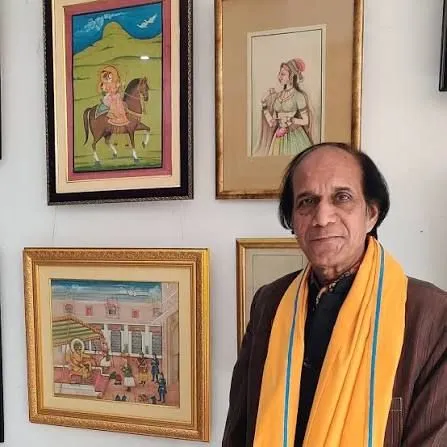
How Virendra Banu Approaches Art Source - Instagram @virenbannu
This was his longest answer, and it is aimed at a habit he sees all around him.
It is a misconception, he wrote, or simply a lack of knowledge. Many Indians believe that miniature means intricate work, and that the more detail a painting has, the more beautiful it is. He wants it on record that Indian miniature painting is about more than fine work. Fineness is one of its qualities, and only one.
In his view, any Indian miniature should have all the qualities set out as the shadanga, the six limbs of painting. He then gave four tests of his own. He says they apply to any painting at all, Indian or Western.
The first test is that a painting should be sundar, beautiful, before anything else. The old texts call this lavanya yojana, the infusion of grace. The second is balance, and he wants the painting perfectly balanced, which sits close to pramana, the limb of proportion and measure. The third is flow. No single limb covers it, but in the Bannu house it lived in the line, which Bannu ji drew from the wrist with the brush held high on the handle. The fourth is expression, and here he was most insistent. Each painting should express itself, whatever the feeling is, whether anger, love, shringar or depression. That is bhava, the emotion a painting carries.
Without expression, he wrote, a painting becomes a piece of craft without a soul.
Depression is on his list. It is not one of the nine rasas of classical theory, though karuna, the rasa of sorrow and compassion, comes close. He puts it next to shringar, the mood of love and adornment, without apology. A working painter is telling you that a modern feeling counts.
He is also not against detail. When the writer Bindu Gopal Rao visited his workspace in 2023, he held up a magnifying glass so she could see the finish on his work. His point is about order. The magnifying glass is the second look at a painting. The first look should tell you whether the painting is beautiful, balanced and alive.
A note on his source. Virendra places the shadanga in the Vishnudharmottara Purana. Its Chitrasutra section is the oldest full treatise on Indian painting and discusses the limbs at length. The six-part list itself is usually traced to Vatsyayana's Kamasutra and explained in Yashodhara's thirteenth-century commentary, the Jayamangala. Many art histories and exam guides credit the list to the Vishnudharmottara as well, so his attribution is a common one.
Deogarh, read from Jaipur
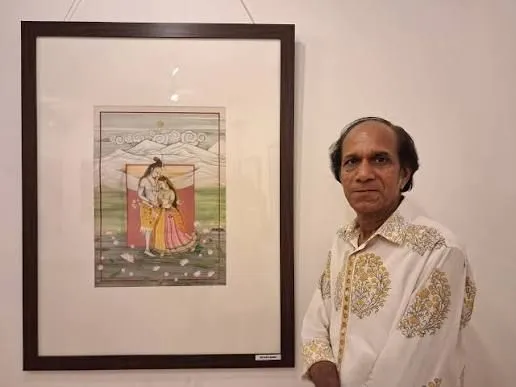
Virendra Bannu Deogarh School of Miniature Painting Source - Facebook Viren Bannu
The Deogarh school is the one he teaches, and he has a clear favourite among its painters. It is Chokha. His works are well composed, Virendra wrote, and his individual face work made him unique.
Some background helps here. Deogarh was a thikana of Mewar, a noble estate ruled by the Chundawat Rawats. In the second half of the eighteenth century, Udaipur had more painters than patrons, and some left to find work at smaller courts. Bagta, active from about 1761 to 1814, trained in the large Udaipur workshops and spent most of his long career at Deogarh. His son Chokha was born in Deogarh but trained in Udaipur, where he painted for Maharana Bhim Singh. Around 1811 he came back to Deogarh and took his father's place as the court's leading painter. Chokha's son Baijnath carried the family style into the 1830s.
Virendra's reading matches that record. Bagta and Chokha were Mewar artists who moved to Deogarh, he wrote, and their Mewar training shows in Deogarh painting. He puts the difference between the two schools simply. Mewar is known for its line and its bright colours. Deogarh added more fine detail.
The same painter who warns against judging by detail praises Deogarh for adding it. The two positions fit once you notice what he admires in Chokha, which is composition and faces. The added detail came along with those, as a by-product.
Chokha's faces also connect to the Bannu house directly. The Metropolitan Museum's notes on the family describe a preference for deep shading, night scenes and stylised, silhouetted portraits. One of Chokha's large Udaipur paintings, a court beauty now in the Met's collection, gives its subject a big lotus-shaped eye borrowed from Kishangarh portraiture. That Kishangarh eye is one of the things Bannu ji took into his own style, and Virendra grew up watching his father paint it. The Deogarh master he likes best is the one whose faces were his own. That connection is our observation, not his.
He was also plain about what remains unknown. A detailed study is needed, he wrote, because no one knows the details of this school. That is half right. The painters' names are unusually well known, because many Deogarh paintings carry inscriptions on the back naming the artist, the patron and the date. What is missing is the working knowledge: the pigments, the workshop order, and how the murals in the Moti Mahal and the Ajara ki Ovari were made.
Jaipur painters have been looking at those walls for a long time. Karl Khandalavala's Lalit Kala portfolio on Deogarh painting includes a fort wall painting of three maidens under a willow, copied by the Jaipur painter Sumahendra. Kalavritt, the Jaipur art institution founded by Dr M. K. Sharma Sumahendra, later held a miniature camp where Virendra taught. There he spoke about mineral colours and gaguli, the old Indian yellow of the Jaipur workshops.
He did not say whether he has stood in the Moti Mahal himself. That is the next question.
Two brothers, one house
Shammi Bannu Sharma and Virendra were trained in the same studio by the same father. Asked how his work differs from his brother's, Virendra wrote a list. It is the most precise description of his own hand that he has given us.
He paints fine jewellery in every painting that needs it. He lets the background melt softly into the foreground instead of drawing a hard edge between them. He uses very soft colours, mostly pastels, and avoids striking ones. He calls his paintings contemporary and credits that to his MA in painting. His figures are delicate, with delicate hands held in mudras and delicate feet. Most of his works carry what he calls modern elements, such as perspective, colour balancing and composition, alongside Indian aesthetics. Many of them also break the frame. Elements cross the painted border and come out of it, so the picture spills past its own edge.
Set that list beside Shammi's work and the contrast is easy to see. Shammi's Sandhya Aarti of Govind Dev Ji sits on a cinnabar ground. He is known for mineral pigment at full strength, and the family says it took him eighteen years to get an accurate ultramarine from lapis lazuli. Virendra works from the same shells of colour in the same house, and he chose to go pale.
Rooftop has not yet put this list to Shammi, and he may describe the difference another way. His view belongs in the record next to this one.
The border point deserves a second look. In a miniature, the border promises that the world inside is complete. Letting a hand or a branch cross it is a small act of disobedience. Painters tend to try it only after they have painted a great many borders the correct way.
His painting Bliss of Music shows several items from that list at once. A woman in traditional Indian dress plays an electric guitar, painted in the soft palette he describes. His father taught through ghazals, and it is hard not to connect the two. He has not told us whether he does.
What his father left in the room
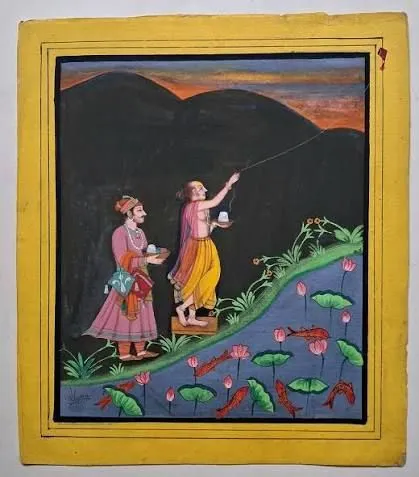
Viren Bannu Painting Collection Source - Instagram @virenbannu
Rooftop's earlier account of Bannu ji records that the singer Hariharan, known for his ghazals, signed the visitors' book in the house off Subhash Chowk. It also records a teacher who refused payment from his students and taught by correction rather than speech. Virendra's notes add the part only a son could add. The silent master talked at home. He talked about life, about the good years and the bad ones, and about being a decent person. The music carried whatever he did not say.
The maxim explains Virendra's four tests better than any text does. Practice gives you the hand, and practice can make you a good miniature artist. The other practice, the private one, gives a painter the vision to make something that survives for centuries. By his father's measure, a painter who has only a fine hand has done half the work.
Learn with Virendra Bannu
Learn with Virendra Bannu
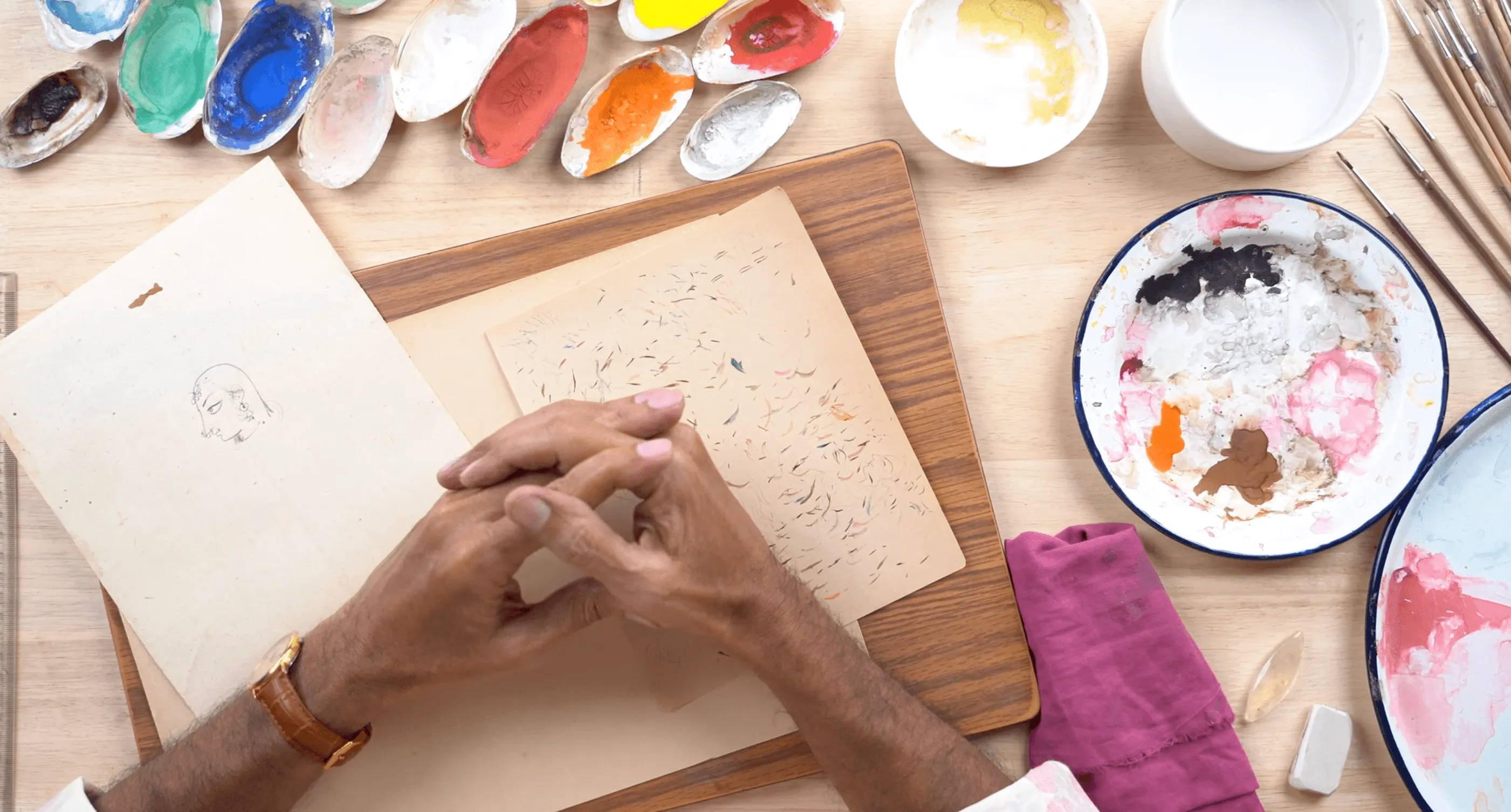
Virendra teaches the Deogarh miniature course on Rooftop. It covers motifs, sketching, colouring and a full Deogarh portrait. In Jaipur, you can sit with him for the three-hour Deogarh miniature painting experience in the old city near Johri Bazar. Groups are one to four people, and you take home a small motif painted on wasli with mineral colour. For the family's own Jaipur school, his brother teaches the Jaipur miniature course. The schools themselves are covered in the Art Wiki entries on the Mewar school of painting and the Jaipur school. The Bikaner master Mahaveer Swami, who counts Bannu ji among his inspirations, tells his side of that influence in his Rooftop interview.
References
- Virendra Bannu, handwritten answers to Rooftop, Jaipur, October 2026.
- Rooftop, Ved Pal Sharma: The Man Harvard's Curator Called a University, August 2026.
- Prime Minister's Office, PM Modi's present to Canadian PM Stephen Harper, narendramodi.in, 15 April 2015.
- Bindu Gopal Rao, Miniature Paintings, Frescoes Flourish in Jaipur's Bylanes, India Currents, 10 June 2023.
- The Metropolitan Museum of Art, artist notes and object records for Bagta and Chokha.
- MAP Academy, Mewar School of Painting; and Sadanga.
- Deogarh Mahal, Deogarh Painting.
- Karl Khandalavala (ed.), Deogarh Painting, Lalit Kala Series Portfolio No. 25.
- Rajasthan News1, Miniature Painting Camp Concludes, Exhibition Begins, October 2015.