

A Leaf and a God, Painted the Same Way: Mahaveer Swami on Bikaner Miniature and the Desert Flora Nobody Had Documented
Bikaner miniature master Mahaveer Swami on painting Rajasthan's desert flora in traditional technique, his work at the Hunt Institute, and why a leaf and a god are painted the same way.

Kartik Gaggar
Author
This piece is drawn from a set of questions Rooftop put to the Bikaner miniature master Mahaveer Swami, answered at length in Hindi and English and relayed by his son and collaborator Anuraag Mahaveer Swami, who works alongside him. Where the father's own words are given, they are marked as his. The material has been translated and lightly edited for clarity.
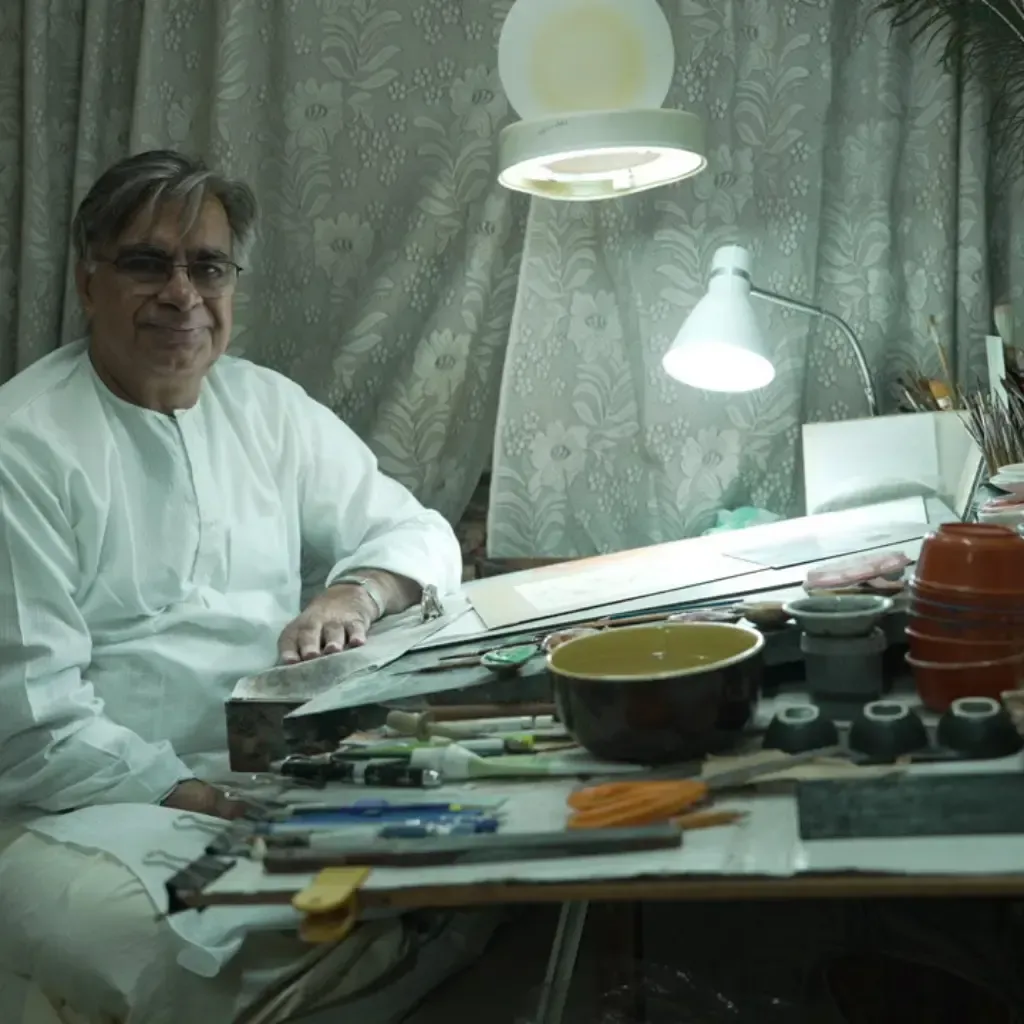
Mahaveer Swami at work on a Bikaner miniature. Source: Rajasthan Studio
Ker is a thorny desert shrub that most people outside Rajasthan have never heard of. It grows in dry, hostile ground, produces a small bitter berry, and turns up on Bikaner dinner tables as ker sangri, the local dish that every household knows. It is not beautiful in any conventional sense. It is not rare. No court painter of the old Bikaner school would have thought to make it the subject of a painting.
Mahaveer Swami has painted it repeatedly, in full traditional Bikaner miniature technique, on handmade wasli paper, with natural mineral pigments, finished with the fine layered shading his school calls pardaz. He has done the same for kankadiya, the wild desert melon, and for watermelon. Works by him sit in the permanent collection of the Hunt Institute for Botanical Documentation at Carnegie Mellon University in Pittsburgh, one of the most serious botanical art archives in the world. He has taught in Paris, Cairo, Jerusalem, Dubai, Bhutan, Algeria, Taiwan, Belgium, Pittsburgh and Washington DC, and his work has reached more than seventeen museums.
What makes this interesting is not the travel. It is the specific, unlikely thing he has done, which is to take a four hundred year old court technique built for gods, kings and courtesans, and point it at the weeds of his own district.
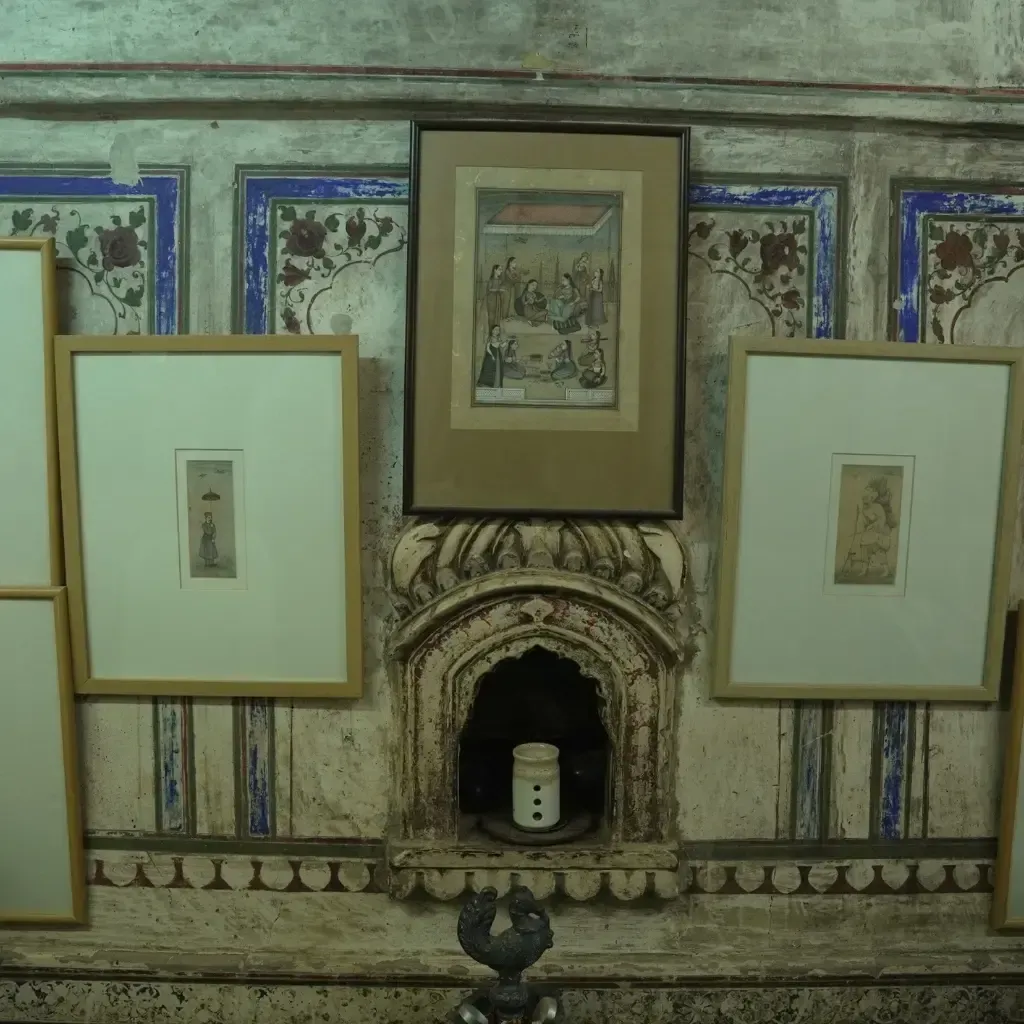
Framed miniatures on a painted wall in the studio. In classical work of this kind the figures hold the centre and the plants sit around them, as border, background and filler.
An Eklavya Apprenticeship
The first thing Anuraag wanted to correct was the record on his father's training, because it is usually told too simply. Mahaveer Swami completed formal academic diplomas, one in drawing and painting and an additional one in clay modelling. That is where the technical foundation was laid. What followed was not a classical guru shishya apprenticeship at all, but something more commercial and, in its way, more demanding.
At the time, miniature replicas of Mughal, Pichhwai and Rajasthani paintings were in high demand, and his own teachers put him to work on commissioned reproduction. He spent years copying masterworks, striving for exact fidelity to originals, and it was this market driven, practice led discipline that built his mastery. Anuraag describes it in terms any working artist will recognise. You are handed a job, you take it on with confidence, and the reaching for that standard becomes the learning. When you must replicate a masterwork exactly, arriving at that level is itself an education.
Somewhere in that period he came into contact with Vedpal Sharma, known as Bannu ji, in Jaipur, and was deeply inspired by his mastery. But the relationship was not a daily classroom one. Anuraag reaches for a precise analogy from the Mahabharata to describe it, the bond between Eklavya and Dronacharya, the student who learned by devotion and observation rather than instruction. The influence was real and it lasted. Even today, Anuraag says, you can catch a glimpse of Bannu ji's aesthetic in his father's work, and the emotional connection is that of a guru, even though the formal study never happened.
A mastery built on replication
Mahaveer Swami trained through formal diplomas in drawing, painting and clay modelling, then through years of commissioned reproductions of Mughal, Pichhwai and Rajasthani masterworks. The discipline of exact fidelity to an original became the foundation of his technique, and his bond with Vedpal Sharma Bannu ji remained one of inspiration rather than formal apprenticeship.
The Turn Toward Plants Was Always in the Painting
Ask how a traditional miniaturist ends up in botanical archives and the answer, it turns out, was hiding in the paintings he was already copying.
Classical Indian miniature painting, whether Mughal, Deccani, Pahari or Pichhwai, is full of botany. There are landscapes behind the figures, floral borders framing the folios, flowering plants and trees filling the middle ground. Anuraag points out that his father was surrounded by this material from the very beginning of his replication work. Look at almost any traditional painting, he says, and there will be a landscape, floral design, plants, trees. The interest in looking at those elements more closely, and observing them in greater detail, grew from constant proximity to them.
Then came the specific catalyst. During the Mughal period, whole albums were devoted to plant studies, most famously the Dara Shikoh Album, with exquisite botanical folios by masters including Mansur and Muhammad Khan. Mahaveer Swami was given the opportunity to replicate work from that album, and the interest sharpened into something of its own. He began composing independent botanical paintings rather than treating plants as background.
The final push was a commission. The late James J. White, curator at the Hunt Institute for Botanical Documentation, asked him to paint indigenous Indian flora for display. What began as a commissioned project turned botanical miniature painting into a major dedicated path in his career, and it has stayed that way since.
How Bikaner Reached the Botanists
The institutional story is unusually specific, and worth setting down because it shows how a traditional Indian artist actually enters global scientific archives, which is almost never through a formal programme.
The American connection came from a curator who travelled. James J. White of the Hunt Institute at Carnegie Mellon invited Mahaveer Swami and visited the family studio in Bikaner himself. He then brought him to the Institute's annual botanical art exhibition, where the artist gave live demonstrations of Indian botanical miniature painting alongside other Indian artists, and several works were acquired for the permanent collection.
The Korean connection came from a student. Mahaveer Swami has long drawn on Far Eastern traditions, Japanese, Chinese and Korean, and has painted replicas in those styles. A Korean student of his facilitated visits and artistic exchanges in South Korea.
The Indian connection came through a scientist who had been his student. There was no independent botanical art society in India at the time. The link was the Botanical Survey of India, made through a student of his working there as an assistant scientist, who arranged joint workshops.
That last one deserves expanding, because it is the most quietly consequential. The Botanical Survey of India organised national workshops that gathered botanical illustrators from its regional centres across the country, and Mahaveer Swami was invited to give masterclasses. What he taught them was how a live botanical specimen can be rendered using traditional natural pigments on handmade wasli paper. A government scientific body, in other words, brought in a hereditary miniature painter to teach its official illustrators an indigenous method of scientific documentation.
In the permanent collection at Carnegie Mellon
Works by Mahaveer Swami were acquired for the permanent collection of the Hunt Institute for Botanical Documentation at Carnegie Mellon University, following an invitation from its late curator James J. White, who visited the artist's studio in Bikaner. He has since collaborated with American, Korean and Indian botanical bodies, including the Botanical Survey of India.
On what that acquisition felt like, the answer is free of any false modesty and also free of vanity. He felt honoured and proud, Anuraag says, and beyond that he found it genuinely inspiring, because the Hunt Institute holds an extraordinarily rich collection and seeing it convinced him that botanical art has enormous scope. He set that against the historical record he already knew well. During the Mughal and Company School periods, British and Indian painters produced a substantial body of botanical documentation in India that is still referenced worldwide today. Being placed inside that lineage reaffirmed, for him, that botanical miniature painting has a great deal of unexplored potential left in it.
Where Accuracy and Beauty Stop Competing
The question we most wanted answered was whether scientific accuracy ever fights with traditional beauty. A botanical illustration must be correct. A miniature must be exquisite. Surely, somewhere, a leaf has to be either true or lovely.
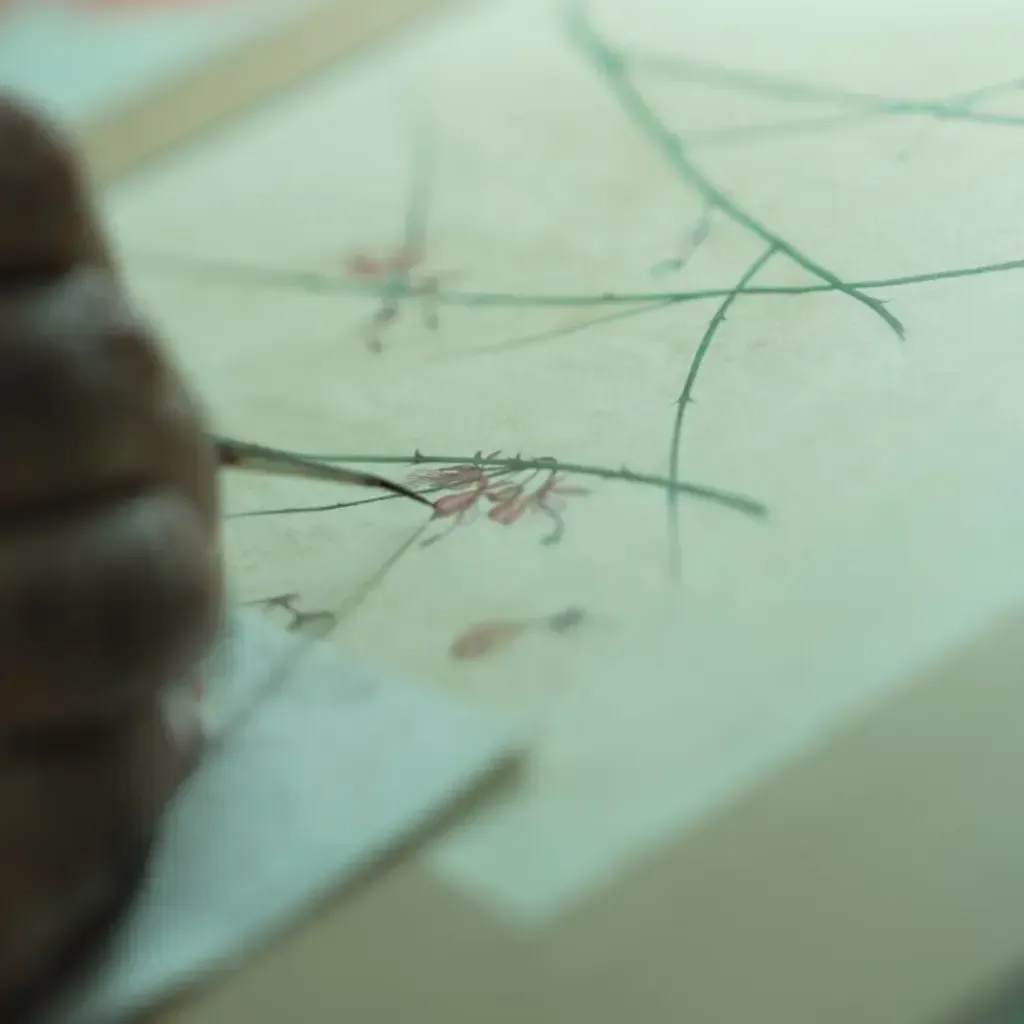
The brush at the moment of the detailing. Accuracy in the line and the colour is what miniature painting already demanded, which is why a live specimen asked nothing new of the technique.
He dismissed the premise, and the reasoning is the most useful thing in this entire conversation. There is no internal conflict for him because the core technique does not change at all. The colours are the same, the fine brushwork is the same, the detailing is the same, the paper formats are the same. The only thing that shifts is where the subject comes from. Mythological and figurative work is drawn from literature, imagination or story. Botanical work is drawn from a live specimen observed directly. That is the whole difference.
As for accuracy and beauty, he says they do not clash, they complement each other, and then he makes the argument that only a miniaturist could make. Precision is already a foundational element of miniature painting. Accuracy in the line, accuracy in the colour application, accuracy in the composition and the detailing are what the discipline is built on. So scientific fidelity is not an external requirement imposed on the art. It is the same demand the tradition was already making. If an illustration is precise, its beauty follows naturally.
Put plainly, botanical science asked him for exactly what his school had been asking of him since he was a student. He did not have to compromise the tradition to serve the specimen. The specimen simply gave the tradition something new to be exact about.
Hanuman and the Kankadiya
We asked whether painting asceticism, Hindu mythology and the daily life of Indian women feels different, emotionally or technically, from painting a plant. His answer came back in his own words, and it is the line the whole piece is named for.
He said he sees no difference emotionally or technically, and that his experience remains the same whether he is painting a figure, painting Lord Hanuman, or rendering a leaf or twig of the ker plant. His bond with everything is uniform. When he paints Hanuman, he has revered him since childhood. When he paints a kankadiya, he has been eating it, seeing it and knowing its smell since childhood. Both therefore hold an equal place for him, without any distinction.
It is worth sitting with how unusual that is. A hierarchy of subjects is built into most art traditions, and certainly into the courtly one he inherited, where deities and rulers occupy the top of the ladder and the ordinary world furnishes the background. He has flattened it entirely, and not through a modern argument about the dignity of the everyday. He has flattened it through familiarity. The god and the desert melon are equal because he grew up with both.
S P E C I M E N Ker Capparis decidua, the thorny desert shrub of western Rajasthan.
The bitter berry of the ker is half of ker sangri, the dish every Bikaner household knows. He has made several paintings of it. It is the plant he names when explaining that a twig and a deity are painted with the same attention.
S P E C I M E N Kankadiya The small wild desert melon of the Rajasthan sands.
He has eaten it, seen it and known its scent since childhood, which is the reason he gives for feeling no distance between painting it and painting Hanuman.
S P E C I M E N Sangri
The slender pod of the khejri tree, Rajasthan's state tree.
The other half of ker sangri, and part of the local flora he works from because the references simply do not exist. Where there is no precedent, he says, he tries to set the example himself.
Looking at a Plant Without Knowing Its Name
Given that his work sits in botanical archives, we expected the observation process to be quasi-scientific. It is not, and he is completely candid about it.
He is not a botanist, he says, and often when he looks at a plant, a branch, a flower or a leaf, he does not even know its botanical name. What he knows is that it looks deeply captivating. That happens, in his description, because the artist inside him speaks first, saying look how beautiful this object is, and asking how it might be captured. The inclination to paint it takes over before any identification does.
Only then does the study begin, and it is rigorous. Before painting, he says, you understand the thing, you build a connection with it, you observe it. You work out which colours it holds, what depth needs to be created, what shades are present, where the detailing goes and what kind of detailing is required. Everything is observed and planned, and only after that is it rendered onto paper.
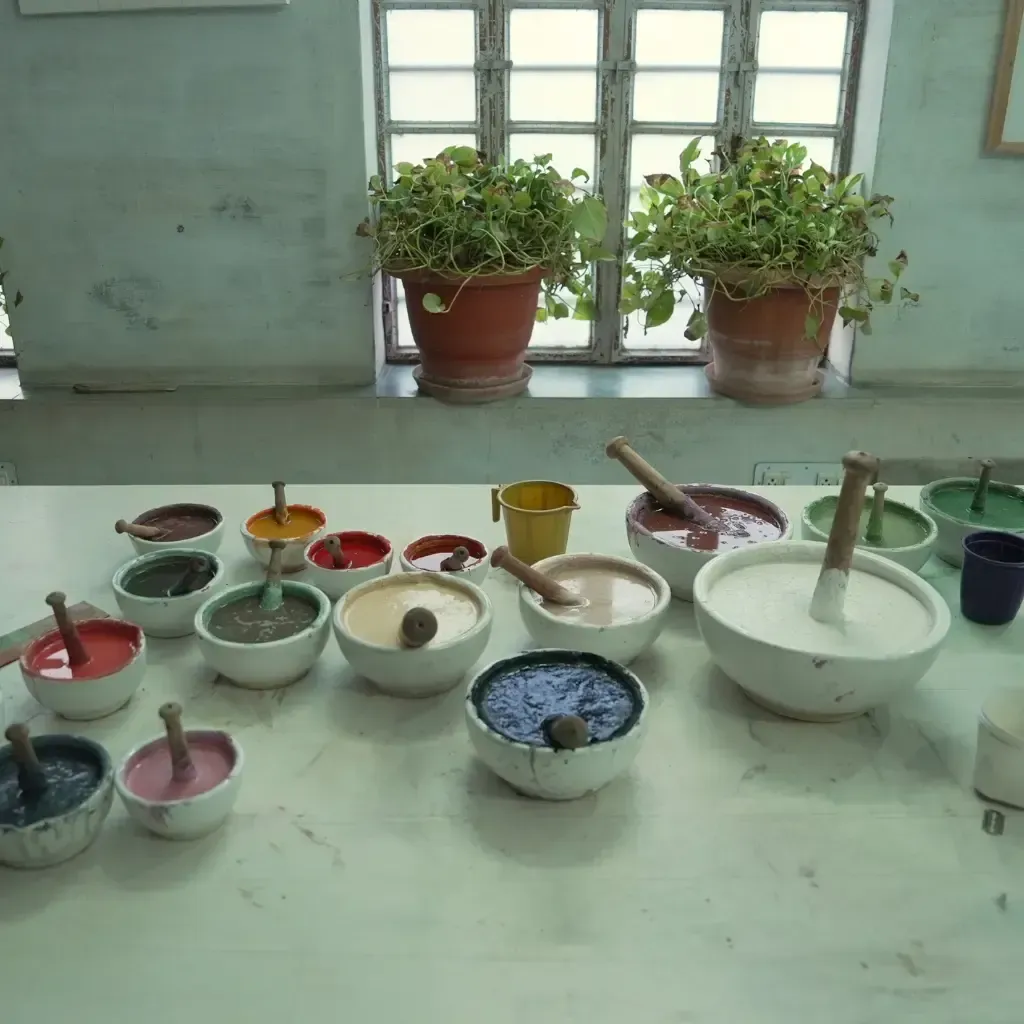
The study before the painting. He works out the colours, the depth and the placement of the detailing first, and the plant often reaches the paper before its botanical name reaches him.
So the sequence runs the opposite way to scientific illustration. A botanical artist working for science starts from the taxonomy and renders what the classification requires. He starts from attraction, and the accuracy arrives through the sheer length of the looking. The result satisfies a scientific archive, but it was not produced by a scientific impulse.
The technique underneath all of this is teachable, and he teaches it. Rooftop's Bikaner miniature course with Mahaveer Swamicarries the method he uses for gods and plants alike, the preparation, the pigments, the fine brushwork and the layered pardaz shading that gives Bikaner work its depth, taught by the artist credited with reviving the school.

Bikaner Miniature course with Mahaveer Swami, the technique from the master who revived the school. View on Rooftop
What Bikaner Kept From Persia, and What It Never Had
The Bikaner school is always described as carrying a Persian imprint, so we asked whether that survives when the subject becomes a desert shrub. The answer separates two things that usually get blurred together.
The Persian and Mughal influence in Bikaner is real, and Anuraag explains its mechanism plainly. Artists migrated to Bikaner from the imperial courts, and the aesthetic came with them. That imprint is simply present in the school.
But botanical depiction, in traditional Bikaner work, was limited. It appeared mainly as a background element or a secondary motif inside a painting. The kind of specialised botanical art seen in the Mughal flora albums, where an entire folio is devoted purely to a plant, was rarely made in the traditional Bikaner style at all. This is the gap his career sits inside. He is not reviving a Bikaner botanical tradition, because there was not much of one to revive.
What he keeps is the technique. The colour application, the layering, the fine detailing, the pardaz, all of it remains the authentic traditional method of Bikaner miniature painting. And the influence is unmistakable in the result. Anyone looking at his botanical works, Anuraag says, can instantly recognise that these were painted by a master Indian miniature painter. The subject is new. The hand is four centuries old.
That confluence of Indian craftsmanship and Mughal aesthetics is what defines the school, a history Rooftop traces in its piece on the artistic influences on Bikaner miniature painting, which also credits Mahaveer Swami with the modern revival of the Bikaner school from a family lineage of traditional painters.
The Question Every Country Asks
Across workshops in Paris, Cairo, Jerusalem, Dubai, Bhutan, Algeria, Taiwan, Belgium, Pittsburgh and Washington DC, we asked which country's students had asked the strangest question about Indian miniature painting. He could not name one, but he named the question that follows him everywhere.
Students always want to know in how many days they can master this traditional art form. His reply, offered every time and without any edge to it, is that he is still learning it himself today.
The regional differences he did describe are about behaviour rather than curiosity. In France and the United States there is a particular artistic sensibility, and participants observe far more than they ask. They watch how the artist works, the brush technique, the fine detailing.
In France his workshops covered both botanical art and traditional miniature painting, and European artists take a keen interest for a specific historical reason, which is that pre-Renaissance European miniature painting used techniques very similar to the Indian ones. The single thing that fascinates foreign participants most, consistently, is the natural mineral and plant pigments. How they are prepared, how they are applied, and which surfaces they can be used on.
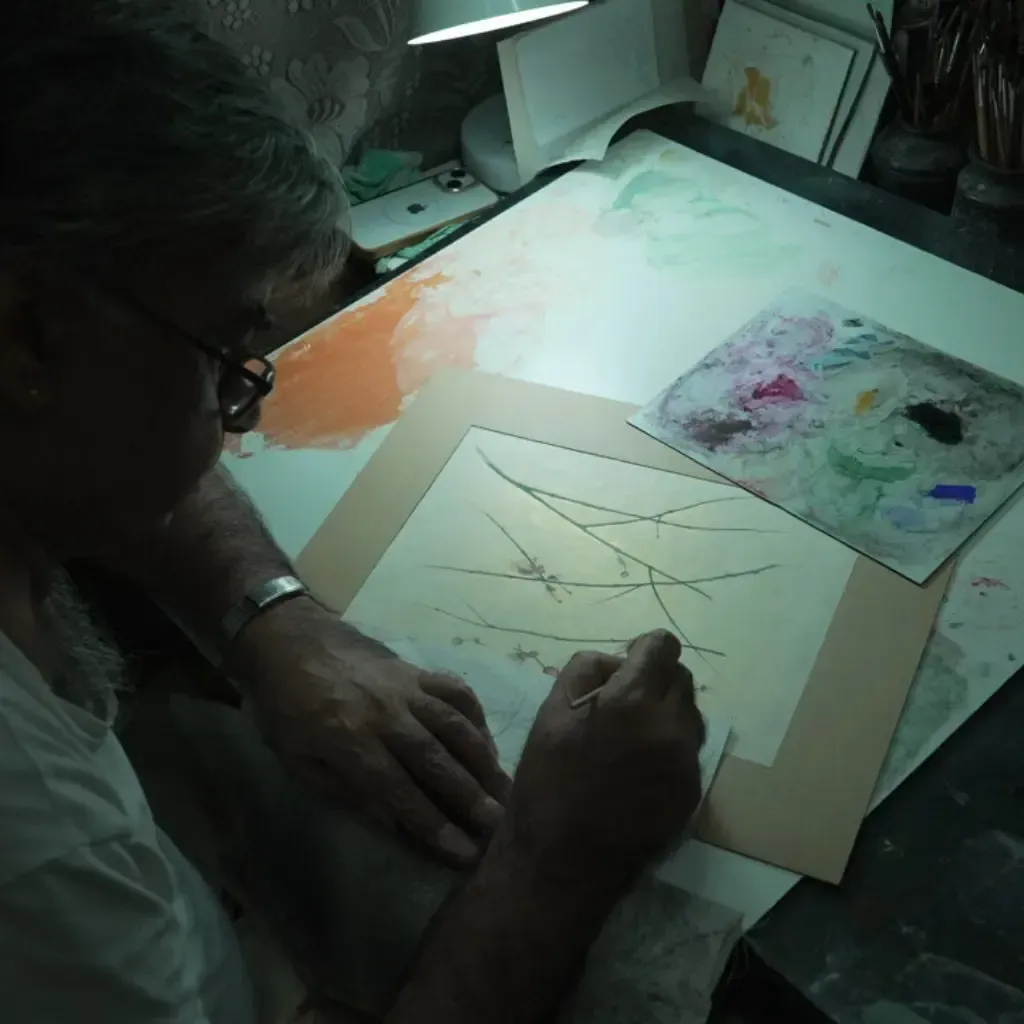
Ground mineral and plant pigments in the studio, each bowl kept with its own pestle. This is the detail foreign workshop participants ask about above everything else, how the colours are prepared, applied and matched to a surface.
Obstacles, and the Refusal to Call Them That
We asked what the biggest obstacle had been on the road from a house in Bikaner to more than seventeen museums, the difficulty people would not guess at. He declined the frame of the question, and Anuraag's account of why is worth quoting in substance.
His father is exceptionally positive on this point. Whenever you undertake any work, he says, the things you might call obstacles are really the things that give you time to understand how to move forward. They are opportunities gained through experience. Rather than looking at them as hindrances, he treats them as chances to learn, and believes that as you progress you gather experiences, learn from them, and keep going.
It is a genuinely different answer from the ones this interview series usually collects. Most of the masters we have sat with name their obstacle precisely, a caste barrier, a vanished market, a GI tag that helped nobody. He simply does not hold the memory that way, and after four decades and seventeen museums, it is difficult to argue with the method.
Setting the Example Where There Is No Reference
The last question was whether the fusion of botany and miniature is his own invention, and whether anyone will carry it forward. Both halves of the answer are careful.
On invention, he refuses the credit as stated. The fusion is not unprecedented, and he points to the historical precedents in Mughal, Persian and Far Eastern art. What is his own is narrower and, arguably, more valuable. His contribution lies in applying the traditional Bikaner miniature technique specifically to document and depict the indigenous flora of Rajasthan. That is the part nobody had done. The Mughals had their flora albums, but nobody had turned this particular technique on the ker, the sangri and the kankadiya.
And that is precisely why the work matters, in a way he describes almost casually. He is searching for new subjects and trying to depict them, Anuraag says, because references for many of those subjects are simply hard to find. So he tries to set the example by creating them. Read that again in the context of a botanical archive. When there is no visual reference for a plant in this tradition, the painting he makes becomes the reference.
Where no reference exists, the painting becomes the reference
Traditional Bikaner miniature rarely treated plants as a primary subject, and many of Rajasthan's indigenous species had no documentation in the style at all. By painting ker, sangri, kankadiya and other local flora in authentic technique, Mahaveer Swami is not illustrating an existing record. He is creating one.
On succession, the answer is sitting in the interview itself. The person who relayed these responses, researched them and expanded on them is his son, Anuraag Mahaveer Swami, who works alongside his father researching, developing new compositions and subject matter, and promoting the art form through what he calls their continuous collaborative dialogue. In a series where nearly every master has told us that no one is coming forward to learn, this is the rare and quietly cheerful exception. The next generation is already in the room, and it was the one that answered our questions.
A Court Technique, Pointed at a Weed
What Mahaveer Swami has done is easy to miss because it looks like continuity rather than rupture. He did not modernise Bikaner miniature painting. He did not simplify it for the market or hybridise it with contemporary art. He kept the wasli, the mineral pigments, the fine brush and the pardaz exactly as they were handed to him, and then he turned all of that apparatus toward a thorny shrub that grows outside his city, which no court had ever thought worth the trouble.
The result satisfied a scientific archive in Pittsburgh, gave the Botanical Survey of India something to teach its illustrators, and produced a body of work in which Lord Hanuman and a wild melon receive precisely the same quality of attention, because the man painting them has known both since he was a child.
For anyone who wants to meet this practice at the source, Rooftop also runs a botanical miniature painting experience with Mahaveer Swami in Bikaner, where the pardaz shading, the handmade paper and the botanical subjects are taught in the artist's own studio, in the city whose school he is credited with bringing back.
He is over forty years into the work and still answers the question about how long mastery takes by saying that he is still learning. Given what he has already done with a plant most people would step over, that is probably not modesty. It is an accurate assessment of how much of this is left to do.