

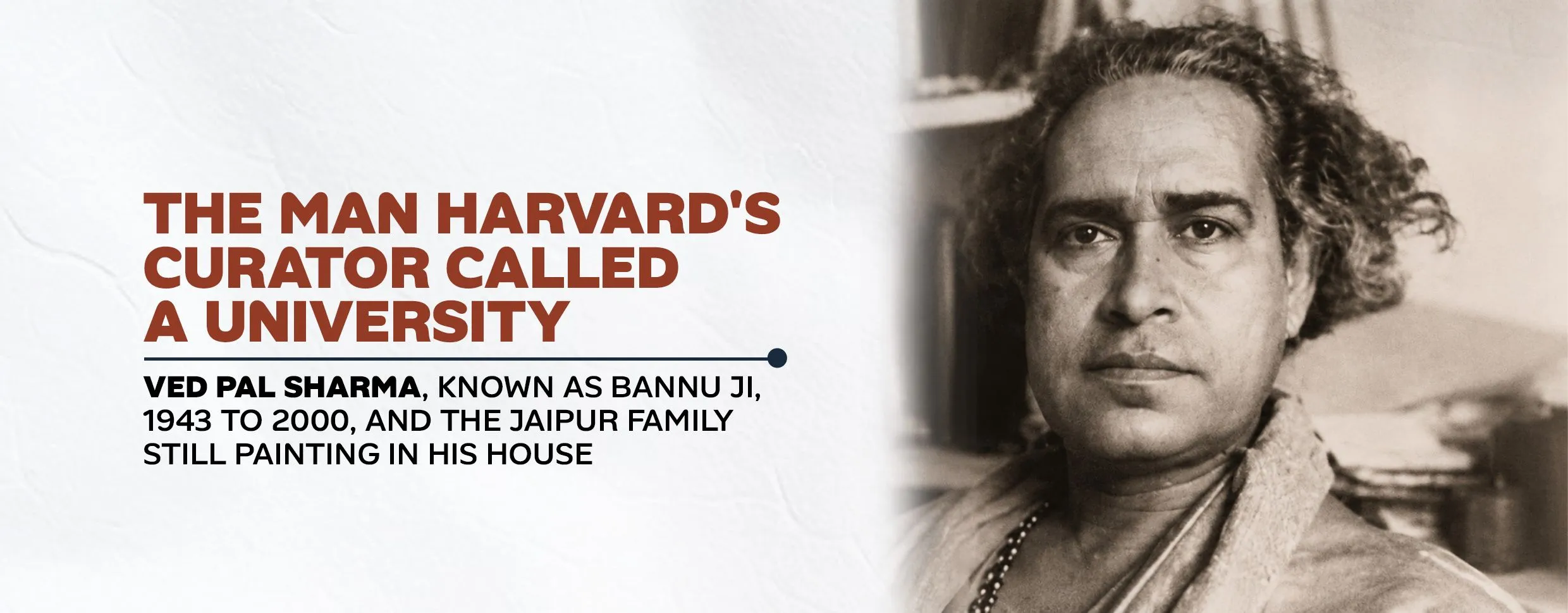
Ved Pal Sharma: The Man Harvard's Curator Called a University
Harvard's curator called him a university. The life of Ved Pal Sharma Bannu (1943 to 2000), his court-painter lineage, and the sons still painting in Jaipur.

Kartik Gaggar
Author
Ved Pal Sharma, known as Bannu ji, 1943 to 2000, and the Jaipur family still painting in his house.
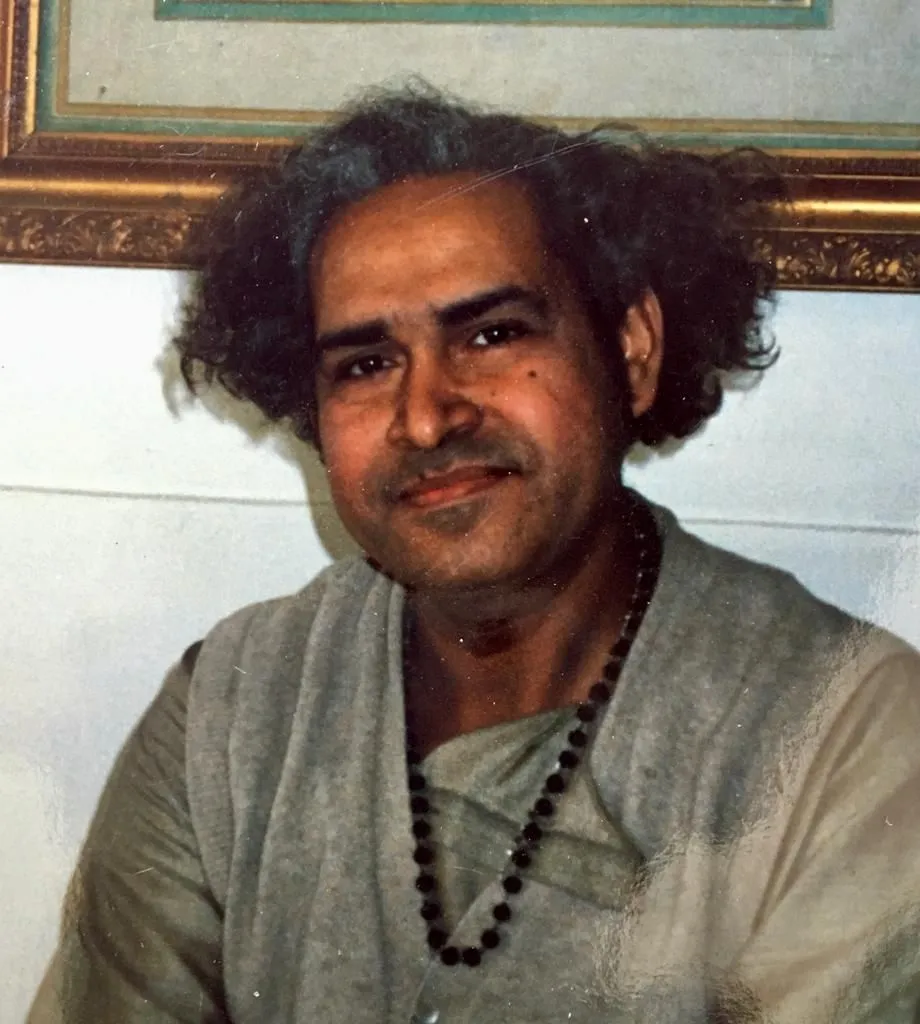
The late maestro Ved Pal Sharma (Bannu Ji), whose pioneering spirit shaped generations of Jaipur miniature art.
In the early 1980s, Stuart Cary Welch, Curator Emeritus of Islamic and Later Indian Art at the Harvard University Art Museums, brought Jacqueline Kennedy Onassis to a house in the narrow lanes off Subhash Chowk in Jaipur. She was so taken with what she found there that she asked its owner to illustrate a book she was preparing, and named the book after the house itself.
A Second Paradise was published by Doubleday, New York, in 1985, with text by Naveen Patnaik. The New York Times gave the book five illustrated pages. Vogue, Horizon, Connoisseur and Harper's and Queen all ran the paintings. Onassis later sent the artist a note, addressed to Bannu, the greatest artist of Jaipur, with admiration, and he painted her words into a composition of running deer, which the family still holds.
The artist was Ved Pal Sharma, known to everyone as Bannu ji. Welch's line about him has outlived them both. Bannu, he said, was a university, and he himself was its student.
Almost none of this is on the internet. What follows is the fullest account we can assemble, from family records, from the tributes published after his death by the scholars who knew him, and from documents shared with Rooftop by his sons.
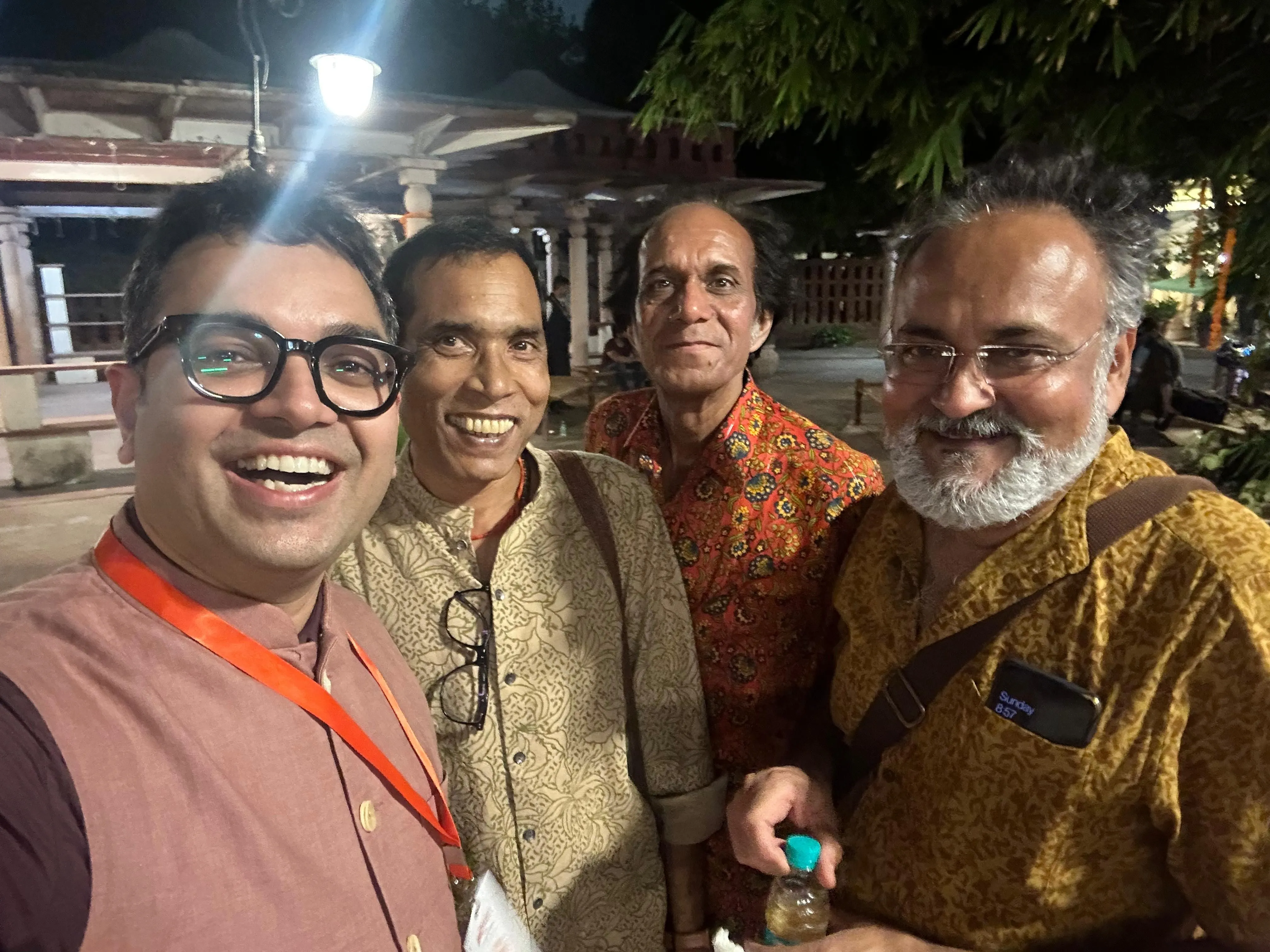
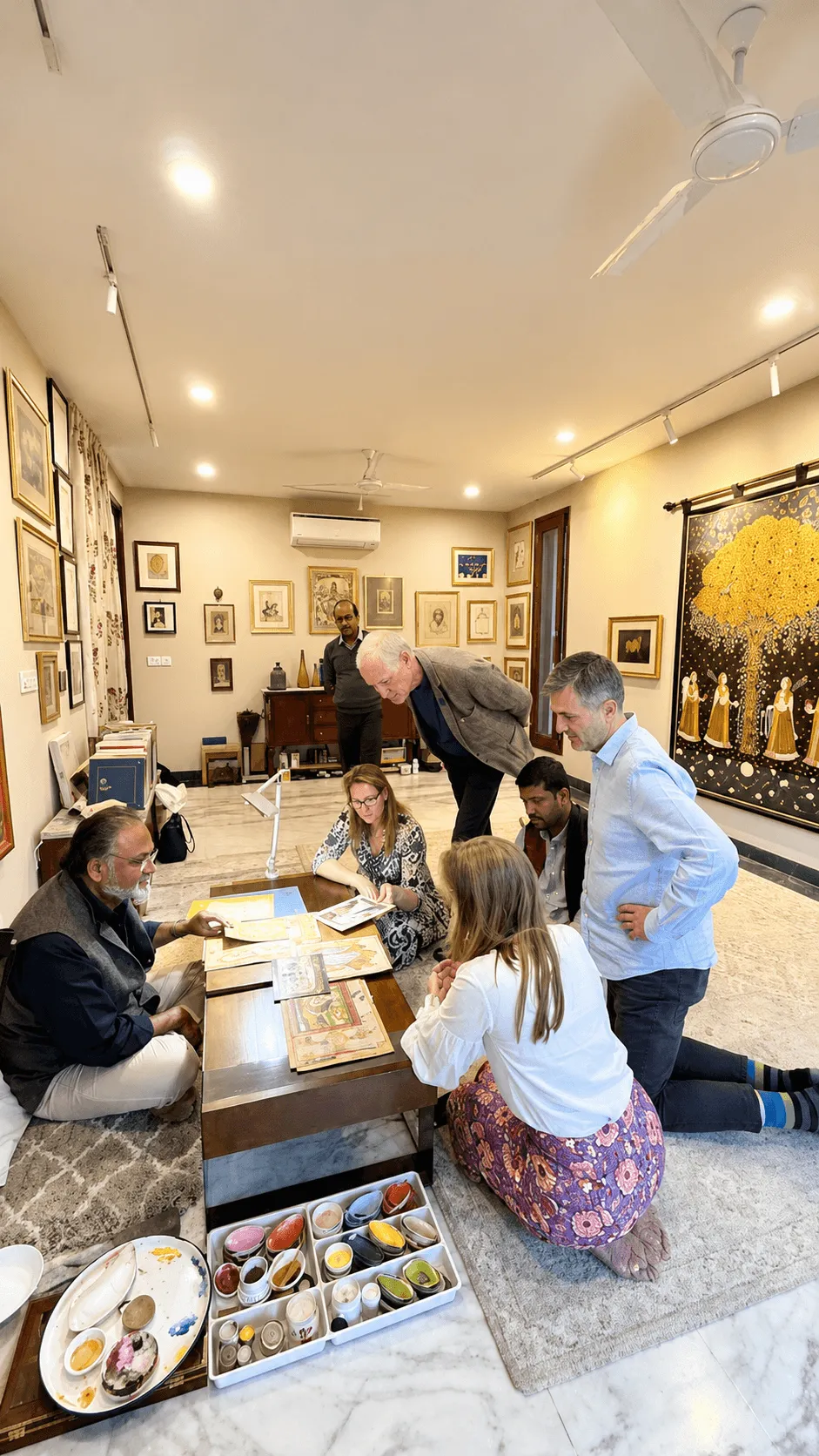
Honouring the roots of a timeless legacy. Rooftop Founder Kartik Gaggar meets with master artisans Shammi ji and Viren ji—the sons carrying forward the iconic lineage of their father, Ved Pal Sharma (Bannu Ji)—alongside veteran artist Venkat Shyam.
A Chain of Court Painters, 1840 to Now
Around 1840, Maharaja Sawai Ram Singh II invited artists to Jaipur to serve the royal court. Among them was Chanderji Mussavvir, who came from Aligarh and joined the Surat Khana, the palace painting workshop. The chain from him runs unbroken to two men working in Jaipur today.
1 Chanderji Mussavvir. Came from Aligarh at the invitation of Maharaja Sawai Ram Singh II and entered the Surat Khana as a court artist. 2 Mangalji. His son, also a member of the Surat Khana, serving the royal family. 3 Murlidharji. Trained under his father and qualified as a court artist at eighteen. Worked mainly in watercolour, adapting the miniature technique then current in Rajasthan and blending it with Mughal practice to develop a particular style. 4 Mohanlalji. Mastered several Indian styles and worked on paper in traditional colours. He made watercolours at a scale others could then achieve only on canvas, on large handmade papers carrying thousands of human figures, works preserved in the City Palace Museum. He was the last royal artist of the family. 5 Mahipalji. Trained at home by his father. With court patronage ended and the palace painting department all but closed, he opened his own studio as a freelance artist at Tripolia Bazar, named Vishwa Jyoti Kala Mandir, working largely in a realist idiom of his own. He died at forty. 6 Ved Pal Sharma, Bannu ji. A young student when his father died, trained by his grandfather Mohanlalji. Restorer, painter, and founder of what became known as the Bannu School. 7 Shammi Sharma and Virendra Bannu. Trained by their father in the same room and by the same method. Both are practising artists and teachers in Jaipur today.
The family tree preserved in the household adds two names the public record omits. Shivduttji, of Mahipalji's generation, who remained unmarried, and the eighth generation now growing up, Bannu ji's grandsons Raj and Surya, photographed on his lap in the last years of his life.
Seven generations, one workshop lineage
From Chanderji Mussavvir's entry into the Jaipur Surat Khana around 1840 to Shammi Sharma and Virendra Bannu teaching today, the family has painted without a break for roughly a hundred and eighty years. Works by the fourth generation hang in the City Palace Museum and the Albert Hall Museum in Jaipur.
The Restorer
Bannu ji did not begin as a painter of his own work. He began by saving other people's.
Restoration of Indian miniatures was a new field in India at the time, and he became its foremost authority. Damaged and mutilated paintings arrived at the house from famous museums and private collectors in every part of the world, across effectively all the schools of Indian painting, Mughal, Rajput, Pahari, Deccani. To repair a painting you must first understand exactly how it was made, which pigment, which binder, which hand, which century. He spent years working inside other masters' methods.
Then, after many years of that, the artist in him wanted to make something that would carry his own signature.
The Bannu School
What emerged is identifiable across a room, and the family describes its components precisely. He took the intricate workmanship of the Mughal school, the colour of Rajput painting, the eyes and the sharp facial features of Kishangarh, the boldness of composition of Basholi, and the delicacy of Kangra, and fused them into something that is none of them individually. Over that he layered his own Jaipuri training with Kota and Bundi influences, arriving at what one critic called a new Dhundhari school. His work experience as a restorer is what made the blending possible, because he had been inside all of those traditions with a brush in his hand.
Radha, Krishna and Holi were his abiding subjects. In the last two and a half years of his life he was deep in a Barahmasa series, the twelve months and their cycle of longing, which contemporaries considered among the strongest expressions the Jaipur miniature tradition had produced in decades. He also had an equal command of creative pencil and brush drawing in a contemporary approach, work shown in Germany, Switzerland, France and London, and he used his medieval-style idiom on ivory as well as paper.
The recognitions
- The Government of India conferred the National Award on him in 1986 for his master workmanship, and he was honoured by the President of India in the national felicitation of craftspersons.
- Robert Skelton, then Head of the Department of Indian Paintings at the Victoria and Albert Museum in London, wrote that he seriously wondered whether the museum should make an effort to acquire Bannu's works.
- At the Festival of India in New York in 1985, Stuart Cary Welch, then at the Metropolitan Museum, said he felt he had become a student of the Bannu university of art.
- Central Independent Television, Birmingham, made a film covering his life and work, The Miniature Makers, broadcast several times in the United Kingdom.
- In 1994 Doubleday published The Garden of Life, Naveen Patnaik's book on India's medicinal plants, illustrated throughout by Bannu ji.
- In 1998 the German art book Chitra covered his life and work.
How He Actually Worked
The technical record here is unusually complete, because Welch persuaded him to make an entire miniature from start to finish while photographing every stage. For years afterwards, students at Harvard learned miniature technique from colour slides of Bannu ji's hands.
The sequence, as Welch recorded it, runs like this. Size the paper and burnish it. Establish the forms by sketching them faintly. Gradually darken and perfect them. Build up the colours area by area. Then add gold, and a paste-like white for jewellery, weapons and turbans. Then burnish again, and again, until the gold turns from a dull tan to radiant metal.
The Jaipur specifics fill that outline in. He began the drawing with a diluted solution of water and lampblack, then laid a pale pink khadiya wash to give the surface its finish. The shading was built with pardaz, the Persian-derived technique of minute strokes in diluted paint layered up until the tone is seamless. The black lines of the eyes were smudged so they read as kohl, and lac paint was applied around the outer corners. For the ground itself he would choose a piece of old handmade paper from his board and coat it evenly with white before working the colour into the fibres.
Three habits of the hand are worth recording because they explain the look of the finished work. His pigments sat in seashell colour pots on the floor to his right, a way of holding colour shared between India and Iran. He used the back of his own left hand as a palette on which to blend. And he held the brush high on the handle, so that the line came from a dancing wrist rather than the fingers, which is why the curves in his work are fluid and never look fought for. Molly Emma Aitken, who studied with him, noted ruefully that she could only ever grip the brush at its base, fighting for control.
On speed, Welch left one measurement that says everything about the level of hand involved. A Kota-style young woman in one of his paintings, three inches from hair to waist, took Bannu ji about five hours to colour. Welch set that beside a painter of Akbar's court who had recorded on the back of his own painting that the work had taken him fifty days.
Sized, sketched, coloured, gilded, then burnished until the gold turns
Bannu ji's full sequence was photographed stage by stage by Stuart Cary Welch and taught from colour slides at Harvard. Pigments in seashells on the floor to his right, the back of his left hand as a palette, and the brush held high on the handle so the line came from the wrist.
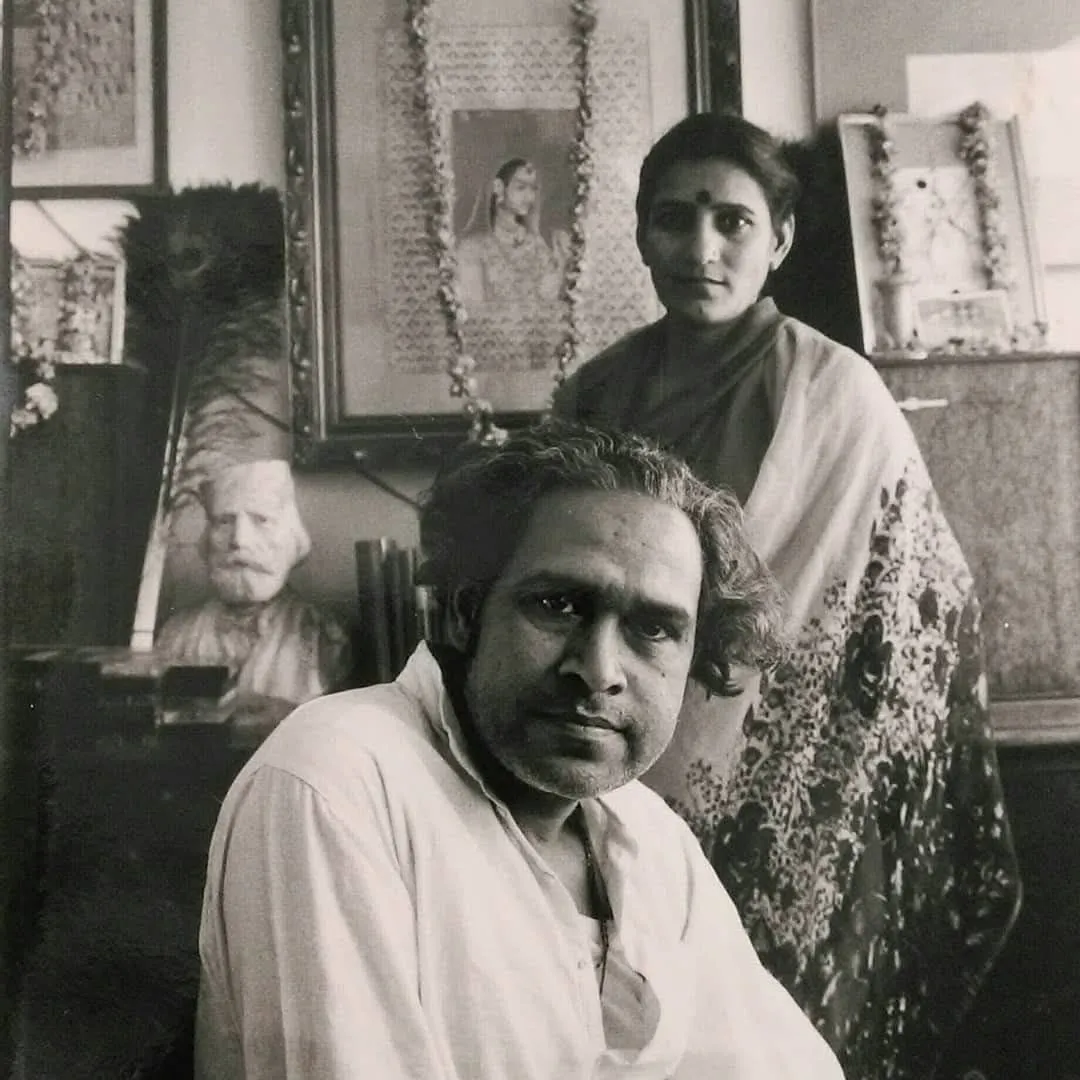
A timeless moment capturing the legendary Jaipur miniature maestro Ved Pal Sharma (Bannu Ji) alongside his guiding light and pillar of strength, Draupadi.
Gaugoli, Documented at Last
One term in the Jaipur vocabulary has resisted documentation almost completely, and this house is where it can finally be pinned down. Gaugoli, sometimes written gaguli, is the precious Indian yellow of the old workshops, described in the tradition as being made from the urine of cows.
Molly Emma Aitken, later of Columbia University, recorded a moment in the studio when Bannu ji found her mixing gaugoli with blue to make green. It was, she wrote, roughly the order of making a breakfast omelette with beluga caviar. He did not scold her. He corrected her with great gentleness, suggesting only that she try a different yellow next time.
That single anecdote is the closest thing to a firsthand attestation of gaugoli in use that we have found anywhere, and it matters beyond this house. In Rooftop's interview with the Bikaner master Mahaveer Swami, who is himself named in the family records as one of Bannu ji's students, the same pigment comes up and he says that in fifty years of practice he has never once seen it made, nor met anyone who saw it made, and he rejects the cruel production story on grounds of what a cow means in Sanatan dharma. Both accounts can be true at once. The pigment was in the studios, and its making was not. Read together, the two testimonies suggest gaugoli reached painters as a supplied material from outside the craft, and vanished when that supply chain did.
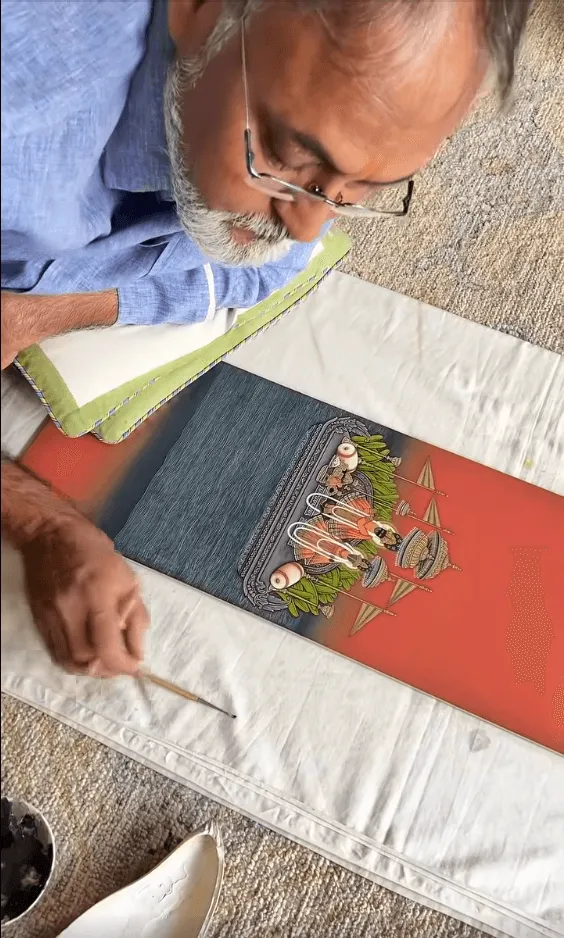
Legacy in Every Stroke: Acclaimed Jaipur miniature artist Shammi Bannu Sharma honors his father Ved Pal Sharma’s heritage with this breathtaking panel painting. Titled Sandhya Aarti (Govind Dev Ji), the work uses a striking cinnabar background to capture the peaceful essence of evening prayers.
A Teacher Who Would Not Explain
Dr Molly Emma Aitken came from the United States at twenty-two, fresh out of college, sent by Stuart Cary Welch and Craigen Bowen at Harvard, who described Bannu ji to her as India's greatest living master of Indian painting. She made the walk from Subhash Chowk through the narrow alleys to the old wooden door almost every day for a year.
She had expected discourses. What she found was a teacher who offered his knowledge to the eye and not the ear. He was never a talkative man. He would give her a simple task, a page of faces or a line drawing of Krishna, and hand her a model to copy, often one of his own drawings, with no pointers of any kind. She would pick up a brush and do what she could. He would take the exercise, look at it silently, sigh, pick up a brush and draw the corrections. That was the lesson. Looking, not asking, was the way to learn in his studio.
Desmond Peter Lazaro was sent to Jaipur by Professor Gulam Mohammed Sheikh of Baroda University, where he was studying as a UK Commonwealth Scholar, with the instruction that Bannu ji was the finest miniature artist and that anyone who wanted to know anything about the craft should go and see him. Lazaro intended to spend a few days. He arrived to find that Bannu ji's wife Deepa had died only days before and the family was still in mourning. He offered his condolences and prepared to leave, embarrassed; Bannu ji smiled and suggested he wait a while. Lazaro made regular pilgrimages to work under him for the next ten years, and has lived in Jaipur since 1997, working alongside his son Shammi.
Neither of them was allowed to pay. Aitken discovered to her consternation that he would not accept any payment at all, and slowly understood that no return was being looked for. The unworded lesson, she wrote, was to accept with grace.
The House Called a Second Paradise
Onassis called the house a second paradise, and the name attached itself first to the studio and then to the book. It stood at 1401 Chanakya Marg, Subhash Chowk, in the lane of the painters, a mini-palace in Welch's description, with a central courtyard and a great many rooms.
The daily life of the place is preserved in these accounts better than most artists' studios ever are. Merchants came every day with their offerings wrapped in newsprint, knowing his weaknesses, perfumes, antique curiosities, exquisite cloths and handmade papers. He burned incense. He floated roses on the water in which the brushes were dipped. He wore a fine muslin bandi and a white lungi and was usually humming something. Visitors describe a man in a permanent quiet exile inside his own colours, who almost never spoke of difficulty, hardship or pain, and who swallowed whatever bitterness he had privately.
The visitors' book carries the filmmaker Muzaffar Ali, who wrote that the house led him to a world beyond Jaipur, a world of dreams and fantasies in which lips do not fade. The singer Hariharan is in it. So are the artists Amit Ambalal of Ahmedabad and Jim Hong Jim of China, R M Naeem from Pakistan, Anand Sarabhai from the United States, Dr Jayant Chakravarty from Shantiniketan, Margret Micehell of Central Television in the United Kingdom, and visitors from Houston, Paris, Japan and Karachi. Welch's line about the university appears there too, written in Hindi in his own hand.
The seventh generation. Shammi Bannu Sharma, National Award 2014, working in natural pigments at his studio.
The Students, and Where They Went
Counts of his students vary between one hundred and two hundred depending on which family document you read. What is not in doubt is where they ended up, and the list is effectively a map of who carries traditional Indian painting today.
Abroad: Peter Dass in Leeds, Susan Leopold in New York, Anita Chowdry in London, Rajeev Sadanand, Molly Emma Aitken, Antra Hilmot, and Nusra Latif in Karachi. In Jaipur: Krishna Sharma, Sanjeev Sharma, Arvind Saxena, Krishnakumari Chhotu, Shakir, Pushpa Sharma, Renu Tholia, Renu Bhandari, Varsha Sen, Madhu Jain, Usha Jain, Ramesh Chandra Sharma, Suresh Chandra Sharma, Sandeep Sharma, Ramu Ramdev and Govind Ramdev. Elsewhere in India: Sharad Bharati in Udaipur, Mahaveer Swami in Bikaner, Mahesh Tak in Ahmedabad, Vijay Sharma in Chamba in Himachal Pradesh, and Rama Sharma in Jhansi.
Several of those names are now masters with their own students, their own awards and their own courses. A tradition that had lost its court patronage two generations earlier rebuilt its transmission network out of one courtyard in Subhash Chowk.
One courtyard, a global teaching lineage
Between roughly one hundred and two hundred students passed through Bannu ji's house, from Leeds, New York, London and Karachi to Bikaner, Chamba, Udaipur, Ahmedabad and Jhansi. He accepted no payment from them. Several are now recognised masters teaching the tradition in their own right.
The Museum He Did Not Get to Build
There is one part of this story that has never been published, and it is the part his family most wants remembered.
Bannu ji wanted to establish two things. The first was a large museum and restoration centre for Indian paintings, which he hoped to build in collaboration with the state and central governments, a place where damaged works could be brought back and the knowledge of how to do it could be held. The second was a prize. He believed that the finest work in miniature painting and in the restoration of decayed paintings deserved an award of the standing that the Nobel, the Booker, the Oscar and the Grammy hold in their own fields, and he wanted such a prize established for this craft.
The cost discussed was around five crore rupees, which his admirers did not consider a large sum. But he was a diffident man and never spoke openly about either plan, and he was also preparing to donate to a museum the incomparable paintings he had inherited from his father and grandfather. According to the tribute written after his death, the people around him were happy enough to share in his renown, and less quick to make the permanent thing happen. He was still holding both dreams when a terminal illness overtook him.
He died on 13 May 2000. The Hindi tribute to him carries a sharp phrase for what a country does with an artist of this rank while he is alive, that the household hen is valued at the price of lentils. He had been more celebrated abroad than at home, which is why the tribute was headed with the line that Bannu ji was dearer to strangers than to his own.
What Continues
His two sons were trained in the same room by the same method, and both still work in the family house.
Shammi Bannu Sharma is a seventh-generation miniature painter who received the National Award in 2014 and is also an accomplished Pichwai artist. He works only in natural colours, and the family account of what that costs is worth stating plainly. It took him eighteen years to arrive at an accurate ultramarine blue from lapis lazuli. He also says that his father never really sat him down to teach him technique, which anyone who has read Aitken's account will recognise instantly. The method was the method for everyone.
Virendra Bannu, born on 25 January 1964, took a different route through the same inheritance. He completed a BA Honours in Painting in 1984 and an MA in Painting in 1986, both in the first division, winning five awards during his studies and representing his university at national level. He received the Rajasthan state award in painting from the Rajasthan Lalit Kala Akademi in 1990 and the all-Rajasthan best drawing award in 1991. He designed a tableau for the Government of Rajasthan that was displayed in the Republic Day parade in Delhi in 1996 and took third prize. He has worked extensively in traditional Indian decorative work, aaraish, gold work, mirror work and murals, on projects for the Taj, Oberoi and Welcomgroup hotel groups and on restaurants and residences in Jaipur, Ahmedabad and Delhi, and his glass work has been shown in a London restaurant.
His work appears in the coffee table book Jaipur Gem of India and in the Forms of Devotion exhibition and book that travelled from Delhi to Spain and beyond from 2015, in Yoga Chakra for the first International Yoga Day, and in the Shanghai China Art Festival in November 2015. He has taught workshops and lectured on traditional colours and their use, including at the visual arts department of Rajasthan University. His works are held by the Kuwait Museum, MOSA Indian Art in Belgium, the Sikh Museum in Ontario in Canada, the Nepal Art Gallery, and private collections around the world. In 2015 the Prime Minister specially ordered an exclusive painting on the Sikh school from him, which was presented to the then Canadian Prime Minister StephenHarper, and his work was mentioned on the Prime Minister's website that April.
The Tradition Is Learnable
The most useful thing about this story is that it does not end in a museum case. Both brothers teach, using the same guru shishya transmission they received, adapted for people who do not live in Jaipur.
Shammi ji teaches the family's own school directly in the Jaipur miniature course on Rooftop, the style his forefathers painted in the Surat Khana, covering the wasli, the squirrel-hair brush, the mineral pigments, the burnishing and the line that comes from the wrist rather than the fingers.

Jaipur Miniature with Shammi Bannu Sharma, seventh generation of the Bannu family. View on Rooftop
Virendra ji teaches the Deogarh school in the Deogarh miniature course on Rooftop, a gateway into the courts of Rajasthan through motifs, sketching and colouring detail, taught step by step by an artist who has spent four decades inside both the traditional and the contemporary sides of this practice.

Deogarh Miniature with Virendra Bannu, the seventh generation teaching a second school. View on Rooftop
The technical vocabulary behind both, the lampblack sketch, the khadiya wash, the pardaz layering and the kohl-smudged eye that Bannu ji perfected, is set out in Rooftop's history of the Jaipur school of miniature painting, which traces the style from the royal ateliers to the two brothers working today.
A Note on the Paintings
Original works by Bannu ji occasionally become available from private collections. Rooftop's founder, Kartik Gaggar, holds a number of them and can speak with collectors seriously interested in acquiring a piece, including on questions of provenance and condition. These are privately held works, and enquiries are handled directly rather than through the artist's family. The address for that conversation is kartik@rooftopapp.com.
Sources and Thanks
This account draws on the obituaries and tributes published after his death by Stuart Cary Welch of the Harvard University Art Museums, Dr Molly Emma Aitken-Zaidi of Columbia University, Desmond Peter Lazaro of the Prince of Wales's Foundation in London, and the writers Ashok Atrey and Shrikrishna Sharma in Kala Kiran; on the family's own biographical documents, including the introduction to the Bannu family of Jaipur, the artist's bio-data sheet and the household family tree; and on the bio-data and records of Virendra Bannu. Our thanks to Shammi Sharma and Virendra Sharma of Jaipur, who provided the material and the permissions.
Where the documents disagree, we have said so rather than smoothing it over. The remaining questions, on the exact court records and seals that evidence the lineage, on the surviving store of eighteenth and nineteenth century hemp wasli in the house, on the full pigment table as the family grades it, and on how the brothers' hands differ from their father's and from each other, belong to a longer conversation with both brothers, which we intend to have.