Melody of Wings
$ 3,399


Let's learn about the miniature paintings from Mewar!
The Mewar school of painting is one of the oldest and most enduring miniature painting traditions in India, rooted in the Mewar region of Rajasthan. Centred in towns like Udaipur, Chittor, and Nathdwara, these paintings blend Rajput aesthetic values with devotional themes drawn from Hindu mythology. At a time when many regional art traditions have faded, the Mewar school continues to be practised by skilled artists and is increasingly accessible to learners through platforms like Rooftop.
What Is Mewar School of Painting?
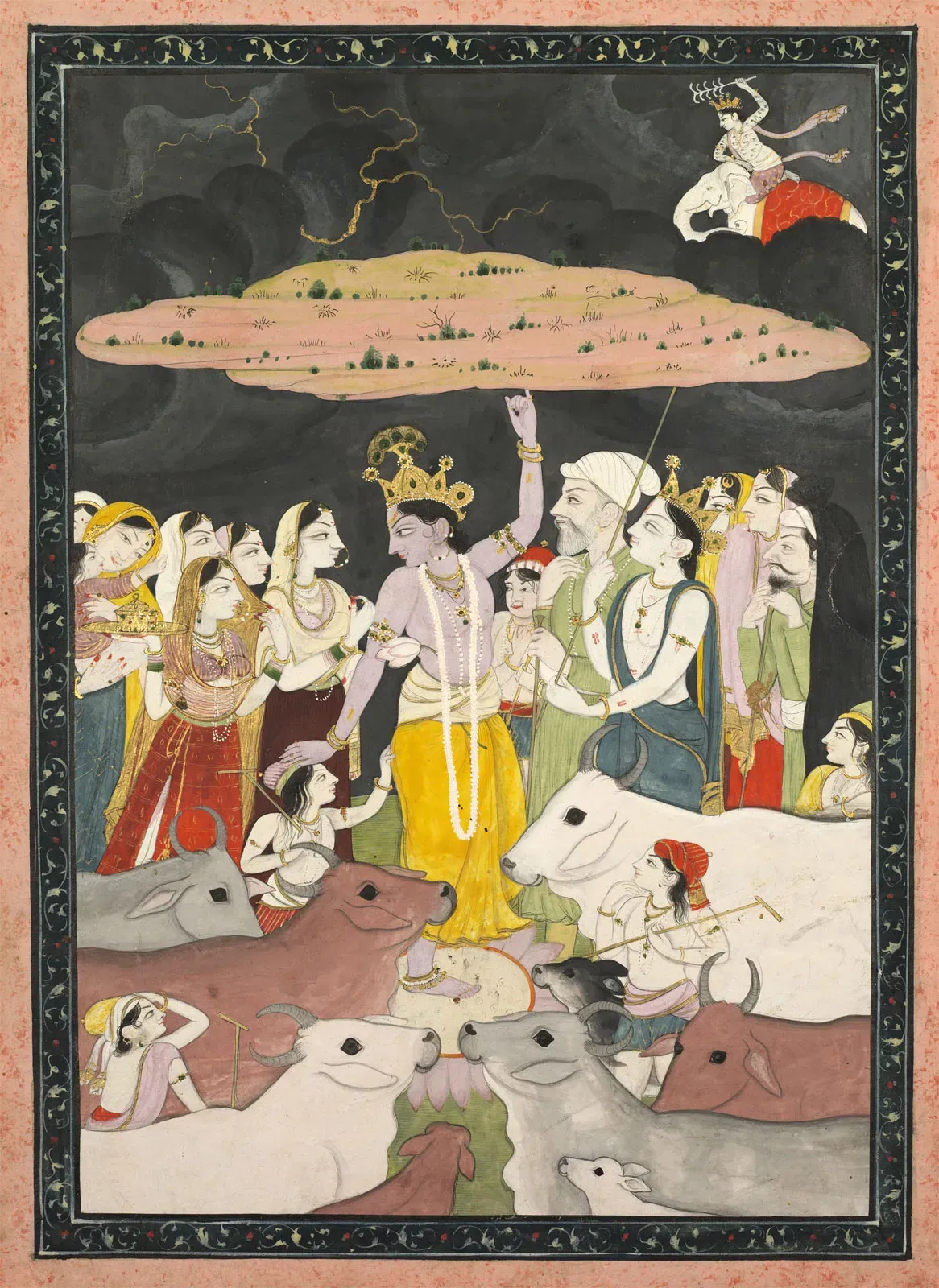
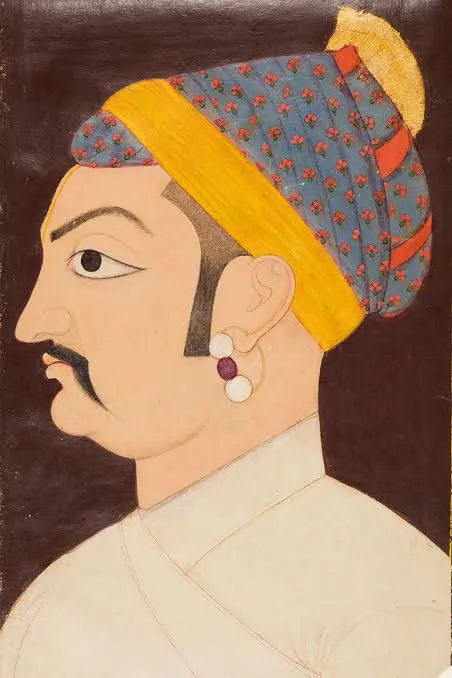
The Mewar school of painting is a style of Indian miniature art that developed in the Mewar province of present-day Rajasthan. Named after its place of origin, it is part of the broader Rajput miniature painting tradition and is considered one of its oldest surviving schools. These paintings are typically created on handmade paper called wasli - multiple layers of cloth and paper pressed together to form a firm canvas. Natural dyes and pigments sourced from vegetables, minerals, and semi-precious stones give the works their characteristic earthy tones: red, saffron, and yellow backgrounds paired with contrasting colours for figures and decorative elements.
The art form is practised primarily by communities in the Mewari-speaking districts of Rajasthan. It traditionally served devotional, courtly, and narrative purposes, illustrating scenes from the Ramayana, the Bhagavata Purana, and the romantic poetry of the Rasikapriya, which depicted the leela - the divine play - between Lord Krishna and Radha.
History and Origin
The Mewar school of painting took shape in the 16th and 17th centuries under the patronage of Rajput rulers, who favoured a visual language quite distinct from the Mughal court style developing in Delhi and Agra. While Mughal miniatures were refined and courtly, Mewar paintings retained a more expressive, folk-influenced quality - figures in full Rajput-Rajasthani dress, bold outlines, and a strong emphasis on religious themes over imperial portraiture.
The historical background of the art is deeply tied to the displacement and settlement of tribes such as the Bhil and Mina communities in the Mewar region, whose cultural motifs influenced the visual vocabulary of the paintings. The Mewari dialect and the joint family structures of Mewar society reinforced a community-centred practice of the art. The tradition reached its peak in the 17th and 18th centuries. By the 19th century, European influence began to appear - visiting British artists including William Carpenter, Val Prinsep, and Marianne North brought new visual ideas into contact with Mewar. Kutch-mounted prints also altered the dynamic of Rajasthani painting more broadly. However, British political presence in Mewar did not displace the school's established rules, and portraiture only gradually supplemented the dominant religious themes. By the late 19th century, photography began replacing the function of court painting, and Udaipur's manuscript painting tradition declined. A notable academic work documenting this period is Pande, A. (2020), The Ragachitras of Mewar: Indian Musical Modes in Rajasthani Miniature Painting, published by Aryan Books International, New Delhi.
Key Features and Visual Style
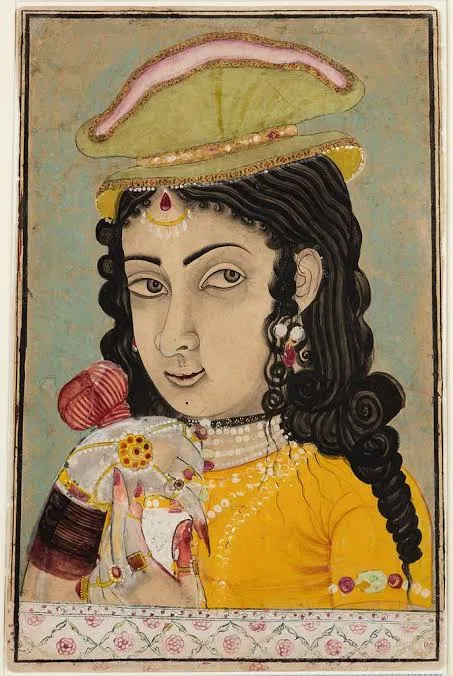
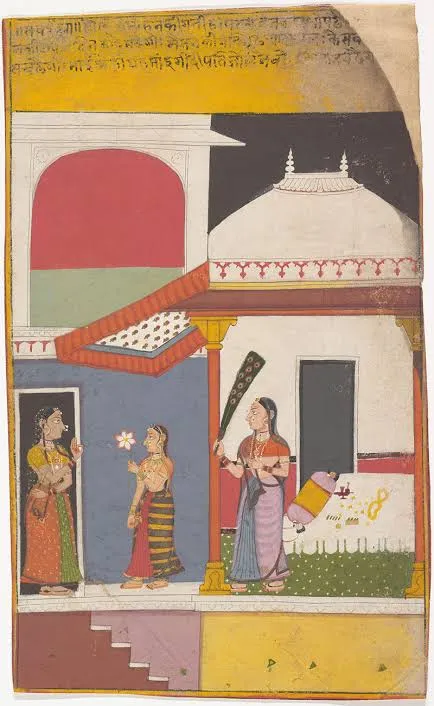
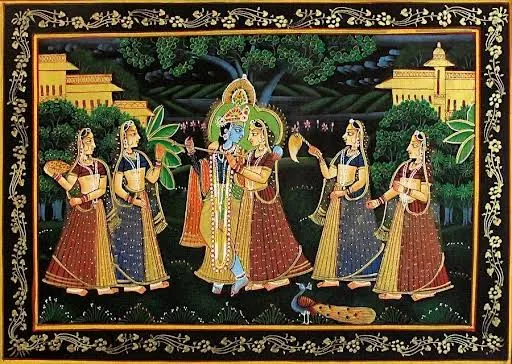
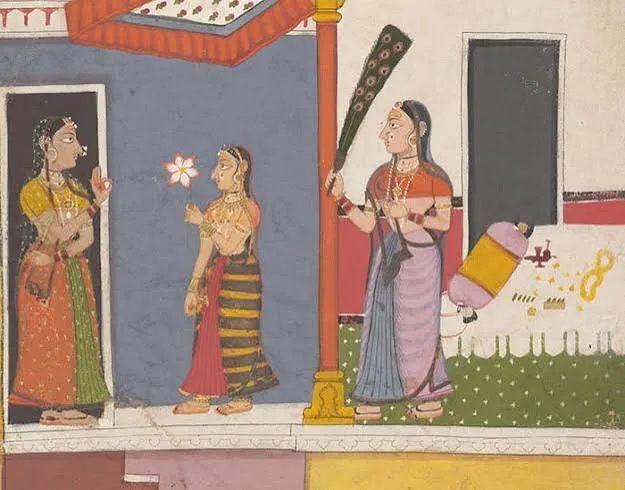
Mewar miniatures are immediately recognisable by their bold, expressive style and strong Rajput aesthetic. Unlike the subtly shaded Mughal miniatures, Mewar paintings use flat colour fills, firm outlines, and a direct visual grammar drawn from devotional art. The Mewar region's landscape - surrounded by shrubbery, water bodies, and mountains - also shapes the imagery, with abundant natural settings appearing throughout the works.
Palette and backgrounds: earthen tones dominate, with red, saffron, and yellow backgrounds offset by contrasting colours for figures and motifs.
Figures and dress: characters appear in full Rajput-Rajasthani clothing; women are drawn shorter than men, with oval or rounded faces, sharp noses, and almond-shaped eyes.
Motifs: the lotus flower appears frequently as a symbol of divinity and purity; nature scenes with verdant scenery and sparse architectural elements complete the compositions.
Borders: paintings typically feature bold decorative borders painted in red and yellow, sometimes incorporating floral motifs.
Materials: natural dyes and pigments from vegetables, minerals, and semi-precious stones are applied with brushes made from squirrel or camel hair onto layered wasli paper.
Process: paper layers are built up three to five sheets thick, dried, then painted after pigments are ground to a fine powder and mixed with water.
Famous Artists of Mewar School of Painting
The living tradition of the Mewar school of painting is carried forward by a number of skilled artists who have devoted their practice to this form. These artists have been recognised both within India and internationally for keeping the classical Mewar style alive.
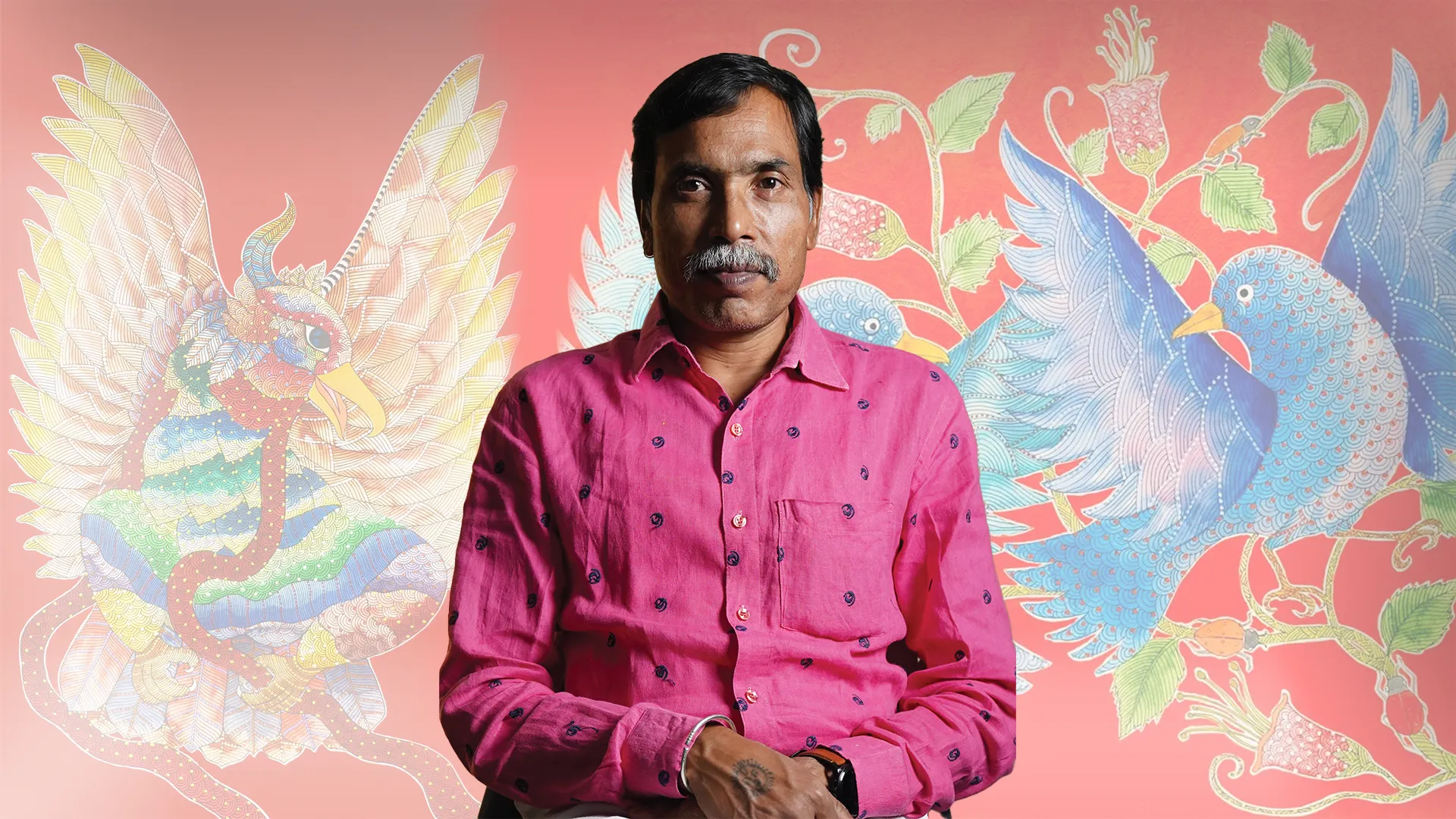
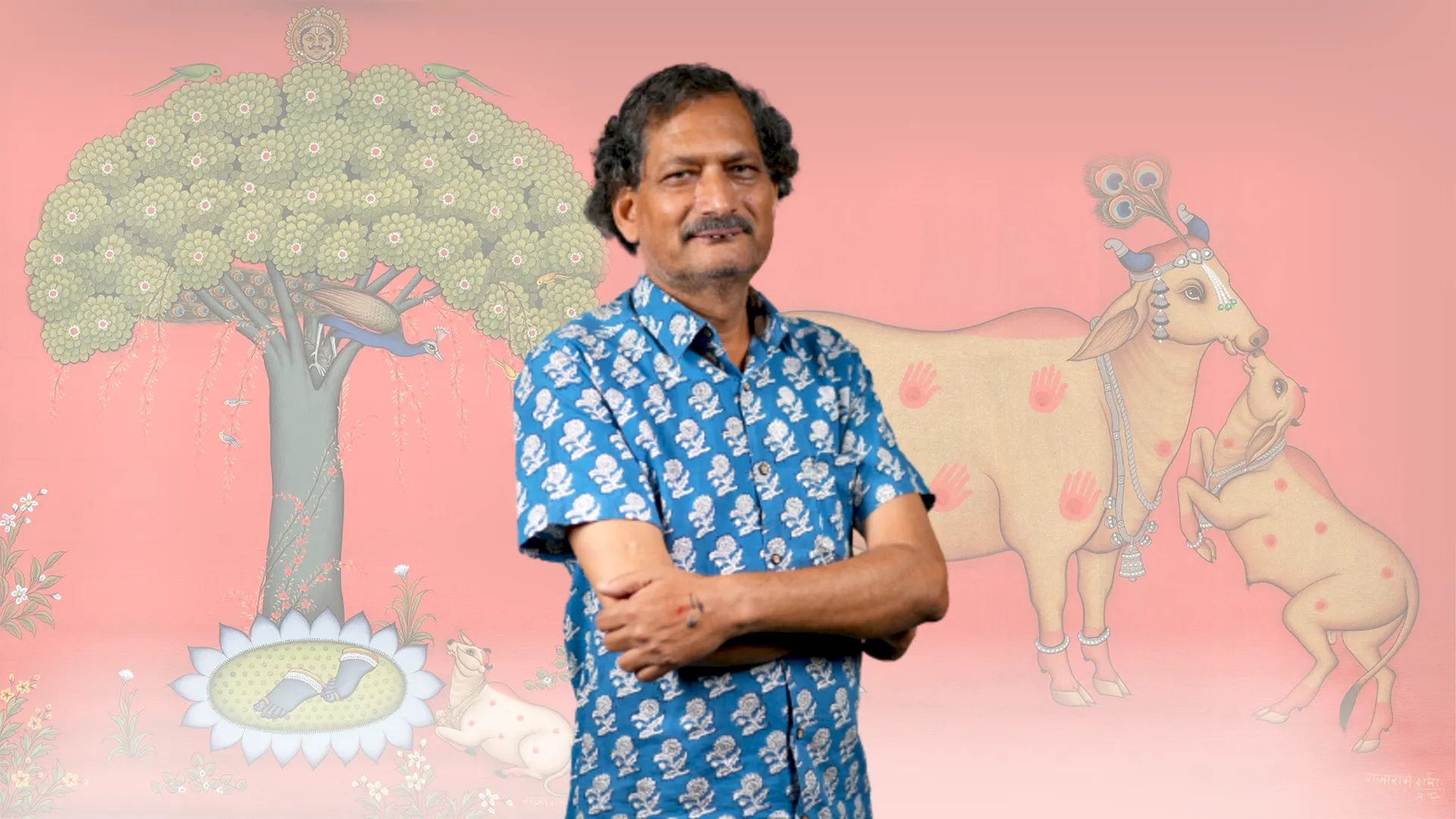
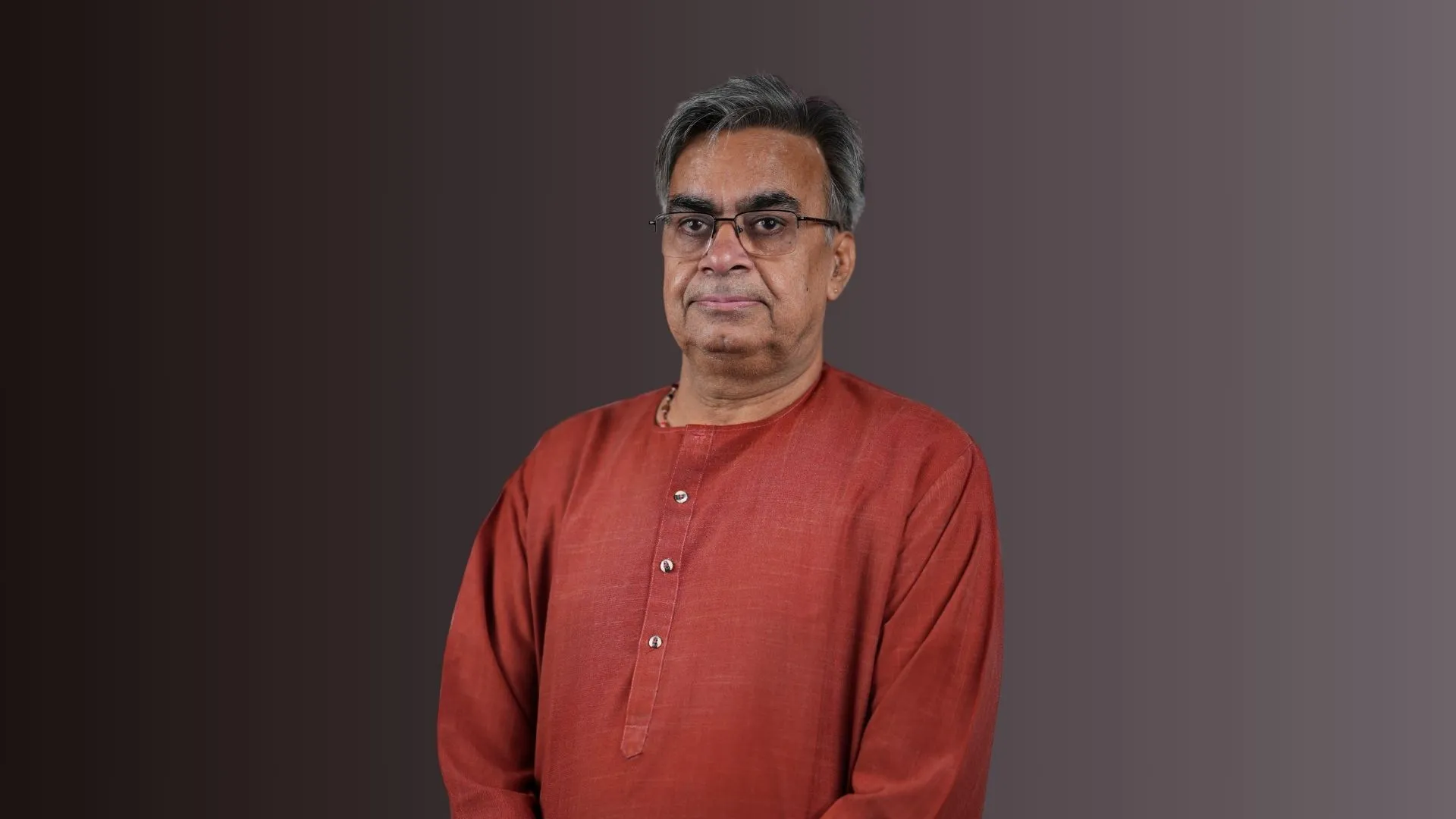
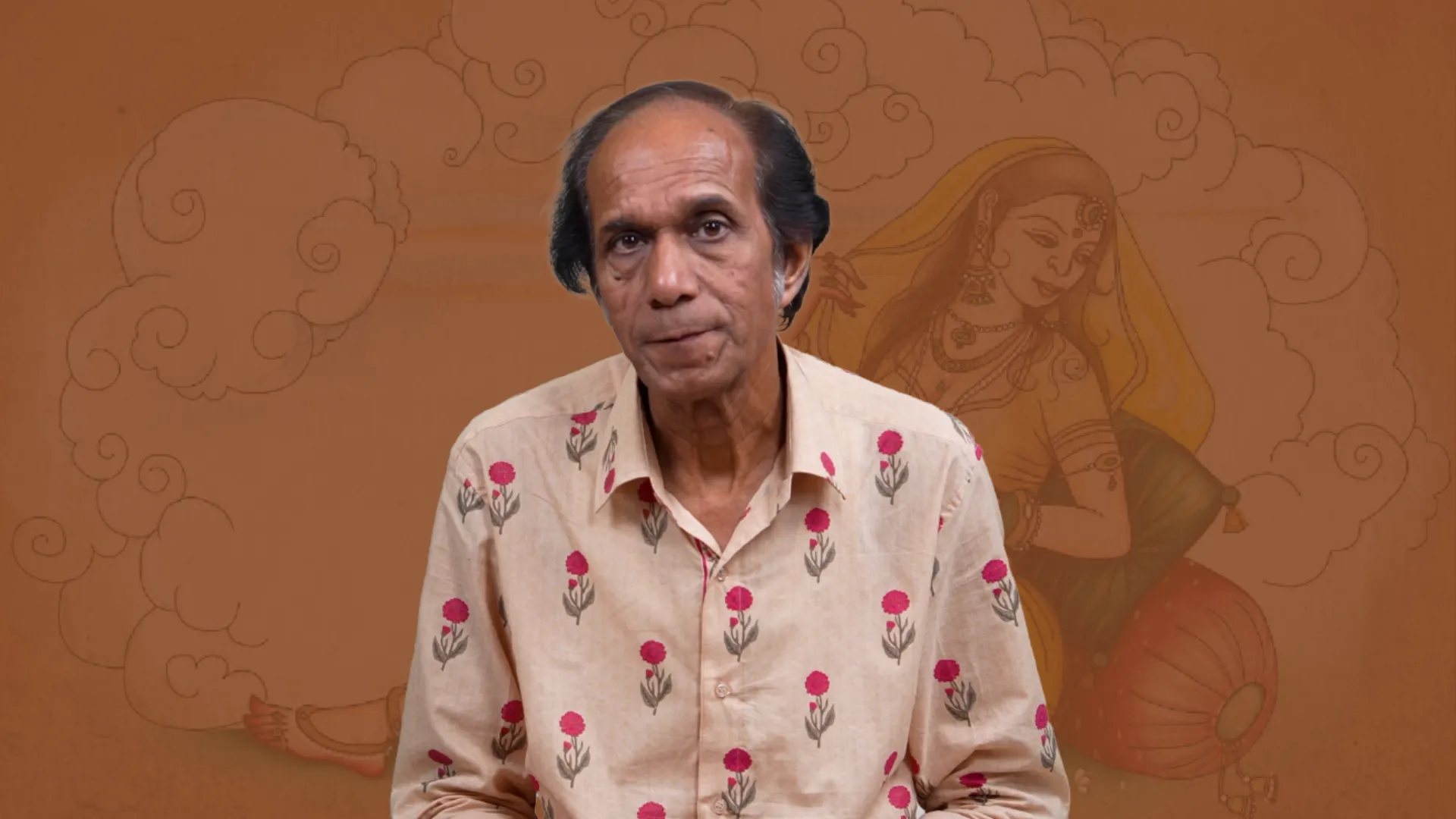
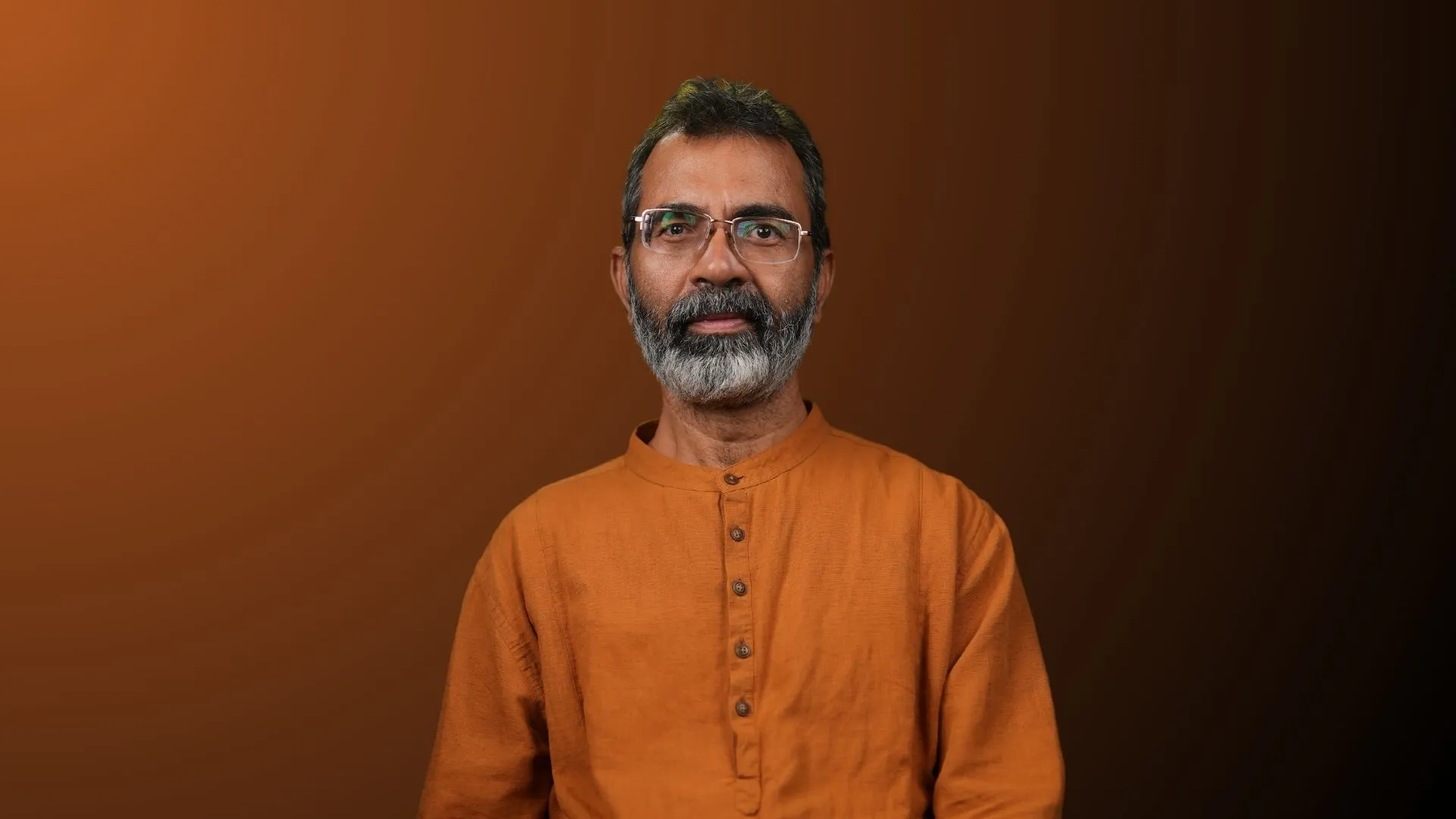
Bhanwar Lal Kumawat from Rajasthan is a master of the Mewar miniature form, known for his precise brushwork and faithful adherence to classical compositional rules. He teaches his technique through a dedicated Mewar miniature course on Rooftop. Anandi Lal Sharma from Nathdwara, Rajasthan, specialises in the Nathdwara sub-tradition of Mewar painting - a devotional style closely associated with the Shrinathji temple and its pichwai paintings. He also teaches on Rooftop through the Nathdwara miniature course.
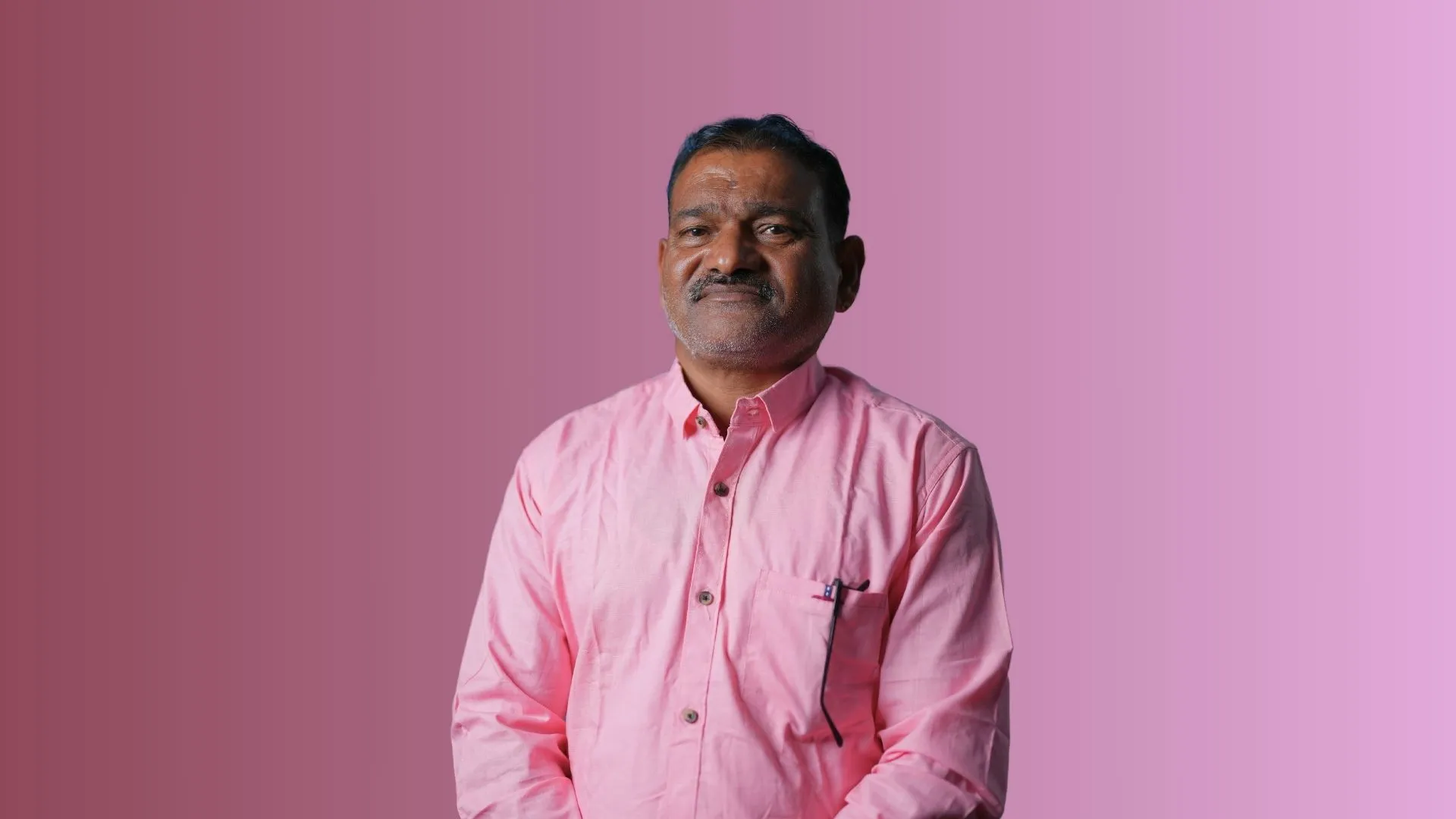
Virendra Bannu from Deogarh, Rajasthan, works within the broader Rajput miniature tradition and has particular expertise in Deogarh-style works, which share compositional roots with the Mewar school. His work is accessible through the Deogarh miniature course on Rooftop.
If you are asking how to learn Mewar school of painting online, Rooftop offers a direct path. The platform connects learners with master artists who have practised this tradition over decades. The Mewar miniature course by Bhanwar Lal Kumawat covers the full process from preparing the wasli base to applying natural pigments and mastering the characteristic Mewar figure style. You can also explore all Indian art courses on Rooftop to find related traditions.
The best places to see Mewar painting India in its original context are the City Palace Museum in Udaipur and the Government Museum in Chittor, both of which hold significant collections. The town of Nathdwara remains an active centre for devotional painting connected to the Mewar tradition. Folk art fairs in Rajasthan, particularly those in Udaipur, regularly feature Mewar miniature works. For buying authentic traditional Indian art in this style, visit the Rooftop shop or explore the full Art Wiki for related art forms including Kishangarh painting, Kota school of painting, and Bundi painting.

What is Mewar school of painting and where does it come from?
The Mewar school of painting is a Rajput miniature art tradition that originated in the Mewar region of present-day Rajasthan, India. It is named after its place of origin and is considered one of the oldest continuous schools of Rajasthani miniature art. Key centres include Udaipur, Chittor, and Nathdwara. The tradition developed from at least the 16th century under Rajput royal patronage.
What makes Mewar paintings different from other Rajasthani miniature styles?
Mewar paintings are distinguished by their bold use of earthen tones - red, saffron, and yellow backgrounds - combined with expressive figures dressed in full Rajput-Rajasthani clothing. Unlike Mughal-influenced schools, Mewar miniatures prioritise devotional themes and a flatter, more folk-influenced visual style. Characters have oval faces, almond-shaped eyes, and sharp features that differ visibly from the more realistic Mughal portrait style.
Who are the most famous artists of the Mewar school of painting?
Notable contemporary artists include Bhanwar Lal Kumawat from Rajasthan, who teaches the classical Mewar miniature style, and Anandi Lal Sharma from Nathdwara, who specialises in devotional Nathdwara-style painting connected to the Mewar tradition. Virendra Bannu from Deogarh works in the closely related Deogarh miniature style. All three artists teach their craft through Rooftop's online courses.
What materials and pigments are used in Mewar paintings?
Mewar paintings are created on wasli - handmade paper formed from three to five layers of cloth and paper pressed together. Natural pigments ground from vegetables, minerals, and semi-precious stones are mixed with water and applied with fine brushes made from squirrel or camel hair. Colours are characteristically earthen: deep reds, saffrons, and yellows form backgrounds, while contrasting hues define figures and decorative elements.
Can I learn Mewar school of painting online in India?
Yes. Rooftop offers an online course in Mewar miniature painting taught by master artist Bhanwar Lal Kumawat, covering all stages from preparing the layered paper base to applying pigments and developing the distinctive figure style of the Mewar school. The course is accessible from anywhere in India and is taught in the traditional method passed down through generations of Rajasthani artists.
Where can I buy authentic Mewar miniature paintings?
Authentic Mewar miniature paintings are available directly from artists in Udaipur, Nathdwara, and Chittor. In Udaipur, the area around the City Palace and local art galleries carry original works. Online, the Rooftop shop carries original works by traditional artists connected to the Mewar and Rajasthani miniature tradition, offering a reliable source for verified, authentic pieces.
The Mewar school of painting represents an unbroken line of artistic practice stretching back over four centuries, shaped by Rajput culture, devotional faith, and the landscapes of Rajasthan. Keeping this tradition alive today are artists who still grind their own pigments and build their canvases by hand. Explore Mewar miniature courses on Rooftop and begin your journey into one of India's most distinctive regional painting schools.
Sources
Image Sources
"Marwar School of Painting." MAP Academy Encyclopedia of Art, https://imp-art.org/articles/marwar-school-of-painting/. Accessed 21 July 2026.
"Mewar Painting." Encyclopaedia Britannica, https://www.britannica.com/art/Mewar-painting. Accessed 21 July 2026.
"Mewar Painting." PICRYL, https://picryl.com/topics/mewar+painting. Accessed 21 July 2026.
"Mewar School of Painting." MAP Academy Encyclopedia of Art, https://imp-art.org/articles/mewar-school-of-painting/. Accessed 21 July 2026.
"The Majestic World of Mewar Painting: A Legacy of Artistic Excellence." Oaklores, https://oaklores.com/2024/09/18/the-majestic-world-of-mewar-painting-a-legacy-of-artistic-excellence/. Accessed 21 July 2026.