Your Cart

Your cart is empty

Sacred Indian Artworks: Gods & Goddesses

Discover the divine essence of Indian folk and tribal art through our Sacred Indian Artworks collection. Hand-painted by revered artists using natural pigments on paper, canvas, or cloth, these original pieces bridge the mortal and divine, depicting gods like Krishna, Shiva, Durga, Ganesha, and tribal deities in timeless styles.

Showing 1 – 15 of 15

All Products
Paintings
Sacred Indian Artworks: Gods & Goddesses 15
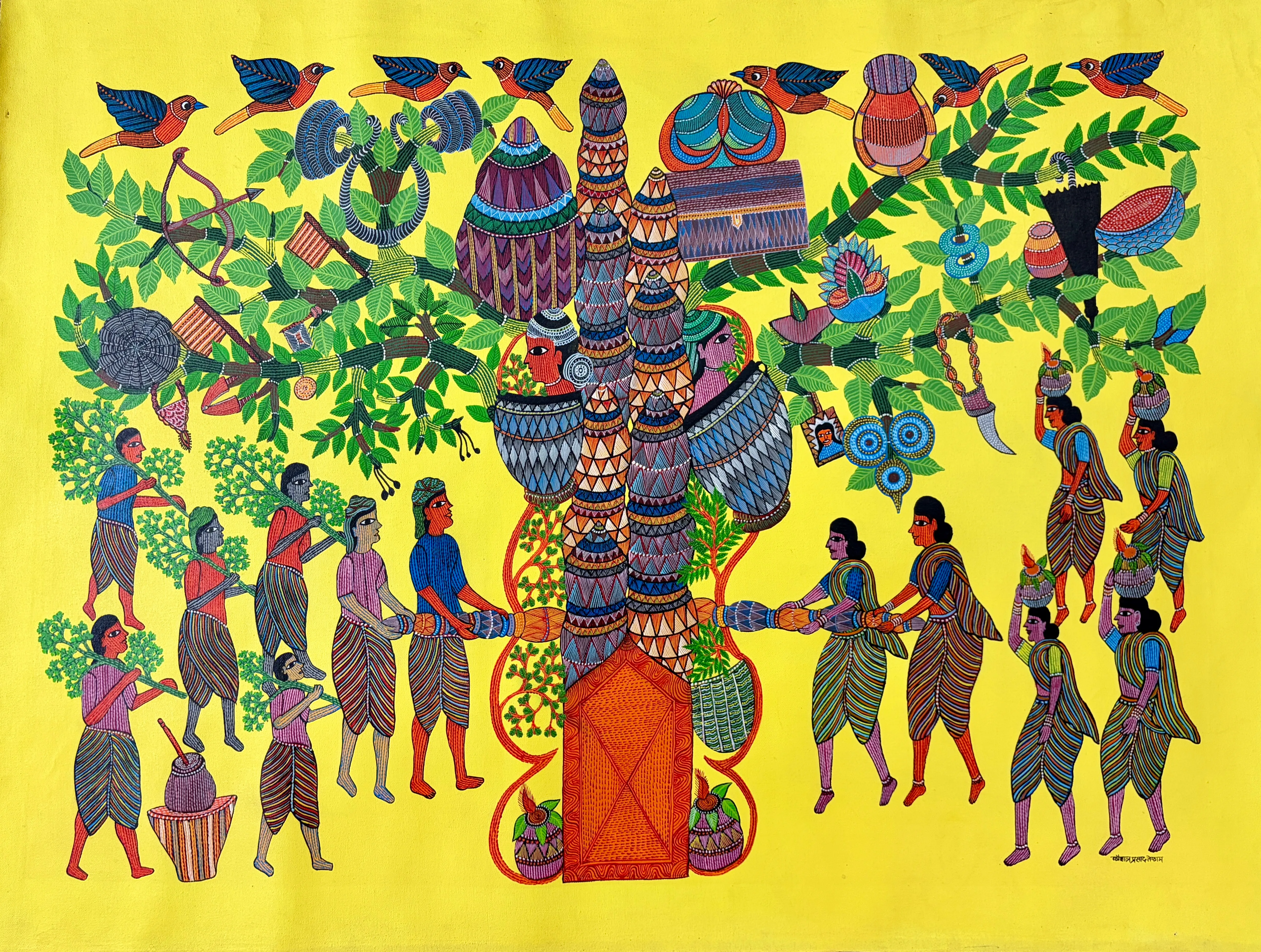
Dudh Lautawa: A Gond Wedding Tradition by Kaushal Prasad Tekam
20% OFFCertifiedOnly 1 left

eCommerce

Dudh Lautawa: A Gond Wedding Tradition by Kaushal Prasad Tekam

Dudh Lautawa: A Gond Wedding Tradition is an original Gond painting by acclaimed artist Kaushal Prasad Tekam, depicting the traditional Dudh Lautawa ceremony practiced among Gond communities of Central India. Dudh Lautawa, literally meaning "returning the milk," is an important wedding ritual that symbolizes gratitude, reciprocity, and the bonds between families. The ceremony acknowledges the nurturing role of the maternal family and celebrates the social relationships that sustain community life. In this painting, the bride, groom, family members, and ceremonial participants gather around a richly adorned Tree of Life, a recurring symbol of continuity, prosperity, and interconnectedness in Gond culture. The branches of the tree are filled with ceremonial objects, ornaments, musical instruments, and symbols of abundance, while birds animate the composition, representing harmony and the transmission of cultural knowledge across generations. Through intricate patterns and vibrant colours, Kaushal Prasad Tekam transforms this living tradition into a powerful visual narrative that preserves and celebrates Gond cultural heritage. * Artist: Kaushal Prasad Tekam * Medium: Acrylic on Canvas * Dimensions: 36 × 48 Inches * Art Form: Gond Art * Origin: Madhya Pradesh, India

$ 3,019$ 3,769
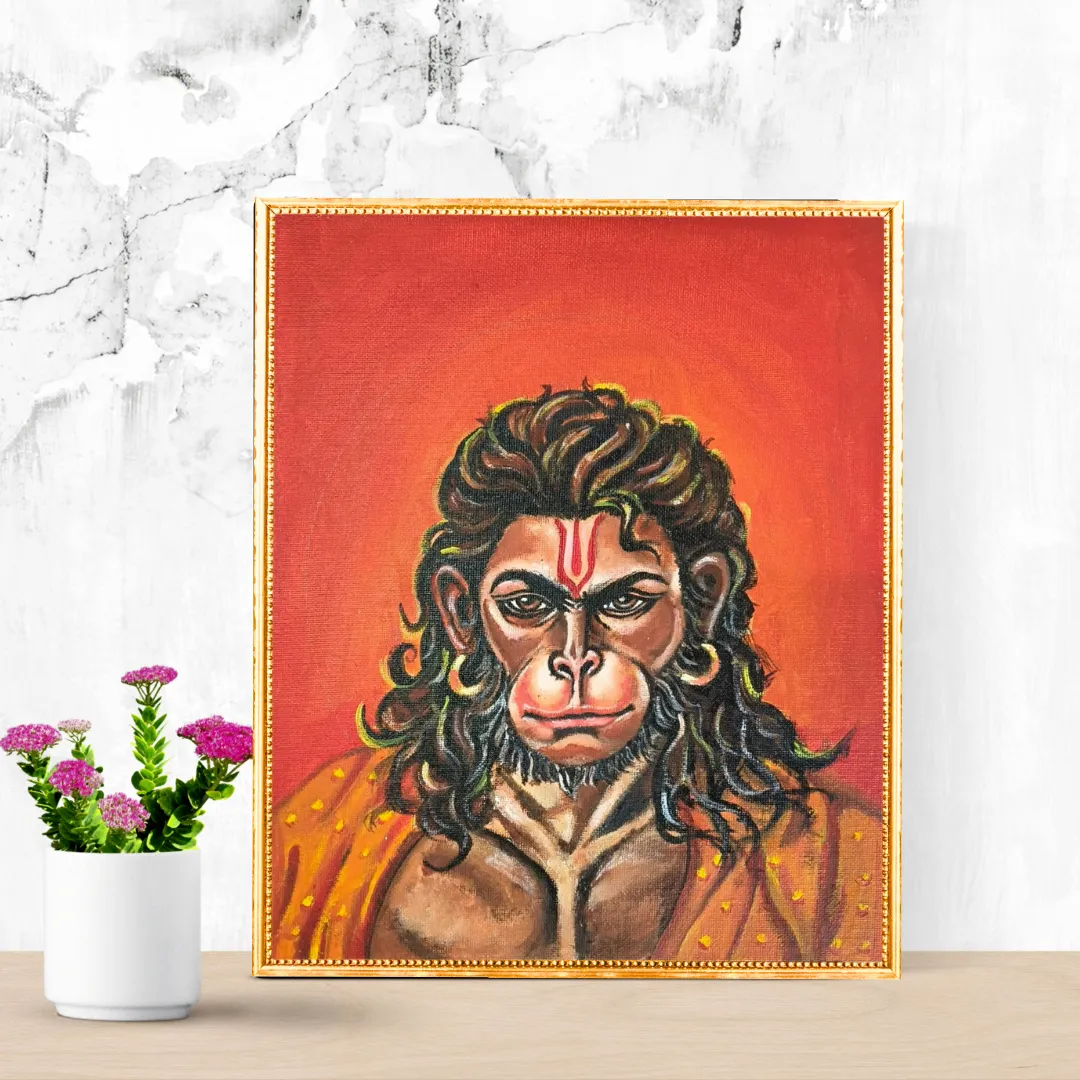
“Divine Strength Hanuman Portrait” - Original Acrylic Painting
CertifiedOnly 1 left

Sacred Indian Artworks: Gods & Goddesses

“Divine Strength Hanuman Portrait” - Original Acrylic Painting

“Divine Strength” is an original hand-painted acrylic artwork inspired by the divine energy and fearless devotion of Lord Hanuman. The intense gaze, detailed expression, and warm fiery background create a strong spiritual presence that instantly uplifts any space. Crafted with rich acrylic colors on canvas board, this painting blends traditional emotion with modern artistic expression, making it ideal for home temples, living rooms, or as a meaningful gift. This is a one-of-a-kind original artwork, created with attention to detail and devotion. ✔ Spiritual & meaningful artwork 🕉️ ✔ Only 1 piece available ✔ Ideal for gifting & home décor ✔ Handcrafted with devotion

$ 29
Painting: Vayuputra
CertifiedOnly 1 left

Sacred Indian Artworks: Gods & Goddesses

Painting: Vayuputra

Against a field of deep, luminous blue, a figure crouches in the compressed stillness of someone about to move. The body is rendered entirely in red, bold and unmodulated, the colour of devotion and sacred energy concentrated into a single form. In one hand, a flag curves upward into the wind. In the other, a string of rudraksha beads, the tears of Shiva, held with the ease of something worn close to the body for a very long time. The posture is not static. It carries the particular quality of a held breath, a moment of complete readiness in which power and composure exist in the same gesture. The flag is the painting's second subject. Unfurled and lifting, it is both emblem and invocation, a reminder that Vayuputra, son of the wind, is never entirely still. The blue ground gives the composition its air, its expanse, the sense of open sky surrounding a form that is equally at home in any element. Bharat Tripathi works in a contemporary idiom that distils devotional iconography into its essential emotional charge: no elaborate ornament, no narrative crowd, only the figure and what it carries. This painting belongs to his Anjaneya Series, work that was exhibited at Jehangir Art Gallery in Mumbai in September 2025, and which approaches the deity not through the conventions of religious art but through the directness of felt presence. Painted in acrylic on canvas, it offers Hanuman not as an object of worship but as a living embodiment of strength held in perfect, unhurried readiness. **Why This Artwork Stands Out** **** - The reduction of the figure to a single unbroken red silhouette against blue gives the composition an iconic clarity that is immediately recognisable and visually arresting at any scale. - The rudraksha beads introduce a devotional intimacy into an otherwise bold, almost graphic composition, anchoring the monumental in the personal. - The unfurled flag introduces movement into a crouching posture, creating a visual tension between stillness and force that is the painting's central emotional drama. - As part of the Anjaneya Series exhibited at Jehangir Art Gallery, this work carries exhibition provenance that places it within a serious and considered body of contemporary devotional art.

$ 3,999
Painting: Panchmukhi II
CertifiedOnly 1 left

Sacred Indian Artworks: Gods & Goddesses

Painting: Panchmukhi II

Five faces look outward in five directions, and the world is held between them. The Panchamukha form of Hanuman is among the most cosmologically complete images in the devotional tradition, each face presiding over a different direction, each a different aspect of divine power gathered into a single body. Bharat Tripathi renders this form not through the layered iconography of temple sculpture but through the compressed, direct language of contemporary painting, where the multiplicity of faces becomes a formal problem solved with compositional clarity rather than decorative accumulation. The result is a figure that is recognisably ancient in its subject and entirely present in its execution.The five heads are not arranged to overwhelm. They are held within the composition with the same quality of contained force that characterises all of Tripathi's figures in the Anjaneya Series: power that does not need to announce itself, presence that fills the frame without crowding it. The contemporary style invites the viewer to encounter a form they may already know through an unfamiliar visual register, stripped of the emblematic detail that can sometimes place devotional imagery at a distance and returned instead to its essential charge. This is Hanuman not as a sacred diagram but as a living presence, multiplied not to intimidate but to encompass. This work was exhibited as part of the Anjaneya Series at Jehangir Art Gallery in Mumbai in September 2025, a body of paintings that engages the devotional tradition with the full resources of contemporary figurative art. Painted in acrylic on canvas, it asks the viewer to look at something familiar and see it newly. **Why This Artwork Stands Out** **** - The five-headed form, traditionally rendered in sculptural or diagrammatic terms, is here translated into contemporary figurative painting, creating a visual encounter rather than an iconographic reference. - The compositional handling of five faces within a single painted field demonstrates a formal intelligence that makes the theological content and the artistic structure inseparable from one another. - The restraint of the contemporary style removes the distance that elaborate devotional iconography can create, making the figure's presence immediate and unmediated. - As part of the Anjaneya Series shown at Jehangir Art Gallery, this work belongs to a sustained and critically engaged body of paintings that repositions Hanuman within the vocabulary of modern Indian art.

$ 3,999
Painting: Sanjeevani
CertifiedOnly 1 left

Sacred Indian Artworks: Gods & Goddesses

Painting: Sanjeevani

He moves through the night sky with the momentum of something that cannot be stopped. The figure is airborne and entirely in motion, red body blazing against a deep teal sky, a yellow trail of energy streaming behind him like the wake of a comet. In one hand, a mountain. In the other, a mace. Below, the Himalayas rise in great dark forms, their peaks catching the cold light of a full moon that holds its position at the centre of the composition with the steadiness of something that has witnessed everything and remains unmoved. The clouds that gather around the flying figure are not obstacles but atmosphere, the painting's way of saying that this journey takes place at the border of the possible. The scene is one of the most charged moments in the Ramayana: Hanuman, unable to identify the Sanjeevani herb among the countless plants of Dronagiri, lifts the entire mountain and carries it through the sky to save the fallen Lakshman. Bharat Tripathi renders this act not as mythology held at a reverent distance but as something immediate and kinetic, a body in full flight, a decision made and acted upon without hesitation. The palette is bold and unambiguous: the red of the deity, the yellow of divine energy, the deep green and blue of mountain and sky, the white of the moon. No detail is decorative. Every colour is load-bearing. This work belongs to Tripathi's Anjaneya Series, exhibited at Jehangir Art Gallery in Mumbai in September 2025, a body of paintings that approaches Hanuman not through iconographic convention but through the directness of painted feeling. In acrylic on canvas, it captures a moment of devotion expressed entirely through action. **Why This Artwork Stands Out** **** - The central moon anchors a composition of tremendous movement, creating a still point around which everything else, figure, mountain, cloud, peak, organises itself with instinctive clarity. - The yellow energy trail behind the figure introduces a sense of speed and divine force that transforms a narrative moment into a visual experience of momentum. - The Himalayan ground below gives the aerial scene genuine spatial scale, making the flight feel both mythologically vast and compositionally grounded. - As part of the Anjaneya Series shown at Jehangir Art Gallery, this work carries exhibition provenance that situates it within a serious and sustained engagement with devotional subject matter in contemporary painting.

$ 3,999
Painting: Lanka Dahan
CertifiedOnly 1 left

Sacred Indian Artworks: Gods & Goddesses

Painting: Lanka Dahan

The city is burning and he stands above it, unhurried. The figure of Hanuman dominates the upper field of the composition, his form immense against a sky that has turned the same colour as the flames below. Red, orange and yellow move through the painting in great surging waves, the palette of fire and of the divine wrath that feeds it. Below, Lanka is consumed. The destruction is total and the destroyer is calm, a combination that is the painting's central and most unsettling truth: that this is not rage but justice, not chaos but the precise consequence of an act of violation against the sacred. Bharat Tripathi works in a figurative language that distils mythological episodes into their essential emotional charge. Lanka Dahan is one of the Ramayana's most theatrically charged moments, the moment when Hanuman, captured and sentenced to have his tail set alight, uses that very punishment to reduce an entire kingdom to ash. Tripathi does not illustrate the episode so much as embody its atmosphere, the overwhelming warmth of the palette creates a canvas that feels genuinely heated, as though the fire has not yet finished. The figure stands in it without being consumed by it, a detail the tradition has always understood as the deepest demonstration of Hanuman's invincibility. This work belongs to Tripathi's Anjaneya Series, exhibited at Jehangir Art Gallery in Mumbai in September 2025, a sustained body of contemporary paintings that approaches Hanuman not as religious subject matter but as living, felt presence. Painted in acrylic on canvas, it is a work that does not ask to be contemplated quietly. **Why This Artwork Stands Out** **** - The monumental scale of the figure against the burning city establishes a visual hierarchy that is both iconographically correct and compositionally powerful, making the deity's dominance felt rather than simply depicted. - The near-total immersion of the palette in warm reds, oranges and yellows makes the painting function as a chromatic experience of fire before it is read as a narrative one. - The calm of the figure within the destruction introduces the painting's deepest emotional register: power that does not require agitation, justice that does not require anger. - As part of the Anjaneya Series shown at Jehangir Art Gallery, this work carries exhibition provenance that places it within a considered and cohesive body of contemporary devotional painting.

$ 3,999
Painting: Kesari Nandan
CertifiedOnly 1 left

Sacred Indian Artworks: Gods & Goddesses

Painting: Kesari Nandan

He kneels, but there is nothing submissive in the posture. The body is coiled with a readiness that makes stillness feel temporary, the pause of someone who could rise in an instant and fill the entire sky. Vermilion red from crown to foot, the figure of Hanuman holds a golden mace with the ease of a being for whom strength is not effort but nature. The mace glows against the lighter blue of the setting, a single warm accent in a composition that otherwise moves between the cool and the sacred. On either side, dark green foliage presses in from the edges, dense and lush, framing the figure the way a forest frames a clearing, with the particular quality of something ancient holding space for something divine. The name Kesari Nandan, son of Kesari, grounds the deity in lineage and in the particular tenderness of the devoted child. Bharat Tripathi holds both registers at once: the muscular form and the kneeling posture, the golden weapon and the contained energy, the guardian and the devotee. Neither quality overwhelms the other. The foliage that flanks the figure is not merely decorative; it situates Hanuman in the natural world from which he is never entirely separate, the forest god as much as the divine warrior. This work belongs to Tripathi's Anjaneya Series, exhibited at Jehangir Art Gallery in Mumbai in September 2025, a sustained body of paintings that approaches Hanuman through the directness of contemporary figurative painting rather than the conventions of devotional imagery. Painted in acrylic on canvas, it is an image of power held quietly, which is the most demanding kind. **Why This Artwork Stands Out** - The kneeling posture introduces a devotional intimacy into an otherwise monumental figure, making the painting's emotional register simultaneously powerful and tender. - The dark green foliage flanking the vermilion form creates a chromatic contrast that gives the figure its visual weight and situates the deity within the natural world. - The golden mace, the sole warm accent against the blue ground, draws the eye with the precision of a detail that carries both iconographic and compositional significance. - As part of the Anjaneya Series shown at Jehangir Art Gallery, this work is part of a cohesive and critically engaged body of contemporary devotional painting.

$ 3,999
Painting: Bal Hanuman
CertifiedOnly 1 left

Sacred Indian Artworks: Gods & Goddesses

Painting: Bal Hanuman

He is airborne and entirely convinced. The child Hanuman streaks across a sky of blue and gold, his red body tilted forward with the absolute confidence of someone who has identified a target and has no reason to doubt he will reach it. The target is the sun. He has mistaken it for a ripe fruit, and the mistake is so pure, so free of hesitation, that it reads less as error and more as the first demonstration of a nature that will spend a lifetime reaching for what others consider unreachable. A yellow scarf streams behind him, catching the motion of flight and giving the composition its sense of speed, the line of colour that tells you the figure has just passed through this part of the sky and is already somewhere further ahead. The palette is warm and unambiguous: the red of the child's body, the yellow of the scarf and the sun-touched horizon, the blue of open sky. Bharat Tripathi renders the scene in the direct, energised language of contemporary figurative painting, where the mythological episode is stripped of ceremonial distance and returned to the quality it has always contained at its core: the irresistible momentum of a child utterly at home in his own extraordinary nature. There is joy in this painting, the specific joy of a being who does not yet know the word impossible. This work belongs to Tripathi's Anjaneya Series, exhibited at Jehangir Art Gallery in Mumbai in September 2025, a body of paintings that approaches Hanuman across all stages of his life and legend with the same quality of felt, immediate presence. Painted in acrylic on canvas, it is the youngest and perhaps the most luminous work in the series. **Why This Artwork Stands Out** - The airborne posture of the child figure captures the precise quality of innocent, unstoppable momentum that makes this episode among the most beloved in the Hanuman legend. - The flowing yellow scarf introduces a trail of movement that animates the composition and gives the sense of flight a visual velocity beyond what the figure alone could carry. - The warm red, yellow and blue palette achieves a celebratory brightness that sets this work apart from the more weighted devotional register of other paintings in the series. - As part of the Anjaneya Series shown at Jehangir Art Gallery, this painting completes the arc from the divine child to the cosmic warrior, giving the series its note of pure, unguarded beginning.

$ 3,999
Painting: Origin of Shiva
CertifiedOnly 1 left

Sacred Indian Artworks: Gods & Goddesses

Painting: Origin of Shiva

This an acrylic on canvas painting by artist Bharat Tripathi that is symbolic depiction of the origin of Shiva. In this powerful composition, the deity's ascetic and cosmic nature has been emphasized through his long matted hair and the golden trident, a symbol of divine authority and spiritual power against the background of intense flames. The scene created is one based on contemporary devotional aesthetic that blends traditional symbolism with modern compositional style. This painting is a part of the Shiva Series by the artist and was displayed in an exhibition titled "The Story of Shiva" held at the Coomaraswamy Hall, CSMVS Museum, Mumbai in December 2012.

$ 3,199
Painting: Shiva and Sati
CertifiedOnly 1 left

Sacred Indian Artworks: Gods & Goddesses

Painting: Shiva and Sati

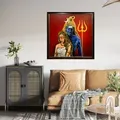
This an acrylic on canvas painting by artist Bharat Tripathi that is a portrayal of Shiva together with Sati in a figurative style. In this aesthetic depiction, the divine couple of Shiva and Sati have been rendered in a contemporary style with strong symbolic elements. The red background intensifies the emotional and spiritual atmosphere. The picture creates a sense of divine companionship and spiritual balance. This painting is a part of the Shiva Series by the artist and was displayed in an exhibition titled "The Story of Shiva" held at the Coomaraswamy Hall, CSMVS Museum, Mumbai in December 2012.

$ 3,199
Painting: Kishkindha Kand - Bali Vadh
CertifiedOnly 1 left

Sacred Indian Artworks: Gods & Goddesses

Painting: Kishkindha Kand - Bali Vadh

This an acrylic on canvas painting by artist Bharat Tripathi that depicts the episode from the Ramayana where Lord Rama kills the ignoble monkey king Bali and reinstates his brother Sugriva on the throne of Kishkindha. In the foreground, one can see the two monkey brothers jostling in combat with the sihouette of Lord Rama in the background. This is an episode from the Kishkindha Kand or the fourth chapter of the Ramayana. This painting is a part of the Ramayana Series by the artist and was displayed in an exhibition at the Lalit Kala Akademi in New Delhi in November 2015.

$ 6,399
Painting: Aranya Kand - Marich
CertifiedOnly 1 left

Sacred Indian Artworks: Gods & Goddesses

Painting: Aranya Kand - Marich

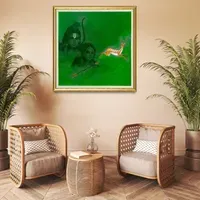
This is an acrylic on canvas painting by artist Bharat Tripathi that depicts the episode from the Ramayana where Rama is led to chase Marich, a demon transformed into a golden deer at the behest of Sita. Set against the background of green signifying the forest, the holy couple look onward to the prancing deer with the arrow signifying the subsequent chase. This is an episode from the Aranya Kand or the third chapter of the Ramayana. This painting is a part of the Ramayana Series by the artist and was displayed in an exhibition at the Lalit Kala Akademi in New Delhi in November 2015.

$ 6,399
Painting: Aranya Kand - Jatayu
CertifiedOnly 1 left

Sacred Indian Artworks: Gods & Goddesses

Painting: Aranya Kand - Jatayu

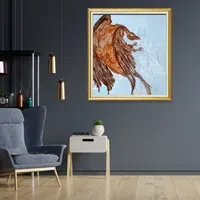
This an acrylic on canvas painting by artist Bharat Tripathi that depicts the episode of the killing of Jatayu by Ravana. In this skillful rendering, one can see the contorted form of Jatayu in the foreground with the faint silhouette of Ravana in the background whose hand is raised to strike down Jatayu. This is an episode from the Aranya Kand or the third chapter of the Ramayana. This painting is a part of the Ramayana Series by the artist and was displayed in an exhibition at the Lalit Kala Akademi in New Delhi in November 2015.

$ 6,399
Painting: Lanka Kand - Ravan Vadh
CertifiedOnly 1 left

Sacred Indian Artworks: Gods & Goddesses

Painting: Lanka Kand - Ravan Vadh

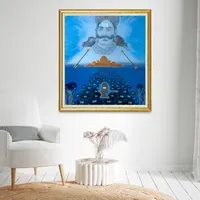
This an acrylic on canvas painting by artist Bharat Tripathi that is a symbolic and figurative representation of the march of Lord Ram towards Lanka that led to the eventual death of Ravan. One can see the Ram Setu leading upto Lanka and Ravan with a depiction of the Shivling in the foreground that symbolises divine order and orchestration that finally leads to the triumph of good over evil. This is an episode from the Lanka Kand or the sixth chapter of the Ramayana. This painting is a part of the Ramayana Series by the artist and was displayed in an exhibition at the Lalit Kala Akademi in New Delhi in November 2015.

$ 6,399
Painting: Lanka Kand - Agni Pariksha
CertifiedOnly 1 left

Sacred Indian Artworks: Gods & Goddesses

Painting: Lanka Kand - Agni Pariksha

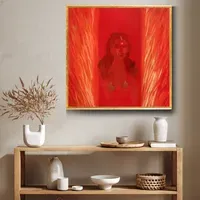
This an acrylic on canvas painting by artist Bharat Tripathi that depicts the episode from the Ramayana where Sita was put through 'agnipariksha' or trial by fire. One can see Sita with her hands folded at the centre of the picture flanked by flames on both sides. The vermillion on her forehead stands out against the bright red background as a testament to her purity. This is an episode from the Lanka Kand or the sixth chapter of the Ramayana. This painting is a part of the Ramayana Series by the artist and was displayed in an exhibition at the Lalit Kala Akademi in New Delhi in November 2015.

$ 7,599

Indian Folk and Tribal Art Paintings Inspired by Gods

For centuries, Indian art has served as a bridge between the mortal and the divine. In our Sacred Indian Artworks - a collection of paintings , that spirit lives on—through hand-painted tributes to gods, goddesses, and age-old rituals, created by India’s most revered folk and tribal artists. Indian folk art paintings depict India’s rich spiritual culture in a timeless way. From the meditative calm of Krishna’s Ras Leela in Pichwai and Kota Bundi MIniature paintings to the fierce grace of Maa Durga in Bengal’s Patachitra, each artwork carries centuries of devotion, layered symbolism, and cultural pride. This beautiful emotion and art extend beyond India’s temple towns, it thrives in forests, rivers, and tribal communities too. That’s where the sacred merges beautifully with the tribal art of India. Bhil artists tell divine stories through rhythmic dots and patterns, creating paintings of gods like Devi and Krishna within the flowing patterns of nature. Gond paintings have intricate linework and vibrant colour to depict tribal deities and animistic spirits, often blending them with tales of Shiva, Ganesha, or Vishnu. In Baiga art, sacred rituals, nature-worship, and cosmic geometry come together to create unique, original Indian paintings.

Each piece is a handcrafted original, created using natural pigments—soot black, haldi yellow, indigo blue, and red earth—painted on paper, canvas, or cloth using traditional methods. These are not just paintings; they are visual mantras—perfect for meditation rooms, prayer corners, cultural spaces, or as meaningful gifts. Whether you’re a collector, a spiritual seeker, or someone looking to reconnect with Indian roots, this collection invites you to experience the divine through the hands of India's master artists.

Srinathji and Pichwai Paintings

Pichwai paintings bring the divine presence of Shreenathji—an incarnation of Krishna—to life with intricate lotus-filled motifs, cows, peacocks, and decorative arches. Traditionally hung behind idols in temples - especially the Srinathji temple in Nathdwara, these artworks are deeply devotional and visually rich. In our collection of original Indian art paintings, each is made by master artists with great precision and fine detailing - making them timeless expressions of skill and faith. A perfect painting for pooja rooms or as statement wall art, Pichwai adds a sense of sacred serenity to your home.

Gond Paintings of Lord Shiva and Ganesha

In Gond art paintings , gods walk alongside nature. Shiva, Ganesha, and various tribal deities are painted with swirling forests, birds, and animals—all intricately composed using fine dots and delicate lines. These paintings often reflect the belief that the divine resides in every living being. Rooted in Madhya Pradesh’s Pardhan Gond tribe, the style is vibrant, earthy, and deeply symbolic. Gond paintings dedicated to gods are perfect for homes that celebrate both culture and creativity, offering a soulful blend of mythology and nature. If you want to shop Gond paintings our collection of certified original Indian paintings are a great place to get started.

Bhil Paintings - A Celebration of Gods and Nature

Whether it's paintings of Devi, ancestral spirits, or forest deities, these artworks use layers of colourful dots and earthy tones to express reverence - Bhil art paints celebrate the connection between gods, humans and nature. The Bhil community paints their walls during festivals to invoke blessings, and this tradition now translates beautifully to canvas. The simplicity of form combined with deep spiritual symbolism makes Bhil art a unique tribute to India’s folk gods and goddesses. Our collection lets you shop original Bhil art online and find paintings that are ideal for contemporary spaces with a hint of rustic charm.

Gods and Goddesses in Kota-Bundi Miniature Paintings

Kota-Bundi miniature paintings are known for their lyrical depictions of Hindu gods, goddesses, and royal devotion. Emerging from the princely states of Rajasthan, these artworks often feature Lord Krishna, Radha, and scenes from the Ramayana set against lush palace gardens and monsoon skies. Intricate floral borders, fine brushwork, and glowing pigments bring every divine scene to life. Handpainted by master artists, these original Indian paintings are perfect for traditional interiors, these paintings are both sacred artefacts and timeless collectibles that connect you with India’s mythological imagination and miniature legacy. Shop Baiga Paintings of Gods and Folk Heroes Baiga art is spiritual by design. Inspired by dreams, rituals, and forest life, these paintings often feature gods, animals, and mystical symbols believed to protect and heal. The Baiga tribe considers art a sacred act, with each stroke invoking nature’s power. Depictions of Mahadev, forest spirits, and creation myths are common, rendered in natural tones and rhythmic forms. These artworks hold a raw, meditative energy—perfect for meditation corners or spiritual spaces seeking depth and authenticity.

Tribal Art - Spiritual Warli Paintings

Minimal yet meaningful, Warli art paintings portray the divine through everyday rituals and cosmic balance. Originating from the Warli tribe of Maharashtra, this artform uses simple geometric forms like circles, triangles, and lines to depict goddesses, nature spirits, and celestial movements. Scenes of tribal ceremonies often include the Mother Goddess (Hirva Devi) and Tarpa dance, symbolising fertility, protection, and harmony with nature. Painted in white on earthy ochre or red backgrounds, these artworks are perfect for minimalist spaces that honour culture and spirituality in equal measure.