

Updated 14 November 2026
Ask ten people to describe a Shiva painting and you will get ten different pictures. One sees a blue god meditating on a snowy mountain. Another sees a dancer inside a ring of fire. A third sees a figure that is half man, half woman. They are all right. Indian painters and sculptors have shown Shiva in dozens of forms, and each form carries a different idea about who he is.
That matters when you buy one. A Shiva painting for a study should probably not be the same Shiva painting you hang at the front door. This guide walks through nine of the forms you will meet most often in Indian art, how to recognise each one, what it means, and which room it tends to suit. With Dev Deepawali falling on 24 November this year, it is also a good moment to choose one.
| Shiva in Indian art | |
|---|---|
| Also called | Mahadev, Shankar, Bholenath, Rudra |
| Common forms in painting | Nataraja, Ardhanarishvara, Dakshinamurti, Gangadhara, Neelkantha, Tripurantaka, Bhairava, Shiva with Parvati, Mahayogi |
| Usual signs | Third eye, crescent moon, matted hair, snake, trident, damaru drum, Nandi the bull |
| Art forms that paint him | Pahari and Rajasthani miniature, Madhubani, Kalighat, Phad, Baiga, Gond, Paitkar |
| Festival link | Dev Deepawali in Varanasi, 24 November 2026 |
How to read a Shiva painting in ten seconds
Before the forms, the clues. Almost every Shiva painting carries a few of these, and they tell you it is him even when the style changes completely.
The third eye sits in the middle of his forehead. A crescent moon rests in his matted hair, and in many paintings the river Ganga springs from the same knot. A snake coils around his neck. He holds a trident and often a small hourglass drum called the damaru. His skin is blue or ash white, he wears a tiger or elephant skin, and Nandi the bull is never far away.
Once you can spot those, you can read the rest of the picture. What he is doing with them is what tells you the form.
The 9 forms of Shiva at a glance
| Form | How you recognise it | What it means | Room it suits |
|---|---|---|---|
| Nataraja | Dancing inside a ring of flames, one leg raised | Creation and destruction as one rhythm | Living room, music or dance space |
| Ardhanarishvara | Half male, half female, split down the middle | Shiva and Shakti as one being | Bedroom |
| Dakshinamurti | Seated under a banyan tree, teaching sages | Shiva as the teacher | Study, children's study |
| Gangadhara | The river Ganga falling into his hair | Shiva softening a force that would destroy the earth | Entrance or living room |
| Neelkantha | Blue throat, often drinking from a cup | Taking in poison to protect the world | Puja room |
| Tripurantaka | Drawing a bow against three flying cities | Victory over arrogance, the story behind Dev Deepawali | Festive spaces, living room |
| Bhairava | Fierce face, often with a dog | Protector and guardian | Entrance, never a bedroom |
| Shiva with Parvati | Seated together on Kailash, often with Ganesha and Nandi | The household, family and marriage | Living or dining room |
| Mahayogi | Ash-smeared ascetic in meditation | Stillness and discipline | Meditation corner, yoga room |
The room column is our practical suggestion, not a rule from scripture. If you follow Vastu closely, our piece on what Vastu really says about the paintings in your home covers directions and placement in more detail.
1. Nataraja, the Lord of Dance
This is the most famous image of Shiva in the world, and it began as bronze rather than paint. Chola sculptors in Tamil Nadu cast Shiva dancing the ananda tandava, the dance of bliss, inside a ring of fire, and the Cleveland Museum of Art holds one of these bronzes, cast in the 1000s. In one hand he holds the damaru, whose beat starts creation. In another he holds the flame that ends it. A raised palm tells you not to fear, and his lifted foot points to release.
Look under his other foot. With every step of the dance he lands on a small figure who stands for ignorance. Painters borrowed the whole composition from these bronzes, so a Nataraja painting usually keeps the circle of flames and the dwarf.
Nataraja is a moving image, full of energy. That makes it a natural fit for a living room, a music room or anywhere people dance and perform.
2. Ardhanarishvara, the lord who is half woman
Ardhanarishvara shows Shiva and Parvati as one body, split down the middle. The right side is usually Shiva, with matted hair, a snake and a flat chest. The left side is Parvati, with a jewelled earring, a rounded breast and a sari. Even the headdress divides in two. The Indira Gandhi National Centre for the Arts notes this split in its study of Ardhanari iconography, where the right half carries the jatabandha, Shiva's knot of matted hair, and the left half a woman's hairstyle, the keshabandha (IGNCA iconography notes).
The idea is simple and deep at once. Shiva without Shakti, his energy, cannot act. Together they are complete. Ardhanarishvara is one of the oldest human forms of Shiva in Indian art.
Because it is a picture of two people made whole, many couples choose it for the bedroom.
3. Dakshinamurti, Shiva as teacher
In this form Shiva sits under a banyan tree, facing south, with sages gathered at his feet. Dakshina means south, and in many South Indian temples you will find him carved on the south wall. He teaches in silence. One hand often shows the chin mudra, the gesture of knowledge, and like Nataraja he rests a foot on the dwarf of ignorance.
Dakshinamurti is calm and inward, a Shiva for learning rather than for drama. It belongs in a study, a library corner or a child's homework space.
4. Gangadhara, the one who holds the Ganga
The sage Bhagiratha wanted the river Ganga to come down from heaven, but her fall would have shattered the earth. Shiva caught her in his hair and let her out gently. In a Pahari painting of the scene from around 1700, now in the Cleveland Museum of Art, Parvati offers Shiva a cup of wine on Mount Kailash, but he is looking at Bhagiratha, who stood on one leg for 1,001 years to win the river. The Ganges pours from Shiva's topknot.
Gangadhara is about taking something overwhelming and making it gentle. It suits an entrance or a living room, where a home receives the outside world.
5. Neelkantha, the blue-throated one
When the gods and demons churned the ocean for the nectar of immortality, a deadly poison rose first. Shiva drank it to save the world. Parvati held his throat so it would not reach his stomach, and the poison turned his throat blue. Neelkantha means exactly that.
In painting, look for the blue throat, sometimes a cup, and a quiet, almost sad face. It is a form about sacrifice, and it sits well in a puja room.
6. Tripurantaka, destroyer of the three cities
Three demon brothers ruled three flying cities, and they could only be destroyed by a single arrow when the cities lined up. Shiva waited, drew his bow and burned all three at once. The Met holds a Chola bronze of Shiva as the Vanquisher of the Three Cities from around 1000–1020, a measure of how old the story is in Indian art (The Met).
This is the story Varanasi lights up for. Dev Deepawali, the Diwali of the gods, marks Shiva's victory over the demon Tripurasura, and Uttar Pradesh Tourism lists this year's festival in Varanasi for 24 November 2026 on the Incredible India portal. A Tripurantaka painting makes a strong festive piece for a living room.
7. Bhairava, the fierce protector
Bhairava is Shiva at his most frightening: bulging eyes, fangs, a garland of skulls and a dog at his side. In Varanasi, Kaal Bhairav is known as the city's guardian. The fierce face is there to scare away harm, not the people inside. Pahari painters often set this side of Shiva beside the fierce goddesses, as in a Mandi painting of Kali standing on Shiva.
That role tells you where it belongs. A Bhairava painting works as a guardian near an entrance. Keep it out of a bedroom or a child's room, where a gentler form fits better.
8. Shiva with Parvati, the family on Kailash
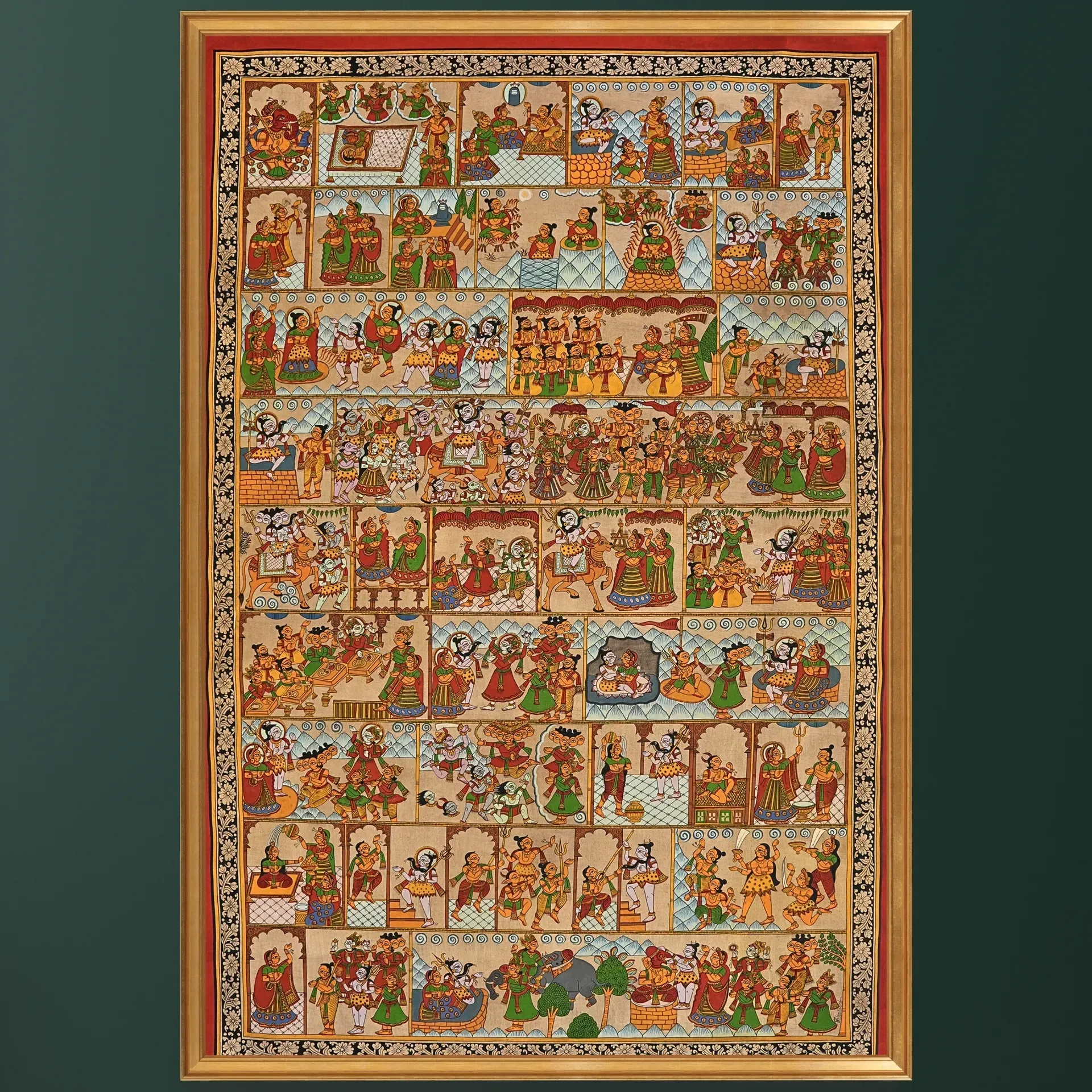
Shiv Puran by Prakash Joshi, the courtship of Shiva and Parvati as a Phad in natural colours on cotton · Image source: Rooftop
Shiva married Parvati after her long penance, and much of Indian painting shows them simply together. They sit on a tiger or elephant skin on Mount Kailash, sometimes with their sons Ganesha and Kartikeya, and Nandi resting nearby. This is the form painters call Uma-Maheshvara or the Shiv Parivar, the family of Shiva.
A Pahari painting from around 1675 seats Shiva and the goddess on the hide of the elephant demon Gajasura, whom Shiva defeated. The fierce story sits underneath, and the mood on top is tender.
A family scene is the easiest Shiva painting to live with. Hang it in a living or dining room, where the household gathers.
9. Mahayogi, the great ascetic
Before he is a husband or a dancer, Shiva is a yogi. In a Bikaner painting from the early 1700s he sits in a shrine with matted hair, a skull necklace, cobras for jewellery and a white body covered in ash, beside his red-skinned goddess, while six women bring brass offerings. That ash-white ascetic is the Mahayogi: the god who sits on Kailash, eyes half closed, outside time.
It is the quietest Shiva of all. Put it in a meditation corner, a yoga room or any spot where you sit still.
What about the linga?
Many people pray to Shiva as the linga, his form without a face. It is the most common image in temples, and you will see it in painting too, often with Nandi kneeling before it. The Archaeological Survey of India describes the 7-metre Sadashiva at Elephanta, near Mumbai, as showing three aspects of Shiva as Creator, Preserver and Destroyer (ASI). The cave was planned around it and a linga shrine, a reminder that the faces and the formless stone are two ways of showing the same god.
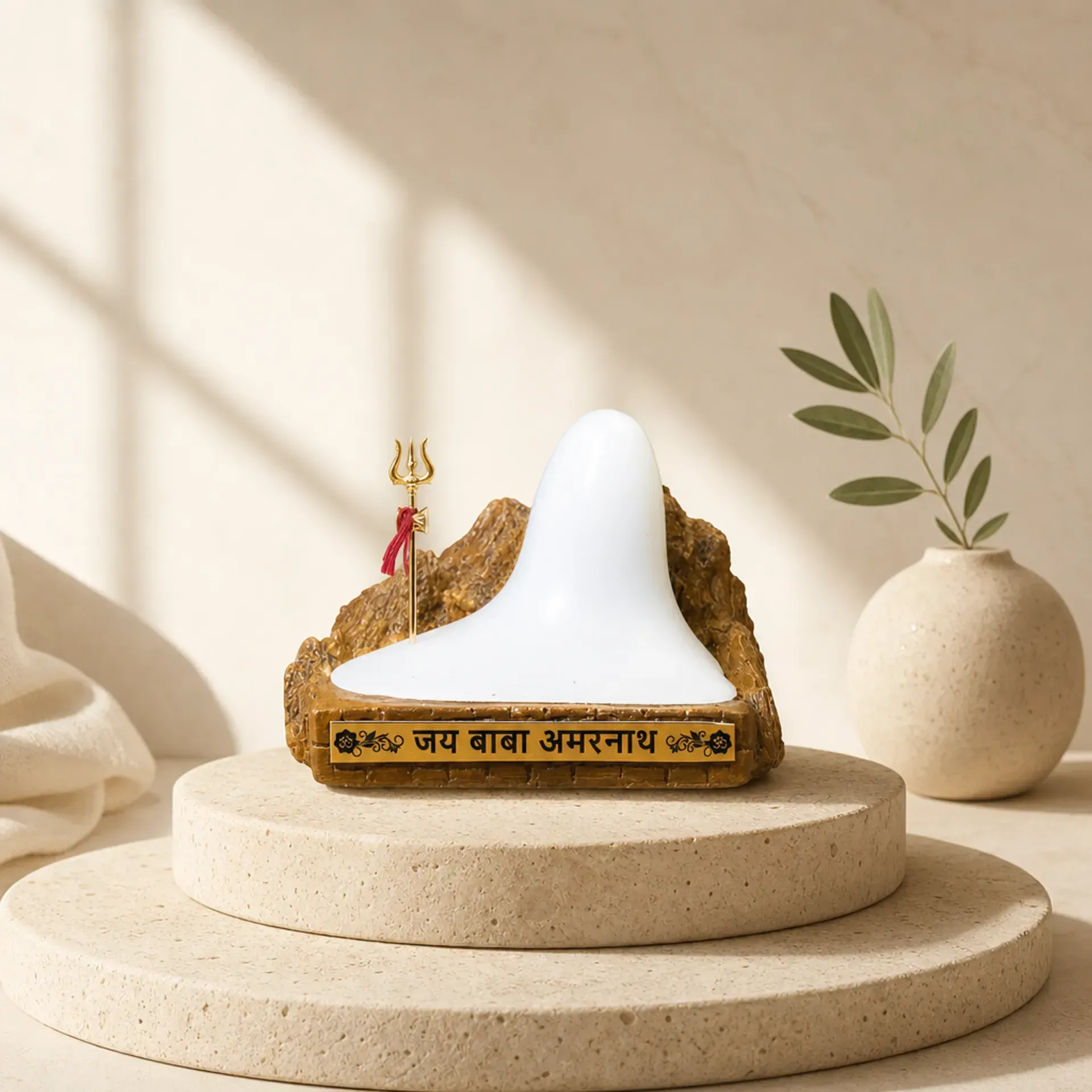
Baba Amarnath miniature, the ice linga of Amarnath in miniature · Image source: Rooftop
The linga also turns up in the shrines people keep at home. The ice linga of Amarnath, which forms each year in a Himalayan cave, is one of the best known, and Rooftop's Baba Amarnath miniature brings it down to the size of a shelf.
How different art forms paint Shiva
The same god looks completely different depending on who paints him.
In Madhubani painting, Shiva rides Nandi with trident and drum while flowers and circles fill every gap around him, as in a Bihar sheet of Shiva and Nandi at the Cleveland Museum of Art. Mithila painters drew him on the walls of homes long before they painted on paper.
In the Pahari and Rajasthani miniatures of the hill and desert courts, he is soft-faced and graceful, and the landscape of Kailash matters as much as the god.
Phad painters of Rajasthan tell his story as a scroll. Prakash Joshi's Shiv Puran Phad on Rooftop follows Shiva from Sati's loss to his marriage with Parvati and the birth of Ganesha, scene by scene.
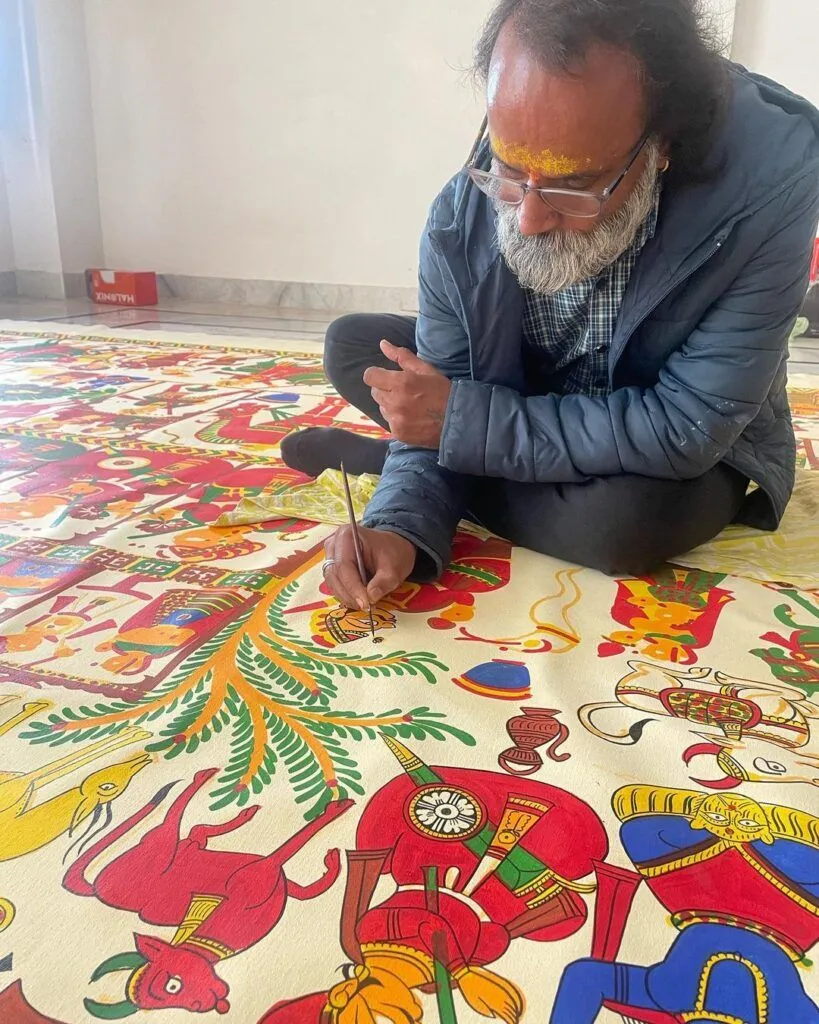
Kalyan Joshi at work on a Phad painting · Image source: Rooftop
Kalighat painters of 19th-century Kolkata made Shiva human and close. Their quick, flowing line shows him with Parvati, or carrying the body of Sati in grief. If you want to paint him that way yourself, Anwar Chitrakar's Kalighat course teaches the line from the first sketch.
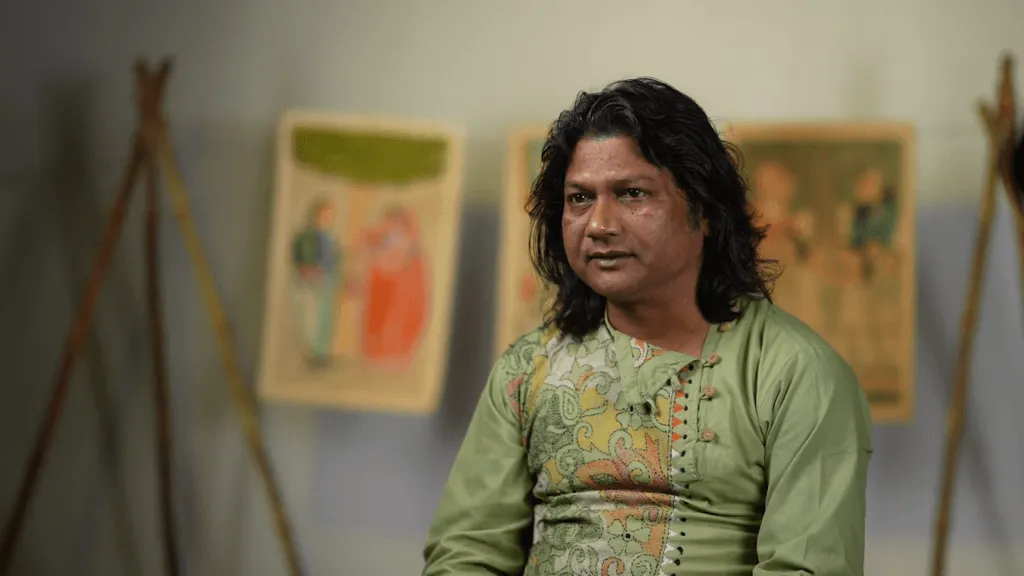
A still from Rooftop's Kalighat course with Anwar Chitrakar · Image source: Rooftop
Among the Baiga of central India, Shiva is close to home. Padma Shri Jodhaiya Bai drew on her forests, the mahua tree and Lord Shiva in her painting. Rooftop's Baiga paintings include Bholenath ka Darbaar and a Lord Shiva painted in rhythmic patterns and bold colour. Gond painters give Nandi the starring role in The Sacred Journey of Nandi, and Paitkar painter Kishor Gayen sets Shiva and Parvati among tribal devotees and hunters in one of the scroll paintings in Rooftop's original paintings.
Choosing your Shiva painting
Start with the room, then pick the form. A study wants Dakshinamurti more than Bhairava. A bedroom wants Ardhanarishvara more than Tripurantaka. If the painting is for a puja room, Neelkantha or the family on Kailash keeps the mood devotional and calm.
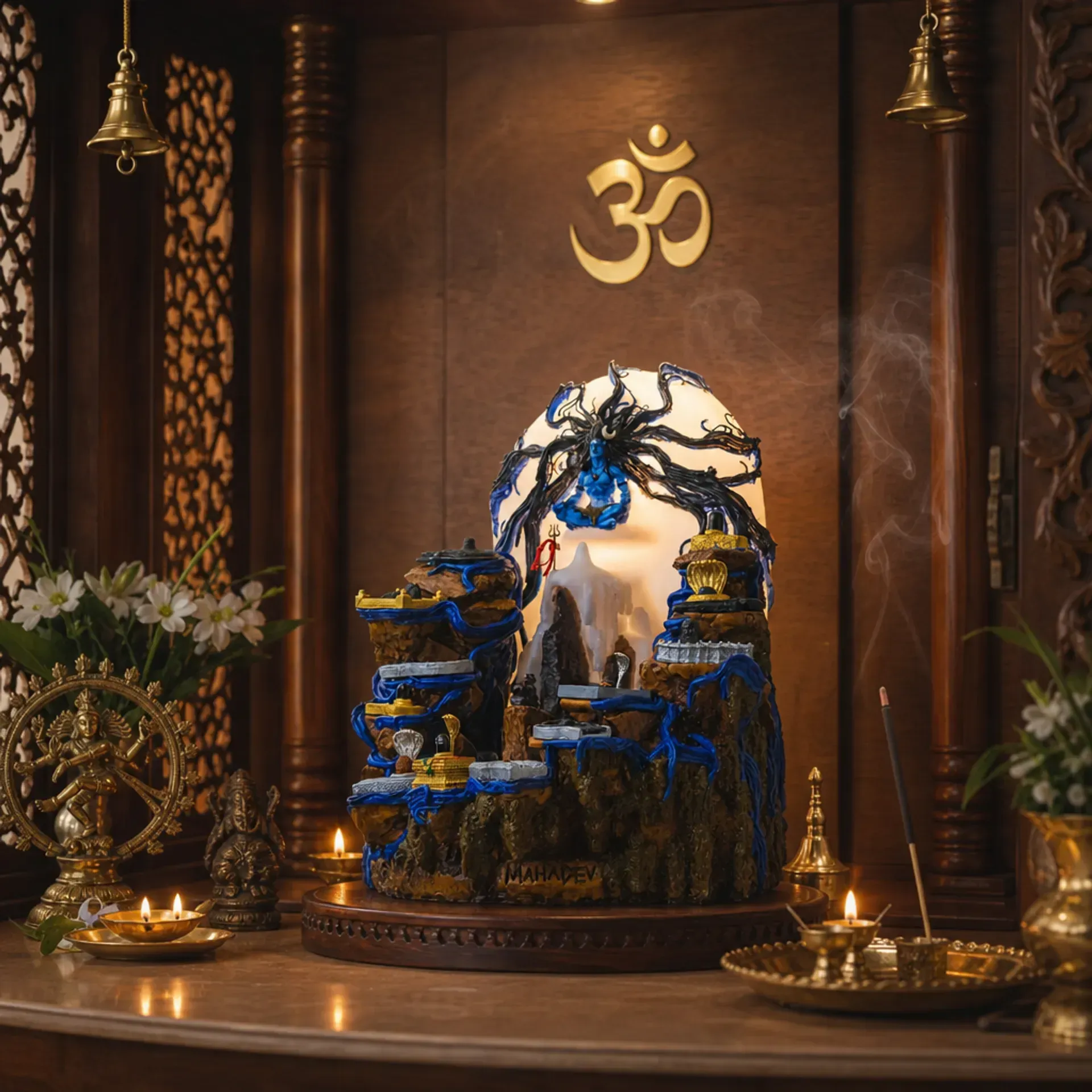
Mahadev miniature with the 12 Jyotirlingas and Nandi · Image source: Rooftop
Some homes want Shiva in three dimensions instead. Rooftop's Mahadev miniature gathers the 12 Jyotirlingas, the Amarnath shrine and Nandi into one lit piece for a home temple.
Then pick the art form whose look you like. A Pahari miniature and a Baiga painting can show the same Shiva and feel like they come from different worlds. Our guide to which Hindu god paintings belong in your home helps if you are choosing between deities as well.
Finally, buy an original from a named painter. A hand-painted Shiva carries the painter's own reading of the god, which is the whole reason these forms survived. Every painting on Rooftop is hand-painted by a verified artist and comes with a certificate of authenticity.
Frequently asked questions
What are the main forms of Shiva in Indian painting?
The forms you will see most often are Nataraja, Ardhanarishvara, Dakshinamurti, Gangadhara, Neelkantha, Tripurantaka, Bhairava, Shiva with Parvati on Kailash, and the meditating Mahayogi. Painters also show him as the linga, with Nandi before it.
Which Shiva painting is best for home?
A calm form suits most homes: the family on Kailash for a living room, Ardhanarishvara for a bedroom, Dakshinamurti for a study and the Mahayogi for a meditation corner. Fierce forms like Bhairava work best near an entrance.
Which Shiva form is linked to Dev Deepawali?
Tripurantaka. Dev Deepawali in Varanasi celebrates Shiva's victory over the demon Tripurasura, and in 2026 it falls on 24 November.
Can I keep a Nataraja painting at home?
Yes. Nataraja shows the dance of creation and destruction, and its energy suits a living room, music room or dance space.