

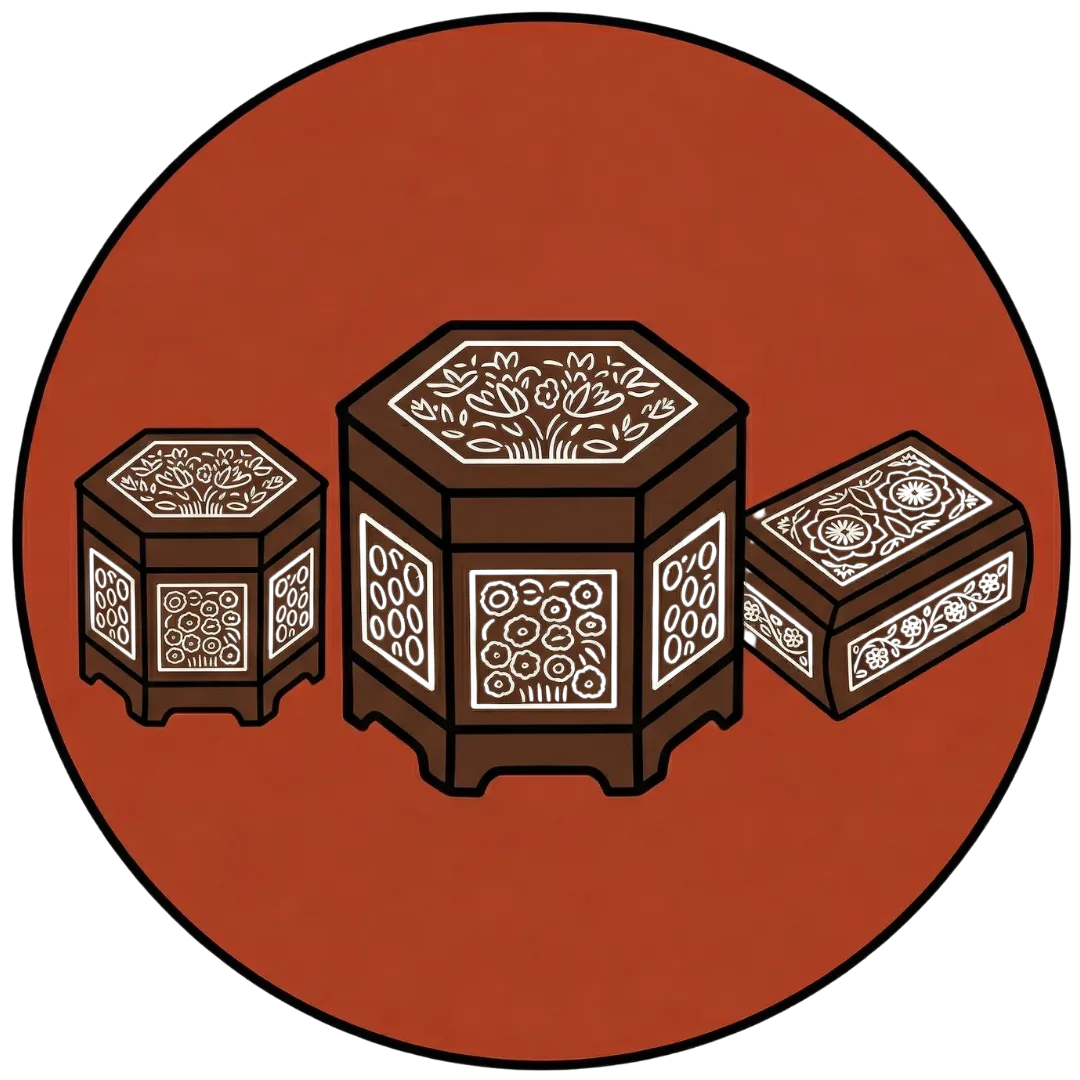
Walnut Wood Carving - The Handicraft Tradition of Jammu & Kashmir
Explore Walnut Wood Carving, the handicraft tradition of Jammu and Kashmir, and learn about its origins, techniques, cultural significance, and artistic heritage.
Introduction
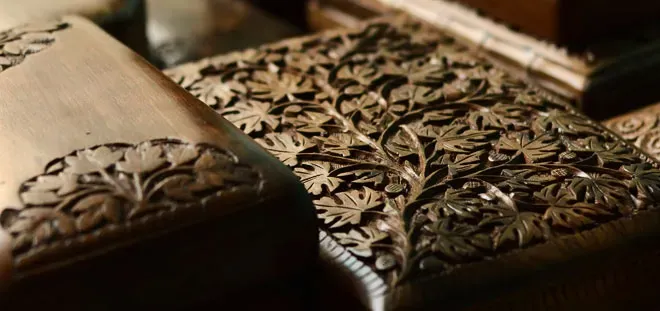
Walnut wood carving is a traditional decorative craft practiced in the Kashmir Valley of Jammu and Kashmir, India. It involves the hand-carving of wood obtained from the Juglans regia (common walnut) tree into furniture, architectural elements, decorative objects, and functional household items. The craft is distinguished by its deep relief carving, detailed floral and geometric surface ornamentation, and the natural properties of walnut wood, which include a close grain, even texture, and a warm natural sheen that responds well to polishing. In 2012, Kashmir Walnut Wood Carving was granted the Geographical Indication (GI) tag by the Government of India under the GI Act 1999, listed at item 182, with registration confirmed by the Controller General of Patents, Designs and Trademarks.
Etymology: The craft is locally referred to as dhun hath kaem (walnut wood work) or dhoon kaem (walnut work) in Kashmiri. The walnut tree itself is called Doon Kul or Akhrot ka Pedh in local usage. The master carver is known as a Naqash, derived from the Arabic-Persian term for engraver or designer. The broader woodworking tradition in Kashmir also encompasses Khatamband (geometric ceiling work) and Pinjrakari (lattice work), though walnut carving constitutes a distinct category within Kashmiri woodcraft.
Origin: The origins of walnut wood carving in Kashmir are linked to the broader introduction of Persian craft traditions in the Kashmir Valley. A widely cited historical narrative attributes the introduction of handicrafts, including woodwork, to Mir Sayyid Ali Hamadani (commonly referred to as Shah Hamadan), a 14th-century Sufi scholar from Iran who reportedly brought approximately 700 artisans from Persia to Kashmir.
These artisans are said to have dispersed across the valley and transmitted their knowledge of various crafts to the local population. A second tradition attributes the specific introduction of walnut woodcarving to Sheikh Hamza Makhdoom during the reign of Sultan Zain-ul-Abidin (commonly known as Budshah) in the 15th century. Zain-ul-Abidin is documented in court chronicles, including those of Pandit Srivara, as having actively promoted arts and crafts by inviting artisans from Bukhara and Persia and providing them with resources to train local Kashmiris. The earliest formal written source to document walnut wood carving as a distinct craft is the Gazetteer of Kashmir, published in 1890. The broader tradition of woodcraft in Kashmir, however, extends over approximately ten centuries, with historical records referencing a twelve-storey wooden palace in Srinagar that was destroyed during the reign of King Harsha (1089 to 1101 CE).
Location: The craft is concentrated in the Kashmir Valley, with the primary production centre located in downtown Srinagar, particularly in the localities of Fateh Kadal, Safa Kadal, and Noor Bagh. These areas contain clusters of karkhanas (workshops) dedicated to walnut wood carving. Walnut trees grow at elevations between 5,500 and 7,500 feet above sea level in the Kashmir region, with districts such as Shopian (also spelled Shupiyan) and Anantnag being noted for producing quality walnut timber. Pahalgam and Sonamarg are also identified as locations of some of the oldest walnut groves. Community
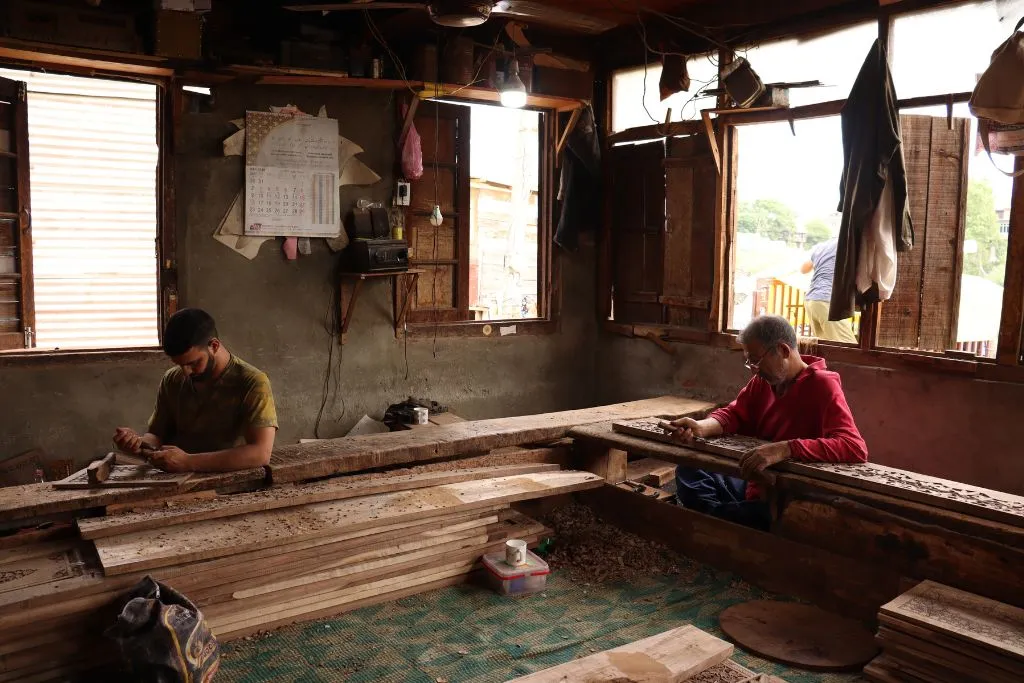
The artisans who practice walnut wood carving are locally known as Naqash (carvers). The craft industry is entirely male-dominated, with no documented tradition of female participation in any phase of production. Walnut wood carving operates as a cottage industry, with skills transmitted through family-based apprenticeship systems across generations. The workforce is organized into three specialized categories: joiners or carpenters who prepare the wooden forms, carvers who execute the designs, and polishers who finish the surfaces. Estimates of the active artisan population vary. The Government of India's Incredible India portal records approximately 600 artisans in Srinagar city as of recent assessments, while other documentation from craft research bodies places the number at approximately 3,000 skilled artisans in Srinagar alone.
Relevance: Kashmir walnut wood carving holds both cultural and economic significance in the region. Walnut wood furniture occupies a central place in Kashmiri households and is a standard component of bridal trousseaus. The craft contributes to the livelihoods of thousands of artisan families and forms a key part of Kashmir's handicraft export economy. In 2021, Srinagar was designated as a UNESCO Creative City in the field of Crafts and Folk Art. The dossier submitted for this designation identified walnut wood carving as one of the seven focal crafts of the city, alongside papier-mache, Khatamband, Pinjrakari, and others.
History
Background: The history of woodcraft in Kashmir extends over approximately a millennium. Historical records reference a multi-storey wooden palace in Srinagar that was destroyed by fire during the reign of King Harsha (1089 to 1101 CE). From approximately 1028 CE onward, woodcraft related to architectural construction began to develop in the region, shaped by the availability of local timber species including walnut and deodar.
The introduction of Persian craft knowledge to Kashmir is most commonly associated with two historical developments. The first is the arrival of Mir Sayyid Ali Hamadani in the 14th century, who reportedly facilitated the migration of approximately 700 Iranian artisans to Kashmir. The second is the patronage of Sultan Zain-ul-Abidin in the 15th century, who according to multiple historical accounts invited craftsmen from Persia, Bukhara, and Central Asia and supported their integration into local craft economies. Written records document the elaborate wood carvings of Zain-ul-Abidin's Razdani palace.
The craft received further patronage during the Mughal period (16th to 18th centuries). The Mughal rulers established royal karkhanas (workshops) in Kashmir and encouraged the development of decorative arts, including wood carving. During this period, inlay work combining metal and walnut wood was practiced, though this particular technique appears to have declined and largely disappeared over subsequent centuries. The Mughal influence introduced calligraphic and ornamental patterns into the existing repertoire of Kashmiri carving designs.
Under the Dogra rulers (19th and early 20th centuries), walnut wood carving continued to receive state support. Maharaja Pratap Singh promoted Kashmiri arts by arranging exhibitions at the Government Museum, an initiative attributed to his minister Dr. A. Mitra. Maharaja Pratap Singh also presented a wood-carved gate and frontage of the Kashmir camp to King George V at the Coronation Durbar held in Delhi, which brought the craft to the attention of British aristocracy and expanded its market among European visitors.
During the colonial era, European traders developed an interest in Kashmiri walnut wood products, particularly those featuring high-relief and undercut carving techniques. This period marked the transition of the craft from primarily architectural and royal usage to commercial production for export markets. According to INTACH (Indian National Trust for Art and Cultural Heritage), the tendency toward highly detailed undercutting appears to have developed in the latter part of the 19th century under European influences, replacing what had previously been a bolder and more direct carving style.
Culture and Societies: Walnut wood carving is deeply embedded in the domestic and social life of the Kashmir Valley. Carved walnut furniture, particularly tables, bed frames, and storage chests, holds a place of prestige in Kashmiri households. Walnut wood items are traditionally included in the wedding trousseau of a Kashmiri bride and are treated as family heirlooms passed across generations. The craft also holds significance in the furnishing of houseboats on Dal Lake, which form a distinctive feature of Srinagar's cultural landscape.
The karkhana (workshop) system constitutes the primary organizational unit of production. Karkhanas are typically located in the old city quarters of downtown Srinagar, concentrated in areas such as Fateh Kadal. Work within a karkhana follows a communal pattern. According to ethnographic research conducted by Sahapedia (documented by researcher Nikita, Department of Sociology, Delhi School of Economics), the daily routine in a karkhana involves a combination of craft work and communal activities, including the singing of Sufiana kalams, romantic Kashmiri songs, and traditional compositions during working hours.
The craft has historically been transmitted through a hereditary apprenticeship model, where sons learn from fathers or uncles within the karkhana environment. In more recent decades, the Handicraft Department of Jammu and Kashmir has established formal craft training centres, where enrolled students learn under master artisans over a two-year period following a structured syllabus. The department also maintains a Craft Museum as part of the School of Design, exhibiting both contemporary and antique samples of traditional Kashmiri crafts for artisan reference and design inspiration.
A notable contemporary challenge to the craft community is the declining number of apprentices and active karigars (craftsmen). Younger generations have increasingly moved away from traditional craft occupations toward other employment. To meet market demand, traders in Kashmir have developed supply relationships with wood carvers in Saharanpur, Uttar Pradesh, a town whose own wood carving tradition was historically influenced by the migration of Kashmiri and Persian craftsmen during the post-Mughal period. This has created tensions around questions of authenticity and the distinction between traditional Kashmiri walnut work and products made elsewhere.
Religious Significance: Walnut wood carving has a documented historical association with religious architecture in Kashmir. Several surviving examples of carved woodwork can be found in Islamic religious structures, including the mosques of Shah Hamdan (Khanqah-i-Mualla), the Naqshband Sahib mosque, the Khankahi Moulla, and the shrine of Sheikh Noor-ud-Din Wali (also known as Nund Rishi) at Charar-i-Sharief. These structures feature elaborate carved wooden panels, doors, ceilings, and decorative elements executed in walnut and deodar wood.
Certain traditional motif categories carry religious content. Taveez Dhar refers to carvings featuring Quranic verses, and Harfi Dhar encompasses Arabic and Persian calligraphic inscriptions. These motifs are typically applied to specific object types such as Quran stands and prayer niches.
However, as noted by scholars referenced in the academic paper "Historical Introduction of Wood Carving Industry in Kashmir" (available through ResearchGate), the presence of animal and figural carvings, including depictions of elephants, dogs, horses, and birds, points to a secular dimension in the craft. The paper observes that such imagery is not consistent with strict religious injunctions against figural representation, suggesting that Kashmiri wood carvers, although predominantly Muslim, have historically maintained a secular artistic outlook.
Understanding the Art
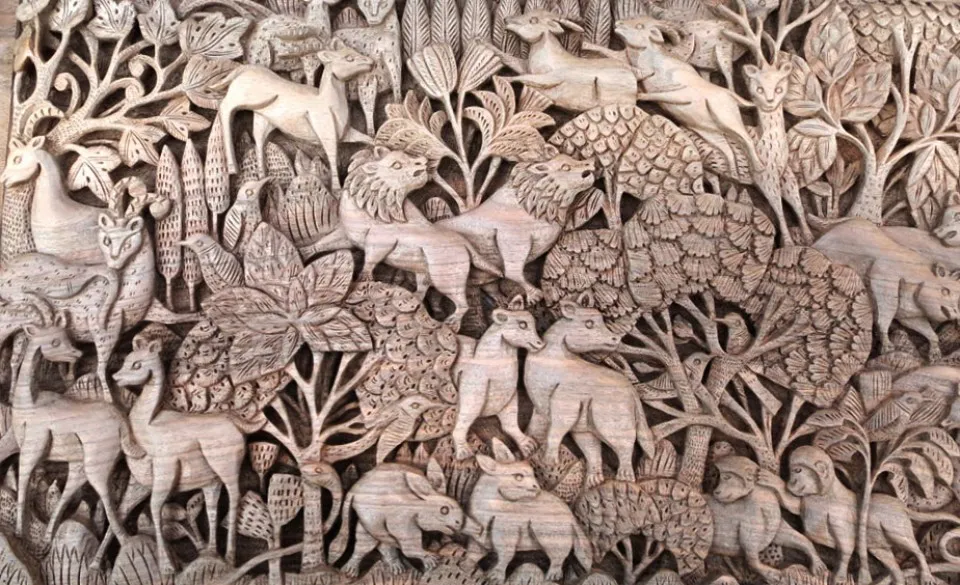
Style: Kashmir walnut wood carving is characterized by surface ornamentation executed through hand-carving techniques that range from shallow engraving to deep three-dimensional relief. The style draws from Persian, Central Asian, and Mughal decorative traditions while incorporating motifs derived from Kashmir's local flora, fauna, and landscape. The overall aesthetic tendency is toward dense surface coverage, with designs either filling the entire surface of an object or arranged as elaborate borders framing a central motif.
Six principal carving styles are documented:
Khokerdar (undercutting) involves carving beneath the surface to create a three-dimensional effect where the design appears to float above the background. This is considered one of the most technically demanding forms.
Vaboraveth (raised carving or deep carving) produces designs in high relief, with carved depth reaching up to five inches. This style is typically used for dragon motifs and large lotus compositions. Padri (engraving or semi-carving) features thin decorative panels along the rim of a surface with a central motif. It represents a moderate level of carving depth.
Jallidhar or Shabokdhar (open or lattice work) involves carving through the wood to create perforated geometric or chinar leaf patterns, producing a lattice effect. This technique is commonly applied to screens, window panels, and room dividers.
Dagakil (nail-textured work) creates surface texture using pointed tools, producing a stippled or hammered background effect.
Sadikaam (shallow or plain carving) involves minimal-depth surface treatment where motifs are chased along pencilled guidelines to produce subtle contours. This style is typically applied to larger flat surfaces. INTACH documentation notes that the Kashmiri walnut carving tradition is largely devoid of geometric patterns in the strict sense. Geometric work is primarily associated with Khatamband (interlocking pinewood ceilings) and Pinjrakari (wooden lattice screens), which are related but distinct craft traditions within the broader Kashmiri woodworking repertoire.
Central Motifs and Their Significance: The motif vocabulary of Kashmir walnut wood carving is drawn predominantly from nature and the regional environment. The Government of India's Incredible India portal and the Asia InCH (Encyclopedia of Intangible Cultural Heritage) document the following traditional design categories:
Gul Tarah (flower motifs): Includes depictions of rose, iris, daffodil, jasmine, lotus, and sunflower. The lotus holds symbolic significance associated with purity in both Hindu and Islamic artistic traditions prevalent in Kashmir. Bhoni Tarah (chinar motif): The chinar leaf (Platanus orientalis) is among the most recognizable symbols of Kashmir and appears across multiple Kashmiri craft traditions, including shawl weaving and papier-mache. Dach Tarah (grape motif) and Badam Tarah (almond motif): Represent the fruit-bearing trees of the Kashmir landscape.
Mavi Dahar (fruit-bearing tree motifs): Encompasses representations of apple, pear, and walnut trees. Janavar ti Jandhar Tarah (animal and bird motifs): Includes carvings of bulbul, parrot, dove, pigeon, fish, lion, deer, rabbit, horse, and snake. Jungle Tarah (jungle scenes): Composite compositions depicting forest landscapes. Scenery Dhar (landscapes): Panoramic depictions of Kashmiri scenery. Harfi Dhar (calligraphic motifs): Arabic, Persian, and Kashmiri verses. Taveez Dhar: Quranic verses applied to religious objects. Hashiyi Dhar (border motifs): Decorative frames and borders. Raiz Kari: Dense, fine floral work covering entire surfaces.
Additionally, dragon motifs (locally called lassi) and paisley patterns (kyam) drawn from Kani shawl designs are applied in deep relief carving. Shawl patterns and four-seasons compositions representing Kashmir's seasonal cycle also form part of the design repertoire. Kashmiri walnut carving features an estimated 160 or more documented patterns, including muraba, kansut, lakut, sarva, and badam variations.
Process: The production of walnut wood carved objects follows a structured sequence of stages involving multiple specialized craftspeople.
Timber Selection and Seasoning: Walnut trees used for carving are of the species Juglans regia. Four cultivated varieties are recognized: Wantu or Vont Dun (hard-shelled fruit), Dunu, Kakazi or Burzol (lightest shell, considered the best fruit variety), and Khanak (a wild variety). Traditionally, trees are harvested only once they have matured, a process that can take up to 300 years. Wood can be obtained from the root, trunk, or branches. Root wood is the most expensive, exhibiting an almost black colour with a pronounced grain. Trunk wood is lighter in colour, while branch wood is the lightest with minimal visible grain. The darker root-derived wood is considered ideal for carving due to its strength, though the use of branch wood has increased in recent decades due to raw material shortages. After felling, the wooden planks are numbered, dated, and stacked with air gaps between layers in shaded conditions to allow natural seasoning. This seasoning process takes between one and four years and is critical to preventing cracking and ensuring long-term stability of the finished product.
Carpentry: The seasoned wood is sent to a carpenter (locally called Chaan), who constructs the required object form, whether a box, table, chair, bed, panel, door, bowl, or other item. Individual pieces are assembled using standard joinery techniques, with hinge joints and dovetail joints being the most commonly employed.
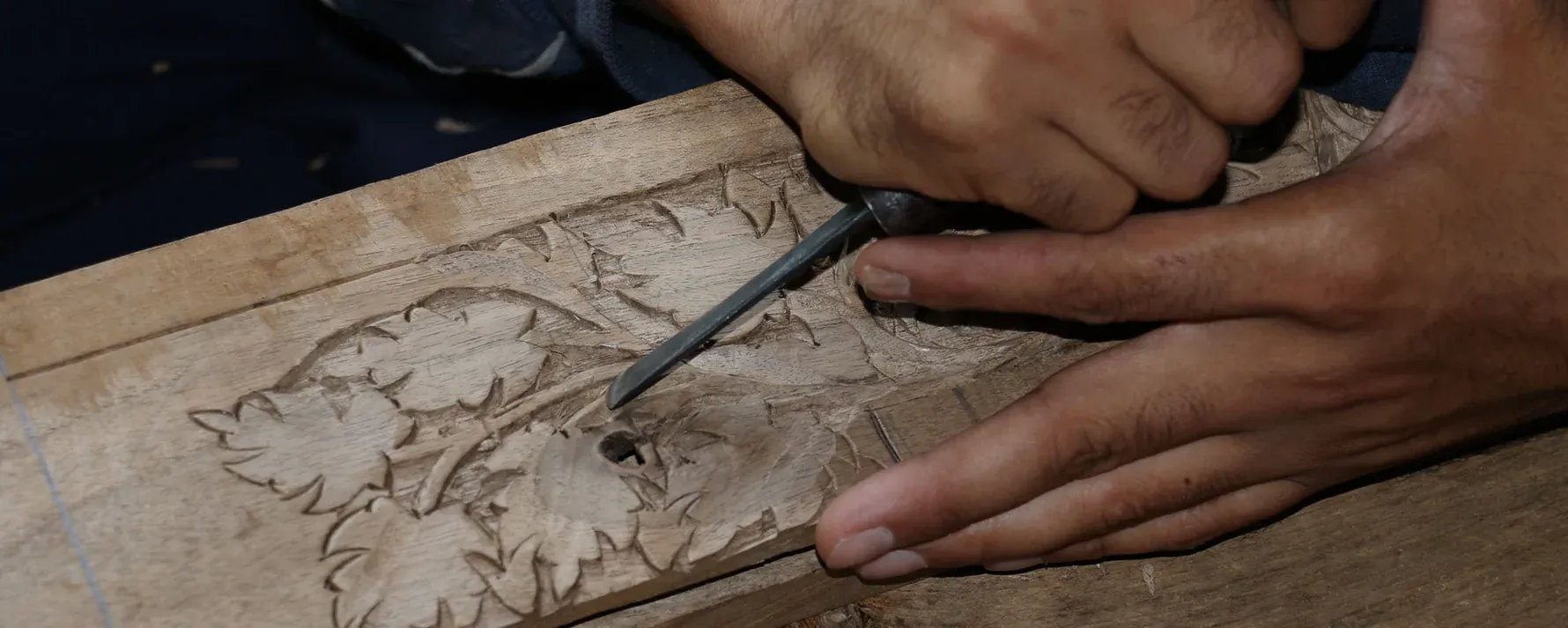
Carving: The master carver (Naqash or Wasta) receives the prepared object and begins by etching the basic pattern onto the wood surface, typically working from pencilled outlines. The first stage of carving, called Dagun, involves broadly delineating the motif from the surrounding surface. The second stage, Zamin Kadun, involves carving away the wood around the motif to establish the relief depth. Subsequent stages involve progressive refinement of detail. The traditional tools employed include chisels of various types (wathlavun), a planer (randha), measuring tape (phet gaz), an L-angle for obtaining parallel and perpendicular lines (khari hat), and a wooden scale (khat chhal). Depending on the complexity of the design, a single piece can require anywhere from two days to six months of continuous work.
Polishing: Walnut wood possesses a natural sheen that emerges through polishing. The finished carved surface is treated with wax or lacquer to bring out the wood's inherent lustre. No artificial colour or staining is typically applied, as the natural colour variation of the walnut wood itself forms part of the aesthetic.
Mediums Used: The primary medium is walnut wood (Juglans regia), locally known as Doon Kul. Walnut is the only wood used specifically for this GI-tagged craft tradition. The wood is valued for its hardness, durability, close grain, even texture, and natural resistance to insect damage. Kashmir is one of the few regions in India where walnut timber is available, and the region remains one of the limited global sources of carving-grade walnut wood.
The tools used are handmade and locally fabricated. The core toolkit consists of chisels of various profiles, a wooden mallet, a planer, a measuring tape, an L-angle, a wooden scale, gouges, and hand saws. Finishing materials include natural wax and lacquer. During the Mughal period, metal inlay was also used in combination with walnut wood, though this technique has largely fallen out of practice.
New Outlook
The contemporary situation of Kashmir walnut wood carving reflects a tension between continued market demand and structural challenges facing the craft. The GI tag awarded in 2012 and Srinagar's 2021 designation as a UNESCO Creative City represent formal institutional recognition that has raised the craft's profile nationally and internationally.
However, several challenges threaten the craft's long-term sustainability. The supply of quality walnut timber has diminished, forcing artisans to rely increasingly on branch wood rather than the traditionally preferred root and trunk sections. The declining number of young apprentices entering the profession has reduced the active workforce. Machine carving and mass-produced imitations, particularly those sourced from Saharanpur, have introduced price competition that undercuts traditionally made products.
The Jammu and Kashmir Handicraft Department operates training centres, provides exhibition opportunities for registered artisans at tourist locations, and maintains the State Crafts Emporium as a retail outlet. The department's School of Design and its associated Craft Museum serve as resources for artisans seeking to study traditional patterns and forms. The economic viability of the craft, however, remains dependent on sustained consumer interest in handmade products and effective mechanisms for distinguishing GI-certified Kashmiri walnut products from machine-made or non-Kashmiri alternatives.
Learn Walnut Wood Carving
Bibliography
Sources
Baharistanshahi. Translated by Kashi Nath Pandit, Firma KLM, 1991.
Bernier, François. Travels in the Mughal Empire, A.D. 1656–1668. Translated by Archibald Constable, 2nd ed., revised and edited by Vincent A. Smith, Oxford UP, 1916.
Dughlat, Mirza Haider. Tarikh-i-Rashidi. Edited with notes and commentary by N. Elias, translated by E. Denison Ross, Sampson Low, 1895.
Kashmir Under the Sikhs. By Dewan Chand Sharma, Seema Publications, 1983.
Kak, R. C. Ancient Monuments of Kashmir. Sagar Publications, 1971.
Lawrence, Walter R. The Valley of Kashmir. H. Frowde (Oxford UP), 1895.
Saraf, D. N. Arts and Crafts of Jammu and Kashmir: Land, People, Culture. Abhinav Publications, 1987.
Sufi, G. M. D. Kashir: Being a History of Kashmir from the Earliest Times to Our Own. 2 vols., University of the Panjab, 1948.
Younghusband, Francis. Kashmir. Adam and Charles Black, 1909.
Image Sources
INTACH Jammu and Kashmir Chapter. INTACH Jammu and Kashmir Chapter. WordPress, intachjkchapter.wordpress.com/. Accessed on April 30, 2026.
Rather, Babar. “Kashmir Walnut Wonders: Preserving the Craftsmanship of Doonhachi Kaem.” Village Square, 31 July 2023, villagesquare.in/kashmir-walnut-wonders-preserving-the-craftsmanship-of-doonhachi-kaem/. Accessed on April 30, 2026.
“Walnut Wood Carving (Part 1).” Kashmir Box, 3 July 2014, www.kashmirbox.com/blogs/craft/walnut-wood-carving-part-1. Accessed on April 30, 2026.
“Walnut Wood Carving from Jammu and Kashmir.” Medium, Direct Create Community, 15 Oct. 2016, medium.com/direct-create/walnut-wood-carving-from-jammu-and-kashmir-59284fbeea6e. Accessed on April 30, 2026.