


Varanasi Wood Carving - The Handicraft Tradition of Uttar Pradesh
Explore Varanasi Wood Carving, the handicraft tradition of Uttar Pradesh, and learn about its origins, techniques, cultural significance, and artistic heritage.
Introduction
Varanasi wood carving is a traditional craft practiced in the city of Varanasi, Uttar Pradesh, in which artisans shape, carve, and lacquer wood into toys, figurines, decorative objects, and religious items. The craft encompasses two related but distinct production streams: lacquerware and wooden toys made on a lathe and by hand carving, and more elaborate carved wooden objects including panels, architectural elements, and sculptural figures. The Geographical Indication tag for Varanasi Wooden Lacquerware and Toys was awarded on 30 March 2015 to cooperatives including Balaji Handicrafts Cooperative Society Limited and Khilauna Udyog Sahkari Samiti Limited, both based in Varanasi.
Etymology The craft is locally referred to as 'Kashi kala,' meaning 'the art of Kashi,' Kashi being the ancient name of Varanasi. The word 'Kashi' derives from the Sanskrit root 'kas,' meaning 'to shine.' The specific designation 'Varanasi Wooden Lacquerware and Toys' reflects the official GI-registered product name used by government bodies and craft cooperatives.
Origin The origins of the craft are not precisely documented. Artisans of the Kharadi community trace their genealogy in woodworking to the Mughal period of the 17th century, during which craftsmen in the region are reported to have received patronage from the Mughal court for ivory carving. Following the Government of India's ban on ivory trade in 1986, practitioners of the Kunder Kharadi Samaj transitioned to wood as their primary material. Some artisans also cite oral tradition connecting the craft to earlier periods, though these accounts are not independently documented in historical records.
Location Varanasi, Uttar Pradesh, with primary production concentrated in the neighborhoods of Khojwa (also spelled Khojwan) and Kashmiri Ganj. Mirzapur, a neighboring district, also has documented wooden lacquerware production associated with this tradition.
Community The Kunder Kharadi Samaj, also referred to as the Kharadi community, is the primary artisan community associated with Varanasi wood carving. The craft is transmitted intergenerationally within Kharadi families. The community maintains a notable cultural practice: when a child is born into an artisan family, a new lathe is added to the household's possessions, marking the continuation of craft succession. Additionally, during marriage arrangements, the groom's family confirms that the prospective bride is familiar with lathe work, indicating the craft's integration into family and social organization. Approximately 3,000 toymakers are reported to work in Khojwa alone.
Relevance The Varanasi Wooden Lacquerware and Toys GI tag covers the craft as both a functional and cultural product category. The craft holds a vulnerable status due to competition from mass-produced plastic toys and imported goods, declining intergenerational transmission among younger artisans, and fluctuating access to quality timber. Government bodies including the Office of the Development Commissioner (Handicrafts), Ministry of Textiles have documented and promoted the craft through exhibitions and cooperative support.
History
Background Documented historical references to the craft's origins remain limited. The most consistently referenced historical connection is to the Mughal period of the 17th century, when artisans in Varanasi worked with ivory under royal patronage. After the Indian government banned ivory trade in 1986, many families in the Kharadi community shifted their skills to working with wood. The neighborhood of Kashmiri Ganj has been a documented center of the craft for multiple generations, and the localities of Khojwa and Kashmiri Ganj are named as the primary craft clusters in official government records including the GI registration certificate. James Hornell's early 20th century surveys of Indian crafts noted significant wood and lacquerware production traditions in Uttar Pradesh, though the specific documentation of Varanasi's toy-making clusters in formal scholarship is limited. The British India period saw the craft receiving patronage from traveling traders, and later from the tourism economy that grew around Varanasi's status as a major pilgrimage and cultural destination.
Culture and Societies The Kharadi community's craft practice is deeply embedded in social structures. The birth ritual of adding a new lathe to family possessions reflects the view of woodworking as an inherited obligation rather than merely an economic activity. The craft has historically been led by male artisans, with women contributing to painting and packaging. Since the early 2000s, organized training programs led by artisan collectives including those under Uday's initiative in Khojwa have specifically targeted women within the community for skill development, covering sourcing, carving, and finishing.
The craft's market geography is concentrated around the pilgrimage and tourism economy of Varanasi. Local shops and workshops are clustered near Dashashwamedh Ghat and Kashi Vishwanath Temple, where artisan production is directly accessible to visitors. The artisan cooperative Balaji Handicrafts Cooperative Society Limited, which holds GI authorization, includes National Award-winning master craftsmen within its membership.
Religious Significance The wooden toys and carved objects produced in Varanasi have documented connections to Hindu religious practices. Carved wooden idols, including figures of Ganesha, Krishna, Shiva, and other deities, are produced for domestic worship and temple use. Major festivals including Durga Puja, Ganesh Chaturthi, and Diwali drive seasonal demand for wooden idols. The auspicious nature of the craft within artisan families is marked by the birth ritual described above, linking the lathe to family prosperity and continuation. The ritual significance of the objects produced extends their function beyond purely decorative or commercial purposes.
Understanding the Art
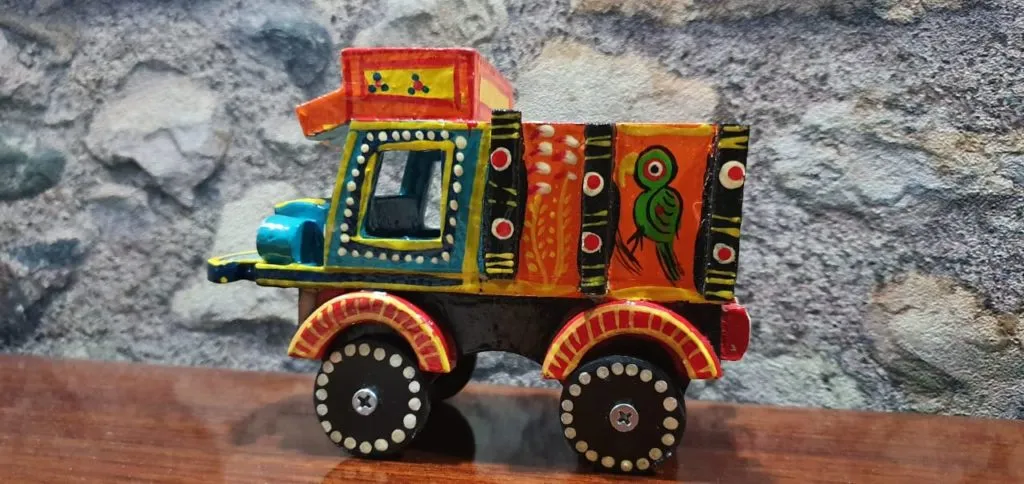
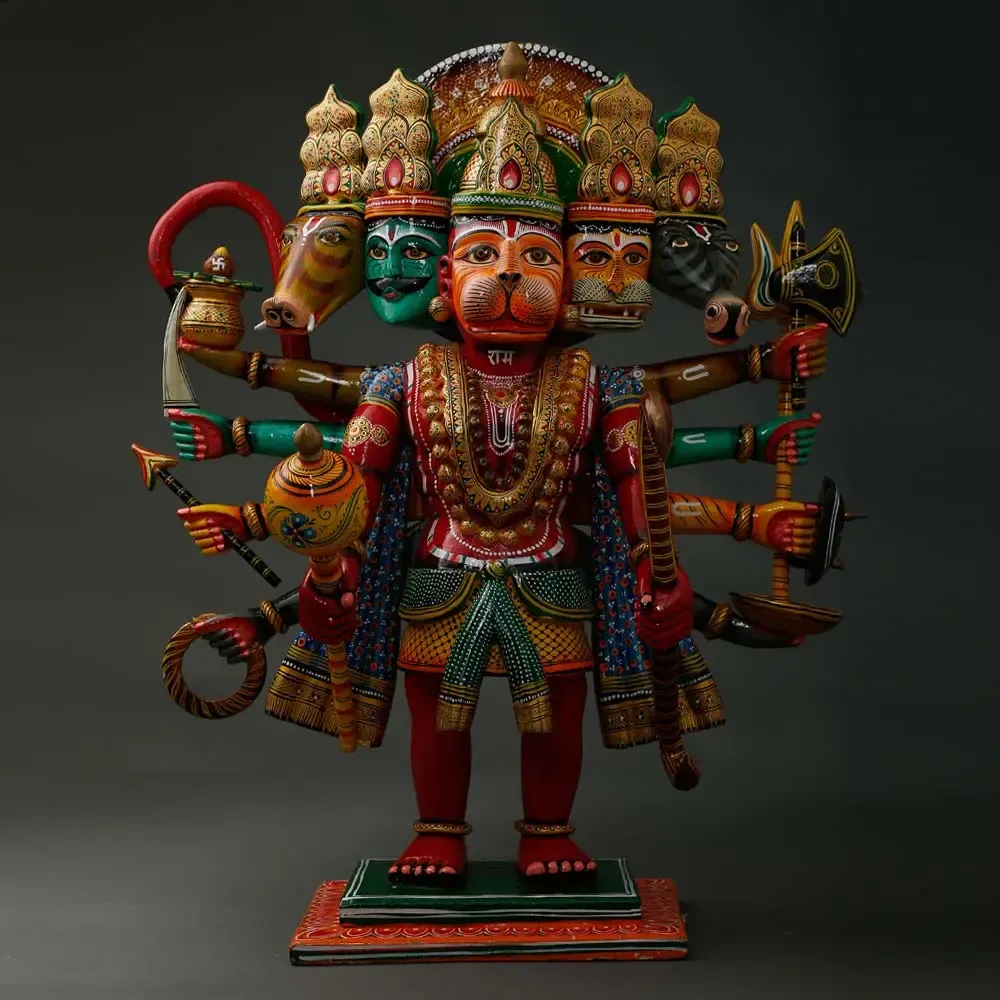
Style Varanasi wood carving encompasses two principal stylistic registers. The first is the lacquered toy tradition, characterized by bright primary colors applied in multiple coats over turned or hand-carved wooden forms. These toys are noted for being made without joints, a feature that distinguishes them from assembled toy-making traditions elsewhere. The forms include spinning tops, dolls, animals, vehicles, and human figurines. The second register includes more elaborately carved objects such as decorative panels, furniture elements, architectural details, and religious sculptures. These are rendered in a style reflecting local mythological and cultural sources, including figures from the Ramayana and Mahabharata.
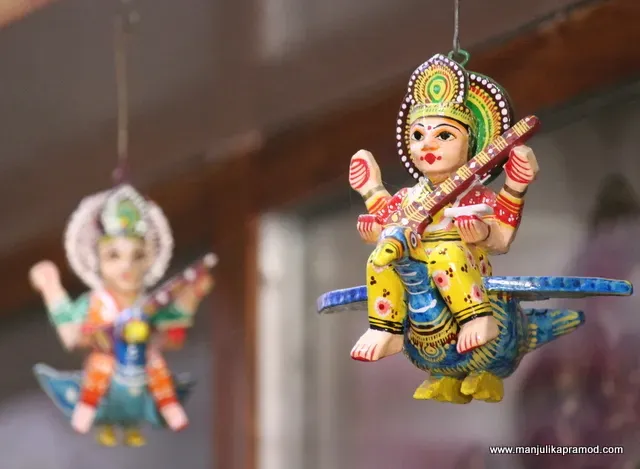
Central Motifs and Their Significance The primary motifs in Varanasi wood carving derive from Hindu mythology, rural life, the natural world, and Varanasi's specific cultural iconography. Carved figures of deities including Ganesha, Krishna, Lakshmi, Saraswati, and Shiva are standard production items. Animal figurines encompassing elephants, horses, peacocks, and cows are among the most common toy forms. Mythological scenes from the Ramayana and Mahabharata are rendered on decorative objects and panels. The craft also produces secular forms including miniature architectural models of Varanasi's ghats and temples. The lacquered toy designs incorporate symbolic color usage: bright and primary colors are used consistently to signal celebration and auspiciousness.
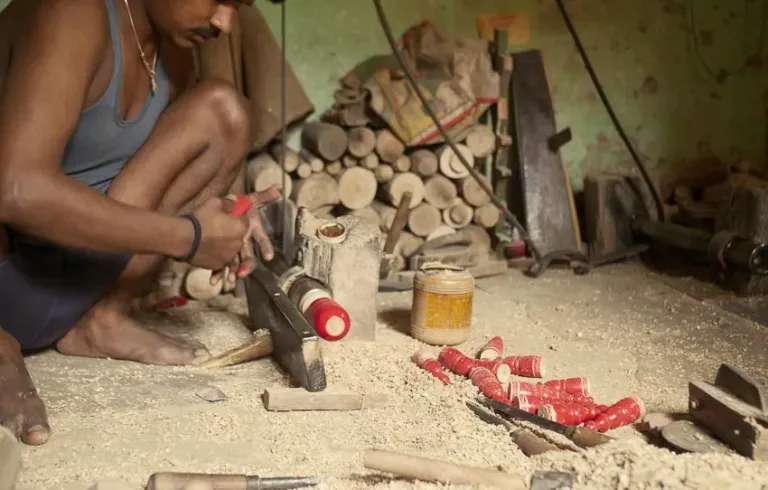
Process The production process begins with the selection and preparation of wood. Logs are cut into pieces sized for the intended object and then slowly heated to remove residual moisture, a time-consuming step considered critical for preventing later cracking. The dried piece is then sanded to achieve a smooth surface. For lathe-turned objects, the wood piece is mounted on a lathe and shaped by the artisan using chisels and gouges. Lacquering may be applied directly on the lathe: a lac stick is pressed against the rotating object, and the heat generated by friction softens the lac, causing it to adhere to the surface. For hand-carved objects, the design is first drawn on the wood, then shaped using a chisel and mallet. After shaping, the surface is smoothed with a file. Both methods then proceed to painting. Multiple coats of paint are applied, typically beginning with a white base coat over a distemper layer. Fine detailing is done using paint brushes made from squirrel tail hair. A final coat of clear or colored lacquer is applied to seal and finish the surface.
Mediums Used Primary Wood Species: Historically, sal (Shorea robusta) and sheesham (Dalbergia sissoo) were the standard materials. Due to rising timber costs, artisans increasingly use lighter and cheaper locally available woods including mahua, mango, eucalyptus, kemah, chilbil, and haldu. Lac: Natural lac is used for lacquering. It is pressed against the rotating object on the lathe, adhering through friction-generated heat. Paints and Pigments: Duco white paint is used as a base coat. Colored pigments are applied in successive layers. Brushes made from squirrel tail hair are used for fine line work. Tools: Lathe, chisels, mallets, files, gouges, and circular saws are the principal tools. A cemented circular saw platform embedded in the workshop floor is a standard feature of production households.
New Outlook
The craft sector faces documented economic pressures from plastic toy imports and machine-made alternatives that compete on price. The GI tag awarded in 2015 has provided a legal framework for distinguishing authentic Varanasi lacquerware from imitations, and cooperative structures provide artisans with access to larger markets including government craft emporiums and export channels. Organizations in Khojwa have initiated training programs specifically oriented toward women artisans, seeking to expand the skilled workforce within the community. Additionally, tourism-driven demand from Varanasi's pilgrim and cultural visitor economy continues to provide a retail base for the craft. Artisan-run enterprises including Namrata Wooden Handicrafts, operated by the Ramchandra family, have built recognition through national and state craft award systems. However, the vulnerability classification of the craft reflects ongoing concerns about raw material access, artisan wages, and the pace of skill transmission to the next generation.
Learn Varanasi Wood Carving

Bibliography
Sources
Bain, W. K. “Bishnupur: A Town of Cultural Excellence.” Journal of the Anthropological Survey of India, 2016.
Government of Uttar Pradesh, and Controller General of Patents, Designs and Trade Marks (CGPDTM). GI Registration Certificate: Varanasi Wooden Lacquerware and Toys. 30 Mar. 2015.
Mukharji, T. N. Art Manufactures of India. 1888.
Office of the Development Commissioner (Handicrafts), Ministry of Textiles, Government of India. Crafts of Uttar Pradesh. Various editions.
Image Sources
Khanna, Antima. “Artistic Carving in Varanasi.” Antima Khanna, 25 Sept. 2023, https://antimakhanna.com/artistic-carving-in-varanasi/. Accessed on May 05, 2026.
Nighoskar, Devyani. “The Transformative Art of Wood Toy Carvers in India’s Varanasi.” New Lines Magazine, 17 Sept. 2021, https://newlinesmag.com/photo-essays/the-transformative-art-of-wood-toy-carvers-in-indias-varanasi/. Accessed on May 05, 2026.
Pramod, Manjulika. “Wooden Toy Makers of Varanasi.” Manjulika Pramod, https://www.manjulikapramod.com/travel/wooden-toy-makers-of-varanasi/. Accessed on May 05, 2026.