

Leather Puppet/ Tholu Bommalata - Explore Handicraft Collection
Explore Tholu Bommalata, the handicraft tradition of Andhra Pradesh, and learn about its origins, techniques, cultural significance, and artistic heritage.
Introduction
Introduction: Tholu Bommalata is a form of shadow puppetry originating in Andhra Pradesh, India, in which large articulated leather puppets are manipulated behind a backlit white screen to enact narratives drawn primarily from Hindu epic literature. The name derives from three Telugu words: tholu meaning leather, bomma meaning puppet or doll, and aata meaning play or dance, yielding the composite meaning "the dance of leather puppets." Andhra Pradesh's leather puppets and related craft products received a Geographical Indication (GI) tag in 2008, registered under India's Geographical Indications of Goods (Registration and Protection) Act, 1999. The tradition is currently classified as an endangered art form, with only a small number of active performance troupes documented as of the 2020s.
Etymology: The three component words of the art form's name are all of Telugu origin. Tholu denotes leather or hide. Bomma denotes a puppet, figurine, or doll. Aata denotes play, dance, or game. The compound is variously transliterated in documentation as Tholu Bommalata, Tolu Bommalata, Tholu Bommalaata, and Tholu Bommalattam, with regional and orthographic variation, but the constituent meanings remain consistent across all sources. The performers as a collective have historically been referred to as bommalata vallu, a hereditary occupational designation.
Origin: The earliest textual reference to leather puppet performance in the Telugu literary tradition is found in the thirteenth-century Telugu text Panditaradhya Charitra, as documented by the MAP Academy Encyclopedia of Art. Inscriptions from as early as 1208 CE also contain references to shadow puppetry in southern India, with records indicating the prestige accorded to master puppeteers through documented gifts they received. These inscriptional records provide the earliest datable evidence for a formalised tradition of the kind that Tholu Bommalata represents.
The broader Indian shadow puppetry tradition, of which Tholu Bommalata is a part, is associated by scholars with the Satavahana and Chalukya dynastic periods, covering the fourth through sixth centuries CE. The MAP Academy notes that this is the period during which shadow theatre from South India is considered to have spread toward Southeast Asia. The Wikipedia article on Tholu Bommalata, drawing on regional historical records, notes that shadow puppetry was in practice during the Satavahana period, which spans the second century BCE to the second century CE, though the relationship between this earlier practice and the formalised Tholu Bommalata tradition as currently understood is not established with documentary precision.
A distinct phase of the tradition's development is associated with the eighteenth century, when groups of performers originating from present-day Maharashtra migrated to the regions of Karnataka, Telangana, and Andhra Pradesh. The MAP Academy, the Sarmaya Arts Foundation documentation, and the Crafts Council of Andhra Pradesh all note this migration as formative for the modern form of Tholu Bommalata. These groups are identified by their use among themselves of Aare, a Marathi dialect, while using Telugu or Kannada in performance contexts.
Location: Tholu Bommalata is concentrated in the Anantapur, Guntur, and Nellore districts of Andhra Pradesh, as documented by the MAP Academy. The primary contemporary centre is Nimmalakunta village in the Anantapur district, specifically in Dharmavaram Mandal. Additional documented centres include Narsaraopet in Guntur district and D.C. Palle in Nellore district. The craft and performance tradition also has a presence in parts of Telangana, and the closely related forms of togalu gombeyaata in Karnataka and tolu bommalatam in Tamil Nadu share historical and community roots with Tholu Bommalata.
Community: The practicing community of Tholu Bommalata is identified in the MAP Academy Encyclopedia of Art and related institutional documentation as the Aare Kapu community. Members of this community use Aare, a Marathi dialect, among themselves. The Crafts Council of Andhra Pradesh and the Lepakshi Handicrafts government portal identify the primary community at Nimmalakunta as the Marathi Balija. Some practitioners identify themselves with the Chitrakar caste, which is also associated with performative painting traditions in Bengal and Odisha. The artisan Sriramulu, a National Award recipient for leather puppet-making and a fourth-generation practitioner at Nimmalakunta, identifies his community as Chitrakara in documented interviews.
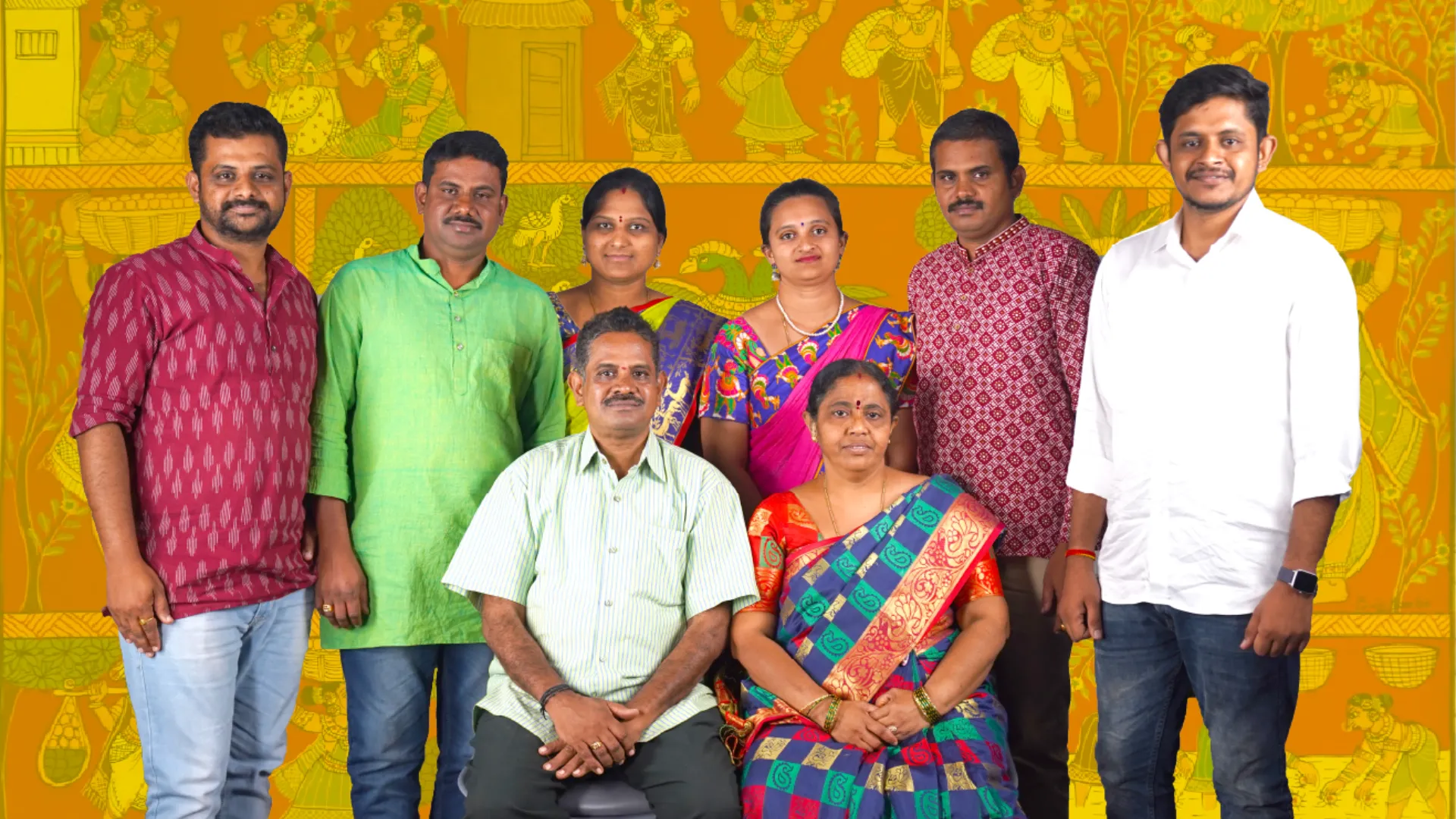
Tholu Bommalata is a hereditary craft transmitted patrilineally within family troupes. A performance troupe typically consists of the head of the family as lead puppeteer, accompanied by two or three other performing members including at least one or two women, and up to five or six additional members including younger family members undergoing training and performing subsidiary duties. The division of labour within the troupe covers puppet manipulation, singing, narration, instrument playing, and the physical management of the performance space.
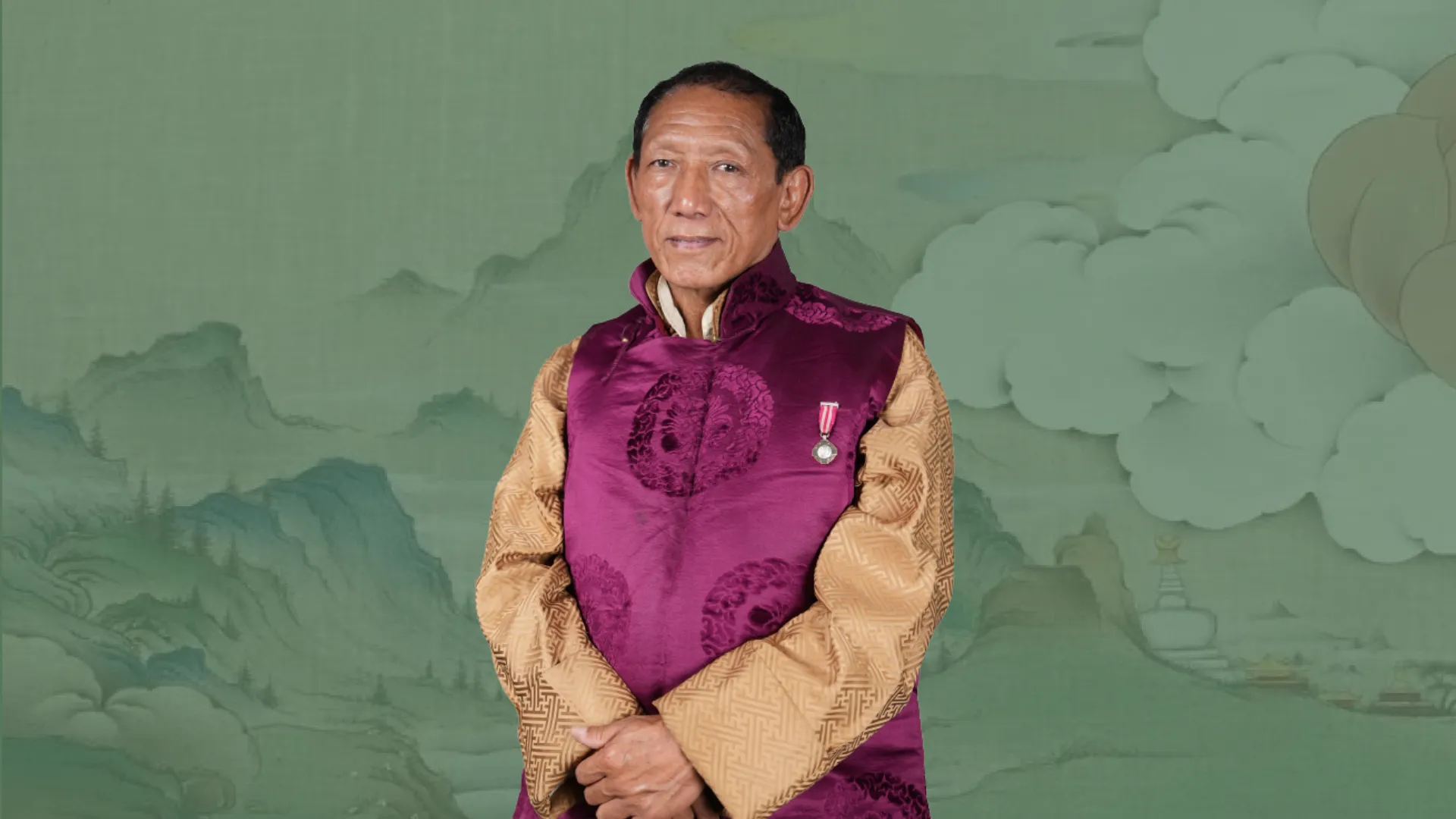
Relevance: Tholu Bommalata holds documented recognition as an endangered intangible cultural heritage with national-level institutional acknowledgement. The GI tag awarded in 2008 provides legal protection to the craft objects associated with the tradition, including puppets and derived decorative products. The Andhra Pradesh government promotes the craft through Lepakshi Handicrafts, the state's official handicrafts marketing agency. Padma Shri recognition was awarded to D. Chalapathi Rao, a leather puppeteer from Nimmalakunta, in 2020, representing the highest civilian recognition accorded to a practitioner of this tradition. The Indira Gandhi National Centre for the Arts has documented performances, including a puppet show on the Sundar Kanda of the Ramayana presented by the Anjaneyulu shadow puppet theatre of Andhra Pradesh. Despite these recognitions, the MAP Academy documents that the GI tag has had limited practical impact on revitalising the performance tradition, and decline has continued since the 1970s.
History
Background: The performance of Tholu Bommalata was historically sustained through royal and temple patronage. The Pallava, Chalukya, and Vijayanagara dynasties are documented as patrons of the shadow theatre tradition. The MAP Academy notes that the Vijayanagara ruler Krishnadevaraya was among the documented patrons of shadow theatre. Between the thirteenth and fifteenth centuries, the tradition reached what multiple sources describe as its period of greatest vitality. The sixteenth-century Ranganatha Ramayana, composed by Gona Budda Reddy under the Kakatiya dynasty, was written specifically as a performance text for shadow puppeteers. Most scholars date the composition of this work to between 1200 and 1310 CE, with most scholars placing the work between 1200 and 1210 CE. The text is in the Telugu dwipada meter, which is suited both for recitation as poetry and for performance with musical accompaniment, and it contains scene-by-scene narrative detail along with information on the colours in which puppets must be painted.
The mid-fourteenth-century establishment of the Bahmani Sultanate introduced Islamic artistic influences into the visual conventions of the puppets, which the Sarmaya Arts Foundation documentation identifies as contributing to the addition of colourful garments, sumptuous ornamental detail, and long beards on male figures. This influence is visible in the puppet aesthetics as documented in institutional art collections.
From the 1970s onwards, the tradition experienced sustained decline. The MAP Academy and multiple press and institutional sources document that financial constraints drove puppeteers away from performance toward agricultural labour and craft production. Competition from cinema, radio, and television removed the rural audience base that had historically sustained the tradition. As of documented counts in the 2020s, approximately nine active troupes remain, with fewer than twenty families engaged in full performance activity.
Culture and Societies: Tholu Bommalata historically functioned as the primary medium for the oral transmission of epic narratives to rural and non-literate populations across Andhra Pradesh. Performances, which traditionally lasted four to eight hours or more per night and continued over multiple evenings for the completion of a full narrative, were communal events that drew audiences from surrounding villages. The tradition served both as entertainment and as a vehicle for the transmission of moral, ethical, and devotional content embedded in the Ramayana and Mahabharata.
The performance troupe historically operated as wandering entertainers, travelling from village to village for weeks at a time. Compensation was traditionally received in kind, including rice, coconut, vegetables, and pulses. This mode of itinerant performance sustained the tradition through pre-modern rural economies but became economically unviable as cash economies developed and alternative entertainment became widely accessible. The shift of many artisan families at Nimmalakunta toward the production of decorative craft items including lampshades, wall hangings, jewellery, and household objects represents a documented adaptive response to the collapse of the performance economy.
Religious Significance: Tholu Bommalata is directly associated with Lord Shiva as the primary deity of the tradition. The MAP Academy Encyclopedia of Art documents that performances are conducted at religious festivals, most prominently Maha Shivaratri, in honour of Shiva. Performances traditionally take place through the night in association with such festivals. The performance structure begins with formal invocations of Ganesha and Saraswati, represented by their respective puppets. A short introductory skit featuring comedic characters, specifically Bangarakka, Jettupoligatu, and Ketigadu, precedes the main narrative and includes offerings of tribute to patrons, organisers, and audience members.
The puppets used to represent deities are accorded ritual significance. The MAP Academy and related documentation note that when a puppet representing a deity has been retired from use, it is traditionally given a formal concluding ritual in which it is immersed in the waters of a sacred river, a practice analogous to the ritual disposal of consecrated objects in several Hindu traditions. Skin selection for puppet construction has historically followed hierarchical conventions aligned with the character's religious status: antelope skin for principal deities and epic heroes, deer skin for warriors such as Bhima and Ravana due to its strength and durability, and goat skin for the majority of other figures.
Understanding Of Style
Style: The visual style of Tholu Bommalata puppets is documented as deriving directly from the mural tradition of the Virabhadra Temple at Lepakshi in the Anantapur district of Andhra Pradesh. The Lepakshi murals, which date to the sixteenth century, are the established stylistic source for the conventions of character depiction in the puppets, including colour application, profile orientation of figures, ornamental detail, and character-specific iconographic markers. The MAP Academy and the Crafts Council of Andhra Pradesh documentation all identify this temple as the definitive aesthetic reference for the tradition.
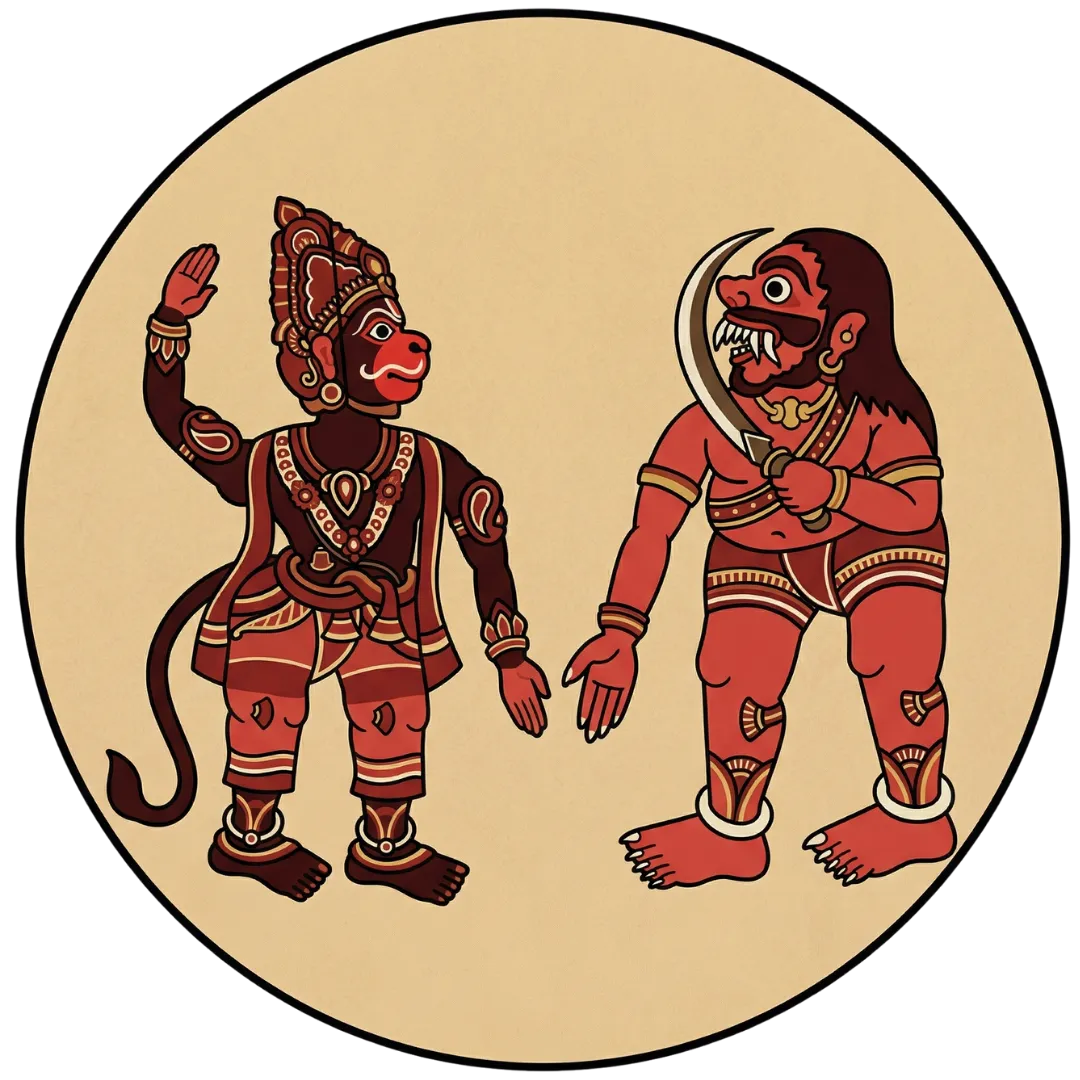
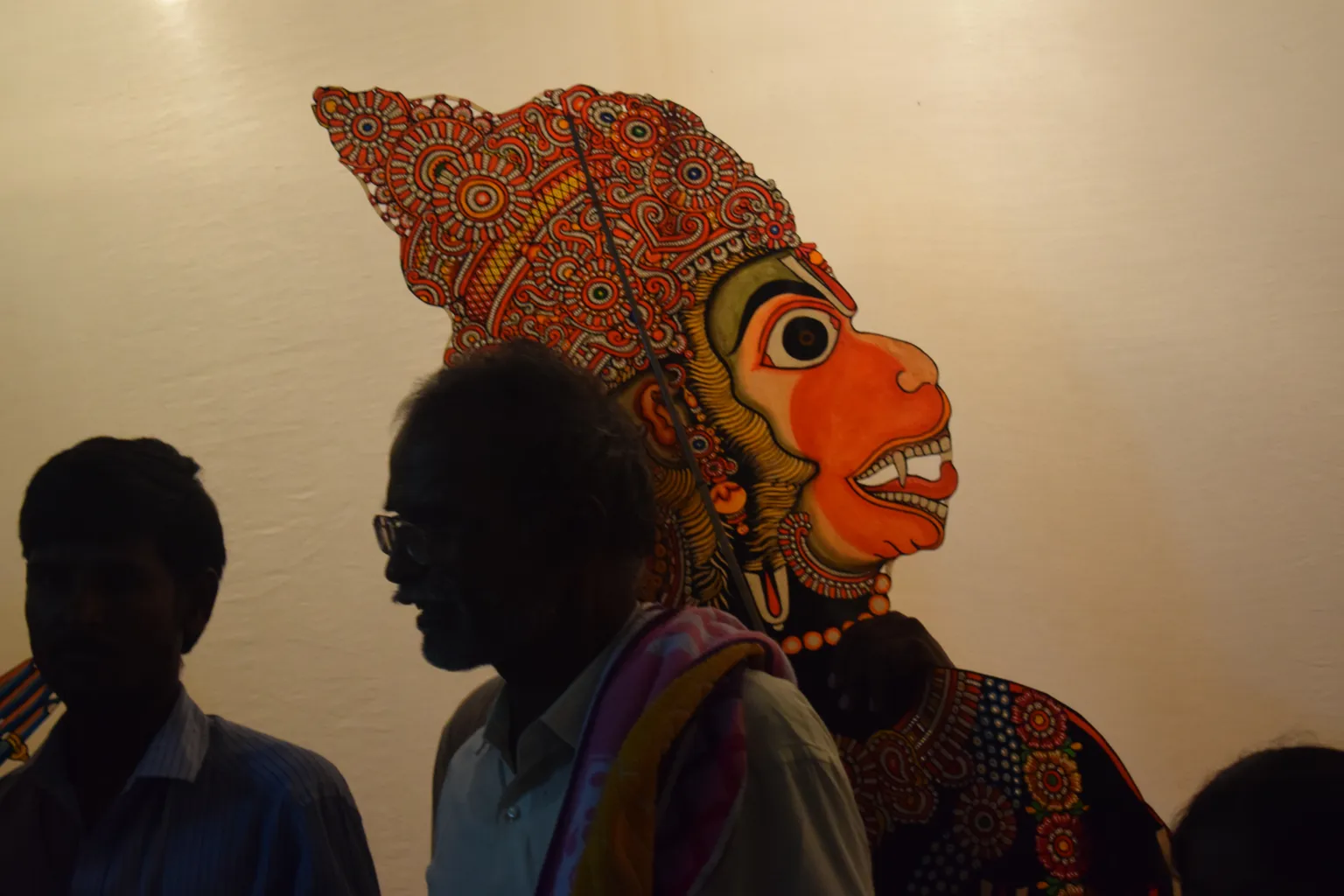
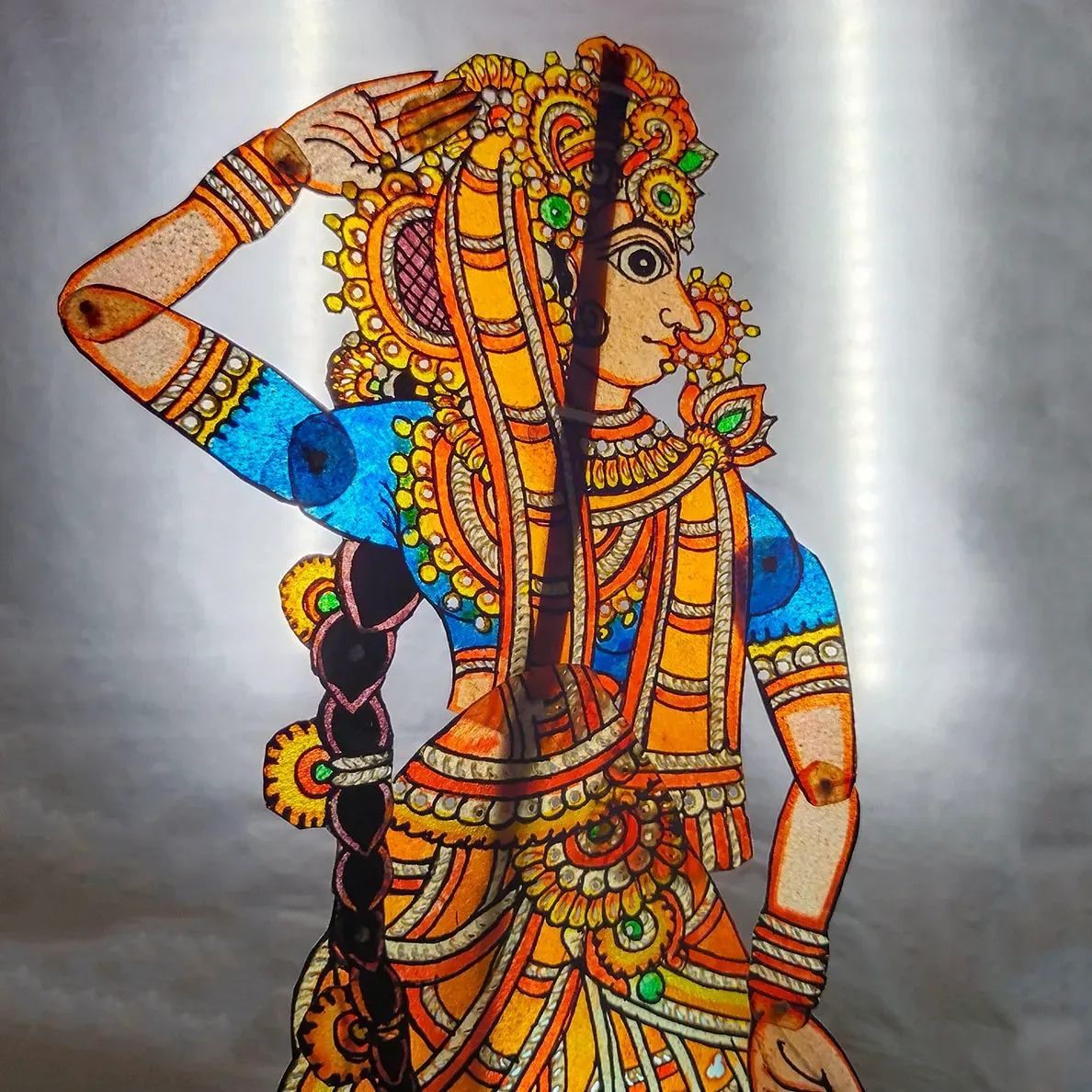
Puppets are characterised by wide, circular eyes. Most human figures are rendered in profile. Clothing, hairstyle, and ornamentation follow documented iconographic conventions that allow audiences to identify characters and their roles within the narrative. Immoral characters are conventionally depicted without clothing. The head covering or hairstyle of a character varies depending on whether the character occupies a royal or ascetic role within a given episode. The colour scheme follows specific conventions for principal characters: the colours applied to figures such as Rama and Krishna adhere to established iconographic rules. The overall visual effect of Islamic influence is visible in the ornamental treatment of garments and jewellery on puppets developed during or after the Bahmani Sultanate period.
Tholu Bommalata puppets are among the largest shadow puppets in South Asia, typically ranging from one to two metres in height, with ensemble sets including both larger and smaller figures. The Hanumana character in a Ramayana ensemble is documented as having four puppet versions, ranging from approximately fifteen centimetres to two hundred and fifty centimetres in height, corresponding to different narrative situations.
Central Motifs and Their Significance: The primary narrative sources for Tholu Bommalata are the Ramayana and the Mahabharata. From the Ramayana, key episodes include Rama's forest exile, the abduction of Sita, the war in Lanka, and the defeat of Ravana. From the Mahabharata, pivotal episodes of conflict and its resolution are enacted. The Ranganatha Ramayana of Gona Budda Reddy (composed between approximately 1200 and 1310 CE) is the most directly associated literary text, written specifically for shadow performance. Vemulapati's Bharatham is cited in documentation as a corresponding performance text for Mahabharata episodes.
Principal characters in documented ensembles include Rama, Sita, Lakshmana, Hanumana, Ravana, Bhima, Arjuna, and attendant divine, warrior, and demonic figures. The ten-headed Ravana is among the most technically demanding puppets to construct and manipulate: at least four separate skins are required for a single Ravana puppet, comprising one for the body, one for the legs, and one for each set of five arms. Composite unarticulated puppets depicting multiple figures, animals, birds, and scenic elements are also part of a complete ensemble.
The comedic characters Bangarakka, Jettupoligatu, and Ketigadu are specific to the Tholu Bommalata performance tradition and appear in the introductory skit before the main narrative. These characters serve to establish rapport with the audience and to acknowledge patrons and local organisers.
Process : The construction of Tholu Bommalata puppets involves a multi-stage process documented across institutional and scholarly sources.
First, skin selection and preparation: The skin is selected according to the character to be made, with goat skin being the most widely used in contemporary practice. After the skin is acquired, it is shaved and cleaned to remove hair and surface material. It is then treated with herbs and beaten repeatedly to render it thin enough to transmit coloured light in shadow projection. After beating, the skin is stretched flat and dried to prevent wrinkling.
Second, outlining and cutting: The character's form is drawn onto the prepared skin following iconographic conventions. The outline is then cut with a pointed iron chisel called a pogaru, which is also used to create the perforations and decorative holes within the figure. These perforations allow points of light to pass through the puppet when it is held against a backlit screen, producing the distinctive glittering effect visible in performance.
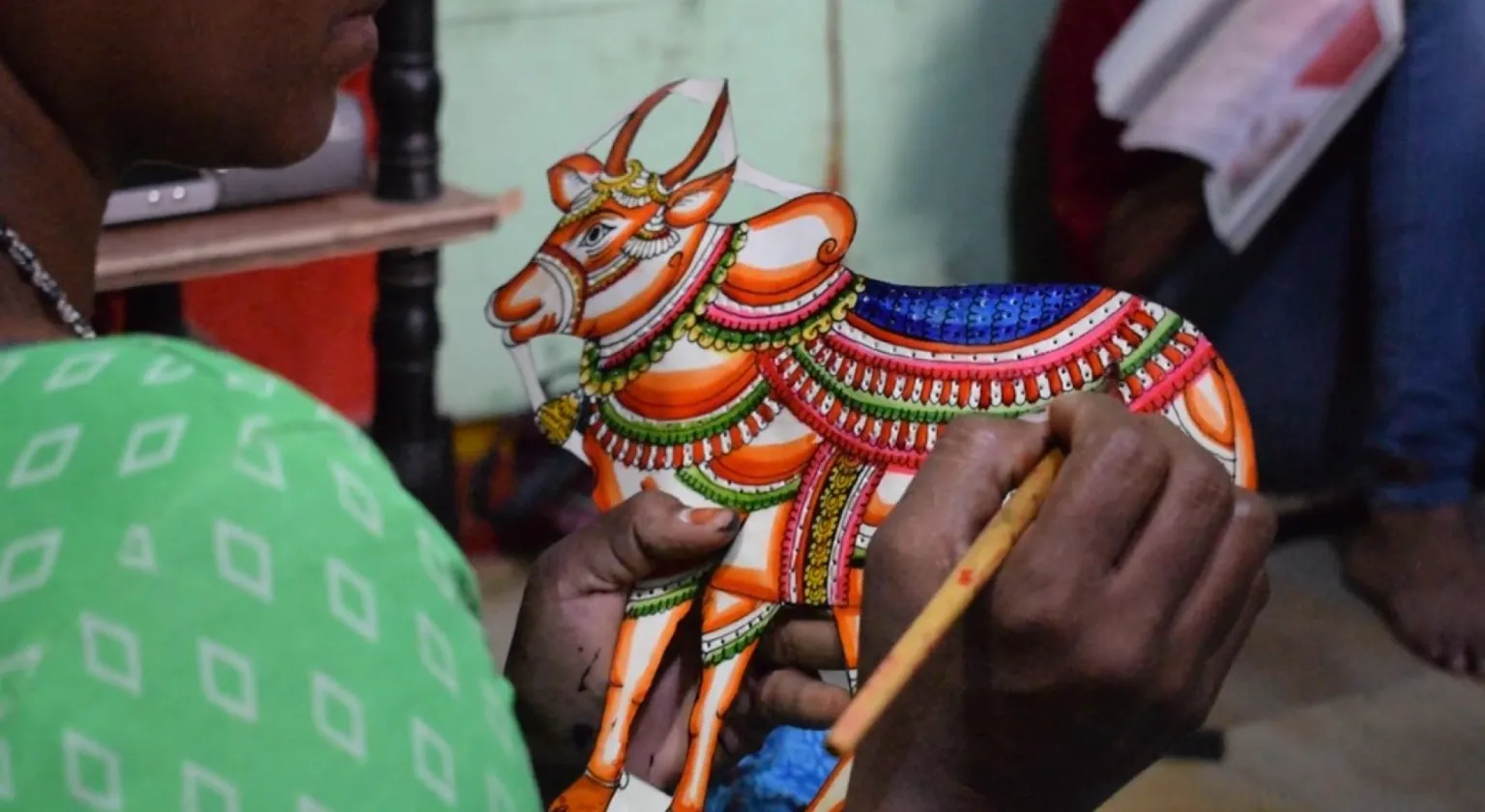
Third, painting: Both sides of the puppet are painted, enhancing the coloured shadow projected onto the screen. Natural vegetable dyes have traditionally been used, including brilliant red, green, white, yellow, brown, and orange. Iconographic colour conventions are strictly observed for principal divine figures. In contemporary practice, synthetic waterproof paints are also used, particularly for decorative craft products.
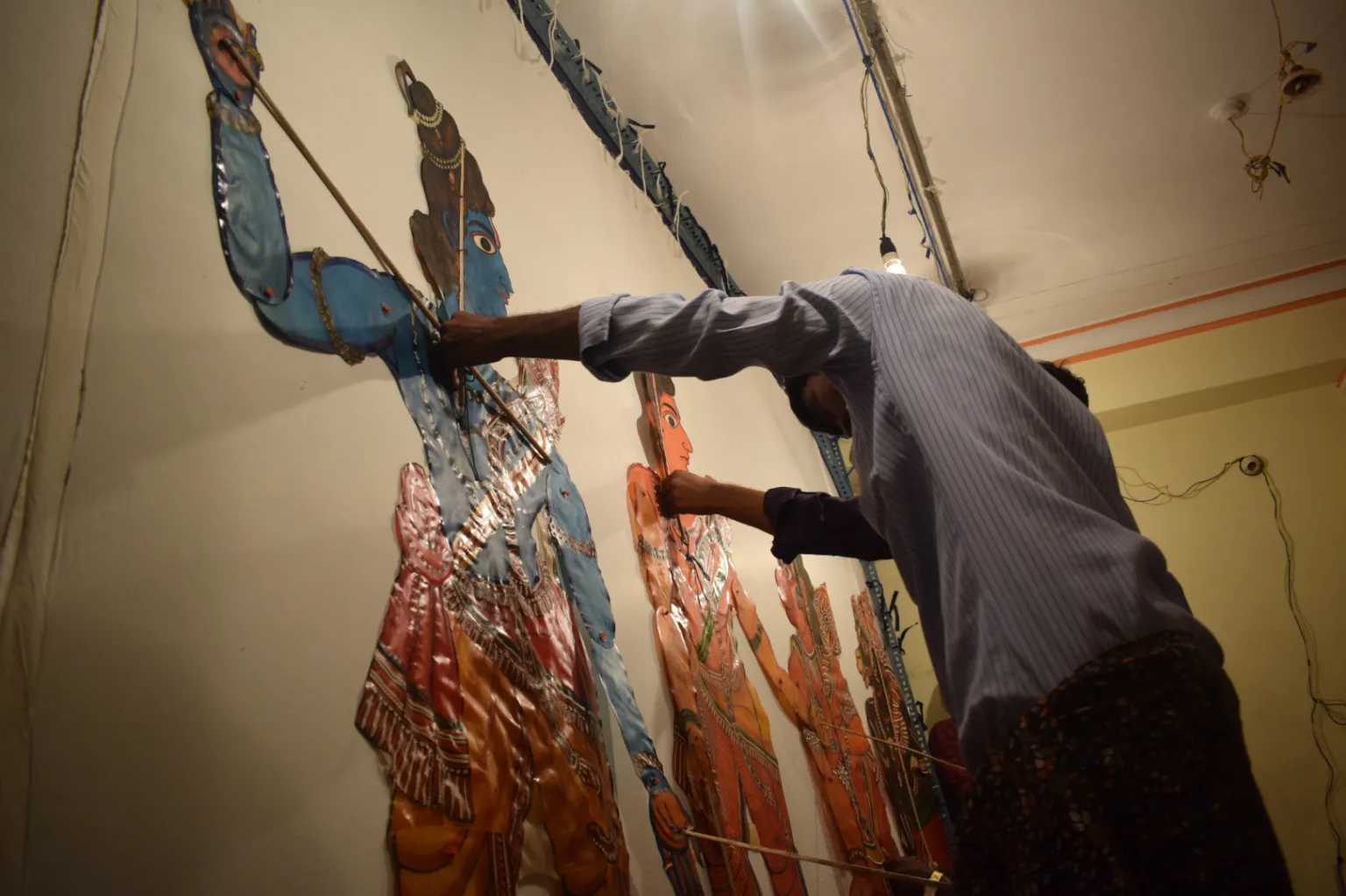
Fourth, framing and assembly: A central vertical bamboo rod is inserted through the puppet to provide rigidity and to serve as the primary manipulation handle. Additional sticks are attached to the articulated limbs, typically the hands, to allow individual movement. Articulated joints are created at the shoulders and hips where separate pieces of skin are attached, enabling movement of the arms and legs during performance.
Fifth, performance setup: the performance screen is a fine white cloth, documented at approximately twelve by nine feet in the documentation from IIT Bombay, raised to approximately one and a half metres above the ground. The lower portion of the performance area is covered with dark cloth to conceal the standing puppeteers. Lighting is provided from behind the puppeteers, traditionally using rows of oil lamps, which have largely been replaced by gas lanterns or electric lights. By adjusting the distance of a puppet from the light source, the puppeteer controls the size of the projected shadow. The musical instruments accompanying performance include the muddalam and mridangam (percussion drums), cymbals, harmonium, mukhaveena (a reed pipe), and shankha (conch), as documented by the MAP Academy.
Mediums Used: The primary material is animal hide. Goat skin is the most widely used in contemporary practice. Deer skin, valued for its strength and resistance, has historically been used for warrior figures such as Bhima and Ravana. Antelope skin was used for principal deity figures. The use of skin from animals that died naturally, rather than slaughtered specifically for their skin, is documented as a convention in some community accounts, reflecting the ritual context of puppets depicting sacred figures. Secondary materials include bamboo for the central rod and manipulation sticks, date palm thorns used for pinning stationary puppets to the screen during performance, natural vegetable dyes for colouring, and waterproof synthetic paints used in contemporary craft production. Iron chisels, referred to as pogaru, are the primary cutting and perforation tools. For the derivative craft products produced at Nimmalakunta, goat and sheep skin are used, along with waterproof colours, moulds, and iron frames for the production of lampshades and wall hangings.
New Outlook
From the 1970s onwards, the performance dimension of Tholu Bommalata has contracted substantially. The MAP Academy documents that only a handful of active troupes continue full performance activity, compared to an estimated total of more than one hundred and eighty troupes active across thirty Indian districts in the mid-twentieth century. The primary factors behind the decline are documented as economic non-viability of itinerant performance, competition from cinema and television, and the absence of mechanisms to compensate performers at commercially sustainable rates.
In response, artisan families at Nimmalakunta and other centres have adapted the visual idiom of the puppets into a range of decorative and functional craft products. Documented product categories include leather lampshades, wall hangings, jewellery, decorative panels, and household objects, all bearing the characteristic cut-out and painted designs of the puppet tradition. Government designers were sent to Nimmalakunta to assist in developing the product range for new markets. Products are sold through Lepakshi Handicrafts, the Central Cottage Emporium, and private retailers, as well as directly by artisans at exhibitions and through informal digital channels.
Institutional preservation efforts include training programmes supported by the Crafts Council of Andhra Pradesh, the cooperative society Kalakriti at Nimmalakunta through which women artisans receive training in drawing and painting, and the artisan society formed by Dalavai Kullayappa, identified in Crafts Council documentation as an artisan trained by the late Dalavai Chinna Narayana. D. Chalapathi Rao. Rao receiving the Padma Shri award in 2020 constitutes the highest government recognition received by a practitioner and was a leading figure at Nimmalakunta before his death.
The GI tag of 2008, while providing legal recognition, has not reversed the decline of the performance tradition according to MAP Academy documentation. The craft production dimension has achieved greater commercial stability than the performance dimension, but the sustained practice of full-length narrative performance remains at risk of extinction.
Learn Tholu bommalata

Bibliography
Text Sources
Gona Budda Reddy. Ranganatha Ramayanamu. Composed c. 1200–1310 CE. Telugu ed., 1949.
Palkuriki Somanatha. Panditaradhya Charitra. 13th century CE.
“Tholu Bommalata.” MAP Academy Encyclopedia of Art, MAP Academy, n.d.
Internet Sources (for Images)*
Joshi, Sharvari. “Chitragatha – The Tale of Puppets: A Beautiful Medley.” F1Studioz, 3 Aug. 2022, https://f1studioz.com/blog/chitragatha-the-tale-of-puppets-a-beautiful-medley/. Accessed on April 21, 2026.
Divya N. “Tholu Bommalata.” Jewelry in Narratives, n.d., https://jewelryinnarratives.com/tholu-bommalata/. Accessed on April 21, 2026.