

Theyyam - The Folk Dance Tradition of Kerala
Explore Theyyam, the performance tradition of Kerala, and learn about its origins, techniques, cultural significance, and artistic heritage.
Introduction
Theyyam is a Hindu ritual art form originating in the North Malabar region of Kerala, India. It is performed in the districts of Kannur, Kasargod, the Mananthavady Taluk of Wayanad, and parts of Kozhikode, as well as in coastal Karnataka, where a closely related form is known as Bhuta Kola or Bhuta Kolam. A Theyyam performance involves a performer who, through an elaborate process of costuming, makeup, chanting, and ritual preparation, embodies a deity or deified ancestor. Devotees approach the performer as an actual manifestation of the divine and seek blessings, counsel, and intercession. More than 450 distinct Theyyam forms have been documented, each associated with a specific deity, costume, narrative, and ritual sequence.
Etymology The word "Theyyam" is understood to be a regional variation of "Daivam," the Malayalam and Sanskrit word for God or deity. Alternative names for the tradition include Kaliyattam (referring to large-scale performances arranged at temples or by prominent families) and Thirayattam (from "thira," meaning village, as every village performed the ritual at its local shrine or sacred grove known as a kaavu).
Origin The origin of Theyyam is traced by scholars including K.K.N. Kurup to ancient Dravidian tribal religious practices of ancestor and spirit worship. The tradition's documented history extends approximately 1,500 years. The Keralolpathi, a historical document on Kerala's origins, references the ritual arts of North Malabar, including Kaliyattam, Puravela, and Daivattam. References in Sangam literature to the Velan, a community of dancer-shamans employed to perform ritual dances, are considered by scholars to be antecedents of the Theyyam tradition. Under Brahminical and later Aryan cultural influence, the tradition absorbed elements of mainstream Hindu religious forms (Shaktism, Vaishnavism, Shaivism) while retaining its tribal structural character.
Location Theyyam is geographically concentrated in North Malabar, particularly in Kannur district, which has the densest concentration of kavus and ancestral homes (tharavads) where performances are held annually. The performance season runs primarily from November to May, with December through April representing peak activity. Each performance site has its own schedule, deity roster, and ritual obligations established over generations.
Community Theyyam is performed by practitioners from specific caste communities, including the Malayan, Vannan, Pambada, Velan, Nalikeyavar, and Parava communities. The Thiyya community holds the right to the Kalasham submission within some performances and traditionally holds the authority to cancel a Theyyam performance if required. Brahmin communities and those who adopted Brahminical customs historically had no performance role in Theyyam. The system created a ritual context in which lower-caste performers were venerated as divine manifestations even by members of higher castes, a dimension scholars have analyzed as a form of social critique embedded in the ritual structure.
Relevance Theyyam has been the subject of substantial academic study. K.K.N. Kurup's work on the subject, R.C. Karippathu's The World of Theyyam (Kairali Books, 2019), and academic journal articles in South Asia: Journal of South Asian Studies and other publications have established a scholarly literature. The tradition has gained recognition as part of Kerala's intangible cultural heritage. International documentation, tourism, and photography have brought Theyyam international attention, creating both opportunities and tensions around the ritual's sacred status.
History
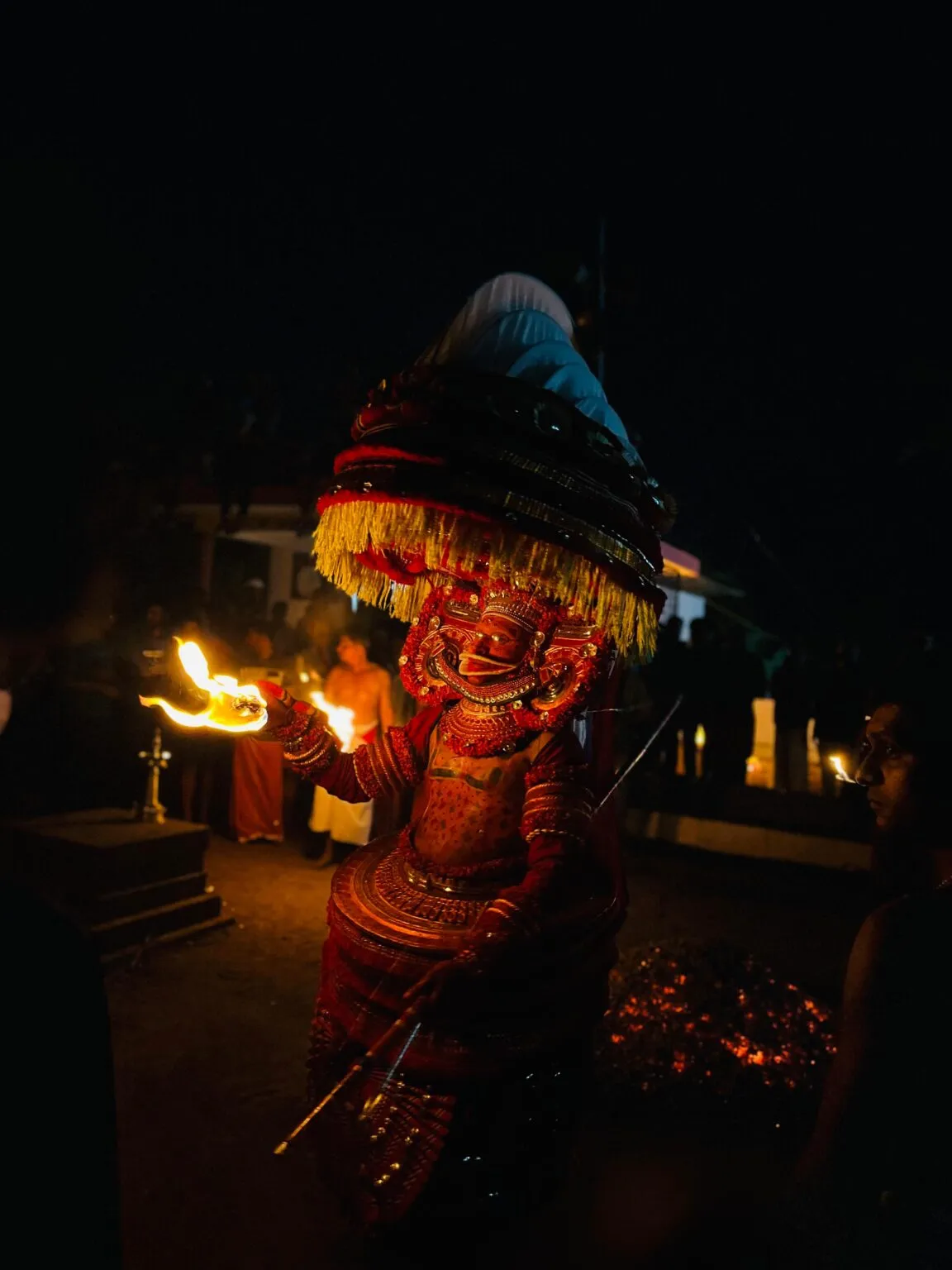
Background The historical trajectory of Theyyam, as analyzed by scholar K.K.N. Kurup and others, reflects a synthesis of tribal animist practice with the formal religious and social structures that transformed Kerala between the Sangam period and the medieval era. The dance of the Velan community, described in Sangam texts as performing exorcistic rituals, is considered by historians to have evolved into the present Theyyam tradition over approximately 1,500 years. The Nambiars and Thiyyas (Ezhava) communities were associated with patronage of the tradition at the tharavad level.
Culture and Societies Theyyam functions as a living religious institution as well as a cultural practice. Performances take place at kavus (sacred groves), before ancestral home shrines, and in temple courtyards. The annual or biennial performance cycle structures time for the communities involved. The tradition encodes social memory, community genealogy, and local histories through its mythology. The interaction between the divine-manifested performer and devotees constitutes a direct form of religious engagement unavailable in temple-based worship, where higher-caste priests serve as intermediaries. Scholar Dilip M. Menon has analyzed the social dimensions of Theyyam within the context of Malabar's late colonial history.
Religious Significance Theyyam is a practice of deep religious significance within its community. The performer does not represent or portray the deity but is believed to become the deity through a process of ritual transformation. This transformation is understood to occur when the mudi (sacred headgear) is placed on the performer, accompanied by mantras. The performer's personal consciousness is believed to recede and the divine consciousness to manifest. Devotees interact directly with this manifestation: they present their sorrows, receive blessings, and seek divine counsel. Blood offerings, fire-walking, and other intense ritual elements are part of specific Theyyam forms.
Understanding the Art
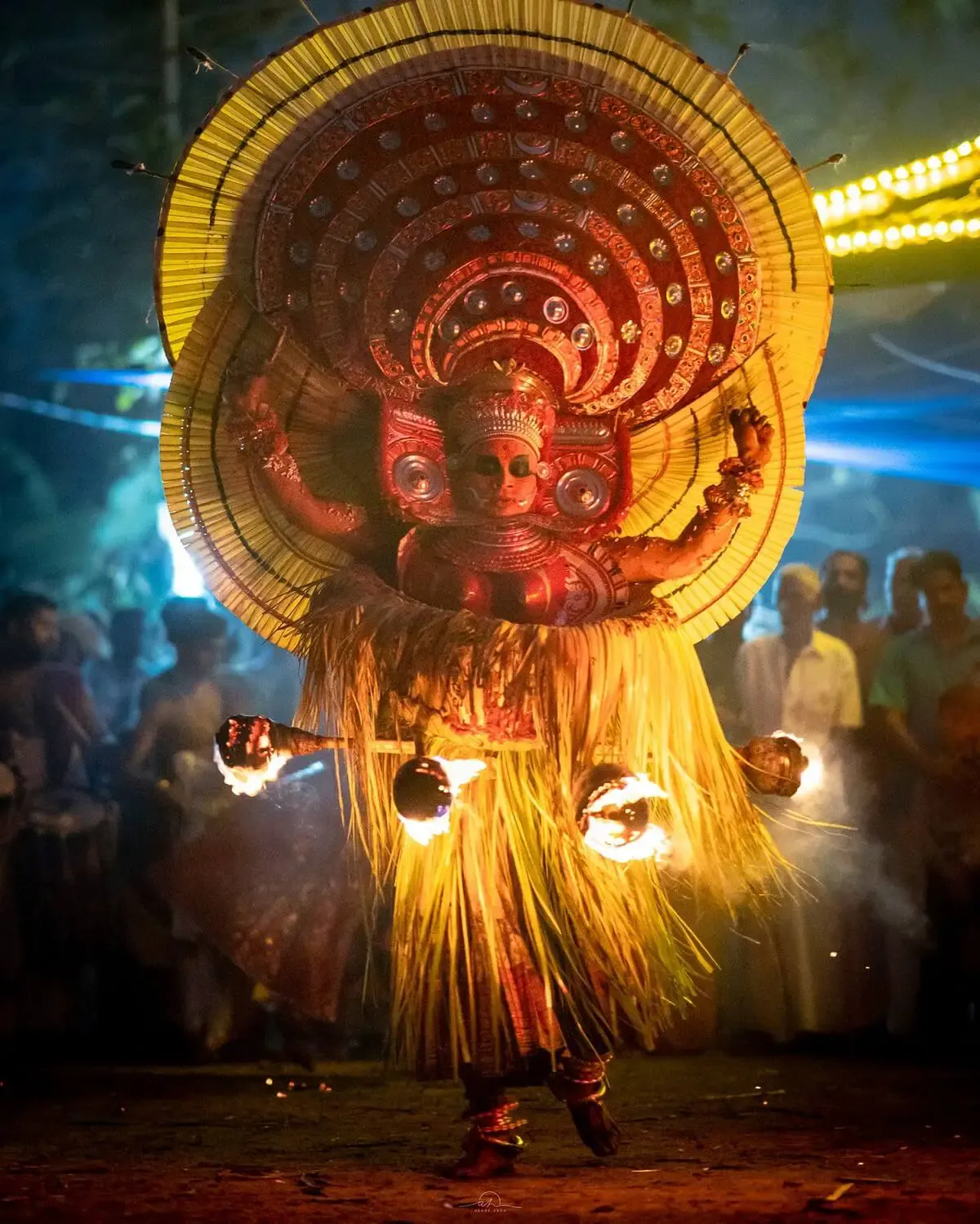
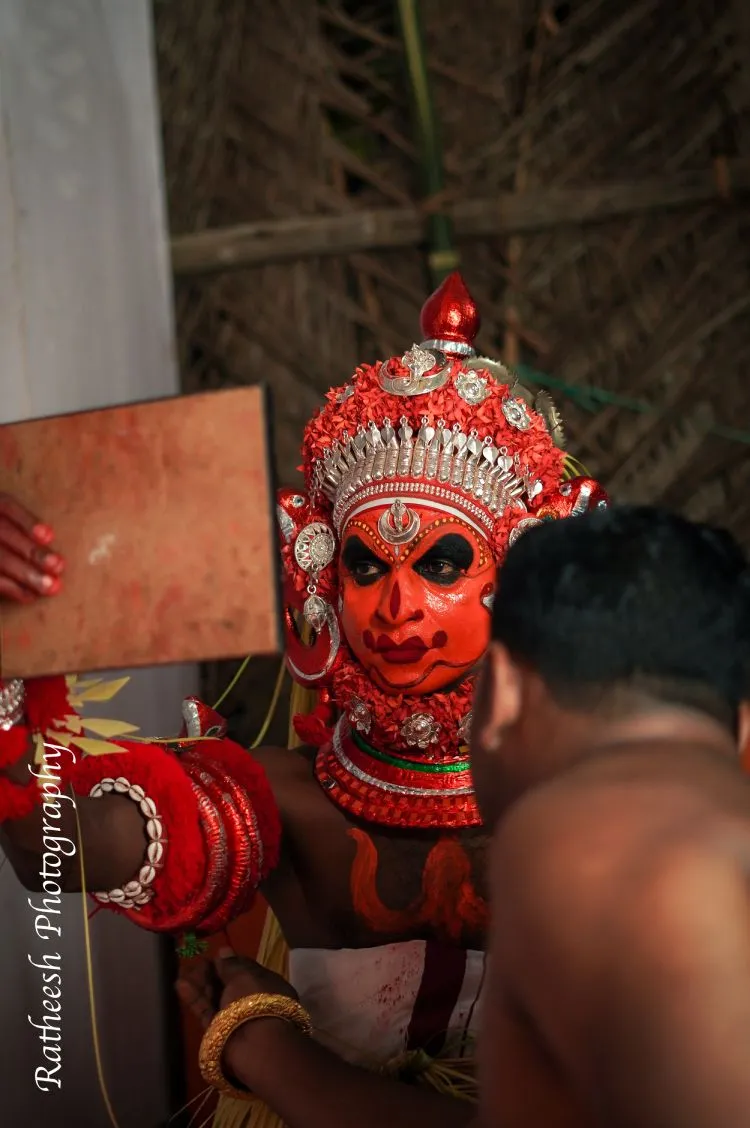
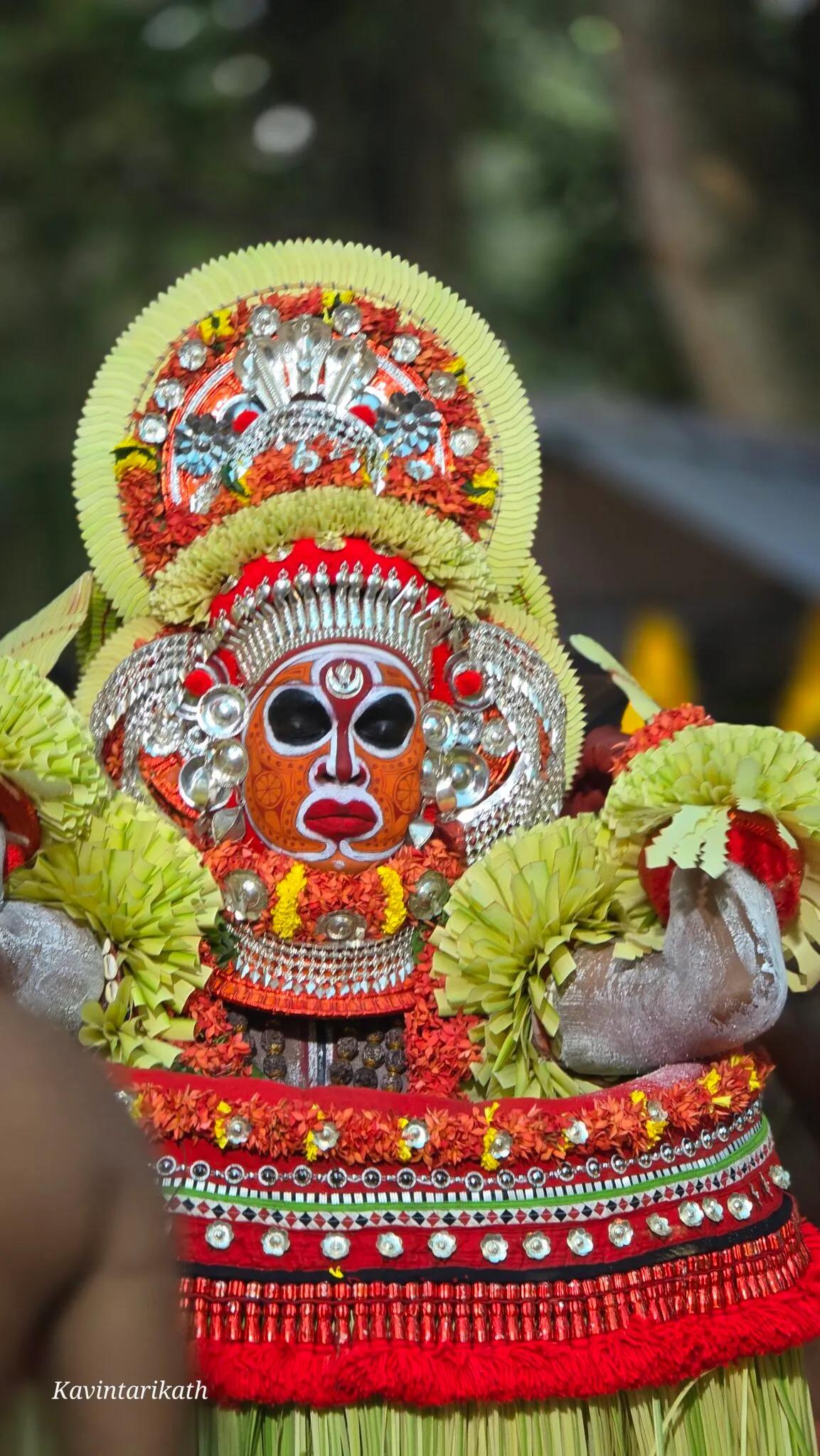
Style The visual form of Theyyam is among the most elaborate in Indian performing arts. Each Theyyam form has its own specified face painting (called Prakkezhuthu, Kattaram, or Kotumpurikum among others), using natural pigments including rice flour, turmeric, and charcoal. Red, symbolizing energy, power, and divine intensity, is the dominant color. Headgear (mudi) made of coconut leaves, bamboo splints, cloth, and flowers can reach heights of several meters in some forms. The performance culminates in vigorous dancing in the shrine courtyard, lasting between twelve and twenty-four hours in full ritual performances.
Central Motifs and Their Significance Each Theyyam embodies a specific deity, deified hero, or ancestor with its own mythology. Major categories include Shakti forms (goddesses such as Raktha Chamundi, Bhagavathi, Chamundi), Vaishnava forms (Vishnumoorthi), Shaiva forms, hero forms (Kandanar Kelan, Aromal Chekavar), and ancestor forms. The ritual chant performed in the initial phase (Vellattam or Thottam) recites the deity's origin narrative and mythological history. The number of documented forms varies between sources but commonly cited figures fall between 400 and 456.
Process The preparation phase spans several days before a performance, during which the performer observes dietary restrictions and physical purity. The performance begins with Thottam, an initial chant using minimal costume, during which the performer recites the deity's narrative accompanied by drummers. After a break, the performer reappears in full costume and makeup and undergoes the ritual placing of the mudi. The performer then enters the divine state, interacts with devotees, distributes blessings (in the form of turmeric powder and rice), and performs the full ritual sequence.
Mediums Used The instruments of Theyyam performance include the Chenda and Maddalam drums, and occasional use of bells and cymbals. Natural pigments are used for face painting. The headgear and body ornaments are constructed from coconut leaves, bamboo, fabric, flowers, and metal elements. The performance space is the open courtyard of the shrine, with no formal stage.
New Outlook
Academic engagement with Theyyam has grown substantially. Key works include K.K.N. Kurup's early scholarship, R.C. Karippathu's 2019 monograph, and journal articles including studies in South Asia: Journal of South Asian Studies. Documentary films and photographic essays have brought Theyyam to global audiences. Questions of authenticity, commercialization, and the management of the sacred-secular boundary in a tourism context have become subjects of scholarly and community discussion.
Learn Theyyam
Bibliography
Sources
Tarabout, Gilles. Malabar Gods. 2005.
The Cult of Theyyam and Hero Worship in Kerala. Indian Institute of Advanced Study, 1973.
The World of Theyyam: A Study on Theyyam, the Ritual Art Form of North Kerala. Kairali Books, 2019.
The Moral Community of the Teyyattam: Popular Culture in Late Colonial Malabar. Studies in History, vol. 9, no. 2, 1993.
Image Sources
“Aalada Bhagavathi Theyyam.” Kerala Theyyam. Accessed on May 21, 2026.
“Theyyam Kala.” Theyyam Kala. Accessed on May 21, 2026.
“Theyyam.” Paradise Kerala. Accessed on May 21, 2026.