

Terracotta - The Handicraft Tradition of West Bengal
Explore Terracotta craft, the handicraft tradition of West Bengal, and learn about its origins, techniques, cultural significance, and artistic heritage.
Introduction
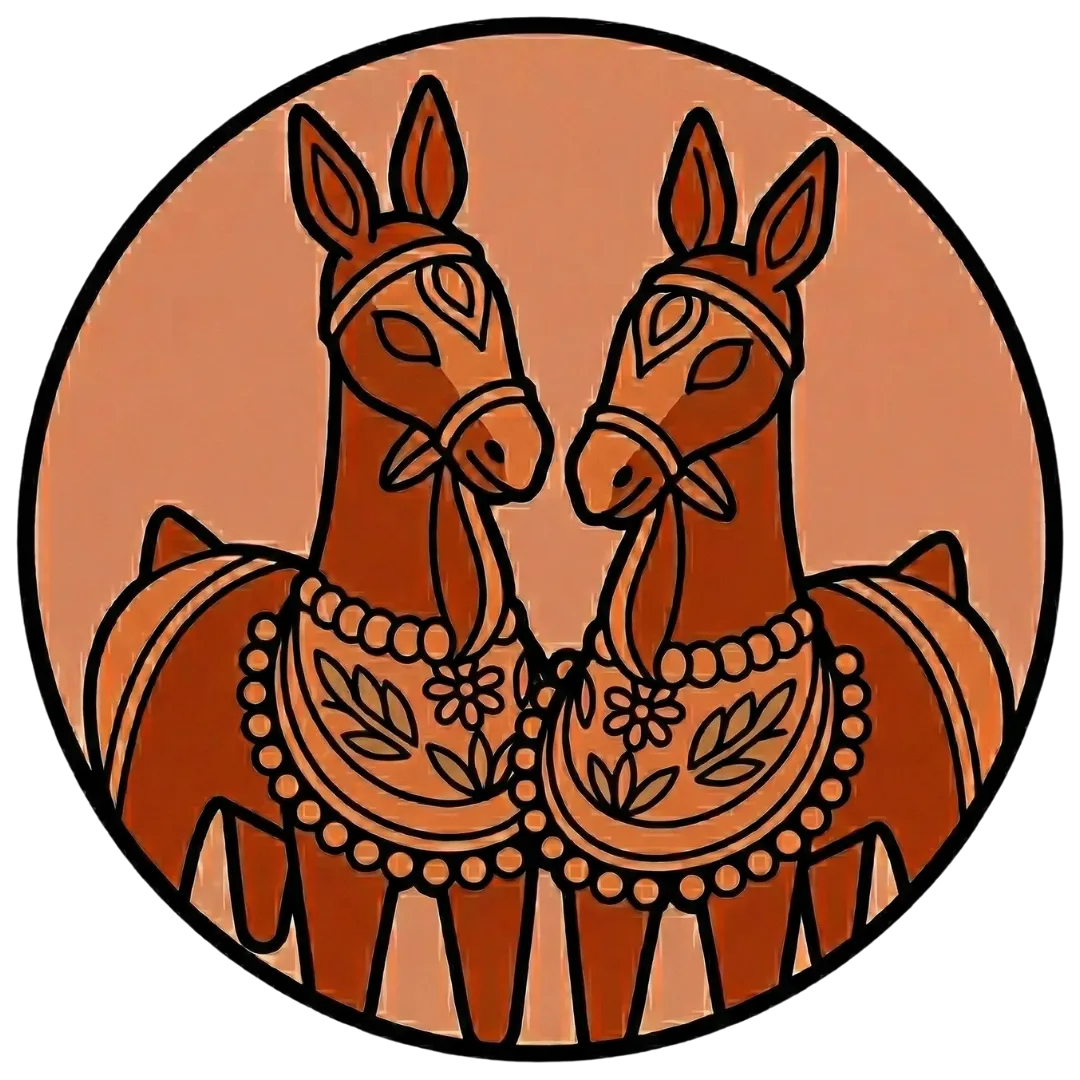
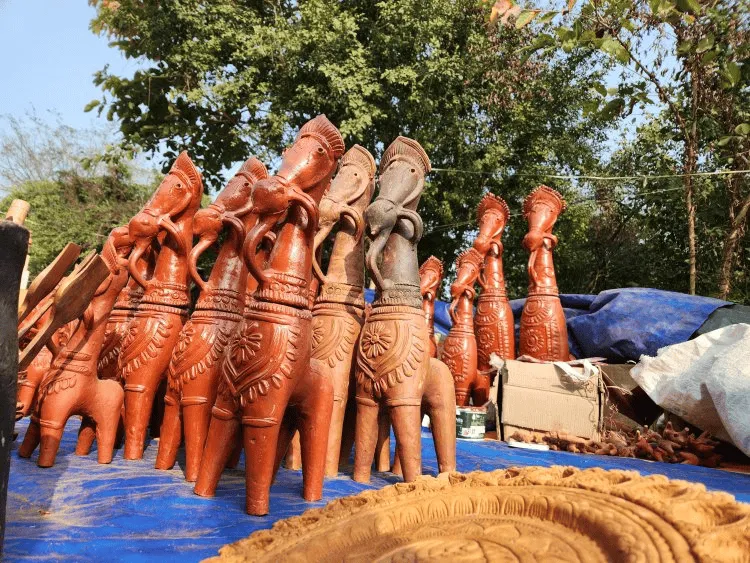
Terracotta of West Bengal refers to the tradition of crafting fired clay objects, architectural panels, decorative figurines, and ritual artefacts using locally sourced alluvial and laterite clay. Centred primarily in Bishnupur and Panchmura in the Bankura district, this craft tradition encompasses temple architectural ornamentation, votive horse figurines, decorative tiles, and household objects. The Bankura horse, produced in Panchmura village, has become the official crest motif of the All India Handicrafts Board and serves as a widely recognized symbol of Indian rural craft heritage.
Etymology The term terracotta derives from the Latin 'terra cocta,' meaning baked or cooked earth. It refers to clay-based unglazed ceramic, typically coarse and porous, that assumes a colour ranging from dull ochre to red after firing. In Bengali usage, the material is often referred to simply by the anglicised term, while the craft tradition in Bankura is locally associated with the Kumbhakar community of potters.
Origin The origins of terracotta craft in Bengal are linked to the Malla dynasty's rule over Mallabhum, with the earliest systematic production of temple ornamentation traceable to the reign of Bir Hambir (Hambir Malla Dev, the 49th Malla king) in the late sixteenth century. Archaeological evidence from the Susunia hillock near Bishnupur, however, indicates the presence of terracotta artefacts in the region dating to prehistoric times. The Malla kings commissioned the construction of terracotta temples beginning in 1600 CE with the Rasmancha, the oldest surviving terracotta temple at Bishnupur. The Kumbhakar potters of Panchmura are credited with the development of the distinctive long-necked horse figurine that became associated with the region.
Location The primary production centres are Panchmura village (approximately 40 kilometres from Bankura town), Bishnupur, Rajagram, Sonamukhi, and Hamirpur in Bankura district, West Bengal. Secondary concentrations are found in the villages of Bibardha and Sendra adjacent to Panchmura, with historical presence across Bardhaman, Hooghly, and Nadia districts.
Community The Kumbhakar caste is the principal practitioner community. Panchmura alone has approximately 450 craftspersons across three settlements (as documented in 2018 by Asia InCH). At peak historical periods, the village had 300 to 400 active artisans; this number has since declined to approximately 70 to 100 families, many of whom have transitioned to supplementary occupations. The Mritshilpi Samabay Samity, a cooperative in Panchmura, serves as a collective forum for artisans.
Relevance The craft is classified as High Priority and Thriving in terms of current production, with active domestic and international markets. The Bankura Panchmura Terracotta Craft received a Geographical Indication (GI) tag from the Government of India on 28 March 2018. Bishnupur's terracotta temples have been nominated to UNESCO's List of Intangible Cultural Heritage.
History
Background The terracotta tradition in Bengal arose partly from the geological conditions of the Bankura district, which is drained by the Damodar, Dwarakeshwar, and Kangsabati rivers, leaving substantial alluvial deposits of clay well-suited to pottery. Unlike northern India, which had access to stone for temple construction, the Bengali plains relied on baked earth, making terracotta the primary medium for architectural expression.
The Malla dynasty, tracing its rule to the seventh century CE, established Bishnupur (meaning 'city of Vishnu') as its capital. The dynasty remained Hindu under successive rulers while tolerating Mughal and later Maratha pressures. The sixteenth and seventeenth centuries, particularly under Bir Hambir and his successors Raja Raghunath Singha (1626–1656) and Veer Singha, marked the apex of terracotta temple construction. These rulers patronised high-caste Brahmins, craftsmen, and masons, creating an ecosystem that supported artistic production across trades including terracotta, Baluchari silk weaving, and bell-metal work.
According to David McCutchion (The Temples of Bankura District, 1967), there were once as many as 450 terracotta and laterite stone temples in Bishnupur during the eighteenth century; approximately 20 survive today in varying states of preservation. By the mid-nineteenth century, terracotta sculptural production at temples had been largely supplanted by stucco work, though the tradition persisted among potters into the twentieth century.
Scholars Ganguly and Ganguly (2015) document that terracotta craft in Bishnupur flourished under Malla royal patronage and subsequently spread from Bishnupur to other parts of Bengal in the eighteenth century and thereafter, carried by artisans who had originally served temple-building programmes. The Chitrolekha Journal on Art and Design (2011, 2013) has published detailed accounts of the Panchmura community's contemporary conditions and historical trajectories.
Culture and Societies The terracotta tradition is embedded in the cultural identity of the Bankura region, functioning both as a practice of artistic production and as a means of participation in ritual life. Village deities including Dharma Thakur, Manasa, Kudra, Boram, and Sini are worshipped through offerings of terracotta horses and elephants. Terracotta animals function as votive objects: worshippers commission or purchase a horse or elephant to offer to a deity upon the fulfilment of a wish. The size of the offering corresponds to the magnitude of the prayer or the financial capacity of the devotee.
According to researcher Sanjay Prasad (International Journal of Humanities and Social Sciences), the Rarh region of Bengal, of which Bankura forms a part, has a particular association with the symbolic sacrifice of terracotta and wooden horses linked to the worship of Dharmathakur. This votive function predates any urban decorative market and constitutes the foundational social purpose of the Panchmura horse.
Bengali linguist Acharya Suniti Kumar Chattopadhyay, in Bangalir Sanskriti (The Culture of Bengal), identified the cultural character of Bengal as a synthesis of Austric, Dravidian, and mixed Aryan influences, and situated the rural craft tradition within this longer historical formation. The Kumbhakar community's craft practice is transmitted through family lineage; formal training and craft certificates have been offered by institutions including small-scale industry boards at the district, state, and national levels.
Religious Significance Terracotta craft in Bankura carries deep Vaishnava associations rooted in the conversion of Bir Hambir to Gaudiya Vaishnavism under the influence of Srinivas Acharya in the sixteenth century. According to Sahapedia's documentation of the Bishnupur temples, this conversion led to the creation of temples dedicated to Radha-Krishna and Vishnu, the ornamentation of which depicted scenes from the Ramayana, Mahabharata, Bhagavata Purana, and Krishnalila. The Rasmancha (built in 1600 CE) served as a ceremonial stage during the annual Raas festival, when idols of deities were brought to the structure for rituals. Individual temples bear narrative programmes: the Madan Mohan temple (built 1694) depicts scenes from Krishna's life on its front facade; the Shyamarai or Pancharatna temple (built 1643 by Raghunath Singha I) contains terracotta tiles depicting Ramayana, Mahabharata, Puranic stories, plants, and animals on all interior and exterior faces.
Outside the Vaishnava temple context, terracotta figurines are also offered at shrines associated with folk and tribal deities, demonstrating a parallel devotional tradition distinct from the Brahmanical Vaishnava strand. Muslim saint tombs in Bankura have also historically received terracotta horse offerings, as documented by local artisan Mahadeb Kumbhakar in a 2020 interview published by the Observer Research Foundation.
Understanding the Art
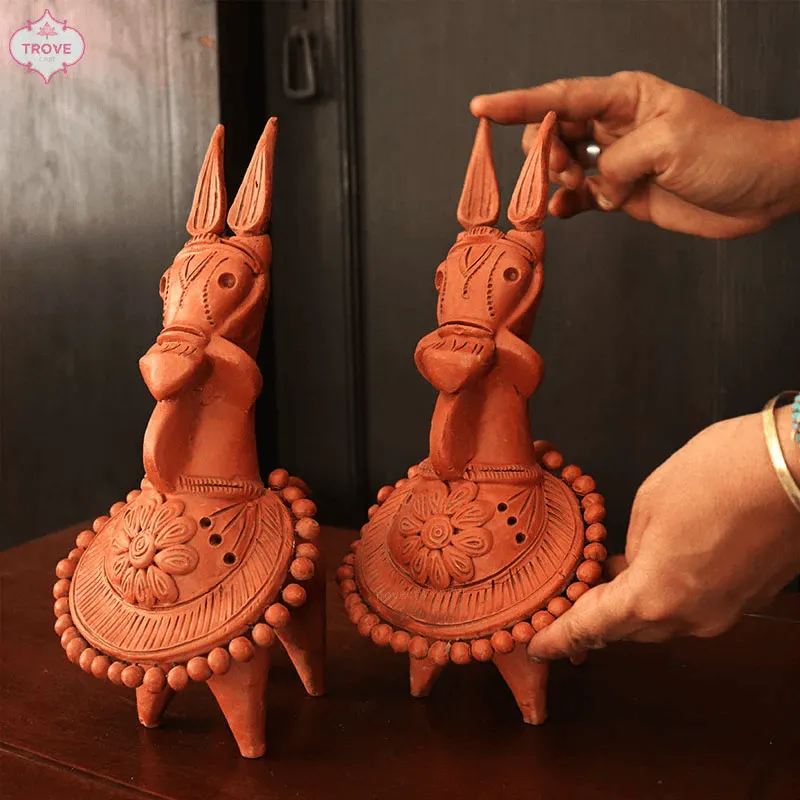
Style The most celebrated stylistic achievement of Bankura terracotta is the abstract long-necked horse produced in Panchmura. Unlike classical sculptural traditions that prioritise anatomical accuracy, the Panchmura horse employs abstraction: different artisans of different localities historically emphasised different parts of the animal's body, producing a range of expressive forms. The Panchmura variant is characterised by a distinctive elongated neck suggesting royalty, elevated shoulder line, straight ears, and an expressive simplified face. The figures are assembled from separately wheel-thrown and hand-modelled components. Temple terracotta panels at Bishnupur represent a distinct stylistic tradition from the votive figurines. These panels are dense with figural and decorative content, presenting narrative scenes in registers or continuous friezes. The tile work at the Kestaraya temple and the Jor Bangla temple demonstrates a system of architectural rhythm created through repeated identical panels, interspersed with bands of decorative ornament. Architectural historians have noted that Bengal's temple forms, including the char-chala (four-sided roof converging at a point), do-chala (two-sided humped roof), and at-chala, are derived from the vernacular bamboo-framed thatched hut, transposed into brick and terracotta.
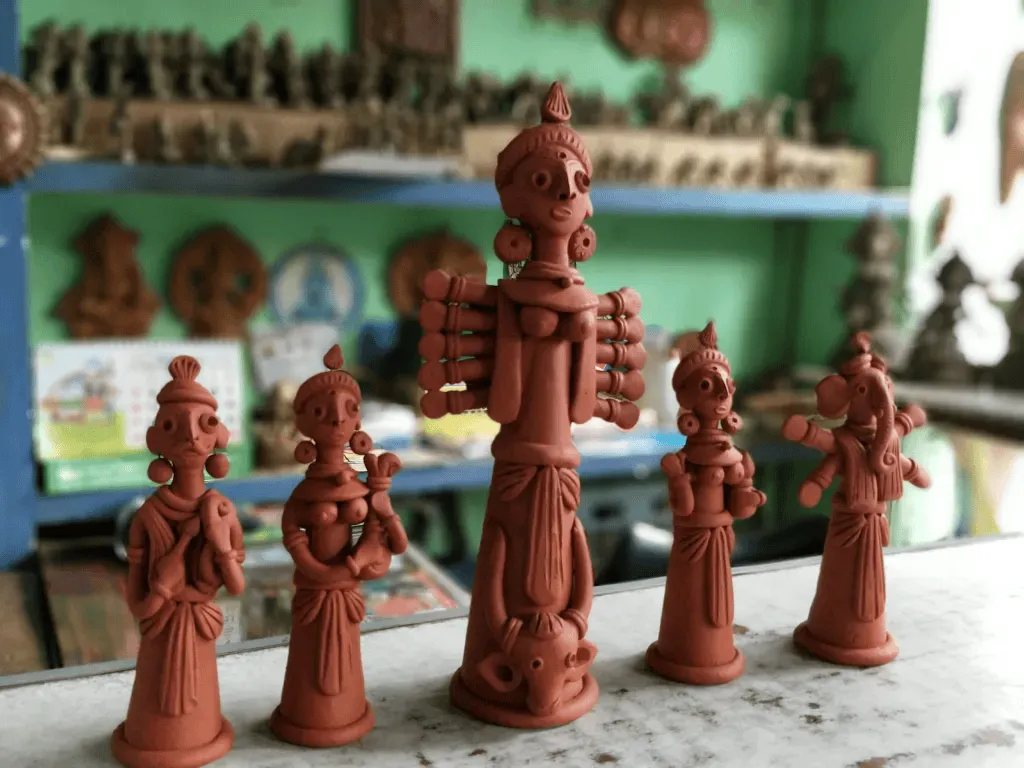
Central Motifs and Their Significance The primary motifs in Bishnupur temple terracotta include scenes from the Ramayana, Mahabharata, Krishnalila, Bhagavata Purana, and Ramlilas. Non-mythological content includes scenes of rural life, farming, male and female musicians, village gardens, and social activities. Decorative elements include lotuses, mangala ghat (auspicious pot), creeper scrolls, and grotesque figures. The horse and elephant are the dominant votive figurines; cat, monkey, and Manasachali (images connected to the snake goddess Manasa) are also produced. Images of Sankirtaniyas (devotees in singing posture associated with the Vaishnava kirtan tradition) are regionally significant products.
The Bankura horse's long neck is interpreted within the artisan community as representing the royalty and power of the Malla kingdom. The form has moved from a primarily votive context into a decorative domestic market, particularly after it was adopted as the crest motif of the All India Handicrafts Board. It featured on an Indian postage stamp in 1957.
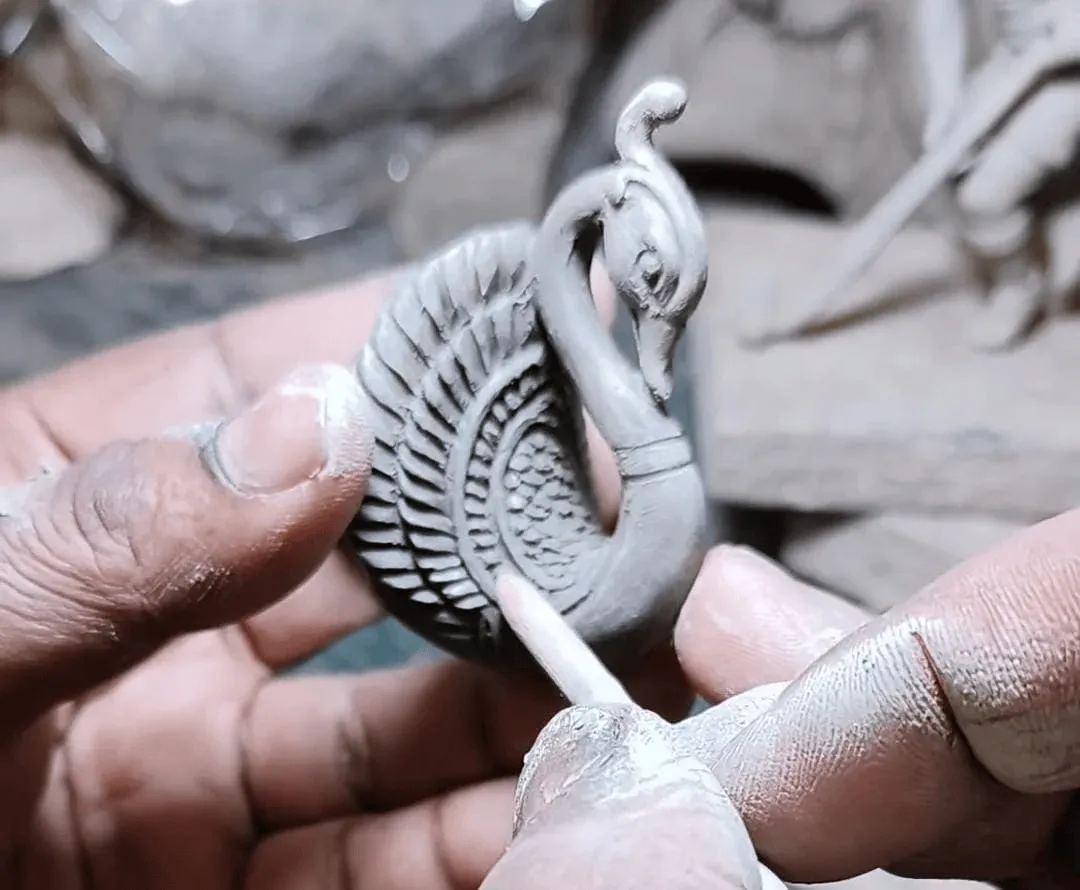
Process The primary clay used in Panchmura is Etel mati, a dense alluvial clay sourced locally. Clay preparation involves removal of impurities, soaking, and kneading to achieve the required consistency for both wheel and hand work. The Bankura horse is assembled from seven separately thrown or moulded components: four hollow legs, the neck in two parts, and the face. Leaf-shaped ears and the tail are made in moulds and inserted into grooves in the body. Additional clay fills any surface defects.
Drying occurs in two stages: initial indoor air-drying for six to seven days, followed by controlled sun-drying. Holes are made in the body at appropriate points during drying to equalise moisture loss between inner and outer surfaces and prevent cracking. Firing takes place in a bhatti (kiln) at temperatures sufficient to achieve the characteristic red to ochre terracotta colour. Tiles and architectural panels are produced by pressing clay into carved moulds, then firing separately before assembly into architectural surfaces.
The entire process in Panchmura is manual. The community follows no mechanised production. Packaging for urban and export markets uses paddy hay and newspaper as protective layers, with ears and tails added as the final step before packing, given their fragility.
Mediums Used The primary medium is clay: Etel mati (dense local alluvial clay) for figurines and Panchmura tiles; laterite clay for the temple architectural panels of Bishnupur, which utilise the locally available red laterite stone alongside terracotta bricks. No glaze is applied; the surface remains natural and uncoated. Natural mineral pigments were historically used for surface colouring on certain figurines; contemporary production uses commercially available paints for some decorative items. The kiln fuel is wood or agricultural residue.
New Outlook
Contemporary terracotta artisans in Panchmura have expanded their production to include jewellery (terracotta earrings, necklaces, pendants), decorative wall panels emulating Bishnupur temple bas-reliefs, tiles for modern architectural interiors, and miniature figurines for urban gift markets. The Craft Council of West Bengal has facilitated international exposure for select artisans, including a government-sponsored visit to Honolulu in 2004. Sales channels include Kolkata craft fairs, state-run emporia such as Biswa Bangla and Bangasree, and wholesale supply to dealers who distribute to urban retail outlets.
The Observer Research Foundation (ORF) published an analysis in 2020 noting that the artisan community's economic viability had been undermined by the pandemic, declining patronage for ritual objects, absence of direct market access, and a lack of specialised packaging and e-commerce infrastructure. Researchers from Chitrolekha Journal (2013) identified the absence of a functioning marketing society at the production level as a structural constraint, noting that traders from Kolkata and Durgapur visit the village to purchase wholesale rather than artisans selling directly. The West Bengal state government has made repeated commitments to develop Panchmura as a tourism destination, though infrastructure remains limited.
Learn Terracotta (West Bengal)
Bibliography
Sources
Banerji, Amiya Kumar. West Bengal District Gazetteers: Bankura. 1968.
Chattopadhyay, Suniti Kumar. Bangalir Sanskriti (The Culture of Bengal). [Bengali language text].
Gangopadhyay, Ashimananda, and Atanu Sen. “Panchmura: The Terracotta Hub of Bengal: A Contemporary Study.” International Journal of Humanities and Social Sciences.
Ganguly, [First Name Unknown], and [First Name Unknown] Ganguly. Documentation on Bishnupur Terracotta Craft under Malla Dynasty Patronage. 2015.
Mallik, Abhaya Pada. History of Bishnupur Raj: An Ancient Kingdom of West Bengal. Kolkata, 1921.
McCutchion, David. The Temples of Bankura District. 1967.
Image Sources
“Bishnupur: The Terracotta Capital of West Bengal.” Summiters Adventures, https://blog.summitersadventures.com/bishnupur-the-terracotta-capital-of-west-bengal. Accessed on May 06, 2026.
Krishna, Anubhuti. “A Guide to the Terracotta Town of West Bengal.” WordPress, 28 Aug. 2018, https://anubhutikrishna.wordpress.com/2018/08/28/a-guide-to-the-terracotta-town-of-west-bengal/. Accessed on May 06, 2026.
“Panchmura Terracotta: Bengal’s Living Clay Legacy.” The Bengal Store, 3 Sept. 2025, https://thebengalstore.com/blogs/blog/panchmura-terracotta-bengal-s-living-clay-legacy. Accessed on May 06, 2026.
“The Exquisite Terracotta Art of West Bengal.” Trove Craft India, 25 Nov. 2025, https://trovecraftindia.com/blogs/the-trove-craft-blog/the-exquisite-terracotta-art-of-west-bengal. Accessed on May 06, 2026.