

Tanjore Dolls - The Handicraft Tradition of Tamil Nadu
Explore Tanjore Dolls, the handicraft tradition of Tamil Nadu, and learn about its origins, techniques, cultural significance, and artistic heritage.
Introduction
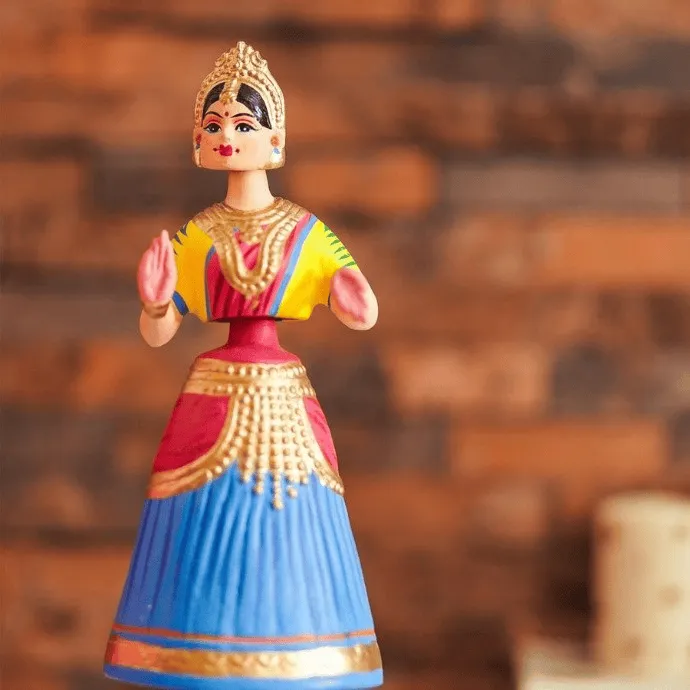
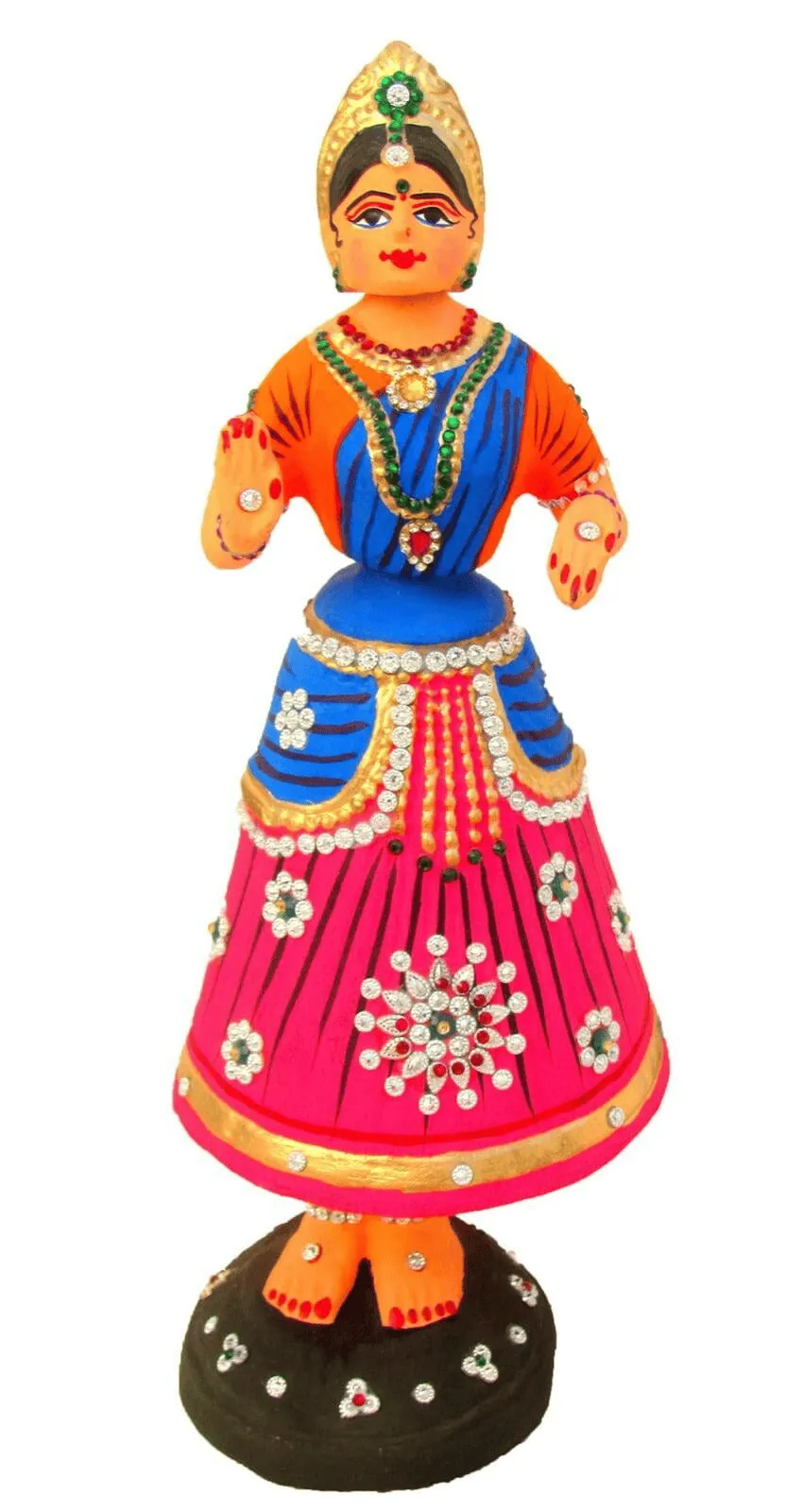
Tanjore Dolls, known in Tamil as Thanjavur Thalaiyatti Bommai, are a category of traditional Indian bobblehead or roly-poly figurines produced in Thanjavur, Tamil Nadu. The dolls are distinguished by a weighted hemispherical base that concentrates the centre of gravity at the lowest point, generating a continuous oscillating motion when disturbed. Manufactured from a combination of terracotta clay, plaster of Paris, paper pulp, and tapioca flour, these hand-painted figurines are associated with the artistic patronage of the Maratha court of Thanjavur and hold cultural significance in festival practice across Tamil Nadu. The craft received Geographical Indication (GI) status from the Government of India in 2008-09.
Etymology The Tamil name 'Thanjavur Thalaiyatti Bommai' translates as 'Thanjavur head-shaking doll.' The component words are: Thanjavur, the city name; thalaiyatti, meaning head-shaking or head-nodding; and bommai, meaning doll or figurine. The Anglicised forms 'Tanjore Doll' and 'Thanjavur Doll' are used interchangeably in craft documentation and trade literature.
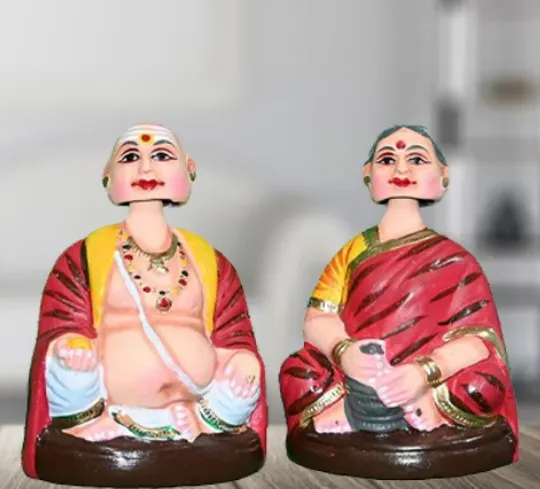
Origin The doll-making craft is documented as having arrived in Thanjavur during the reign of Maratha ruler Raja Serfoji II (also recorded as Saraboji), who ruled Thanjavur in the early 19th century. Serfoji II was a noted patron of the arts and sciences, and the doll craft was fostered under his cultural patronage. Some sources trace the tradition to the broader Thanjavur Nayak period beginning in the 16th century, when the Nayaks of the Vijayanagara Empire governed the region. The earliest documented form produced figurines as pairs of raja and rani, symbolising the dynasties that ruled Thanjavur.
Location Thanjavur district, Tamil Nadu. Production has extended to other parts of Tamil Nadu in recent decades, though GI protection restricts the authentic designation to Thanjavur.
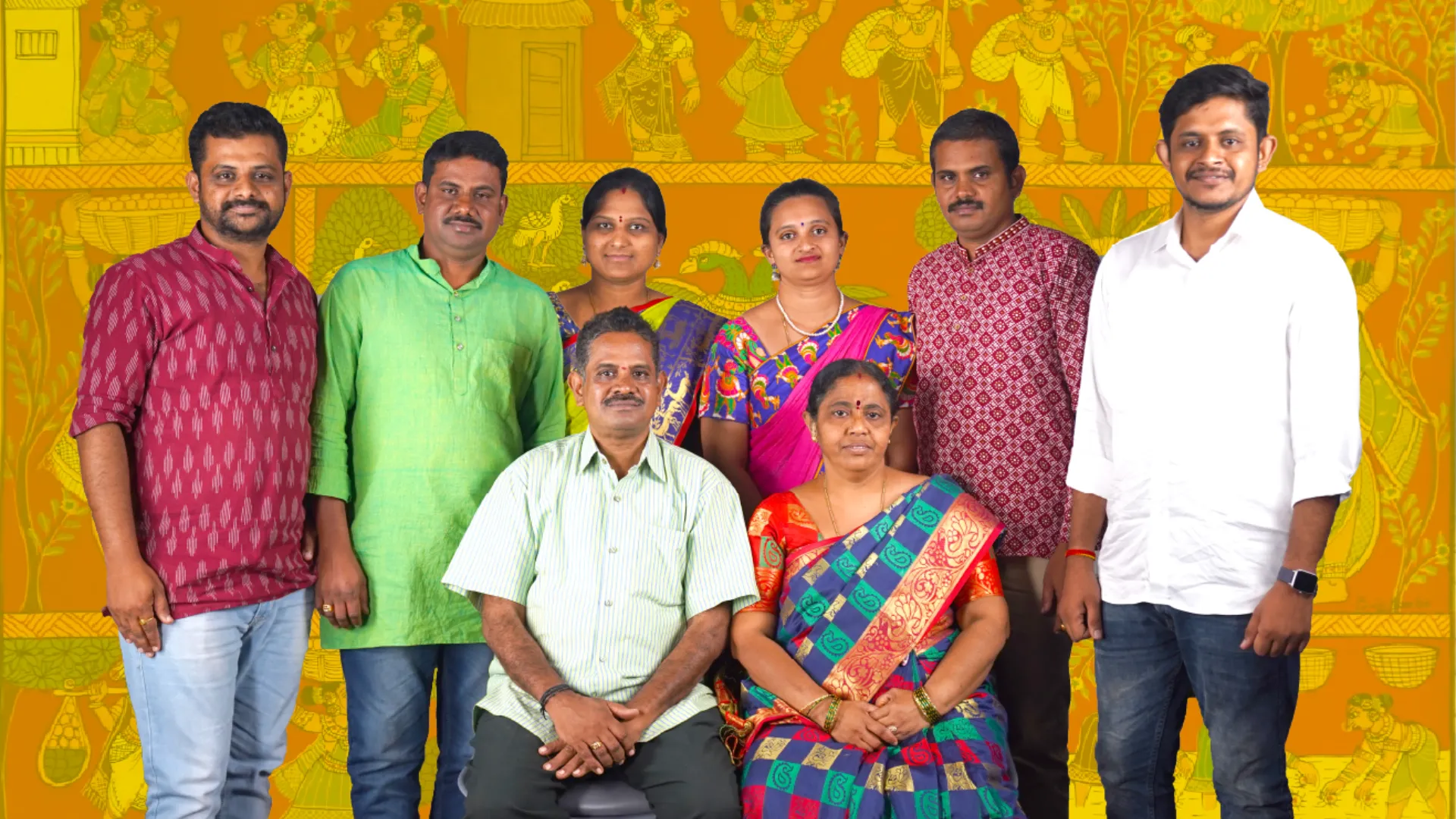
Community Artisan families engaged in doll production are concentrated in Thanjavur. The craft is hereditary within these families. Women-led self-help groups have become significant production units in recent decades.
Relevance Tanjore Dolls are among the most recognised handicraft products of Tamil Nadu. They feature prominently in the Navratri Golu festival and function as souvenirs and decorative objects. The craft is classified as thriving in market terms, though it faces challenges including competition from plastic dolls and a declining number of artisans skilled in traditional terracotta production. NRI and urban collector demand has created a segment for custom-order dolls.
History
Background The city of Thanjavur was the capital of the Chola dynasty from the 9th to the 13th centuries, producing among the most significant temple architecture and bronze sculpture in Indian history. The Brihadeeswarar Temple, a UNESCO World Heritage Site, was completed under Raja Raja Chola I around 1010 CE. Subsequent dynasties including the Vijayanagara Nayaks (16th to 17th centuries) and the Marathas (17th to 19th centuries) continued to patronise Thanjavur's arts ecosystem. Tanjore Paintings, bronze icon-casting, and musical instrument production all flourished under successive patronage. The doll craft entered this environment during the Maratha period, with Raja Serfoji II's personal enthusiasm for craft and colour documented in historical accounts of his court.
Culture and Societies Tanjore Dolls occupy a specific place in Tamil cultural practice through the Navratri Golu tradition, in which households arrange dolls on a tiered display as a form of devotion during the nine-night festival. The pairing of raja and rani figurines symbolises royal couples from the dynasties that governed Thanjavur. Over time the repertoire expanded to include classical dancers, saints, deities, and character types from Tamil social life. The doll display tradition reinforces intergenerational cultural transmission as households accumulate and pass down collections.
Religious Significance Tanjore Dolls are not themselves objects of primary religious worship, but function as ritual accessories in the Navratri Kolu festival dedicated to the goddess Shakti. The doll display is central to the festival's domestic ritual structure across South India. Some figurines depict deities including Lord Ganesha and Goddess Lakshmi. The craft is therefore embedded in the religious practice of the region, with the figurines serving a ceremonial rather than strictly devotional function.
Understanding the Art
Style The defining stylistic characteristic of Tanjore Dolls is the weighted hemispherical base that drives the bobblehead or roly-poly mechanism. Two principal variants exist. The tilting doll, known as Uruttu Bommai, has a fully rounded base that oscillates in all directions when touched, returning to an upright position due to weight concentration at the base. The bobblehead variant has a fixed body connected to a moveable head via a thin metal string attached to the base, causing the head to nod independently when tapped. Figures are depicted in seated or standing postures with elaborate painted costumes in bright oil-based colours, featuring ornamental detail including jewellery, headwear, and ceremonial garments.
Central Motifs and Their Significance The canonical Tanjore Doll subject is the raja-rani pair. Female classical dancers in Bharatanatyam postures are another well-established motif. Depictions of deities, saints, and figures from Hindu mythology form a secondary category. Character figurines representing social types from Tamil life are also produced. Thematic sets are commissioned for festival Kolu displays incorporating subjects from specific purana narratives.
Process A dough of plaster of Paris and paper pulp in a 1:3 ratio is combined with tapioca flour (sago) and kneaded to a roti-dough consistency. Copper sulphate powder is incorporated as a fungicide. The dough is pressed into stone moulds to produce front and back panel halves. Cast panels are removed and dried in shade for approximately half an hour, then affixed with paper and dried for a further one and a half hours. The front and back halves are joined using tuber gum. A clay and sand mixture comprising vandal mann (fine river silt), kali mann (clayey riverbed mud), and manal (loose aggregate) is used to fill the base, providing the weight concentration required for oscillation. Assembled dolls are smoothed with sandpaper, coated with oil-based paints in multiple colours, and finished with fine decorative detail. For the bobblehead version, a thin metal string connecting head to base is inserted during assembly.
Mediums Used Plaster of Paris: The primary structural material, combined with paper pulp in a 1:3 ratio.
Paper Pulp and Tapioca Flour: Mixed with plaster of Paris to form the moulding dough.
Clay: Sourced from the banks of the Cauvery River, used with river sediments in the base weighting compound.
Copper Sulphate: Added as a fungicide.
Oil Paints: Used for surface decoration and figural painting.
Metal String: Used in the bobblehead variant to connect the moveable head to the weighted base.
New Outlook
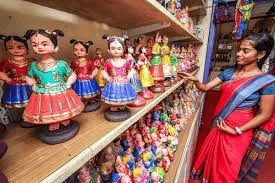
Metal String: Used in the bobblehead variant to connect the moveable head to the weighted base. The craft received the GI tag in 2008-09. Women's self-help groups in Thanjavur now operate production units with government loan support. Competition from imported plastic toys and declining artisan wages remain challenges. Tamil Nadu Tourism and the Office of the Development Commissioner (Handicrafts) have promoted the craft through trade exhibitions. NRI demand for smaller-format dolls suitable for international transport has created a new market segment.
Learn Tanjore Dolls

Bibliography
Sources
Craft Revival Trust. “Thanjavur Dolls of Tamil Nadu.” Asia InCH: Encyclopedia of Intangible Cultural Heritage, https://asiainch.org/craft/thanjavur-dolls-of-tamil-nadu/
Government of India, Office of the Development Commissioner (Handicrafts). “Thanjavur Doll.” Handicrafts of India, https://handicrafts.gov.in/crafts/All_Crafts/Craft_Categories/Miscellaneous/Figurines&Toys/Thanjavur_Doll/ThanjavurDollWebPage.html
Jaitly, Jaya, and Ruchira Verma, editors. Crafts of India: Handmade in India. Lustre Press/Roli Books, 2007.
Thatavarthi, Gayathri. “Art in Miniature: Thanjavur Dolls and Their Charm.” Caleidoscope, Jan. 2024, https://www.caleidoscope.in/art-culture/thanjavur-dolls
Image Sources “Tanjore Dolls.” Chola Impressions Blog, https://www.cholaimpressions.com/blogs/tanjore-dolls/. Accessed on May 05, 2026.
“Bring Home Elegance: Tanjore Dancing Dolls Online at Your Fingertips.” Indoscraft, 10 June 2024, https://www.indoscraft.com/blogs/handmade/art-of-enameling-the-origin-of-meenakari. Accessed on May 05, 2026.
“Thanjavur Doll: The Graceful Nodding Icon of Tamil Nadu.” Digital GI, https://digitalgi.in/thanjavur-doll-the-graceful-nodding-icon-of-tamil-nadu/. Accessed on May 05, 2026.