


Sital Pati - The Handicraft Tradition of Assam
Explore Sitalpati, the handicraft tradition of Assam, and learn about its origins, techniques, cultural significance, and artistic heritage.
Introduction
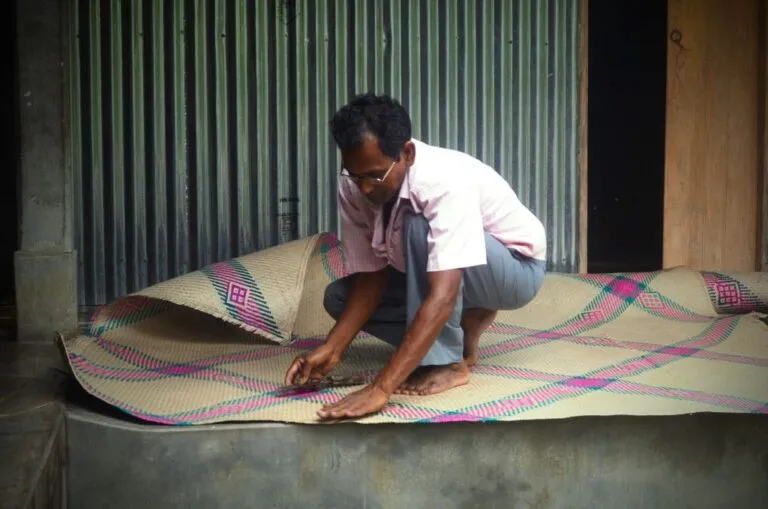
Sitalpati is a traditional mat-weaving craft practiced in Assam, India, in which the stems of the Murta plant (Schumannianthus dichotomus, family Marantaceae) are split into fine strips and hand-woven into flat mats used for sitting, sleeping, and prayer. The craft is classified as a cottage and household industry, practiced primarily in the Cachar, Karimganj, and Goalpara districts of Assam, and is identified as the most notable and popular product among the handicrafts of the state, as recorded by the Assam State Portal. Sitalpati production within the broader South Asian context also extends to the neighbouring state of West Bengal, to Tripura, and most substantially to the Sylhet region of Bangladesh, where the UNESCO Representative List of the Intangible Cultural Heritage of Humanity recognised it under the designation "Traditional Art of Shital Pati Weaving of Sylhet" in 2017.
Etymology: The name sitalpati is derived from two words in Bengali and Assamese: sital (also spelled sheetal or shital), meaning cool or cold, and pati, meaning mat. The compound term thus translates directly as cool mat, a reference to the tactile property of the finished product, which imparts a sensation of coolness to the person sitting or lying on it. This characteristic is documented consistently across the Asia InCH Encyclopedia of Intangible Cultural Heritage and the Assam State Portal. In Assamese, the Murta plant used to make the mat is known as pati doi. In Sylheti Bengali it is called Murta, and in standard Bengali it is referred to as mostak, patibet, or patipata depending on the locality. Mats bearing decorative designs are specifically called nakshi pati in the Bengali tradition of the craft.
Origin: No definitive pre-colonial origin date for sitalpati weaving in Assam is established in available documentation. The Commissionerate of Industries and Commerce, Government of Assam, identifies the craft as a well-established cottage industry in the state, but does not specify a founding period or a founding community. The broader mat-weaving tradition of which sitalpati is a part is traced to ancient contexts in India by the Asia InCH Encyclopedia, which notes that Vedic texts depict sages meditating on woven mats, and that mat-weaving as a skill is referenced in the Vedic corpus.
For the Assam-specific tradition, a distinct and documented point of formal introduction is recorded for the Goalpara district. A Nezine.com field report from Goalpara, citing weaver Sridaam Nandy, states that a British national named John Graham arrived in the village of Dubapara around 1950 to establish a sugar mill, and on observing Murta reeds growing wild in the area, arranged for an expert mat-weaver from Kolkata to travel to the village and instruct the local population in the craft. This account, if accurate, dates the establishment of sitalpati weaving in Dubapara specifically to around the mid-twentieth century. Sitalpati production in the Barak Valley districts of Cachar and Karimganj, however, predates this and reflects the broader cross-regional tradition shared with undivided Bengal, from which many weaving families have ancestral and cultural connections. The IJRAR research paper on Ghugumari village in Cooch Behar (West Bengal) documents that many sitalpati-weaving families in that area migrated from the Tangail and Sirajganj regions of present-day Bangladesh, bringing the craft with them at Partition. A parallel migration dynamic likely contributed to the Barak Valley tradition in Assam, though this remains insufficiently documented in available academic sources for Assam specifically.
Location: Sitalpati weaving in Assam is concentrated in three primary areas: the undivided Cachar district (now comprising the districts of Cachar, Hailakandi, and Karimganj), which forms the Barak Valley zone of southern Assam, and the Goalpara district in western Assam. The Assam State Portal and the Commissionerate of Industries and Commerce (Government of Assam) identify the following villages as the primary production centres: Katakhal, Kaliganj, Karimpur, Basigram, and Sridurgapur in the Barak Valley, and Dubapara and Pharsingpara in the Goalpara district. Of these, Kaliganj and Katakhal in the Barak Valley are specifically identified in the ResearchGate paper on the Murta plant (Bhattacharjee and Seal, 2017) as very famous for sitalpati production. Dubapara and Pharsingpara are identified as the two major hubs in Goalpara district by the Yeh Hai India documentation portal. The craft is also documented in the Majuli island area of Assam, where the Schumannianthus dichotomus plant grows in its wild riverine habitat.
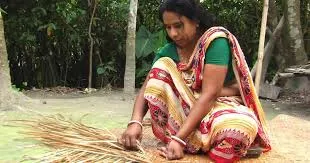
Community: The Assam State Portal explicitly notes that the makers of sitalpati in Assam are usually Kayasthas in caste, identifying this as significant because Kayasthas are not a traditional craftspeople caste in the conventional categorisation of hereditary artisan communities. The Yeh Hai India documentation identifies the Nadi and Dey communities in Dubapara and Pharsingpara villages in Goalpara district as the primary practitioners in that area. The Nezine.com field report from Dubapara corroborates the Dey family name among practitioners there, naming Ranjit Kumar Dey as a National Award-winning weaver and Kalpana Dey as a practicing woman artisan. The gendered division of labour is consistent across documentation: men prepare and process the raw cane strips, and women perform the weaving. This division is stated uniformly by the Assam State Portal, the Commissionerate of Industries and Commerce, and the field reports from both the Barak Valley and Goalpara areas.
Relevance: Sitalpati is identified by the Assam State Portal as the most notable and popular product among the handicrafts of Assam. The craft has received recognition through institutional and international channels. Ranjit Kumar Dey of Dubapara, Goalpara district, received the National Award for the craft in 2002 and the UNESCO Seal of Excellence in 2004, and has represented the craft at international exhibitions in Thailand, France, Sri Lanka, and England. The broader sitalpati tradition, specifically the Sylhet form in Bangladesh, was inscribed on the UNESCO Representative List of the Intangible Cultural Heritage of Humanity in 2017. The Assam form of the craft has not received a separate Geographical Indication tag under the Geographical Indications of Goods (Registration and Protection) Act, 1999, as of the documentation reviewed. The craft is classified as vulnerable in terms of its sustainability due to declining artisan numbers, raw material access difficulties caused by floods and land pressure, and low commercial returns at the producer level, as documented in the Nezine.com field report.
History
Background: The historical depth of sitalpati weaving in Assam as a distinct and independently documented tradition is limited in the formal academic record. The craft's presence in the broader Bengal-Assam-Bangladesh region draws on a shared cultural and ecological substrate: the Murta plant (Schumannianthus dichotomus) grows naturally in the marshy, waterlogged lowlands of this region, and the skill of splitting its stems and weaving them was distributed across the entire area prior to the 1947 partition of Bengal. The Asia InCH Encyclopedia contextualises mat-weaving in India within the Vedic textual tradition, but does not establish a specific historical timeline for the Assam form. Documentation of sitalpati as a functioning cottage industry in Cachar and Karimganj districts predates mid-twentieth century accounts, and the Commissionerate of Industries and Commerce documentation, which is a government record, treats the craft in these districts as a pre-existing traditional industry rather than a recent introduction.
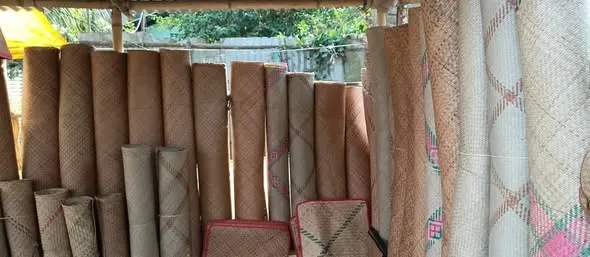
Culture and Societies: Sitalpati weaving in Assam functions as a family-based cottage industry in which all family members participate according to the gendered division of labour described above. The craft provides a primary or subsidiary livelihood to the communities involved. In the Goalpara area, the Nezine.com field report documents that approximately 200 to 300 Murta stems are required to produce a single mat, and that five grades of sitalpati are available in the Goalpara market, in sizes including 7 by 8 feet, 4.5 by 6 feet, and 3.5 by 6 feet. The craft is practiced outdoors or in the domestic space of the artisan's home with no mechanical devices, as is consistent with all documented forms of the sitalpati tradition across India and Bangladesh. Kaliganj in the Barak Valley also has its own market for mat trading, which is documented in the ResearchGate botanical paper as locally significant. The craft's commercial value is suppressed by the role of middlemen who purchase finished products at the production site and resell them in the market, a structural problem identified by artisans and documented in the Nezine.com field report.
Religious Significance: No institutionally documented theological or ritual requirement exists for sitalpati weaving as a craft in Assam. However, the finished product has documented uses in religious practice. The Nezine.com field report from Goalpara notes that local Muslim residents use sitalpati mats as prayer mats for namaz, and that this function has contributed to demand for the craft in that area. The Memeraki cultural documentation website notes that in the Barak Valley, sitalpati mats are considered to carry auspicious significance among certain communities. These are functional and cultural uses of the product rather than embedded ritual requirements for the craft process itself. No initiation rite, offering, or ceremonial procedure within the weaving process is documented for the Assam tradition in available sources.
Understanding the Art
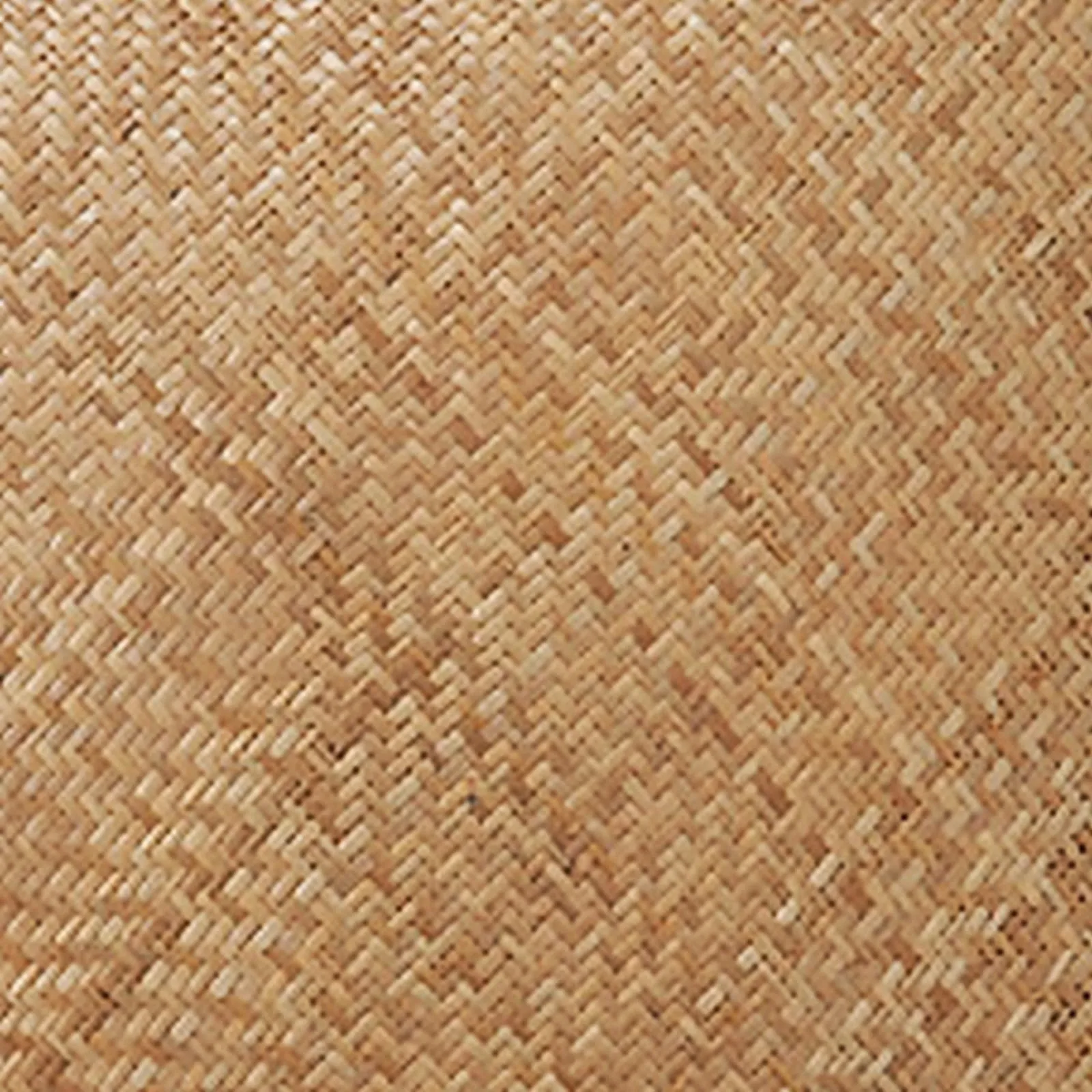
Style: The quality of sitalpati is judged by three primary attributes documented across multiple sources: glossiness, smoothness, and fineness of texture. The Asia InCH and Global InCH Encyclopedias of Intangible Cultural Heritage note that the best sitalpati is characterised by such smoothness that even a snake cannot glide over it, a standard of quality that is cited as a traditional measure within the craft community. The finished mat's visual character is determined by the natural colour range of the processed Murta strips, which shift from cream to brown tones during the drying process. The topmost strip of a split Murta stem, being the outermost layer, produces the coolest and finest quality strip and is reserved for sitalpati weaving proper, as documented in the Asia InCH field account citing Goalpara weaver Pradeep Das. The lower strips, which are coarser and less cool, are used for other mat or basketry items. The overall visual surface of a sitalpati mat in its natural state is a medley of cream and brown tones created by the natural colour variation in the cane strips, without requiring artificial colouring to generate pattern.
Central Motifs and Their Significance: Sitalpati weaving employs geometric patterns produced through the manipulation of the weave structure itself rather than through applied ornamentation. The standard weave types documented in the Asia InCH Encyclopedia are check, twill, zigzag, diagonal, and diamond configurations. The adept weaver manipulates the natural tonal variation between light and darker strips to create geometric shapes and repeating patterns within these weave types. Mats with more elaborate decorative patterns are specifically called nakshi pati in the Bengali mat-weaving tradition, though this term is applied most specifically to the Sylhet and Noakhali forms in Bangladesh. In the Assam tradition, the Nezine.com field report describes the weave as generally twill or chequered with slight variations, which aligns with the documented pattern vocabulary of the broader regional tradition. No symbolic, narrative, or cosmological significance has been formally documented for individual motifs in the Assam sitalpati tradition in the academic and institutional sources reviewed.
Process: The manufacture of sitalpati involves a sequence of preparation, splitting, sizing, and weaving steps, all performed by hand without mechanical devices. The Commissionerate of Industries and Commerce, Government of Assam, and the Nezine.com field report provide the most detailed documentation of the process as practiced in Assam. The raw Murta stems are first washed in water mixed with washing soda (sodium bicarbonate) to clean the surface. After washing, they are spread in open sunlight to dry. Once dried, the stems are divided lengthwise into two equal halves using a dao (bill-hook). Each half is then subdivided into four strips of equal length and breadth. The inner soft pith, called boka in local terminology, is removed from each strip using a chopping tool called a chip. This stage of removing the inner pith is called aushani (planing) in the local craft vocabulary. The strips are then subjected to nawkhani (sizing), in which each strip is made uniformly equal in breadth throughout its entire length, which is essential for consistent weave quality. The Murta plant requires three to four years to reach harvestable size before this process can begin, as documented in the Nezine.com field report.
Colouring of the prepared strips, where applied, is done using natural dyestuffs documented in the Goalpara tradition. Ivory or white colour is obtained by boiling the splits in rice-water (the starchy water from boiled rice). Different colours are produced by dipping strips in bhatar-phen (juice of boiled rice), in a liquid made from mesh of amrapata flowers (Hibiscus sabdariffa) and tamarind leaves, or by wrapping bundles of strips in mango bark and burying them under mud for approximately seven days to achieve black colouring. Red is the one colour for which a chemical dye, locally called Mezenta, is used at the point of production documented. Once prepared and coloured, the strips are woven by women into the flat mat structure using the twill, chequered, or diagonal weave patterns described above. The Asia InCH field account states that a mat measuring four by six feet takes approximately one and a half days to weave, with the wetting, drying, and colouring processes taking additional time separately.
Mediums Used: The primary and only documented raw material for sitalpati in Assam is the stem of Schumannianthus dichotomus (Murta or pati doi), a perennial wetland shrub of the family Marantaceae, first described botanically by Roxburgh and later named by Gagnepain. The plant grows in marshy and waterlogged areas and requires three to four years to reach harvestable size. In Assam, it is found naturally in riverine areas including Majuli island and is cultivated in the wetland areas of the Barak Valley and Goalpara districts.
Propagation is through rhizomes and branch cuttings. Harvesting is typically done during the February to March period, as documented in the ResearchGate paper on Murta as a non-wood forest product (2017). The processing tools include the dao (bill-hook) for splitting, the chip (chopping tool) for removing the inner pith, and no mechanical devices of any kind. Natural dyestuffs include rice-water, Hibiscus sabdariffa, tamarind leaves, and mango bark. Chemical red dye (Mezenta) is documented as used solely for producing the colour red in the Goalpara tradition.
New Outlook
The sitalpati craft in Assam faces sustainability pressures documented across multiple sources. Access to raw Murta stems has been constrained by flooding, which periodically destroys Murta plantations, and by land scarcity due to population growth, forcing artisans to source stems from distant locations such as Dibrugarh in Upper Assam, as documented in the Nezine.com field report. The low commercial price of finished mats relative to the labour and material cost is a documented structural constraint. Artisans are typically not directly connected to urban or export markets and rely on a middleman distribution system that keeps returns at the producer level low.
Institutional responses include the guru-shishya parampara scheme of the Government of India, under which Ranjit Kumar Dey of Goalpara has transmitted the craft to younger artisans. The Sreemanta Sankar Mission of Guwahati, designated as a Nodal Agency for the Northeast Region by NITI Aayog under the Women Entrepreneurs Platform, has proposed a project for Goalpara district focused on cultivating and processing Maranta cane as a natural fibre for sitalpati production, with the involvement of specialist designers for product development and export orientation. Some artisans have expanded their product range beyond floor and sleeping mats to include bags, mobile covers, school bags, tablemats, and partitions, as documented in the Yeh Hai India and Nezine.com sources, adapting the weave structure to contemporary functional products. Online retail availability of sitalpati mats from Assam has been noted in commerce documentation.
The UNESCO inscription of the Sylhet form of the craft in 2017 has provided broader international visibility to the sitalpati tradition as a regional heritage practice, though the Assam form has not received equivalent formal international recognition as of the sources reviewed.
Learn Sitalpati

Bibliography
Text Sources
Banu, Zinat Mahrukh. “Nakshi Pati.” Banglapedia: National Encyclopedia of Bangladesh, edited by Sirajul Islam and Ahmed A. Jamal, 2nd ed., Asiatic Society of Bangladesh, 2012.
Bhattacharjee, S., and Seal, A.. “Murta Plant, a Non-Wood Forest Product Can Be a Sustainable Source of Rural Income in Northeastern Part of India.” ResearchGate, 2017.
Chowdhury, D., and Konwar, B. K.. “Morphology and Karyotype Study of Patidoi (Schumannianthus dichotomus (Roxb.) Gagnep., Synonym Clinogyne dichotoma Salisb.), a Traditional Plant of Assam.” Current Science, vol. 91, no. 5, 2006, pp. 648–651.
Chowdhury, M. S. H., et al. “Management and Economic Value of Schumannianthus dichotoma in Rural Homesteads in the Sylhet Region of Bangladesh.” Journal of Subtropical Agriculture Research and Development, vol. 5, no. 1, 2007, pp. 202–207.
Internet Sources (for Images)
Dhar, Shreayashi. “Whispers of the Weave: Sitalpati, the Mats of Bengal’s Soul.” Oak Lores, 21 Apr. 2025, https://oaklores.com/2025/04/21/whispers-of-the-weave-sitalpati-the-mats-of-bengals-soul/. Accessed on April 22, 2026.
Dibarijit. “When Summer Turns Up the Heat: Assam’s Sitalpati, the Humble Handwoven Cool Mat…” Facebook, 13th June 2025, https://www.facebook.com/dibarijit/posts/when-summer-turns-up-the-heat-assams-sitalpatithe-humble-handwoven-cool-matbecom/24704793705790440/. Accessed on April 22, 2026.
“Handicrafts from Cooch Behar (West Bengal): Sitalpati Mat Handbags.” Muthusamy Photo Stream, 4 Apr. 2014, https://muthusamyphotostream.blogspot.com/2014/04/handicrafts-from-cooch-behar-west.html. Accessed on April 22, 2026.
“Shital Pati.” ZiveLiblog, 27 June 2016, https://ziveliblog.wordpress.com/2016/06/27/shital-pati/. Accessed on April 22, 2026.