

Sikki Grass Craft - The Handicraft Tradition of Bihar
Explore Sikki Grass Craft, the handicraft tradition of Bihar, and learn about its origins, techniques, cultural significance, and artistic heritage.
Introduction
Sikki grass craft is a traditional coiling and weaving technique practiced primarily by women in the Mithila region of North Bihar, India, in which a golden-stemmed grass called sikki is coiled around a structural base of munj grass to produce domestic objects, ritual items, decorative pieces, and toys. The craft is also referred to as sikkikala in Maithili-language usage, and the primary material gives the craft its common alternative name, golden grass craft. Sikki grass craft holds Geographical Indication (GI) status conferred by the Government of India, and is presently classified as endangered due to declining practitioner numbers and structural market challenges.
Etymology: The word sikki refers specifically to the inner fibrous stem extracted from a tall golden-coloured grass that grows in the wet and marshy areas of the Mithila region. The term designates both the raw material and the craft tradition built upon it. The craft tradition is also called sikkikala, where kala is the Maithili and Sanskrit word for art or skill. In documentation, the craft is frequently identified by the descriptor "golden grass craft," which refers to the distinctive golden-yellow colour that the prepared stems retain after drying. The structural supporting grass used in the same craft is called munj (botanical name Saccharum munja), which is a cheaper and more abundant reed used to provide interior form and rigidity to sikki products. The term pauti, frequently encountered in documentation, refers to the specific small covered box form made from sikki that is traditionally given to daughters at the time of marriage.
Origin: The origin of sikki grass craft cannot be established with precision on the basis of currently available documented evidence. The Khoj Studios craft documentation states explicitly that it is difficult to trace the origin of this craft, but concludes from a study of social customs and manufacturing methods that it is an ancient craft. The CraftMark craft cluster documentation (published via the Office of the Development Commissioner, Handicrafts, Government of India) does not assign a founding date. The ResearchGate academic paper on sikki grass craft and women entrepreneurship (2023) places the tradition in the Vedic era, though this claim is made without citation to a specific primary source, and should be treated as an approximate characterisation of deep antiquity rather than a precisely documented period. The UMSAS (Upendra Maharathi Shilp Anusandhan Sansthan, the Bihar state craft research body) documentation describes the craft as having originated when women of the Mithilanchal began making storage vessels for grain from the sikki grass that grew in local waterlogged areas, a process that predated any recorded commercial context.
Raiyam village in the Jhanjharpur block of Madhubani district is identified in multiple sources, including the Shubham Singh craft study (Medium, 2022) and the UMSAS documentation, as the site considered to be the place of origin of the craft within its present production geography. This attribution is based on local practitioner accounts and is not independently supported by archaeological or archival evidence.
Location: Sikki grass craft is concentrated in three districts of North Bihar: Madhubani, Sitamarhi, and Darbhanga. These are identified as the primary production zones in the CraftMark documentation, the UMSAS craft documentation, and the Shubham Singh craft study. Within Madhubani district, nine villages are specifically documented by the Shubham Singh study as centres of active production: Raiyam (considered the traditional place of origin), Laheriaganj, Jitwarpur, Sapta, Rahika, Ranti, Bhagirathpur, Umari, and Rampatti. The Craft Furnish documentation additionally identifies Rayam, Rampur, Madehpur, Siddhi, Jaynagar, Katihar, Gaonaha, Sonvarsha, and Sitamarhi as major centres. The craft is practiced more broadly across North Bihar, but commercial production and trained practitioners are concentrated in Madhubani district.
Sikki grass itself grows in the wet and marshy areas around rivers and ponds in the Mithila region, specifically in zones of heavy rainfall. The Asia InCH Encyclopedia of Intangible Cultural Heritage identifies the marshy areas of Madhubani district as the primary growth zone of the grass. The Koshi river region within Madhubani district is specifically mentioned by the UMSAS documentation as a habitat for the grass. Production of the craft is also documented in some parts of Uttar Pradesh, though at lower concentrations than in North Bihar.
Community: Sikki grass craft is documented uniformly across all sources as a women's craft. The Asia InCH Encyclopedia entry, the CraftMark documentation, the UMSAS documentation, and the ResearchGate academic paper all confirm that the craft is practiced by women of the household across castes and communities in the Mithila region, and that skill is transmitted through the female line from mothers, grandmothers, and older women to daughters and younger girls. The CraftMark documentation records that young girls learn the craft from their grandmothers or mothers because it is a very old craft of the area and a majority of older women possess the skill.
The Asia InCH Encyclopedia notes, in documentation of the practitioner Meera Thakur of Umri village, that while her father worked alongside her mother in making sikki products, the craft is dominantly practiced by women. Male participation is documented in some cases, particularly to fulfil commercial orders when demand exceeds capacity of household female practitioners, but the craft is not a male professional tradition. The harvesting of the raw grass is documented by the Asia InCH Encyclopedia and the Gaatha craft documentation as typically carried out by women of the Harijan community (Scheduled Caste communities), who collect and dry the grass during the rainy season and sell it at weekly haat markets or through itinerant door-to-door traders. The Gaatha documentation identifies the community of grass harvesters by the local term Amas.
The craft is not associated with a single caste community. Across documented practitioners, women from multiple communities within the Mithila region engage in the tradition. The ResearchGate study notes that the Mithila region supports over 4,000 active artists in the craft, with limitations on earnings stemming from market access rather than community exclusion.
Relevance: Sikki grass craft received Geographical Indication (GI) registration from the Government of India, as documented by the Memeraki craft portal and the Craft Furnish documentation. This registration was undertaken to protect the craft from imitation and to secure the economic rights of artisans practicing sikki work in Bihar. The Craft Furnish documentation records that the Bihar tableau at the Republic Day Parade of 2013 in New Delhi was presented on the theme of sikki grass craft, and the Bihar Pavilion at the International Trade Fair at Pragati Maidan in New Delhi in 2014 was decorated with sikki art, both representing formal government-level national recognition.
The craft provides a livelihood, either as a full-time occupation or as supplementary income, to a significant number of women across North Bihar. The UMSAS craft documentation identifies the Raiyam and Rampur villages in Madhubani as presently active production centres. The Asia InCH Encyclopedia records that the artisan Gucchi Devi of Umri village teaches harijan women to make sikki products, collects these for sale at exhibitions and fairs across India, and pays the women for their work, illustrating the cooperative production and distribution structure that many practitioners depend upon.
Key documented practitioners with formal recognition include Meera Thakur of Umri, Madhubani, who received the Bal Shilpi Artist award from the Delhi Crafts Council in 1988 and the UNESCO Seal of Excellence for Handicrafts in 2005, and was awarded the Nari Shakti Puraskar by the President of India in 2022 (documented in the Wikipedia article on Meera Thakur). Nazda Khatoon is documented by The India Craft Project as a National Awardee in sikki grass craft. Kumudani Devi, Dhirendra Kumar, and Sudhira Devi with her husband Chandra Kumar (both National Awardees) are documented by the Craft Furnish and Sakoya Foundation sources as award-holding practitioners.
History
Background: The craft tradition of sikki grass weaving is understood by all available documentation to predate any recorded commercial or institutional context. The CraftMark documentation describes a past in which the women of the Mithila villages made different artistic crafts and paintings for their entertainment as well as to make utility products for household use when few other sources of entertainment existed. The UMSAS documentation records that in early times almost every household in Mithilanchal made daily use items, including Dalia (flat baskets), Mauni (trays), Daura (large structural baskets used in gift exchange), and Chattai (mats) from sikki grass. Over time, the product range expanded to include toys, dolls, figures of animals and birds, and eventually deity figures for worship.
The craft experienced a commercial decline with the proliferation of cheap plastic goods, as documented by the Craft Furnish documentation. A period of revival is documented from the 1990s onward: the Ar. Abhishek Kumar documentation notes that the craft saw revival in the nineties as awareness of local goods grew with improved communication networks and economic liberalisation. The UMSAS contributed to revival by training artists in new skills and designs and highlighting the craft at trade fairs. A significant innovation in the craft was introduced by Dhirendra Kumar of Rampur village in Madhubani, who developed the technique of applying sikki grass to canvas using a cut-and-paste method rather than the traditional coiling structure, creating two-dimensional pictorial works from sikki.
Culture and Societies: Sikki grass craft occupies a central position in the social and domestic life of Mithila women. The Khoj Studios documentation states that it is closely connected with the marriage ceremony and that the young bride is expected to have learned the art of making objects from sikki from childhood, so that at the time of departure for her new home (sasural) she can carry a collection of items. Villagers traditionally assess the ability and imagination of a young bride by the variety and quality of sikki articles she brings. The Ar. Abhishek Kumar documentation records the cultural expectation that before marriage, a girl should know five craft forms: painting, Sujni craft, Kshidakari craft, papier mache craft, and sikki craft.
The Asia InCH Encyclopedia confirms that girls and brides-to-be take sikki products to their husband's homes after marriage as part of their dowry, and that this tradition continues in the present. Eleven sikki baskets (Daura) were documented as a customary gift set given to the bride as part of the marriage ritual (ResearchGate study, 2023). The pauti (small covered box) is documented by Wikipedia as given to daughters at marriage to hold sindoor, ornaments, and jewellery.
The craft is practiced as a communal social activity. The ResearchGate study documents that women sit together in groups, particularly on winter mornings in the sun, to make sikki products, and that this communal practice functions as a social activity alongside an economic one. Skill is transmitted informally through observation and practice within the household and through community settings, without formal institutional training in its traditional form.
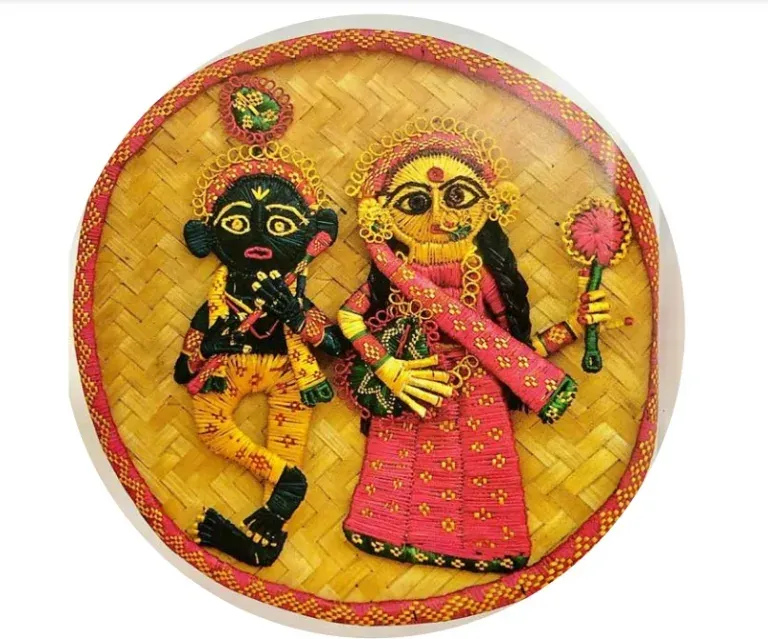
Religious Significance: Sikki grass craft has documented religious and ritual significance at multiple levels. The Asia InCH Encyclopedia records that for religious festivals, women make figures of the deities to be worshipped, including Ram, Lakshman, Sita, Ganesh, Durga Devi, Hanuman, Saraswati, and Lakshmi, which are placed in the home for worship. The Gaatha craft documentation identifies Sailesh Puja (also documented as Salhesh Puja), the principal festival of the Moosahar tribe of Bihar, as involving a range of sikki products for ritualistic uses, including large platters, small boxes, lamps, and fruits all made from sikki.
The ResearchGate study documents that sikki baskets are used to carry the samagri (food offerings) during Chhath Puja, one of the principal festivals of Bihar. The decorative coverings and mandap (wedding canopy) elements for marriages are also made from sikki grass, as documented in the same study. The Shubham Singh craft study documents that Kohbar paintings in sikki are made and worshipped in Mithilanchal during auspicious occasions, particularly marriages, using the traditional Kohbar iconographic programme of peacock, bride and groom, Gauri-Shankar, navgraha, bamboo, snakes, fish, and tortoise. Figures of Lord Shiva and Ganesha made in sikki are documented as installed in homes for worship. The grass itself is considered auspicious by the communities of the region, as noted in the Gaatha documentation.
Understanding the Art
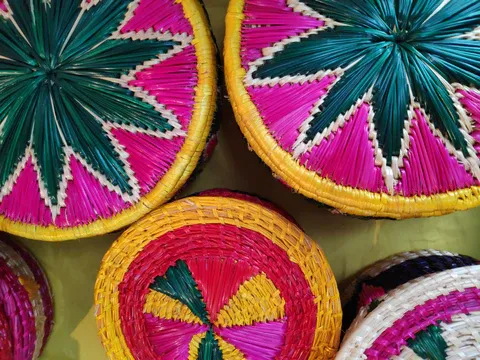
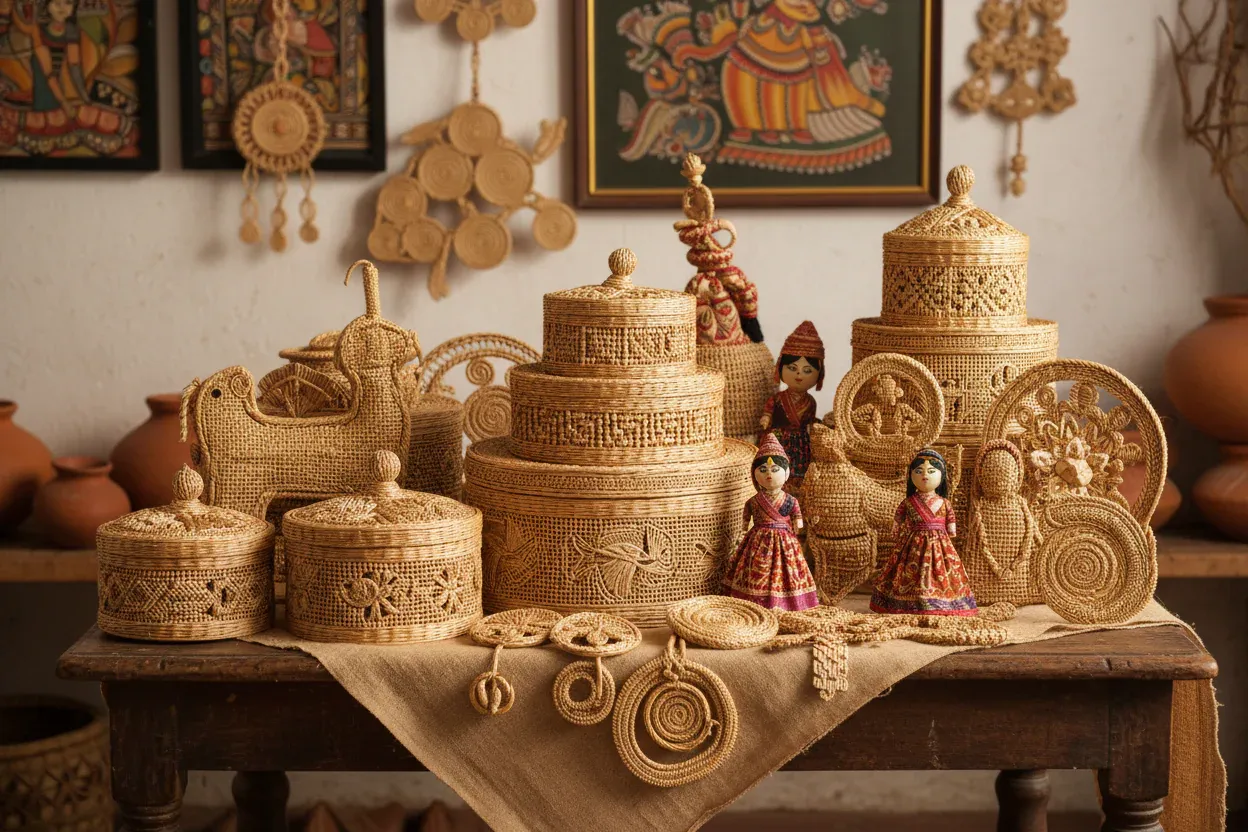
Style: The visual and structural character of sikki grass craft is defined by the coiling technique and the contrast between the natural golden colour of unsized sikki and the dyed colours applied to a portion of the grass. The Asia InCH Encyclopedia and the CraftMark documentation both identify the combination of dyed sikki with natural golden-coloured sikki as the primary means of generating visual pattern and decorative surface in the finished object. Products are typically tightly coiled, with the munj interior completely covered and invisible. The surfaces appear as continuous bands of colour in geometric, zigzag, and diagonal configurations corresponding to the alternation of dyed and undyed grass lengths in the coiling sequence.
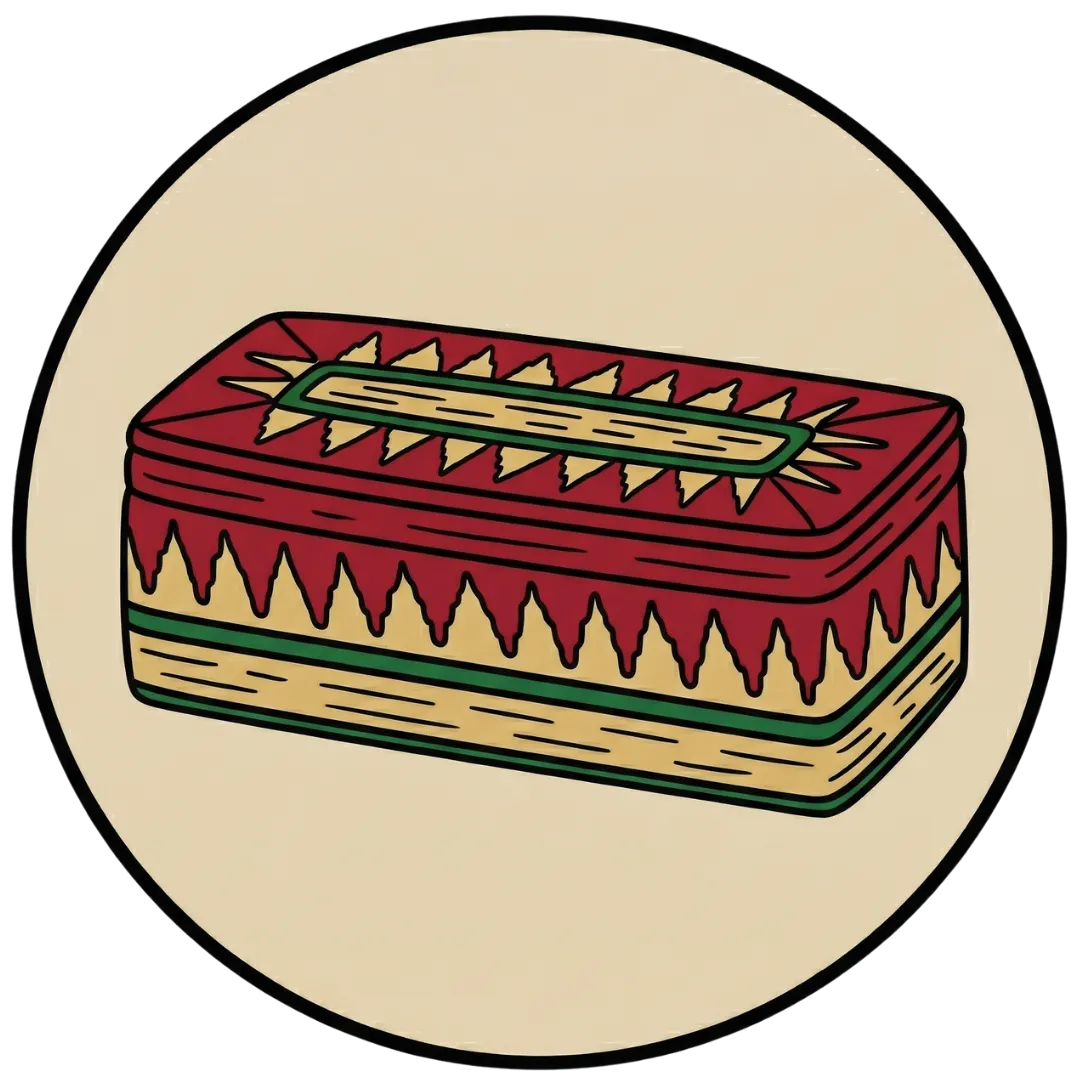
Three-dimensional objects including bowls, covered boxes (pauti), trays (mauni), storage containers (jhappa), and deity figures are the traditional forms. The CraftMark documentation and the Asia InCH Encyclopedia note that two-dimensional representations of birds, animals, trees, and deity figures are also produced. The Shubham Singh craft study documents Kohbar-style compositions in sikki as a distinct pictorial form using the iconographic vocabulary of Mithila marriage ritual. The canvas-based pictorial form developed by Dhirendra Kumar of Rampur uses a cut-and-paste application of undyed golden sikki strips to create images without dye colouring.
Central Motifs and Their Significance: The motif vocabulary of traditional sikki craft objects is drawn from the same iconographic repertoire that characterises Mithila visual culture. Deity figures most commonly produced include Ganesh, Durga, Lakshman, Ram, Sita, Hanuman, Saraswati, Lakshmi, and Shiva, as documented by the Asia InCH Encyclopedia. These are made as three-dimensional standing or seated figures for worship in the domestic context. Birds and animals represented in two- and three-dimensional form include peacock, fish, tortoise, and various generic birds and animals, documented across the CraftMark, Gaatha, and Shubham Singh sources.
The Kohbar composition, which is the ritual iconographic programme of the Mithila marriage ceremony, is specifically reproduced in sikki form and documented by the Shubham Singh study as including peacock, bride and groom figures, Gauri-Shankar, navgraha (the nine planets), bamboo, snakes, fish, and tortoise. Each of these motifs carries a specific symbolic significance within the Mithila marriage ritual framework: bamboo and fish are fertility symbols, tortoise represents longevity and stability, snakes represent divine protection, and peacock represents beauty and prosperity. The Gaatha documentation confirms that sikki figures of deities constitute votive offerings during festivals, and the Asia InCH Encyclopedia records that festival-specific ritual objects are made for each major annual occasion. Geometric banding and border patterns are generated by the coiling technique itself and do not carry separately documented symbolic content.
Process: The production process of sikki grass craft is entirely manual and is documented in detail by the Asia InCH Encyclopedia (primary field documentation from artisan Meera Thakur), the CraftMark documentation (from field visits to Laheriaganj and Sarisabpahi in Madhubani), and the ResearchGate academic study.
The grass is harvested during the rainy season (August and September), typically by women of the Harijan community, who cut the stems from near the base, discard the flowering upper portion, and dry the remainder in the sun. The dried grass is split lengthwise into two strips per stem. These strips are the usable raw material. The strips are soaked in water before use to increase pliability. When colouring is desired, the sikki strips are boiled in dye dissolved in water for several hours until the required shade is achieved. The most frequently used colours are purple, deep blue, bright yellow, magenta pink, green, and red, all used in combination with the natural golden colour.
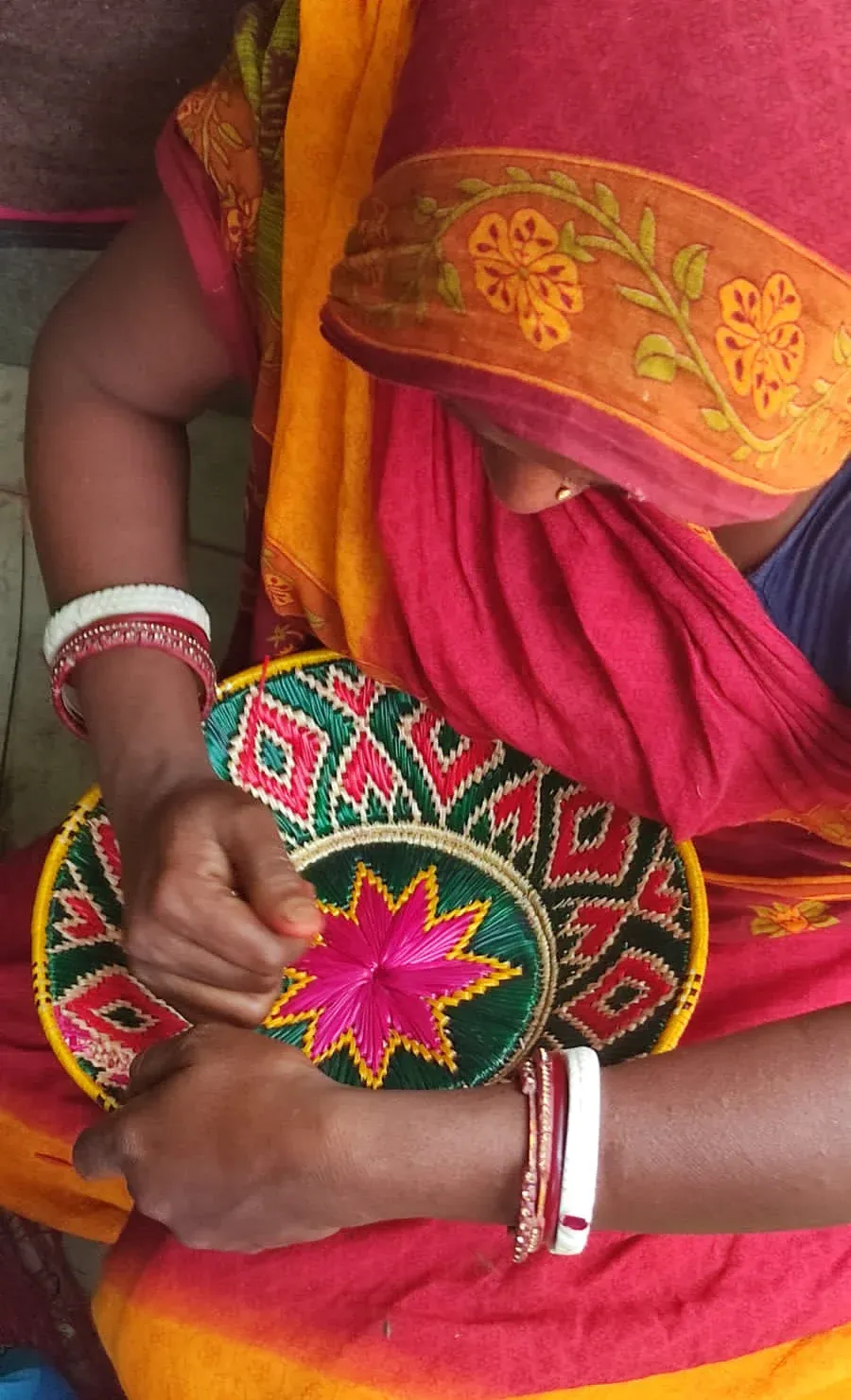
The structural base of each product is formed from munj grass, which is bent, curved, and coiled into the required shape. The munj is cheaper and more readily available than sikki and provides interior rigidity. Once the munj base is shaped, sikki strips are coiled tightly around and over it, completely covering the munj so that it is not visible in the finished product. The coiling is worked using the takua, a needle-shaped iron implement approximately five to six inches long with a rounded lacquer or lac head for grip. The takua is used to create gaps in the tightly coiled structure into which the leading tip of the next sikki strip is inserted and pulled through. A thin knife called choori and scissors called kaichi are used for splitting and cutting. No threads, cords, or additional materials are used in traditional sikki craft. Some contemporary practitioners produce items without the munj base, using sikki alone for thinner tablemats and similar flat objects.
Mediums Used: The primary raw material is sikki grass, the inner fibrous stem extracted from a tall golden-coloured grass species growing in the marshy areas of North Bihar's river systems. The Ar. Abhishek Kumar documentation identifies sikki as commonly described as related to vetiver grass. The Asia InCH Encyclopedia describes the structural supporting material as munj, identifying its botanical name as Saccharum munja. Khar (also called khara in some sources), which is the straw remainder of the grass after sikki extraction, is documented by the Gaatha source and the CraftMark documentation as an alternative structural material occasionally used in place of munj. Dyes for colouring are purchased in powder or pellet form from local markets, as documented by the Asia InCH Encyclopedia from direct artisan testimony (Meera Thakur). The lac dye reference in The India Craft Project documentation indicates lac-based dyes among the dyestuffs used. Water is documented as an essential medium for both soaking the grass before coiling and for the dye-boiling process. The sole tool is the takua. No mechanised equipment is used at any stage.
New Outlook
Sikki grass craft faces documented pressures from multiple directions. The proliferation of cheap plastic goods reduced demand for traditional household items made in sikki, as documented by the Craft Furnish source, and a significant portion of the rural population that once engaged in the craft has moved away from it. The ResearchGate study identifies the Mithila region as supporting over 4,000 artists in the craft at present, with major constraints including shortage of trained artisans, lack of consistent commercial orders, gender-related limitations on mobility and marketing, and dependence on government-sponsored exhibitions as the primary market access mechanism. The India Craft Project field documentation records that artisans report limited design expertise and knowledge of other materials as barriers to market expansion.
Institutional responses include the Upendra Maharathi Shilp Anusandhan Sansthan (UMSAS) in Patna, which has trained artisans in new skills and design approaches since the 1990s and facilitated participation in trade fairs. The GI registration of sikki grass craft provides legal protection against imitation. Meera Thakur runs the Hastakala Vikas Kendra in Madhubani and the Folk Art Handicraft Training Centre, through which she trains disadvantaged women in the craft (Wikipedia, Meera Thakur article). State and central government training centres are documented by the Asia InCH Encyclopedia as operational within the production region.
Contemporary product adaptation has expanded the range of sikki objects to include mobile phone cases, coasters, table mats, pen stands, paper weights, mirror frames, masks, and bangles, all documented in the CraftMark and Asia InCH sources. The canvas-based pictorial work developed by Dhirendra Kumar represents a significant formal innovation that has opened an urban decorative art market for sikki craft. However, the Asia InCH Encyclopedia field documentation notes that there is hardly any local market for sikki products, and that the craft's commercial sustainability depends on exhibition participation and connections with external buyers in urban and national markets. The craft remains classified as endangered due to the combination of declining practitioner numbers, limited commercial infrastructure, and the fragility of the transmission system in which the craft's survival depends on its continued embedding in domestic and marriage ritual contexts.
Learn Sikki Grass Craft
Bibliography
Text Sources
Chattopadhyay, Kamaladevi. Handicrafts of India. Indian Council for Cultural Relations, 1975.
Chattopadhyay, Kamaladevi. Indian Crafts Tradition. Publications Division, Ministry of Information and Broadcasting, Government of India, 1980.
Jaitly, Jaya. The Craft Traditions of India. Lustre Press / Roli Books, 1990.
Jaikar, Pupul. The Earth Mother: Legends, Ritual Arts, and Goddesses of India. Harper & Row / Penguin Books India, 1990.
Internet Sources (for Images)
“Golden Strands: Exploring the Sikki Grass Craft of Bihar.” Oak Lores, 15 Jan. 2025, https://oaklores.com/2025/01/15/golden-strands-exploring-the-sikki-grass-craft-of-bihar/. Accessed on April 22, 2026.
“Shikki Grass Craft from Bihar.” The India Craft Project, https://www.theindiacraftproject.com/blogs/blogs/sikki-grass-craft-from-bihar. Accessed on April 22, 2026.
“Sikki Grass Craft of Bihar.” Krafteria, https://krafteria.com/blogs/news/sikki-grass-craft-of-bihar. Accessed on April 22, 2026.
“सिक्की: मिथिला का लोकशिल्प (Sikki: Mithila’s Folk Craft).” Punarnawa, https://punarnawa.com/blogs/our-journal/%E0%A4%B8%E0%A4%BF%E0%A4%95%E0%A5%8D%E0%A4%95%E0%A5%80-%E0%A4%AE%E0%A4%BF%E0%A4%A5%E0%A4%BF%E0%A4%B2%E0%A4%BE-%E0%A4%95%E0%A4%BE-%E0%A4%B2%E0%A5%8B%E0%A4%95%E0%A4%B6%E0%A4%BF%E0%A4%B2%E0%A5%8D%E0%A4%AA-4. Accessed on April 22, 2026.