


Shola Craft - The Handicraft Tradition of West Bengal
Explore Shola Craft or Sholapith Shilpa, the handicraft tradition of West Bengal, and learn about its origins, techniques, cultural significance, and artistic heritage.
Introduction
Shola craft, also known as Sholapith craft or Sholapith shilpa, is a traditional craft practiced in West Bengal in which artisans carve and assemble the dried, spongy core of the shola plant (Aeschynomene aspera and Aeschynomene indica) into ornamental objects, ritual headgear, decorative elements for festivals, and a wide range of figurative and functional items. The material is also known as Indian cork. Shola craft is one of the most extensively integrated crafts in Bengali religious and social life, with sholapith objects used in Hindu wedding ceremonies, death rituals, the naming ceremony of infants, Durga Puja and other major festivals, and snake-goddess worship. Approximately 5,000 artisans practice this craft in West Bengal. The craft is classified as vulnerable due to the depletion of natural shola habitat and declining artisan incomes.
Etymology The word 'shola' refers to the plant Aeschynomene aspera, a species of aquatic herb in the bean family (Fabaceae). 'Pith' refers to the soft, spongy interior tissue of the plant's stem, which is the usable material for craft production. The material is classified as 'Indian cork' due to its functional resemblance to cork in terms of lightweight and compressibility. The artisan community is known as 'Malakar,' a term derived from 'mala' (garland) and 'kar' (maker), reflecting the community's ancestral role in producing garlands and decorative elements for religious ceremonies and the noble class.
Origin The historical origins of shola craft in Bengal are not precisely documented in academic sources. The craft's integration into Hindu religious practice is documented through its use in contexts that predate colonial records. An origin legend describes the shola plant as arising from a lock of Shiva's hair dropped into a pond, and the Malakar artisan community as emerging from the same divine act, though this is religious narrative rather than historical record. One documented historical event is the pre-1905 migration of shola craftsmen from Chittagong (now Bangladesh) to Bankapasi in Bardhaman district, which occurred before the first Partition of Bengal. An additional transition documented in academic sources is the move by ivory carvers in Murshidabad to shola as a substitute material after the fall of the Nawab of Bengal's court in Murshidabad and the later ban on ivory trade.
Location The craft is distributed across multiple West Bengal districts: Cooch Behar, Alipurduar, Dinajpur, Malda, Murshidabad, Birbhum, Bardhaman, Nadia, Hooghly, Bankura, and South 24 Parganas. Each region has documented stylistic specializations. Approximately 70 Shola craft units are documented in Bankapasi, Mangalkot block of Bardhaman district. Shola cultivation, however, is now restricted primarily to South 24 Parganas due to the destruction of marshy habitats elsewhere.
Community The Malakar community is the primary artisan community. The Malakars belong to the Nabasakha group of artisan castes in Bengal, which comprises nine branches: Kumbhakar, Karmakar, Malakar, Kangsakar, Sankhakar, Swarnakar, Sutradhar, Chitrakar, and Tantubay. This classification places shola craftsmen within a formalized artisan hierarchy documented in Bengali social history. The craft is transmitted intergenerationally within Malakar families.
Relevance Sholapith objects are integral to the major ritualistic occasions of Hindu Bengali life. Their white color is symbolically associated with purity and auspiciousness, making them particularly appropriate for sacred contexts. The craft has gained international market presence through export to countries including the USA, UK, Australia, Canada, Japan, Thailand, Korea, and China, though artisan incomes remain low due to middlemen and export company appropriation of margins. Government retail platforms including Biswa Bangla and Bangasree in Kolkata provide institutional market access. Large Durga Puja pandal decorations in Kolkata are regularly executed in sholapith, creating a high-visibility seasonal market.
History
Background The formal documentation of shola craft in academic and governmental sources is limited relative to its cultural ubiquity. The Sahapedia entry on Sholapith craftspeople in rural Bengal, authored in the context of MSME and National Institute of Design surveys, provides the most systematic published documentation of artisan conditions. Academic literature includes Ghosh, Kundan's 2015 paper 'Sholapith Craft of West Bengal' published in the International Journal of Interdisciplinary and Multidisciplinary Studies, and a subsequent overview paper on Academia.edu. The design-focused documentation at sholacraft.com, which runs a preservation project focused on skill transmission and innovation, supplements the academic record.
Two documented historical transitions shaped the craft's development in its present centers. The first is the Murshidabad transition: after the Nawab of Bengal's court at Murshidabad lost power following the Battle of Plassey (1757), the ivory carvers who had served the court lost their patronage, and artisans subsequently adopted shola as a substitute material given the similarity of the carving process. The second transition is the Chittagong migration: before the first Partition of Bengal in 1905, a group of shola craftsmen from Chittagong migrated to Bankapasi in Bardhaman district and established production units there, contributing to the emergence of a distinct Bardhaman craft tradition.
The colonial period produced one of the craft's most globally visible applications: the pith helmet, or shola topee (topi), worn as standard headgear in British colonial administration across Asia and Africa. This application gave shola pith its English description as 'Indian cork' and its widespread production for export markets during British rule. Even after Indian independence, the shola topee continued to be produced for ceremonial and symbolic purposes.
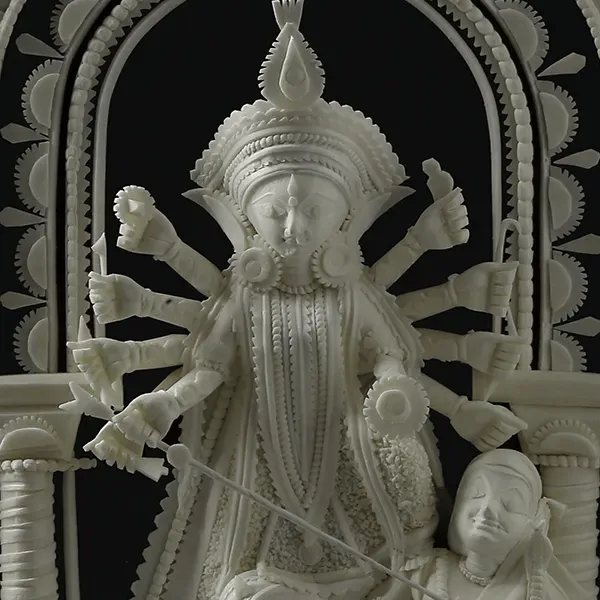
Culture and Societies Sholapith objects are embedded in almost every major life-cycle ritual in Hindu Bengali tradition. The topor (conical ceremonial headgear for the groom) and sithi mukut (crown for the bride) are essential components of the traditional Bengali Hindu wedding. The saitol, an object used in wedding ceremonies, funerals, and the first ceremonial meal of a child, is fashioned from shola in the Rangpur tradition. The worship of Manasa, the goddess of snakes, fertility, and wealth, incorporates the 'Manasar Chali,' a halo of snake hoods around the deity's head, crafted from shola. At Durga Puja, elaborate decorative backdrops for the deity's image are made from sholapith by artisans who may spend months on a single piece.
During the zamindari period, shola craft was restricted primarily to religious and ritualistic products serving zamindars and temple institutions. Following the abolition of the zamindari system, public Durga Pujas expanded significantly, creating increased demand for shola pith products. Units in Bankapasi operate with 5 to 10 artisans per unit, rising to 10 to 15 during peak festival seasons. Artisans may work on a seasonal contract basis with unit heads who advance wages.
The Sahapedia documentation notes that shola products exported internationally are mostly sold at high retail prices in the range of Rs. 2,500 for a shola palanquin, while artisan wages remain very low. A survey in Mandirbazar block under MSME, Bengal Women Welfare Association, and National Institute of Design found that some shola craftswomen earn extremely low daily wages. The middlemen and export companies are documented as appropriating most of the profit from international sales.
Religious Significance Shola craft's primary function is ritual and religious. The symbolic significance of the material's white color, associated with purity in Hindu religious tradition, underpins its use in sacred contexts. The Malakar community's origin narrative derives directly from a mythological account involving Shiva, Parvati, and the divine origin of the shola plant, placing the craft within a sacred cosmology. Key religious applications include the wedding topor and sithi mukut headgear; the Manasar Chali for snake goddess worship; decorative backdrops and ornaments for Durga Puja, Kali Puja, Saraswati Puja, and Lakshmi Puja; garlands and offerings for deities; and the chandmala (moon garland) and kodomphool (fragrant flower replica) that appear in virtually every Bengali ritual occasion.
The Sahapedia documentation records that sholapith craft 'came into being and continues to be in practice mainly with its white colour, suggestive of purity and sacredness.' The craft is classified among the nine recognized artisan communities (Nabasakha) of Bengali Hindu society, whose roles are specifically defined in relation to ritual service to the community.
Understanding the Art
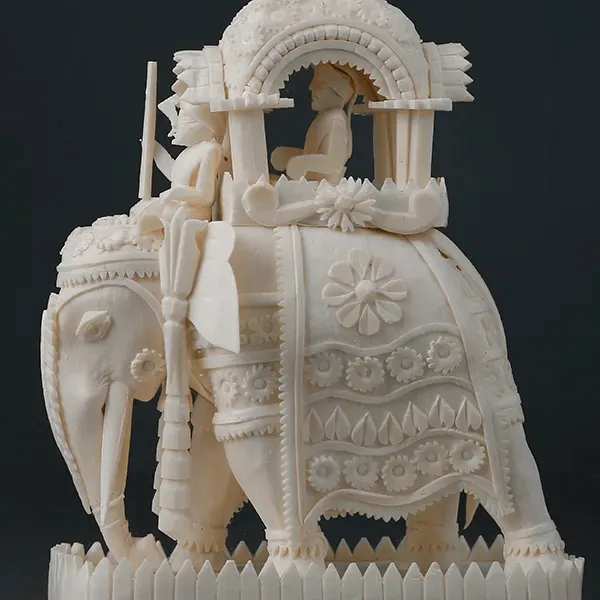
Style Shola craft products fall into several categories differentiated by function and technique. Ritualistic products include topor (bridal headdress), chandmala, kodomphool, garlands, and items for specific deity worship including the Manasar Chali. Festival decorative products include large-scale backdrops for Durga Puja images and pandal decoration. Representational objects include peacock boats, palanquins, elephant howdahs, bullock carts, chariots, and miniature figurines. Contemporary decorative products include wall hangings, flower vases, souvenir miniatures, and figurines of classical dance forms. Regional stylistic variation is documented: Murshidabad specializes in flowery designs and decorative headwear; South 24 Parganas produces simpler flowers and birds for household income; Bardhaman has the Bankapasi cluster with its own workshop-based production model.
Central Motifs and Their Significance The dominant formal vocabulary of shola craft is derived from the natural world, particularly floral and botanical forms. Geometric motifs are also documented. The design research documentation notes that 'most of the decorations are based and derived from nature in terms of floral patterns. Geometric motifs and floral designs or shola petals reign over decorations.' Figurative representation appears in deity faces, animals, and miniature architectural forms. The white material itself is the central aesthetic attribute: the craft's visual identity depends on the luminous, uniform whiteness of sholapith, which is occasionally supplemented with color in specific product categories. Traditional coloring uses reddish-brown and white as primary colors.
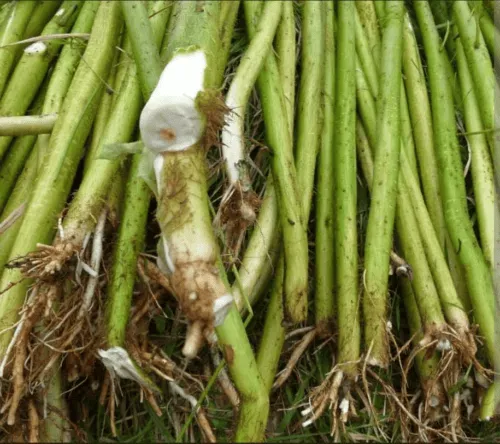
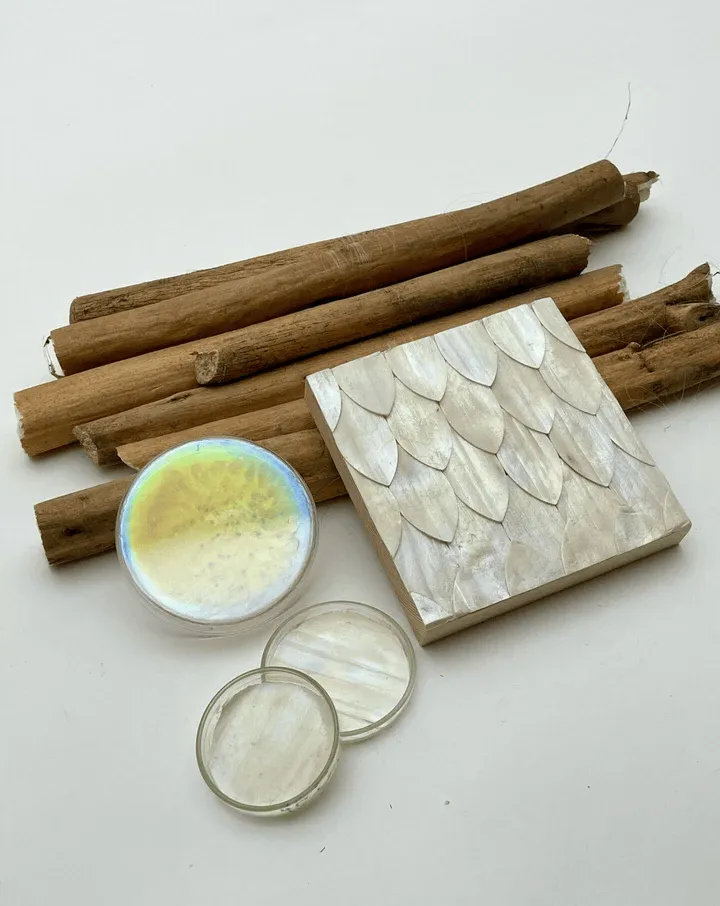
Process Shola plants are harvested from marshy areas. Stems are submerged in water during growth and are uprooted when mature. The uprooted plants are dried until the outer brown bark turns fully brown. Dried stems, which are approximately one meter in length, are cut into pieces of four to eight inches. The brown outer bark is peeled to reveal the inner white core, which is approximately 1.5 inches in diameter. The core is then sliced into thin strips or sheets called 'kap' (sheets) or 'paturi' (slices) using a knife tool called a 'kath.' For the engraving method, artisans shape individual pieces of sholapith using knives, scissors, and needles to achieve the desired forms. Multiple pieces (approximately 20 to 25 sheets) may be held and rolled into cylindrical forms before being shaped further. The pieces are assembled using natural adhesives. Precision is critical because errors in the soft material cannot be corrected after carving. For the painting method, artisans apply color to the shola surface using their own traditional painting technique. Finished products are often packed in airtight glass cases with black tape for shipping to distant markets.
Mediums Used Primary Material: Sholapith: the spongy, white, dried core of Aeschynomene aspera (Bhat shola) and Aeschynomene indica (Kath shola). Both species grow in marshy, waterlogged areas. Adhesive: Natural adhesives are used to bind assembled sholapith pieces. Colorants: Traditional coloring uses reddish-brown and white pigments. Contemporary production uses a broader range of colors for export and decorative markets. Tools: Knife (kath), scissors, needles, measuring tape, and string. No specialized mechanical equipment is used; the craft is entirely manual.
New Outlook
Shola craft is classified as vulnerable. The most significant structural challenge is the destruction of marshy wetland habitats that support Aeschynomene aspera growth. Shola cultivation as a cash crop is now largely restricted to South 24 Parganas, where farmers grow it under 4 to 5 feet of water during the June-July monsoon months. The National Institute of Design survey conducted in collaboration with MSME and the Bengal Women Welfare Association found that artisan wages are extremely low, with significant gaps between retail export prices and producer incomes due to middlemen extraction.
Conservation initiatives including the sholacraft.com preservation project, which focuses on skill transmission, documentation, and design innovation, aim to sustain the craft by training younger artisans and connecting practitioners with contemporary design markets. The project conducted workshops in Bhatibari village, Alipurduar (2019) and published a coffee table book 'Shola: The Wonder Wood' alongside a documentary film 'Shola Gantha,' released at KCC in Kolkata in November 2019. The Bengal Art Gallery at ICCR has hosted exhibitions of shola craft, and artisan organizations maintain connections with government retail platforms Viswa Bangla and Bangasree.
Several artisans hold national recognition: a National Award winner trained from a young age under elder brother mentorship (Samir Saha), a President's Award recipient (for Saraswati-related work, 1966), and National Award holder Sandip Biswas. These individual recognitions coexist with systemic economic fragility in the artisan community, where younger generations migrate to cities for higher and more stable incomes, creating a documented skill transmission gap.
Learn Sholapith Shilpa








Bibliography
Sources
Ghosh, Kundan. “Sholapith Craft of West Bengal.” International Journal of Interdisciplinary and Multidisciplinary Studies, vol. 3, no. 1, 2015.
Sahapedia. “Conditions of Sholapith Craftspeople in Rural Bengal.” Sahapedia, New Delhi, sahapedia.org.
Shola: The Wonder Wood. Sholacraft.com, 2019.
Mukharji, T. N. Art Manufactures of India. Calcutta, 1888.
Singh, Martand, editor. Crafts of West Bengal. Mapin Publishing / Crafts Council of West Bengal.
National Institute of Design, et al. Survey of Sholapith Workers, Mandirbazar Block, South 24 Parganas. (Cited in Sahapedia documentation.)
Image Sources
Bhattacharya, Ritomitra. “The Art of Sholapith Crafting: Ethereal Beauty from the Spongewood of Bengal.” Oaklores, 10 Mar. 2026, https://oaklores.com/2026/03/10/the-art-of-sholapith-crafting-ethereal-beauty-from-the-spongewood-of-bengal/. Accessed on May 06, 2026.
“Crafting the Future: How Ancient Wisdom Is Shaping Tomorrow’s Materials.” Dulcie, 8 Oct. 2024, https://www.dulcie.world/blogs/news/crafting-the-future-how-ancient-wisdom-is-shaping-tomorrow-s-materials. Accessed on May 06, 2026.
“Whispers of Tradition: Dive into the Ethereal Craftsmanship of Shola Pith Carving in West Bengal.” Medium, Craft Gum, https://medium.com/craft-gum/whispers-of-tradition-dive-into-the-ethereal-craftsmanship-of-shola-pith-carving-in-west-bengal-bd1c94c08da7. Accessed on May 06, 2026.