

Papier Mache - The Handicraft Tradition of Jammu & Kashmir
Explore Papier Mache, the handicraft tradition of Jammu and Kashmir, and learn about its origins, techniques, cultural significance, and artistic heritage.
Introduction
Kashmir Papier Mache is a traditional craft of the Kashmir valley in which paper pulp is moulded into decorative objects and subsequently painted with freehand designs using mineral, vegetable, and synthetic pigments. The craft combines two distinct specialist practices: sakhtasazi, the structural forming of the paper pulp base, and naqashi, the painted ornamentation of its surface. The product is registered under the Geographical Indications of Goods (Registration and Protection) Act 1999, Government of India, under the title "Kashmir Paper Machie," with registration completed by the Controller General of Patents Designs and Trademarks in the period April 2011 to March 2012.
Etymology: The word papier mache derives from the French phrase meaning chewed paper, referring to the process of reducing paper to pulp for moulding. As documented across multiple sources including Wikipedia's Kashmir papier mache entry and the Gaatha.org craft archive, the craft was originally known in Kashmir by its Persian name kar-i-qalamdani (also rendered kar-i-kalamdani), meaning pen-case work, named for the qalamdan or pen case that was its earliest primary product. The craft is also referred to as kar-i-munaqqash, meaning painted work, a term describing the decorated surface rather than the structural form.
The French designation replaced the original Persian terminology through the course of nineteenth-century European trade in the craft, as documented in the Dastkari Haat Samiti documentation published on Google Arts and Culture (2017) and the Sahapedia archive by Sadaf Nazir Wani. The Gaatha.org craft archive and the JK Arts Foundation documentation note that the local Kashmiri term koshur kagaz refers to the traditional handmade paper of Kashmir that historically formed the raw material base of the craft.
Origin: The origin of Kashmir Papier Mache presents two principal accounts in the documented historical record, both of which are reported across multiple sources without scholarly consensus resolving between them. The first account attributes the introduction of the craft to Mir Sayyid Ali Hamadani (1314 to 1384 AD), the Sufi mystic from Hamadan in present-day Iran, known in Kashmir as Shah-i-Hamadan. The Sahapedia documentation by Sadaf Nazir Wani records that in collective Kashmiri memory, the craft's popularisation is associated with Mir Sayyid Ali Hamadani, who arrived in Kashmir accompanied by approximately 700 followers and disciples, some of whom were skilled artisans. Wikipedia's Kashmir papier mache entry states that these craftsmen used handmade paper pulp from Iran and Central Asia. A number of contemporary Kashmiri craftspeople, including Afzal Abdullah of Asia Crafts in Srinagar, as documented by the JK Arts Foundation, claim descent from the Persian craftsmen who arrived with Hamadani and describe the craft as a gift from Persia.
The second account, documented in the Dastkari Haat Samiti material curated by Jaya Jaitly for Google Arts and Culture (2017) and in the Gaatha.org craft archive, attributes the introduction to Sultan Zain-ul-Abidin (reigned 1420 to 1470), the eighth sultan of Kashmir, who had spent time as a prisoner in Samarkand before his accession to the throne. According to this account, Zain-ul-Abidin was exposed to Central Asian craft techniques, including the use of paper pulp as a base for painted and lacquered work, during his captivity.
When he returned to Kashmir, he brought artisans from Samarkand to introduce these skills. The Gaatha.org craft archive records that contemporary papier mache artist Mohammed Saleh Beigh identified Samarkand specifically as the source from which Zain-ul-Abidin obtained artisans versed in kar-i-kalamdani.
The JK Arts Foundation documentation and the Gaatha.org archive present both accounts without privileging either, noting that the two figures are connected by the historical period they share rather than being mutually exclusive sources. The Gaatha.org archive additionally records a legend in which the craft's connection to Samarkand arose from an episode in 1398, when Sultan Sikander's son was held hostage by Timur Lane and encountered Central Asian and Persian craftsmen there.
The Sahapedia documentation situates the craft's origin within the broader history of Kashmir's position on the Silk Route and notes that the beginning of papier mache is closely associated with the advent of Islam in Kashmir.
Location: The primary centre of Kashmir Papier Mache production is Srinagar, the capital city of Jammu and Kashmir, as documented across the Dastkari Haat Samiti (Google Arts and Culture, 2017), the Sahapedia archive, and the Wikipedia entry. The Dastkari Haat Samiti documentation records the craft as found in Srinagar and the nearby districts of Kupwara, Baramula, Badgam, and Anantnag.
The Gaatha.org craft archive records that most historical documentation places the craft as largely limited to Srinagar and specifically concentrated within the Shia community in the capital. The Sahapedia documentation by Sadaf Nazir Wani confirms that historically the craft was predominantly concentrated in Srinagar. The JK Arts Foundation documentation notes that the craft is produced in homes and workshops across the Kashmir Valley. The Victoria and Albert Museum, London, holds Kashmiri papier mache objects in its collection, including a domed box made in Srinagar dated approximately 1850, presented by Queen Victoria in 1852, providing documented evidence of the craft's export scale during the mid-nineteenth century.
Community: Kashmir Papier Mache is produced predominantly within the Shia Muslim community of Kashmir. The Sahapedia documentation by Sadaf Nazir Wani records that the craft is largely pursued by the Shia sect of Kashmiri Muslims, who have been the traditional craftspeople engaged with this occupation. A large number of practitioners trace their ancestry to the craftsmen who migrated with Shah-i-Hamadan from Iran, with some families holding documentary evidence of their lineage and others relying on oral tradition.
The production structure divides the craft between two specialist roles. The sakhtasaz creates the base structure from paper pulp, moulding it into the required form. The naqqash (also naqqashi artist) undertakes the painted decoration and polishing of the surface. The Sahapedia photoessay on the craft documents that these two sets of artists work in separate karkhanas (workshops). The Dastkari Haat Samiti documentation (Google Arts and Culture, 2017) records this division explicitly: the sakhtasaz makes the object with paper pulp, and the naqqash does the painted ornamentation of the surface.
The Sahapedia archive notes that traditionally the karkhana was also the point of sale for the craft, with the household-based workshop enabling female family members and children to participate in production. Over time, the workshop and the retail shop have been separated. The JK Arts Foundation documentation records that contemporary artisans face significant economic pressure, with daily earnings documented at approximately Rs. 300 per day, causing many skilled practitioners to take on additional occupations.
Relevance: Kashmir Papier Mache holds a Geographical Indication registration under the Geographical Indications of Goods (Registration and Protection) Act 1999, Government of India, registered by the Controller General of Patents Designs and Trademarks between April 2011 and March 2012 under the title Kashmir Paper Machie, as recorded in Wikipedia's Kashmir papier mache entry. The Government of Kashmir has included papier mache as a curriculum subject in schools to support continuity of the craft, as documented in the Wikipedia entry.
The craft features in major international museum collections, most notably the Victoria and Albert Museum in London, which holds Kashmiri papier mache objects documented from the mid-nineteenth century and holds examples given by Queen Victoria. The JK Arts Foundation and the Gaatha.org archive document that fine specimens of Kashmiri papier mache from before the nineteenth century are extremely rare due to the fragile and perishable nature of the materials, but that literary evidence from travel accounts confirms continuity of the tradition since the fifteenth century.
P.N.K. Bamzai, in his Cultural and Political History of Kashmir, Volume II, noted that the craft reached its peak during the Mughal period, when pen cases, jewellery boxes, and book ends produced in the papier mache tradition were in high demand in Delhi and other provincial capitals. Walter Lawrence, in The Valley of Kashmir (1895), documented the craft through direct observation, recording that the skill of the naqqash in sketching and designing was remarkable and that drawing was executed entirely freehand without mathematical instruments.
History
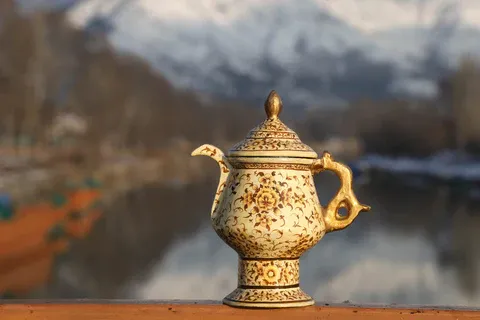
Background: The documented history of Kashmir Papier Mache begins with the Sultanate period of the fourteenth to sixteenth centuries, though no physical object from this period survives, as noted in the Gaatha.org craft archive. The earliest surviving physical evidence is from the fifteenth century, represented in architectural applications such as the papier mache decorations of the Madin Sahib Mosque (built in 1444), the ceiling of the Shah Hamdan Mosque, and elements at the Shalimar Garden, all in or near Srinagar, as documented in Wikipedia's Kashmir papier mache entry.
The JK Arts Foundation documentation records that the history of papier mache is entangled with the history of koshur kagaz, the traditional Kashmiri handmade paper. Kashmir became the first paper-producing region in India in the fifteenth century, when Sultan Zain-ul-Abidin brought papermakers during his return from Samarkand. The demand for pen cases and related writing materials was high in Kashmir because of the presence of munshis (scribes, accountants, and secretaries), and this demand helped sustain the craft in its early phase.
The craft flourished under Mughal patronage. The Oaklores platform documentation records, drawing on travel accounts, that in 1823 William Moorcroft learned that the papier mache industry had flourished under Mughal patronage, with craftsmen regularly sending samples to Delhi for the emperor's review. Moorcroft was shown patterns painted on planks submitted to Emperor Aurangzeb, who particularly favoured a style called subz-kar, characterised by foliage against a gilded background.
French traveller Bernier documented the craft in 1665, providing one of the earliest non-Indian written records. During the nineteenth century, French shawl traders used papier mache boxes as packaging for fine Kashmiri shawls, and these boxes were subsequently sold independently in France. This trade is documented by Dastkari Haat Samiti as the means by which the craft became known to the wider European market under the French name papier mache, displacing the original Persian designation.
Culture and Societies: Kashmir Papier Mache has historically been embedded in both the domestic economy and the architectural culture of the Kashmir valley. The Gaatha.org craft archive documents that the karkhana system, in which the workshop and the household were the same space, enabled families to participate collectively in production, with long winters creating the conditions for intensive craft activity. The Sahapedia documentation by Sadaf Nazir Wani, drawing on the analysis of historian G.M.D. Sufi, notes that the Kashmiris took full advantage of the closely-housed existence necessitated by long severe winters to develop cottage industries at home.
The craft has served architectural and domestic functions alongside its role as a portable decorative object. The Dastkari Haat Samiti documentation records that painting as a skill was already established in Kashmir before the introduction of papier mache, used on mud walls, wood, and bark. The papier mache technique was applied to ceilings, walls, and furniture, most visibly in the Shah Hamdan Mosque in Srinagar, where the walls and ceiling are decorated with papier mache work incorporating floral designs and calligraphy, as recorded in the Dastkari Haat Samiti documentation.
The Gaatha.org archive notes that the naqqash tradition maintained individual masters who sometimes signed their artworks, and that during the Mughal period the Mughals commissioned large numbers of items in the kar-i-kalamdani technique as gifting products, including decorations on palanquins, howdahs, and tent poles. The Sahapedia documentation by Sadaf Nazir Wani notes that the craft sustains Kashmir's historical and affective connection with Iran through the presence of craftspeople claiming Persian descent, and through the predominantly Persian-named motif vocabulary that persists in contemporary production.
Religious Significance: Kashmir Papier Mache has a documented religious dimension in two distinct respects.
First, the craft has been used in the decoration of Islamic religious architecture. Wikipedia's Kashmir papier mache entry and the Dastkari Haat Samiti documentation both record that papier mache decorates the ceiling of the Shah Hamdan Mosque in Srinagar, the Madin Sahib Mosque, and other religious structures. Within these spaces, artisans have incorporated both floral designs and Islamic calligraphy, as documented in the Dastkari Haat Samiti records. The Shah Hamdan Mosque's interior is described in the same source as a site of active religious and artistic inspiration for contemporary practitioners such as award-winning artist Fayaz Jan.
Second, the production of specifically religious objects has been documented. The Daily Sabah article on the craft (Ambreen Yousuf, 2021) records that some artisans produce rahles (small reading desks for reciting the Quran) and Quran boxes using papier mache, inscribing Quranic verses on them. Islamic calligraphy featuring Quranic verses and other Islamic texts is documented as a recurring design element on book covers and in architectural applications.
The Sahapedia documentation by Sadaf Nazir Wani notes that the history of the craft is linked with the formation of ethnic and religious identities in Kashmir, and that its beginning is closely associated with the advent of Islam in the valley.
Understanding the Art
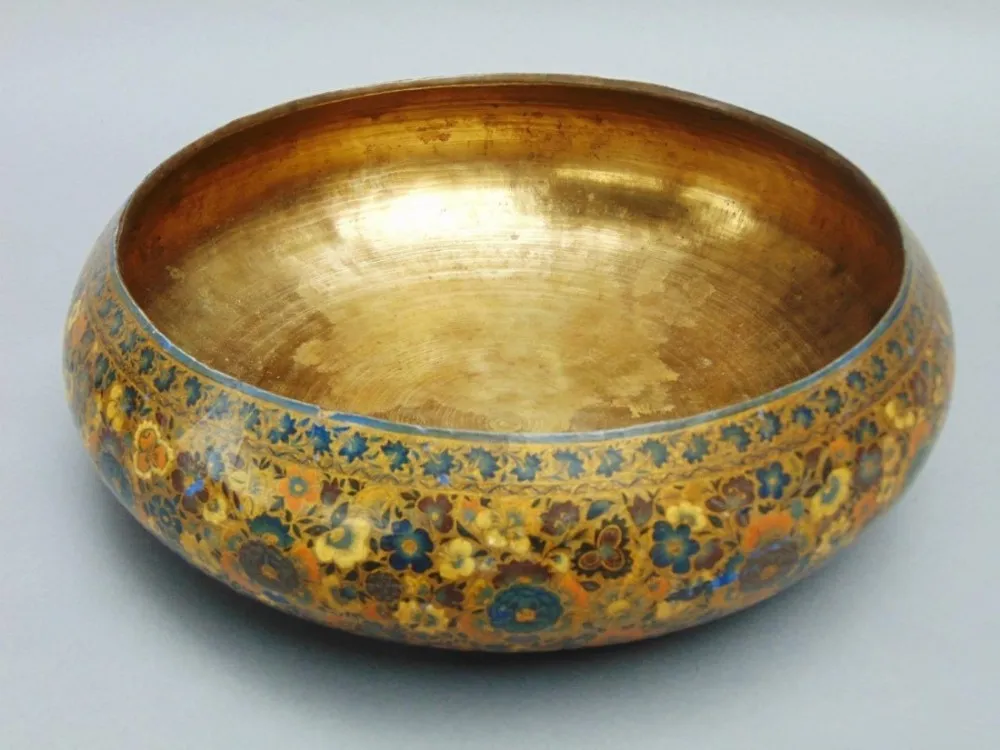
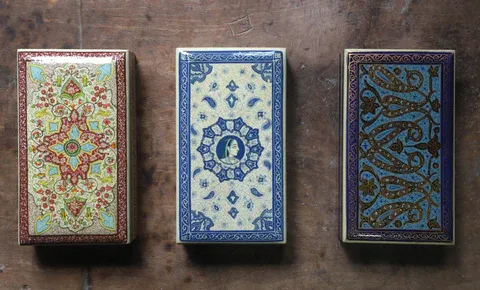
Style: Kashmir Papier Mache objects range from small portable items such as pen cases, boxes, bowls, vases, trays, ring boxes, pill boxes, lamp bases, and picture frames, to architectural applications on ceilings and walls. The kashmirart.com craft documentation records that the product range includes flower vases, wall plaques, bowls, ashtrays, screens, ring boxes, pill boxes, and boxes of various sizes and shapes. The Victoria and Albert Museum collection includes a writing box for pens, ink, and equipment, and a domed box, both dated to around 1850 and made in Srinagar.
The Oaklores documentation records that the naqqashi painting style is of two types: raised and flat. The raised type approximates relief work, with birds and butterflies sometimes depicted in a three-dimensional manner among flowers and foliage on a flat ground. The flat type covers the surface with two-dimensional painted designs. The patterns are drawn entirely freehand by the master naqqash, with assistants filling in colours at intermediate stages and the master completing the final outline. The kashmirart.com documentation notes that a price differential exists across multiple grades of the craft depending on the quality of the paper pulp and the purity of the gold used, and distinguishes between objects made from true papier mache pulp and cheaper substitutes using cardboard or wood. The Dastkari Haat Samiti documentation records that the first papier mache objects produced in Kashmir were kalamdans, long horizontal cases for holding pens, brushes, and inkpots, giving the craft its original local name of kar-i-kalamdani.
Central Motifs and Their Significance: The motif vocabulary of Kashmir Papier Mache is drawn primarily from Persian and Kashmiri natural forms and Islamic decorative traditions. The Sahapedia photoessay documents the following named motifs retaining their original Persian names in contemporary use: gul-andar-gul (flower inside flower), gul-i-hazara (thousand flowers), bagaldar, chinar, gonder, gul-i-wilayat, and kashaan.
The JK Arts Foundation documentation provides a comparable catalogue of contemporary motifs: Gulander Gul (flower inside flower), Gul-i-Vilayat (foreign flowers), Gonder (bunch), Bagalder Chinar (chinar leaf motif), Gul-i-Hazara (thousand flowers), Kashan and Kaleen (carpet designs used as motifs), and Jamavar (a shawl pattern type). The kashmirart.com documentation identifies specific named design styles: Arabesque, done in gold against a brown or red ground to show sprays of rose blossoms in fine lines; and Yarkand, an elaborate design built up in spirals with gold rosettes radiating from various centres and white flowers laid over gold scroll work.
The chinar leaf motif, representing the Platanus orientalis tree strongly associated with the Kashmir landscape, is consistently identified across all sources as a central Kashmiri symbol in the craft. The paisley or badam tarah motif, originating in Persian decorative arts, is documented in the Memeraki blog on Kashmiri papier mache motifs as carrying associations with fertility and abundance in both Islamic and Hindu decorative contexts, and as having travelled southward through India under the alternative name kiairi or mango, as noted in the Dastkari Haat Samiti products documentation.
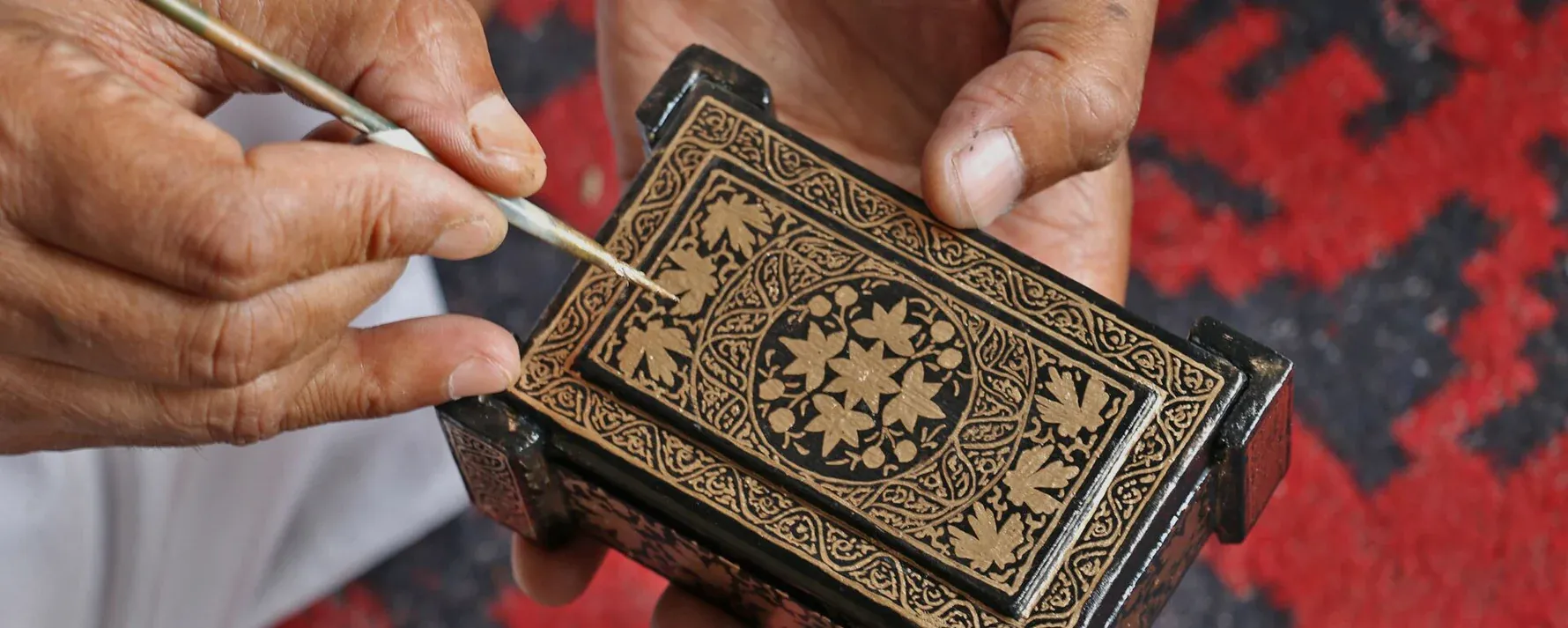
Islamic calligraphy, incorporating verses from the Quran and other texts, is documented across multiple sources as a recurring decorative element, particularly on book covers, border elements (hashiya), and architectural applications. The abina technique, documented in the Sahapedia archive, involves making a watermark sketch with a moistened brush in plain water, which dries to leave an invisible guide for the painters who follow.
The Dastkari Haat Samiti documentation notes that exchange of designs across Kashmiri craft forms is a key characteristic, with patterns from woodcarving, shawls, and carpets frequently replicated in papier mache.
Process: The production of Kashmir Papier Mache involves two sequential phases performed by specialist artisans.
In the first phase, sakhtasazi, the sakhtasaz prepares the paper pulp base. The Sahapedia photoessay documents that press cuttings, pages from used school notebooks, and tissue papers are soaked in water for five to six days, extending to fifteen days in winter. After adequate soaking, large chunks of paper are placed in a stone mortar and ground with a wooden pestle. A variety of rice flour called maand is then added to the ground paper, and the mixture is poured into frameworks of different shapes and sizes. Once settled and dried, the mixture acquires the required form. The Slideshare document on Kashmiri papier mache records that the pulp mixture also includes cloth and the straw of rice plants, bound together with a locally prepared rice-based adhesive called atij (or ajit in some sources). The moulds used were traditionally clay, with contemporary practice using wood, brass, or plaster of Paris moulds.
After drying, the hardened object is detached from the mould using a saw, then the two halves are rejoined with dense glue and smoothed using a wooden file called kathwa. The object at this stage is called a kalib. The Sahapedia photoessay records that the object is then coated with a mixture of chalk mitti (powder) and saresh (an adhesive), and polished with a kiln-burnt brick in a process called gassayiee. A layer of tissues is then glued to the surface to make it water-resistant and prevent cracking, followed by several rounds of gassayiee with sandpaper and three or four thick coats of colour.
In the second phase, naqashi, the naqqash takes over the decorated surface. The Wikipedia entry records that the surface is treated with a coat of silver and gold foils combined with a paste of chalk and glue applied with a brush. After drying, the surface is polished with baked brick pieces. Gold, white, black, blue, and red are among the base colours applied. Designs are then drawn freehand, followed by a layer of varnish. The Sahapedia archive records a finishing stage using mohra, a type of smooth stone, to polish the final piece.
Mediums Used: The primary raw material of Kashmir Papier Mache is waste or discarded paper, traditionally including used school notebooks, press cuttings, tissue paper, and historically the traditional Kashmiri handmade paper koshur kagaz. The Sahapedia photoessay and the JK Arts Foundation documentation confirm these materials. Rice-based adhesive (maand or atij) is used to bind the pulp.
Pigments for the naqashi phase were historically derived from mineral, organic, and vegetable sources. The Oaklores documentation, drawing on William Moorcroft's early nineteenth-century travelogues, records specific historical pigment sources: black from walnut, white lead from Russia, verdigris from Surat or Britain, and lapis lazuli for ultramarine blue from Yarkand. Varnish was produced from linseed oil combined with gum resin. Brushes were historically made from the hair of Pashmina goats and cat fur, as recorded by Moorcroft. The kashmirart.com documentation notes that gold is used on most objects, either as the sole colour or to highlight motifs, and distinguishes between pure gold leaf, bronze dust, and gold poster paint, with pure gold leaf commanding the highest price. The Oaklores documentation records that the use of natural pigments has diminished due to commercialisation, with synthetic colours and varnishes now prevalent.
Moulds are made of wood (commonly willow or poplar as noted in the Memeraki blog on the craft's process), brass, or plaster of Paris. Stone, including locally sourced mohra and baked brick pieces, is used for polishing at multiple stages.
New Outlook
The contemporary state of Kashmir Papier Mache presents a tension between its continued institutional recognition and the economic difficulties facing its practitioners. The craft holds a GI registration and is included in the school curriculum of Kashmir. Examples are held at the Victoria and Albert Museum in London, and the National Crafts Museum in New Delhi, and the craft maintains both domestic and export markets.
However, the economic situation of individual artisans is documented as precarious. The JK Arts Foundation and the Daily Sabah documentation record that artisans earn approximately Rs. 300 per day, leading many to supplement their income with other work. The JK Arts Foundation records specific cases: award-winning artist Ajaz Shah worked as an auto-rickshaw driver, and Niyaz Ahmad Bhat took up shawl making alongside papier mache to support his family. Mehraj-ud-din cited the next generation's disinterest in the craft due to limited economic prospects. The Kashmir Chamber of Commerce and Industry documented a loss of approximately seven million US dollars to the Kashmiri tourism and handicraft industries during the COVID-19 pandemic lockdowns.
The Oaklores documentation records that lower-quality machine-produced products have presented direct commercial competition, and Wikipedia's entry notes that the economic viability of the craft has been affected by machine carving and artisans preferring other employment. The kashmirart.com documentation notes the existence of at least three quality grades in the market, with cheaper cardboard or wood substitutes sold alongside true papier mache products.
The Dastkari Haat Samiti documentation (Google Arts and Culture, 2017) records product diversification as a contemporary development, with craftsmen occasionally introducing new materials such as willow work over which papier mache embellishments are added, and with the product range expanding well beyond its original pen-case focus to include Christmas ornaments, houseboats, samovars, and other objects reflecting both domestic and export demand.
Learn Kashmiri Paper Mache
Bibliography
Sources
Bamzai, P. N. K. Cultural and Political History of Kashmir. Vol. 2.
Dastkari Haat Samiti. “Papier Mache: Community and Places / Products / Painting Process.” Google Arts & Culture, 2017. Text by Jaya Jaitly, photographs by Suleiman Merchant.
Lawrence, Walter. The Valley of Kashmir. Henry Frowde, 1895.
Sheikh, A. R. “Papier Mache: A Delicate Art of Kashmir.” International Journal of Research in Social Sciences, vol. 8, no. 11, 2018, pp. 321–330.
Wani, Sadaf Nazir. “Kashmir’s Papier Mache Craft: An Archive of Its People and Their History.” Sahapedia, 2024, www.sahapedia.org
Image Sources
“Paper Mache – An Incredible Art.” Kashmir Box, 3 Apr. 2019, www.kashmirbox.com/blogs/craft/paper-mache-an-incredible-art. Accessed on April 30, 2026.
“Popular Uses of Kashmiri Paper Mache.” Hands of Gold, www.handsofgold.in/blogs/news/popular-uses-of-kashmiri-paper-mache. Accessed on April 30, 2026.
“Research: Kashmir Paper Mache.” Learning Journal, 15 Oct. 2020, learningjournal.video.blog/2020/10/15/research-kashmir-paper-mache/. Accessed on April 30, 2026.