

Oppana - The Folk Dance Tradition of Kerala
Explore Oppana dance, the performance tradition of Kerala, and learn about its origins, techniques, cultural significance, and artistic heritage.
Introduction
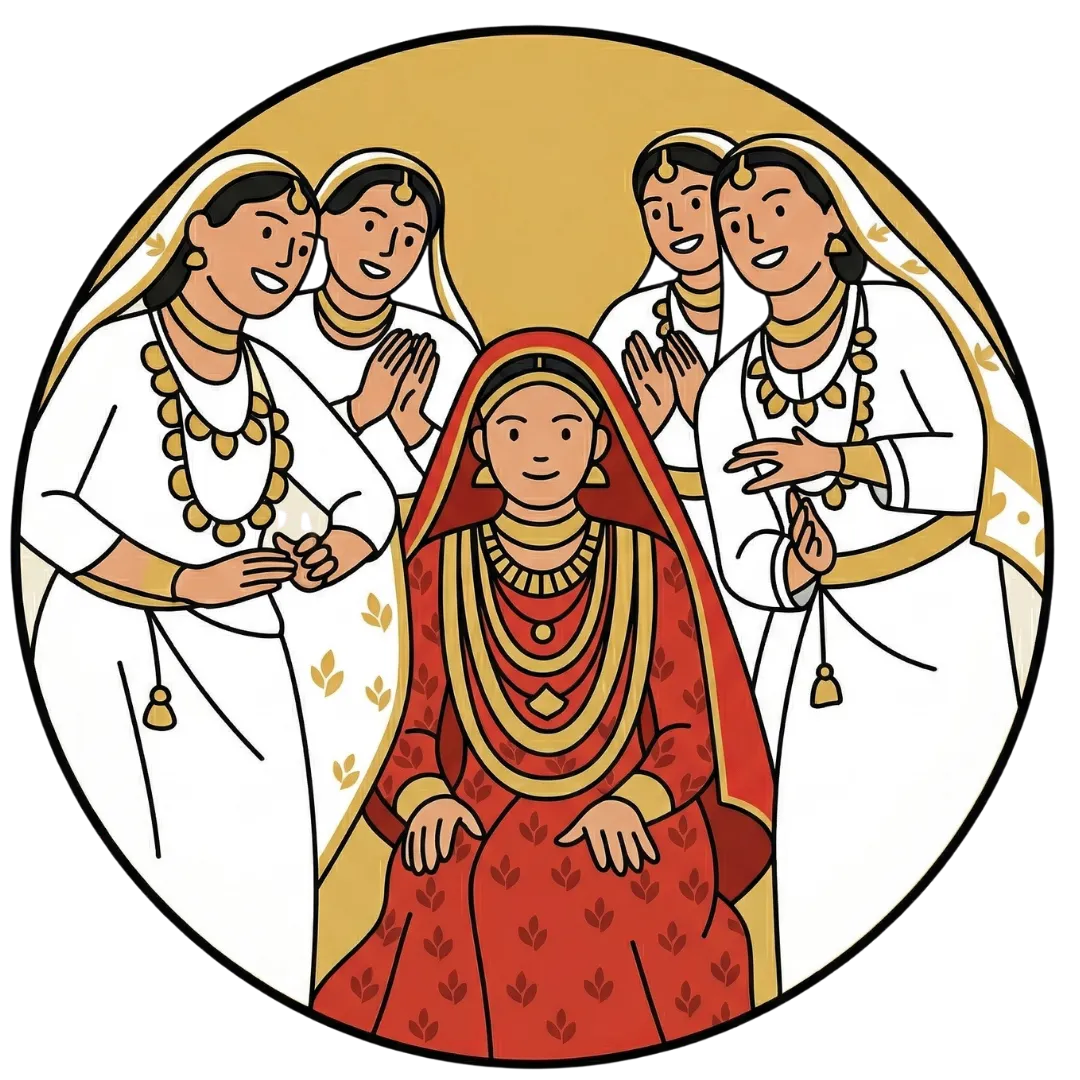
Oppana is a traditional group dance and song form performed by the Mappila Muslim community of the Malabar region of Kerala, India. It is most prominently staged as part of the wedding celebrations of Muslim families, particularly on the eve of the wedding, when female relatives and friends of the bride gather to sing and dance around her. The art form integrates folk song, rhythmic clapping, and structured dance movement and reflects the distinct cultural synthesis of Arab and indigenous Malabar elements that characterizes Mappila artistic traditions.
Etymology The word "Oppana" is derived from the Arabic word "affna" or "afna." One interpretation of the Arabic root suggests the meaning of stretching both hands to one side and bringing the palms together, which describes a central movement in the dance. Another interpretation offered in available sources glosses "affna" as meaning "one's own." The term does not appear to derive from a Malayalam root, and its Arabic derivation reflects the broader Arab-Malabar cultural synthesis that produced the Mappila community and its artistic traditions.
Origin The Mappila community emerged historically through sustained trade contact between Arab merchants and the coastal communities of Malabar, a process documented to pre-date the third century CE. Arab traders who settled temporarily or permanently in Kerala intermarried with local women, producing a community with strong indigenous and Arabian cultural elements. Oppana is believed to have drawn influence from wedding-related performance practices of Arabian women that were adapted into the Malabar context and merged with indigenous performance traditions, including Thiruvatirakkali, the Hindu women's circular clapping dance. Anthropological research by Babu C.T. Sunil (published in Shodhkosh, 2023) examines Oppana as part of the broader category of Mappila performing arts that are indigenous in character despite Islamic religious content.
Location Oppana is performed throughout the Malabar region of Kerala, with its primary concentration in the northern districts of Kozhikode, Malappuram, and Kannur. It is documented in the Malappuram district in particular as the center of the tradition. The art form has been included in the Kerala School Kalolsavam, which has extended its geographic spread across Kerala.
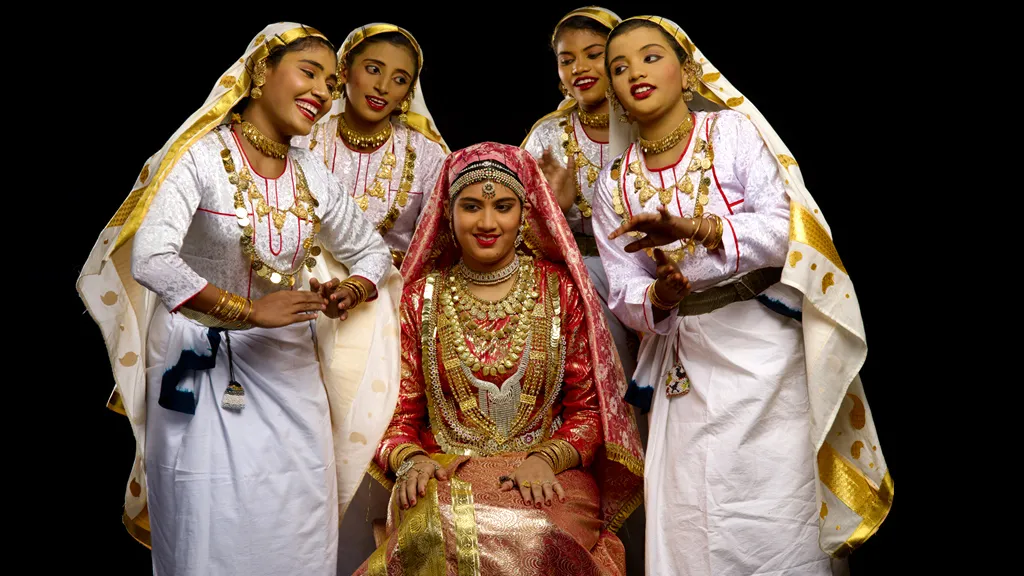
Community Oppana is the performance tradition of the Mappila Muslim women of Malabar. The performance typically involves a minimum of fifteen female participants. The bride sits at the center of the performance, adorned with traditional jewelry and henna (mailanji), while her female relatives and friends form the performing group. Male Oppana performance exists but is restricted to certain contexts. The art form is also performed at other rites of passage in Mappila families, including the circumcision of boys, a girl's first menstruation, and the ceremonial bath of a woman on the fourteenth day after childbirth.
Relevance Oppana was incorporated into Malayalam cinema from the 1950s onward, which significantly expanded its popular reach. It remains an essential component of Mappila Muslim wedding culture in Kerala and has been included in competitions at the Kerala School Kalolsavam. It is one of the most widely recognized folk forms associated with the Muslim community in Kerala and has been documented by India Video in association with UNESCO.
History
Background The Mappila community's culture developed over centuries of interaction between Arab trading settlers and the indigenous population of the Malabar Coast. Anthropologist Babu C.T. Sunil's research characterizes Oppana as an art form whose indigenousness is evident in its absorption of local aesthetic forms even as it retained Islamic content. The integration of Arabimalayalam, the community's hybrid language that mixed Arabic and Malayalam, into the lyrical content of Oppana songs reflects this cultural history. One documented influence is the practice among Arabian women of performing on wedding eves, which found local expression through Malabar movement and musical traditions.
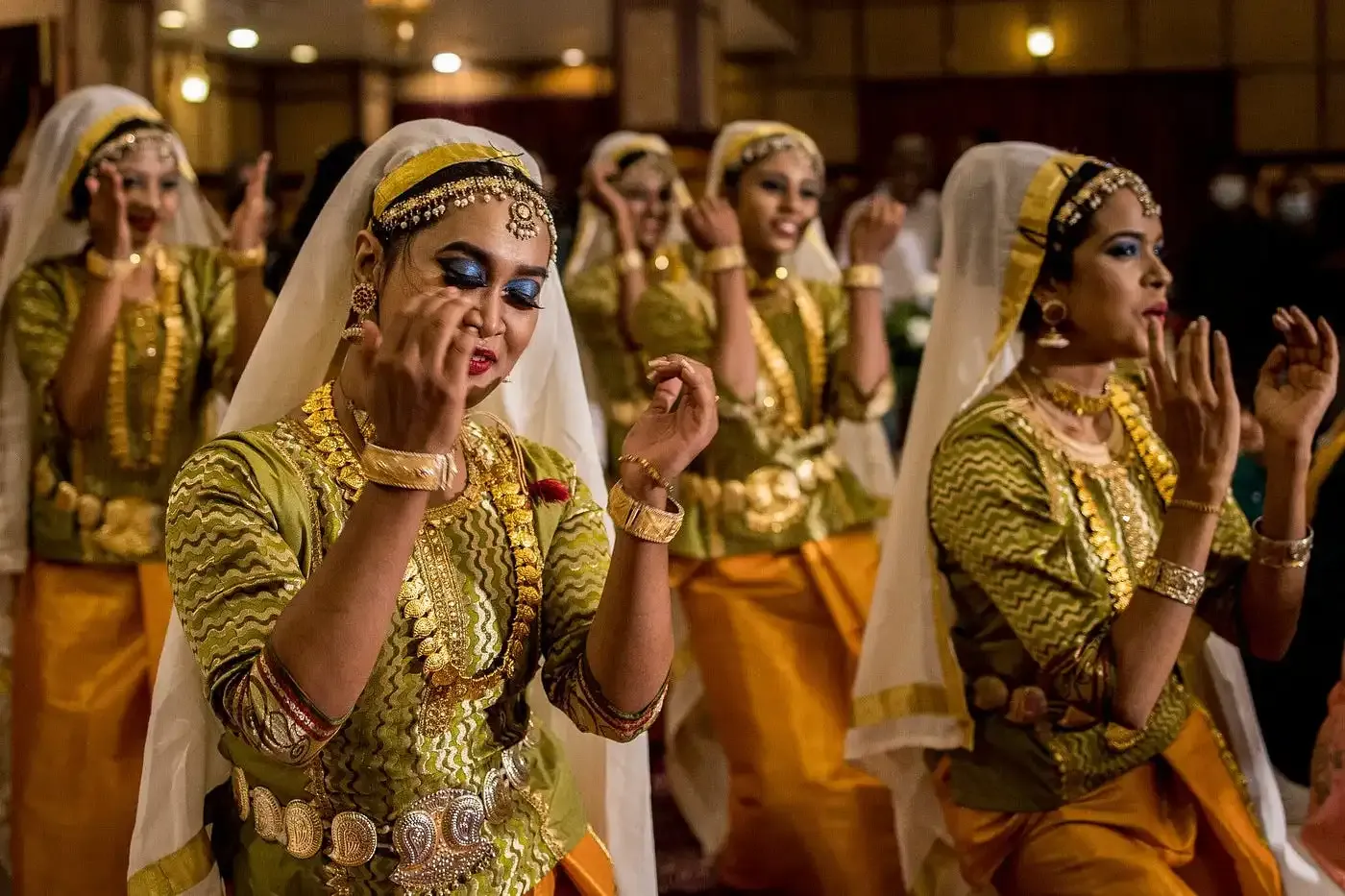
Culture and Societies Oppana is a social performance that marks and reinforces community bonds at a family's most significant ritual occasions. Songs praise the beauty of the bride and groom, include teasing commentary on forthcoming married life, and honor the life of the Prophet Muhammad. The songs are composed in the tradition of Mappila Pattu, the distinctive musical genre of the Malabar Muslim community. Two forms of Oppana performance have been documented: Oppana Chayal, which involves swaying movements without clapping, and Oppana Murukkam, a faster form with rhythmic clapping. The tempo and intensity of clapping and footwork increase with the music's pace.
Religious Significance Oppana's religious dimension is present through the lyrical content of Mappila Pattu songs, which include verses honoring the Prophet Muhammad and drawing on Islamic narrative traditions. The occasion of the wedding in Islamic practice carries religious significance, and the performance functions partly as a celebratory expression of that significance. However, the dance itself is not a ritual prescribed by Islamic religious authority; its sacred dimension is embedded in cultural tradition rather than in formal religious doctrine.
Understanding the Art
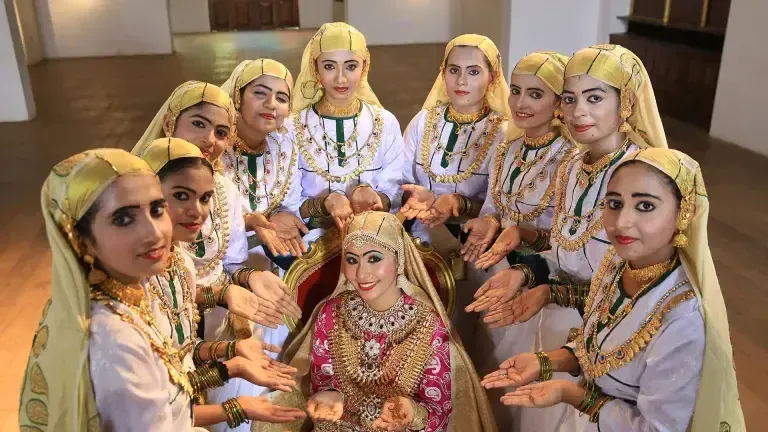
Style The bride sits at the center of the performance space in a chair, dressed in traditional attire with jewelry and henna. The performers form a circle around her and move in synchronized patterns involving clapping, footwork, and body swaying. One or two lead singers begin the song, and the group joins in chorus. The movements alternate between slower swaying and faster rhythmic sequences depending on the song's tempo and type (Chayal or Murukkam).
Central Motifs and Their Significance The primary thematic motifs in Oppana songs are the beauty of the bride and groom, the joy of the union, the blessings expected for the new household, and devotional content relating to the Prophet Muhammad. The physical motif of the circle, with the bride at its center, is consistent across all versions of Oppana and symbolizes the community's enclosure and protection of the bride at this threshold moment in her life.
Process The performance begins when the lead singers establish the opening verse. Performers clap and dance around the bride, varying their formation and tempo with the music. The musical instruments used include the harmonium, tabla, ganjira (a frame drum), ilathalom (cymbals), and in some performances, a tambourine. The songs are drawn from the Mailanchippaattu genre of Mappila Pattu.
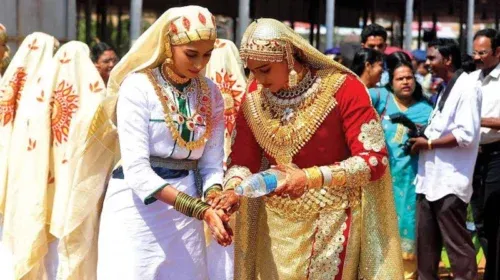
Mediums Used The performance mediums of Oppana are the voice, the clapping of hands as an integral rhythmic element, and the harmonium, tabla, ganjira, and cymbals as accompaniment. Traditional attire, including the kachi mundu, thattam (head covering), and blouse, along with gold jewelry and henna, form an integral visual and ceremonial component.
New Outlook
Oppana's prominence has increased through its inclusion in the Kerala School Kalolsavam competition circuit, which has produced a substantial pool of trained young performers. The form has appeared regularly in Malayalam cinema. Academic documentation, including anthropological research published through international journals, has brought scholarly attention to Oppana as a subject that bridges Islamic cultural practice, gendered performance, and the specific sociology of the Mappila community.
Learn Oppana
Bibliography
Sources
Koppilan, K. P. Mappila Kalaprakaranam. 2008. Referenced in academic discussions of Mappila performing arts.
Logan, William. Malabar Manual. 1887. Reprint, Govt. Press, 1951.
Sunil, Babu C. T. “Mappilappaattu and Oppana: An Anthropological Note on Mappila Songs and Performing Art.” Shodhkosh, 2023.
Image Sources
“Oppana: A Dance for the Bride-to-Be.” Oaklores. Accessed on May 21, 2026.
“Oppana Performing Art.” Kerala Tourism Photo Gallery. Accessed on May 21, 2026.
“Oppana – the Traditional Wedding Dance of Muslims.” Kerala Tourism, 2018. Accessed on May 21, 2026.
“Oppana – Wedding Dance of Muslims.” Kerala Tourism. Accessed on May 21, 2026.
“Wedding Dance and Entertainments in Kerala.” Jaspira Wedding Planners. Accessed on May 21, 2026.