

Namda - The Handicraft Tradition of Jammu & Kashmir
Explore Namda, the handicraft tradition of Jammu and Kashmir, and learn about its origins, techniques, cultural significance, and artistic heritage.
Introduction
Namda is a handcrafted felted textile produced primarily in the Kashmir valley of Jammu and Kashmir, as well as in parts of Himachal Pradesh, Rajasthan, and Gujarat, used principally as a floor covering and mattress. The craft is distinguished by its method of production: wool fibres are entangled through the application of water, soap, and mechanical pressure rather than by weaving, producing a dense, non-woven fabric. The surface of the felted base is subsequently decorated with aari or kashidakari chain-stitch embroidery, with appliqué, or with inlaid coloured felt patterns formed during the felting stage itself. Namda has been listed as an identifiable endangered craft of India by the Development Commissioner of Handicrafts, Ministry of Textiles, Government of India.
Etymology: The term Namda is documented by the Asia InCH Encyclopedia of Intangible Cultural Heritage (Craft Revival Trust) as deriving from the Sanskrit word Namada, meaning woollen stuff. The craft is also rendered as Namdah and Numda in different sources. In traditional usage, the word referred to an additional felted layer placed above a gabba, the everyday floor covering of Kashmiri households made from old blankets, though in contemporary usage Namda designates the felted rug as an independent object. The peer-reviewed paper "An Insight into the Traditional Namda Craft of India" published in the International Journal of Research and Innovation in Social Science (Sharan and Arya, 2023) describes Namda as a local term for traditional handcrafted felted floor covering made from coarse wool. The MAP Academy's Encyclopedia of Art in South Asia records the word in the same sense, describing Namda as hand-felted and embroidered rugs produced using felting instead of weaving.
Origin: The origin of Namda involves multiple documented accounts that differ in chronology and attribution, and no single archival record provides unambiguous confirmation of a founding event or date. The Asia InCH Encyclopedia records that the craft is believed to have originated in Central Asia around the first century AD and reached Kashmir during the Mughal period. This Central Asian origin for felting as a technique is consistent with the documented persistence of felted carpet traditions across Kyrgyzstan, Uzbekistan, parts of Pakistan, and Turkey. The MAP Academy article states that the felting technique came to India from Iran and Turkey during the Mughal period.
The most commonly cited narrative in Indian cultural documentation connects the development of Namda as a named Kashmiri craft to the Mughal period. According to this account, recorded in the Asia InCH Encyclopedia, the Gaatha.org craft archive, the RSIS International journal paper, and the Fibre2Fashion industry documentation, a craftsman named Nubi created an embroidered felted covering for Emperor Akbar's horse to protect it from the cold, and the resulting product was named Namda. The Rau's IAS documentation, citing historical records, states that Nubi was Akbar's exchequer and that the emperor rewarded him with land grants. These sources present this account as a historically rooted tradition rather than a verifiably dated archival event.
The Asia InCH Encyclopedia records an earlier milestone: that in 1420, during the reign of Sultan Zainulabdin, the embroidered Namda industry first flourished in Kashmir using locally sourced wool. Sultan Zainulabdin is widely documented in Kashmiri historical scholarship as an active patron of craft traditions in the valley. The same source records that plain Namdas were imported in large numbers from Yarqand, in present-day Xinjiang, China, until the beginning of the nineteenth century, with imports reaching up to 200,000 units annually until 1940. These Central Asian Namdas were plain and unadorned; they were imported into Kashmir and embroidered there in the jalik-doozi style before re-export.
Local production of the felted base began by 1929, a full-fledged manufacturing industry was established by 1938, and by 1941 Kashmir was self-sufficient in Namda production, as documented by the Asia InCH Encyclopedia. The establishment of a workshop by Las Khan from Kabul in Srinagar in 1850 is recorded in the same source as the event that formalised local Namda manufacturing and led to the development of the Namdagari Muhalla craft cluster in the city.
The Gaatha.org craft archive also records the attribution of the craft's introduction as a livelihood activity to Mir Syed Ali Hamadani (Shah-e-Hamdan), the fourteenth-century Sufi saint who visited Kashmir three times between 1372 and 1383 AD and is credited in Kashmiri cultural and historical literature with bringing artisans from Central Asia to the valley.
Location: The principal production centres for Namda in Jammu and Kashmir are documented as Anantnag, Rainawari (a locality within Srinagar), and Baramula, as recorded in the Gaatha.org craft archive and the RSIS International journal paper. The Asia InCH Encyclopedia identifies the downtown area of Sher-e-Khas in Srinagar as a centre where the complete production chain, including felting, rolling, dyeing, and embroidery, takes place. The MAP Academy article records prominent manufacturing centres as Srinagar in Kashmir and Tonk in Rajasthan.
The RSIS International journal paper documents the craft as practiced across four states: Kashmir, Himachal Pradesh, Rajasthan, and Gujarat. The paper establishes that Namdas of Himachal Pradesh and Kashmir are closely similar in technique, while those of Rajasthan use geometric motifs and those of Gujarat use a combination of bird, floral, and geometric motifs. The Karolia and Sardiwal study published in the Indian Journal of Traditional Knowledge (2014) specifically documents the Namda tradition of Tonk district, Rajasthan.
The Asia InCH Encyclopedia records that wool for the Kashmiri Namda is sourced from markets in Ganderbal, Sonmarg, and Yusmarg, identified as producing wool of the best quality for the craft. The RSIS International journal paper additionally records Badgam, Pahalgam, and Naushera as sourcing locations for locally termed kat yer (sheep wool).
Community: Namda-making in Kashmir is a household craft practiced primarily by the Muslim community, as documented in the MAP Academy article, which records that the craft is passed from one generation to another within producing families. The Gaatha.org craft archive describes it as a cottage industry rooted in the domestic economy of the valley. The MAP Academy article records that in the eastern part of Kutch, Gujarat, the Pinjara and Mansoori communities practice Namda-making as floor coverings for the use of Darbar communities. The Karolia and Sardiwal study (Indian Journal of Traditional Knowledge, 2014) records that in Tonk, Rajasthan, the craft is primarily practiced by the Muslim population, though craftsmen from the Hindu community have begun to participate in more recent years.
The Fibre2Fashion article documents that Namda-making in Kashmir was initially restricted to men, with women subsequently joining the craft. Contemporary field documentation records that women and girls now participate equally in the process. The MAP Academy article records that the craft is labour-intensive, requiring a craftsman to work with the assistance of three people to produce two Namdas in a day.
A significant contemporary practitioner is Arifa Jan of Srinagar, who completed a postgraduate programme in craft management from the Craft Development Institute (CDI), Srinagar in 2011, and subsequently established a Namda production centre. Documentation from the Oaklores platform records that artisans at her centre receive a daily wage of Rs. 750 in contrast to the Rs. 100 offered at other centres at the time. Jan received the Nari Shakti Puraskar in 2020, presented by President of India Ram Nath Kovind, for her work in reviving the craft, and was cited by Prime Minister Narendra Modi on social media under the #SheInspiresUs campaign.
Relevance: Namda has been classified as an identifiable endangered craft of India by the Development Commissioner of Handicrafts, Government of India, a formal designation that reflects the significant decline in production volume, artisan numbers, and export income documented from the late twentieth century onward. In response to this endangered status, the Ministry of Skill Development and Entrepreneurship (MSDE) launched a special pilot project under the Pradhan Mantri Kaushal Vikas Yojana (PMKVY) 3.0 in November 2021. The project targeted 2,250 beneficiaries across 30 Namda clusters in six districts of Jammu and Kashmir. A parallel Recognition of Prior Learning (RPL) component targeted 10,900 artisans and weavers for skills assessment and certification.
The Asia InCH Encyclopedia records that the Namda trade was at its peak during the First World War period. The MAP Academy article confirms that notable demand for Namdas persists in urban Indian cities and international markets. The Oaklores documentation records that Kashmiri handicraft sales, including Namda, reached Rs. 18.5 crore in 2022, described as historically high. Namda is also held in the collections of the National Crafts Museum, New Delhi, where displayed pieces attracted purchase orders from international visitors, as documented in the Oaklores account of Arifa Jan's revival work.
History
Background: The documented history of Namda as a production industry in Kashmir begins with the large-scale import of plain, unadorned felted mats from Yarqand in Central Asia. The Asia InCH Encyclopedia records that these Namdas were plain and imported into Kashmir for embroidery in the jalik-doozi style before re-export. This trade pattern, in which Central Asian felt was embellished with Kashmiri embroidery, represents the earliest documented phase of Namda as a Kashmiri industry.
The embroidered Namda industry is documented in the Asia InCH Encyclopedia as first flourishing during the reign of Sultan Zainulabdin around 1420, using local wool. The formalisation of local production within Srinagar is dated to 1850 with Las Khan's arrival from Kabul and the subsequent development of the Namdagari Muhalla. By 1938, a full-fledged Namda manufacturing industry existed in Kashmir, and by 1941 the region was self-sufficient in production, no longer dependent on imports from Central Asia.
The Asia InCH Encyclopedia records a setback in the Namda industry between 1947 and 1953 due to quality deterioration caused by competition among producers. The Fibre2Fashion article documents a more severe decline between 1998 and 2008, during which export fell by almost 100 percent, attributed to adulteration of raw materials and inadequate marketing strategies.
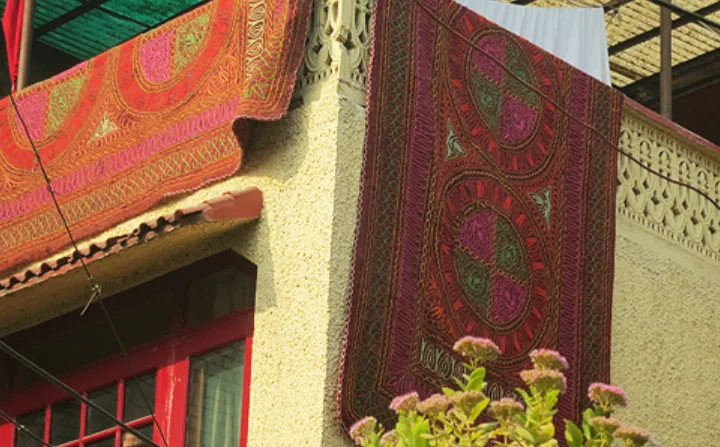
Culture and Societies: The Namda rug is embedded in the material culture of Kashmiri domestic life. The Gaatha.org craft archive records that all Kashmir households, regardless of economic status, follow the tradition of floor-sitting arrangements, and that the extreme cold of the valley made effective insulating floor coverings a functional necessity. The gabba and the Namda together formed the standard floor-covering system of the traditional Kashmiri home. The MAP Academy article confirms that in Kashmir, Namdas are used as mattresses and floor coverings in response to extreme cold weather.
The formation of the Namdagari Muhalla within Srinagar illustrates the extent to which the craft shaped the social and spatial organisation of specific urban communities. The Asia InCH Encyclopedia notes that the entire production process was concentrated in the downtown areas of Srinagar, creating an integrated craft neighbourhood. The MAP Academy article records that Namdas are sold in craft bazaars in Srinagar, sustaining a market connection between artisan and consumer within the city.
The Gaatha.org craft archive records the attribution of the craft's introduction as a community livelihood to Mir Syed Ali Hamadani (Shah-e-Hamdan), the fourteenth-century Sufi saint. The Asia InCH Encyclopedia frames this connection as evidence that the craft, like several other Kashmiri handicraft traditions, was partly established through the agency of Sufi figures who brought Central Asian artisan knowledge to the valley.
Religious Significance: No documented academic study or government record establishes a formal religious or devotional function for the Namda rug itself. The product is a domestic floor covering and mattress, and no ceremonial, liturgical, or votive use has been recorded in the sources available for this article. The attribution of the craft's introduction as a livelihood to Mir Syed Ali Hamadani, a figure of profound religious significance in Kashmiri Muslim culture, is documented in the Gaatha.org craft archive and the Asia InCH Encyclopedia. This historical attribution connects the craft's origins to Sufi-mediated cultural development in Kashmir, though the Namda rug itself is not documented as carrying religious iconography or serving any ritual function.
Understanding the Art
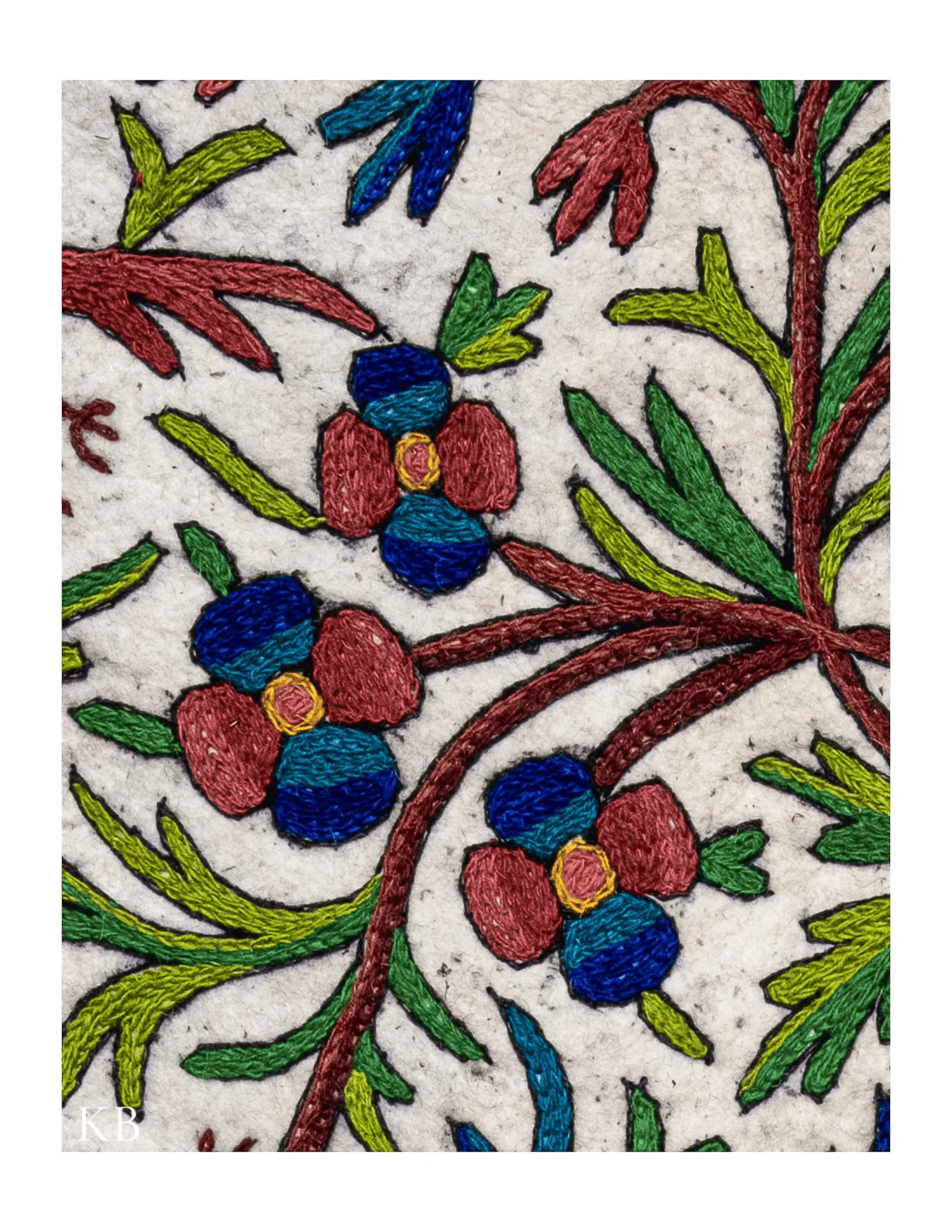
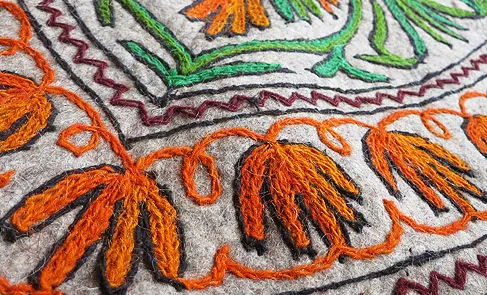
Style: Namda is produced in three documented variants. The first is the plain Namda, an unadorned felted sheet. The second, and most widely recognised variant, is the embroidered Namda, in which floral, animal, and botanical compositions are applied to the dried felted surface using aari or kashidakari chain-stitch embroidery. The third variant, documented by the Asia InCH Encyclopedia as a contemporary addition, is the patterned Namda, in which strips and patches of dyed felt are arranged in designed patterns and incorporated into the first layer of wool before the felting process begins, making the pattern structurally integral to the fabric rather than surface-applied.
Standard shapes documented in the Asia InCH Encyclopedia include rectangular, oval, and circular forms, with the circular variant with dashe (wool tassels) identified as particularly distinctive. The most common commercial size is 6 feet by 4 feet. The MAP Academy article records that cotton is often mixed with wool in the Kashmiri Namda to produce a light shade of white that provides a ground suited to coloured embroidery. The RSIS International journal paper notes that in Srinagar, cotton is added in varying ratios to increase thickness and whiteness and to ease the embroidery work.
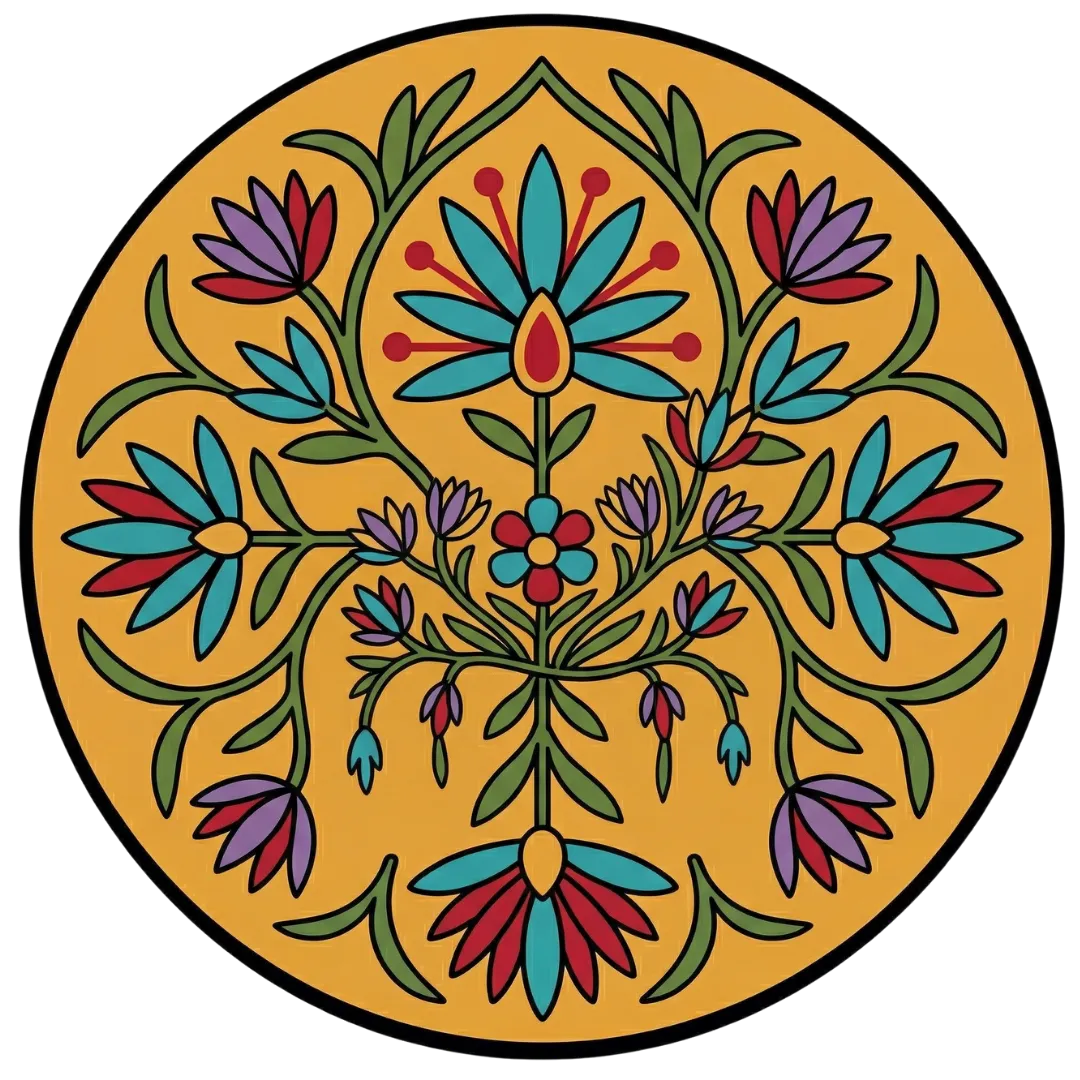
Central Motifs and Their Significance: The motif vocabulary of Kashmiri Namda embroidery is drawn primarily from botanical, floral, and natural forms, reflecting both the local environment and the historical influence of Persian and Turkish carpet traditions documented in the Asia InCH Encyclopedia. The MAP Academy article records the following specific motifs used in Kashmiri Namda decoration: chinar (the maple leaf, closely identified with the landscape of Kashmir), dachh (vine), cherry blossoms, and pamposh (lotus). The Asia InCH Encyclopedia provides a more extensive documented list of named design patterns: Pamposh (lotus), Chinar, Paisley, Satburg (seven-petalled flower), Rent maal (loop chain), Ghas (three-leafed grass), Naal (outline of flowers), Kuldaar (Tree of Life), Czuberg (four-petalled flower), Jangildaar (forest), and Gurundaar.
The RSIS International journal paper establishes motif distinctions between regional traditions: Kashmir uses floral motifs; Rajasthan uses geometric motifs; Gujarat uses a combination of bird, floral, and geometric motifs. The Karolia and Sardiwal study (Indian Journal of Traditional Knowledge, 2014) documents the Tonk, Rajasthan tradition as using hand embroidery, machine embroidery, or appliqué for surface ornamentation.
The traditional method of transferring designs onto the felted surface involved carved wooden blocks dipped in a mixture of charcoal powder and kerosene oil or white mud, as documented in the Asia InCH Encyclopedia. Contemporary practice uses tracing sheets with designs drawn on them and small holes poked through for ink transfer onto the Namda surface. The Gyawun platform documentation records the use of a wooden naqsha or mold (prot) in an alternative traditional transfer method.
Process: The Namda production process is documented in detail across the Asia InCH Encyclopedia, the MAP Academy article, the Gaatha.org craft archive, and the RSIS International journal paper.
The first stage is carding, in which raw wool is processed to remove dirt and foreign particles and to achieve uniform thickness. The Asia InCH Encyclopedia records that the traditional tool was the painja, a wooden instrument resembling a large bow used to beat and fluff large quantities of wool. The MAP Academy article identifies this tool as a wicker punja (comb). Contemporary workshops use mechanical carding machines for this stage.
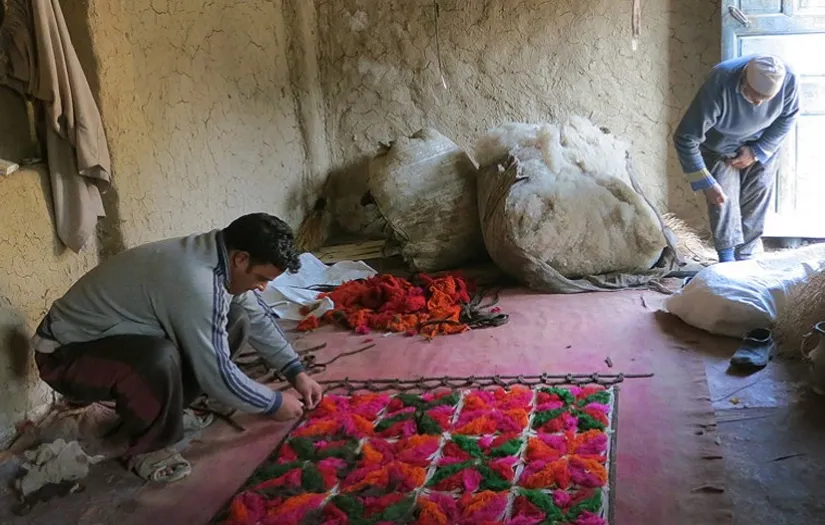
After carding, the prepared wool is spread in layers over a large flat surface, typically a burlap or jute mat, with a border defined to set the dimensions of the finished rug. The MAP Academy article records that a minimum of three layers are prepared, each spread separately, sprinkled with soapy water, and pressed with a pinjra tool to enmesh and interlock the fibres, with each layer flattened to a uniform size using water and heavy compression. The Gyawun platform documentation records that the soap used in Kashmir is handmade locally in small quantities and functions both to clean the wool and to bind the fibres.
Once the layers are assembled and pressed, the bundle is rolled tightly with the mat and tied with rope. The rolled bundle is then compressed by rolling it to and fro on the floor with hands and feet. The Asia InCH Encyclopedia records this process as continuing for approximately one hour to achieve fibre-to-fibre fusion. The MAP Academy article describes the following step as: the layered wool is rolled out to rinse excess water, washed with a cleaning agent, and left in the sun to dry. After drying, the Namda is ready for surface decoration.
Embroidery is applied using an aari (tambour) needle with woollen or acrylic yarn. The Asia InCH Encyclopedia documents the embroidery as involving two steps: first, the design is traced onto the white or off-white surface; second, the design is outlined with long Tahrir stitches, filled in with contrasting colours, and finished at the edges with blanket stitches. The MAP Academy article describes this surface work as colourful aari and kashidakari embroidery in floral patterns and animal motifs.
Mediums Used: Sheep wool is the primary raw material of Namda across all regional traditions. The Asia InCH Encyclopedia records that in Kashmir, wool is sourced from the markets of Ganderbal, Sonmarg, and Yusmarg. The RSIS International journal paper identifies the local term for the sheep wool as kat yer and records that Merino wool imported from Australia is also used in modern production, and that Namdas made from Kullu-Kangra wool have greater strength.
In the Kashmiri tradition, cotton is commonly added to wool in varying proportions. The MAP Academy article records that cotton is often mixed with wool to produce a light white base suited to embroidery. The RSIS International journal paper notes that in Srinagar, cotton is added to increase the thickness and whiteness of the product.
Embroidery thread is traditionally wool yarn. The Gaatha.org craft archive and the Asia InCH Encyclopedia both document that acrylic yarn (cashmelon) is now widely used in place of wool yarn for the embroidery stage. The MAP Academy article confirms the use of aari and kashidakari embroidery techniques using coloured thread.
The jute or burlap mat used as the base surface during felting is documented across multiple sources. The pinjra or punja tool, used during the compression stage, is described variously as a flat wooden device, a woven willow wicker instrument, or a grass mat rolled with the wool inside. The Asia InCH Encyclopedia records that dashe (wool tassels) are added to some Namdas by order as a finishing decorative element.
New Outlook
The contemporary state of Namda craft is documented as one of severe vulnerability. The Fibre2Fashion article records that export declined by almost 100 percent between 1998 and 2008, attributed to adulteration, poor marketing strategies, low wages that caused artisans to leave the trade, shortage of skilled practitioners, and lack of digital marketing knowledge. The craft's listing as an identifiable endangered craft of India formalises this assessment.
The Government of India's PMKVY 3.0 pilot project, launched in November 2021 by the Ministry of Skill Development and Entrepreneurship, is the most substantial recent government intervention. Targeting 2,250 artisans across 30 Namda clusters in six districts of Jammu and Kashmir, with a complementary RPL programme for 10,900 artisans, it represents a significant institutional commitment to sustaining the craft. The MAP Academy article confirms that notable demand for Namdas persists in urban Indian cities and international markets, and that prominent manufacturing centres in Srinagar and Tonk continue to sell through craft bazaars.
The Asia InCH Encyclopedia documents a technical innovation introduced by artisan Zufa Iqbal: a rolling machine that reduces the felting time for a 4x6-foot rug from a full working day for two people to approximately half an hour. The India Heritage Walks documentation records community debate about the adoption of this machine, with one practitioner endorsing it on the grounds that there is no set age to learn something new. Sales data reported by the Oaklores documentation indicate that Kashmiri handicraft sales, including Namda, reached Rs. 18.5 crore in 2022, the highest figure in four decades, with the G20 events credited as contributing to increased visibility.
Learn Namda








Bibliography
Sources
Karolia, Anjali, and Surbhi Sardiwal. “Namda: The Traditional Felted Craft of Rajasthan.” Indian Journal of Traditional Knowledge, vol. 13, no. 2, Apr. 2014, pp. 409–415.
“Namda.” MAP Academy: Encyclopedia of Art in South Asia, Museum of Art and Photography, 2023, https://mapacademy.io/article/namda/
“Namda Mats from Kashmir.” Asia InCH Encyclopedia of Intangible Cultural Heritage, Craft Revival Trust, https://asiainch.org/craft/namda-mats-from-kashmir/
Sharan, Madhu, and Swati Arya. “An Insight into the Traditional Namda Craft of India.” International Journal of Research and Innovation in Social Science (IJRISS), vol. 7, no. 6, June 2023, pp. 153–159.
Karolia, Anjali, and Surbhi Sardiwal. “Namda: The Traditional Felted Craft of Rajasthan.” Indian Journal of Traditional Knowledge, vol. 13, no. 2, Apr. 2014, pp. 409–415.
“Namda.” MAP Academy: Encyclopedia of Art in South Asia, Museum of Art and Photography, 2023, https://mapacademy.io/article/namda/
“Namda Mats from Kashmir.” Asia InCH Encyclopedia of Intangible Cultural Heritage, Craft Revival Trust, https://asiainch.org/craft/namda-mats-from-kashmir/
Image Sources
“Have You Felt It Yet?” Gaatha, https://gaatha.com/blog-have-you-felt-it-yet/. Accessed on April 24, 2026.
Farooqui, Nida. “Namda Art of Kashmir: Reviving the Heritage of Handcrafted Rugs.” Oaklores, 6 Dec. 2024, https://oaklores.com/2024/12/06/namda-art-of-kashmir-reviving-the-heritage-of-handcrafted-rugs/. Accessed on April 24, 2026.