


Mysore Rosewood Inlay - The Handicraft Tradition of Karnataka
Explore Mysore Rosewood Inlay, the handicraft tradition of Karnataka, and learn about its origins, techniques, cultural significance, and artistic heritage.
Introduction
Mysore Rosewood Inlay is a traditional wood inlay craft associated with Mysuru (Mysore), Karnataka. The craft involves embedding contrasting materials, traditionally ivory and now bone, brass, or other materials, into the surface of rosewood to create decorative patterns. The craft developed under the patronage of the Mysore royal court and is recognised as a heritage craft of Karnataka. Documentation of Mysore Rosewood Inlay in formal academic or institutional sources is limited compared to other Karnataka crafts; the following entry is scoped accordingly.
Etymology The name Mysore Rosewood Inlay is a descriptive designation combining the city of origin (Mysore/Mysuru), the primary material (Indian rosewood, Dalbergia latifolia), and the technique (inlay). The craft is also locally referenced by the Kannada terms for the wood and the inlaid decoration.
Origin The craft is associated with the Mysore court tradition, where skilled craftsmen produced decorative objects for royal patronage. The use of rosewood combined with ivory inlay was a prestige craft reflecting the Mysore kingdom's support for fine decorative arts. Formal academic documentation of the precise historical period of origin is limited; available sources date the craft's prominent development to the period of Mysore's princely state administration.
Location Mysuru (Mysore), Karnataka, is the primary centre of this craft. Artisans working in this tradition are concentrated in and around the city, and the craft has been promoted through Mysore's cultural and artisan economy.
Community The craft is practiced by specialised artisan communities in Mysuru. Detailed demographic documentation of the specific communities involved is limited in available published sources. The craft has historically been passed through family lineages.
Relevance Mysore Rosewood Inlay holds GI tag status as a recognised handicraft of Karnataka, protecting the authenticity of products made using this technique in the Mysore region. The craft is promoted by organisations including the Karnataka Handicrafts Development Corporation and features in national-level craft exhibitions.
History
Background The craft was developed under royal patronage in Mysore. The Mysore palace tradition supported decorative arts including furniture, panels, and objets d'art incorporating rosewood and ivory inlay. Following the prohibition on ivory use in India, the craft transitioned to alternative materials including bone, brass, and synthetic substitutes while retaining the rosewood base and inlay technique. Limited formal academic documentation exists on the detailed historical evolution of this craft.
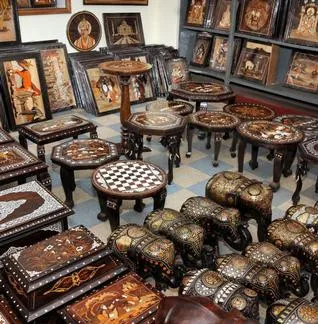
Culture and Societies The craft has been part of Mysore's broader heritage craft tradition, which also includes silk weaving, sandalwood carving, and bidriware. Royal patronage sustained the craft through the colonial period and into independence. Contemporary production serves the souvenir, home decor, and export markets.
Religious Significance No documented religious significance has been established for Mysore Rosewood Inlay. It is a secular decorative craft associated with courtly and domestic aesthetics.
Understanding the Art
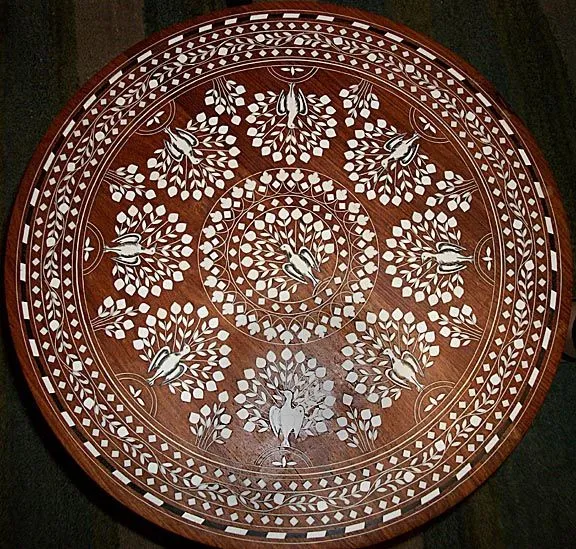
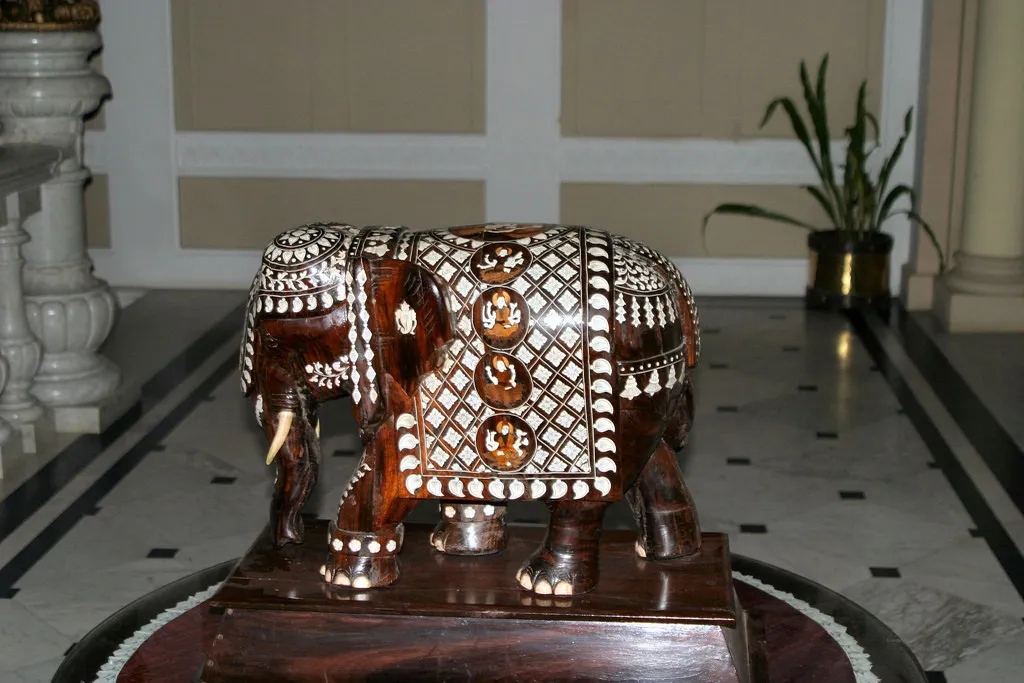
Style The aesthetic is characterised by the dark, close-grained surface of Indian rosewood contrasted with lighter inlaid materials. Designs tend toward geometric, floral, and foliate patterns. The high polish of rosewood and the precision of inlay work are the defining visual qualities.
Central Motifs and Their Significance Common motifs include floral patterns, geometric borders, elephant figures (connected to Mysore's royal symbolism), and foliate scrolls. These motifs draw from the broader south Indian decorative tradition and from the design vocabulary of the Mysore court.
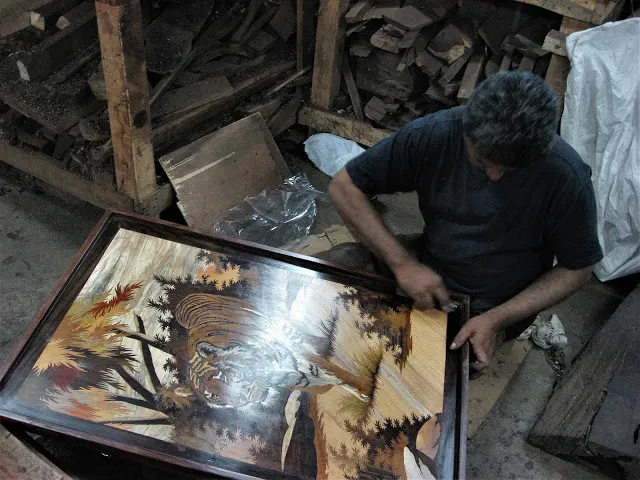
Process The process involves selecting and seasoning rosewood planks; drawing or transferring designs onto the wood surface; cutting grooves or channels corresponding to the design using chisels and gouges; cutting and fitting pieces of inlay material (historically ivory, now bone, brass, or other approved substitutes) into the channels; securing the inlay with adhesive; and finishing the surface by sanding and polishing to achieve the characteristic high gloss. Precision in cutting and fitting is essential for a flush, even surface.
Mediums Used Indian rosewood (Dalbergia latifolia) is the primary base material, valued for its density, fine grain, and dark colour. Inlay materials have historically included elephant ivory (now prohibited), and presently include bone, brass wire, and sometimes synthetic materials. Adhesives and finishing oils or lacquers are also used.
New Outlook
The craft faces challenges related to the availability of quality rosewood, the transition from ivory to alternative inlay materials, and competition from machine-produced imitations. Artisans and government agencies have worked to sustain the craft through GI protection and exhibition promotion. Limited new information is available in current published documentation on recent developments.
Learn Mysore Rosewood Inlay

Bibliography
Note
Relevant materials may be consulted in the archives of the Karnataka Handicrafts Development Corporation and in catalogue records of the National Crafts Museum & Hastkala Academy, which serve as key institutional repositories for research on the subject.
Image Sources
“Crafts Unparalleled #6: Mysore Rosewood Inlay Work.” Steemit, steemit.com/india/@rainsa/crafts-unparalleled-6-mysore-rosewood-inlay-work. Accessed on May 01, 2026.
Ghose, Indrani. “Making of Rosewood Inlay Handicraft, Mysore Crafts.” iShareThese, 8 Nov. 2021, isharethese.com/making-of-rosewood-inlay-handicraft-mysore-crafts-india/. Accessed on May 01, 2026.