

Moradabad Brass - The Handicraft Tradition of Uttar Pradesh
Explore Moradabad Brass, the handicraft tradition of Uttar Pradesh, and learn about its origins, techniques, cultural significance, and artistic heritage.
Introduction
Moradabad Brass, also referred to as Moradabad Metal Craft, encompasses a tradition of handcrafted metalwork centred in Moradabad, a city on the banks of the Ramganga River in western Uttar Pradesh. The craft produces a broad range of decorative and utilitarian objects from brass as its primary material, with copper, iron, aluminium, and nickel silver also employed. Moradabad is widely called Peetal Nagri, meaning Brass City, and supplies an estimated 80 percent of India's domestically produced brassware. The city's metal craft received the Geographical Indication (GI) tag from the Government of India under the designation 'Moradabad Metal Craft (Word Mark),' with the GI award recorded in 2013-14.
Etymology The city of Moradabad was founded in 1625 CE by Mughal prince Murad Baksh, son of Emperor Shah Jahan, after whom the city is named. 'Murad' is an Arabic-Persian name meaning 'desired' or 'wish fulfilled.' The nickname Peetal Nagri derives from 'peetal,' the Hindi-Urdu word for brass, and 'nagri,' meaning city or town. The English compound 'Moradabad Brass' is the standard trade designation used in export documentation and craft literature.
Origin Moradabad's development as a metalwork centre is traced to the Mughal period following the city's founding in 1625. Multiple craft documentation sources record that artisans from Kashmir migrated to Moradabad under the patronage of Emperor Shah Jahan, bringing metalworking knowledge that formed the foundation of the tradition. Live History India records that during Shah Jahan's reign, brassware from Moradabad was exported to Iran, Turkey, and the Middle East. Persian, Turkish, and Egyptian ornamental engraving techniques transmitted through Mughal court culture transformed the functional metalwork of early Moradabad into a refined decorative tradition. Artisans from Banaras, Lucknow, and Agra subsequently joined the cluster.
Location Moradabad city, Moradabad district, Uttar Pradesh. The city is situated on the Ramganga River, approximately 167 kilometres east of Delhi.
Community Moradabad's metal craft industry is organised around a large cluster of artisan households and small-scale manufacturing units. The city has approximately 850 export units and 25,000 metal craft industrial units. The total artisan workforce is estimated at 250,000. The craft is structured around specialist roles including engravers, enamellers, casters, polishers, and finishers, with different tasks typically carried out by different artisans or family units.
Relevance Moradabad's metal craft is of very high economic and cultural relevance. The city exports brassware to the United States, the United Kingdom, Canada, Germany, France, Italy, the Middle East, and Asia, with annual exports estimated at approximately Rs. 4,500 crore. The craft is included under the Uttar Pradesh ODOP programme and supported by the Export Promotion Industrial Park (EPIP). Aluminium has displaced brass as the dominant material by volume in the cluster's current production, but the brass tradition remains the cultural and reputational foundation of Moradabad's craft identity.
History
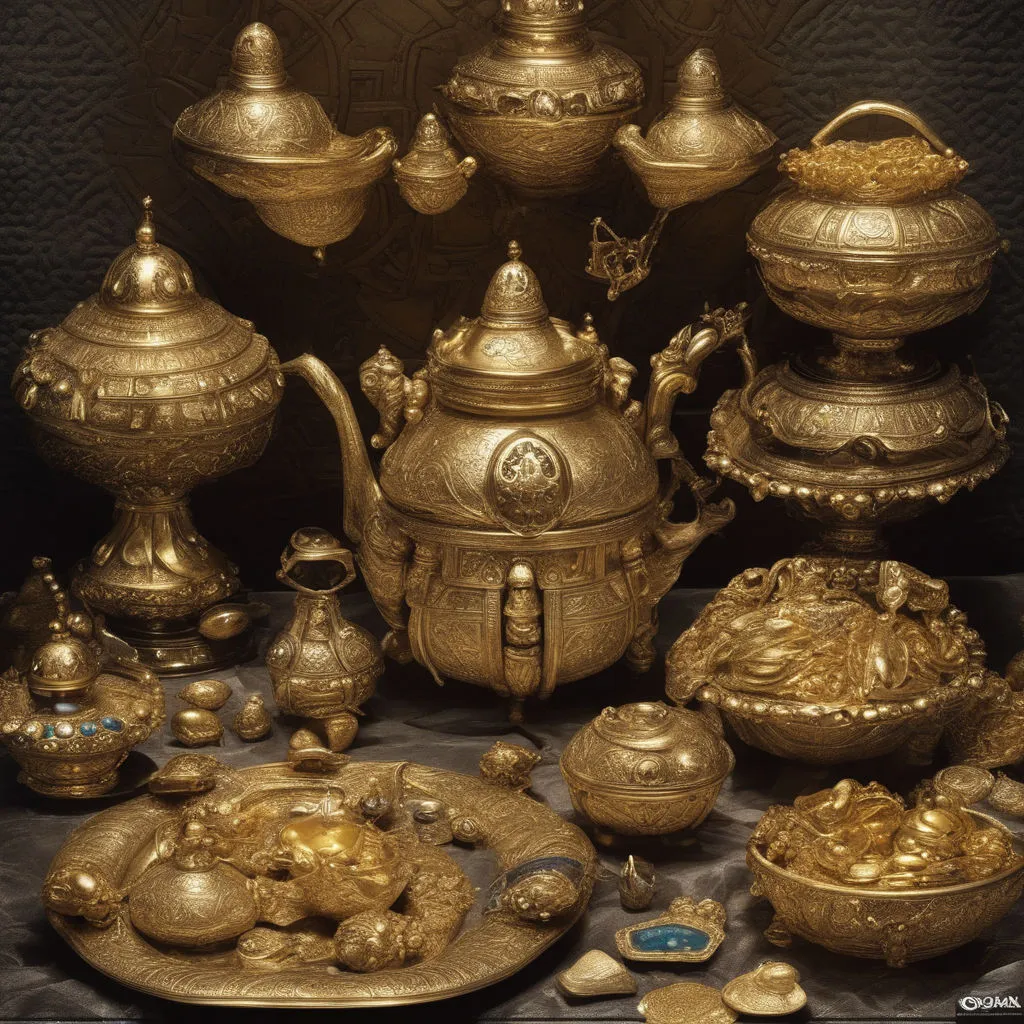
Background Moradabad was founded in 1625 CE as a Mughal administrative settlement. The Jama Masjid of Moradabad, built during the reign of Shah Jahan, is among the city's principal Mughal-era landmarks. As the city developed as a trading centre, the metalworking tradition brought by Kashmiri artisans under Mughal patronage became progressively established. By the 18th century, Moradabad had consolidated its identity as an important trading town. The British East India Company introduced new export incentives, and by the 19th century Moradabad had emerged as a major centre exporting brassware to Europe. The railway network opened international markets directly. Moradabad brassware was exhibited at the Wembley Exhibition in London in 1924-25. By the 1970s, over 13,000 artisans were employed in the city's brass industry.
Culture and Societies Moradabad's identity as Peetal Nagri permeates the social and cultural fabric of the city. The craft is hereditary within artisan families. The specialised knowledge of Ramganga River sand, described in IIT Kanpur documentation as a distinctive fine and soft sand serving as a superior binding material in the sand-casting process, is considered a defining technical asset of Moradabad production. The craft cluster includes both small family workshops and larger export-oriented manufacturing facilities.
Religious Significance Moradabad brass craft produces a significant category of religious objects including idols and figurines of Hindu deities, religious utensils, diyas, incense holders, and ritual accessories. Orders for such objects increase substantially during major religious events. The craft does not carry religious identity intrinsically, but a significant portion of its production serves devotional and ritual functions across Hindu, Jain, and other religious traditions.
Understanding the Art
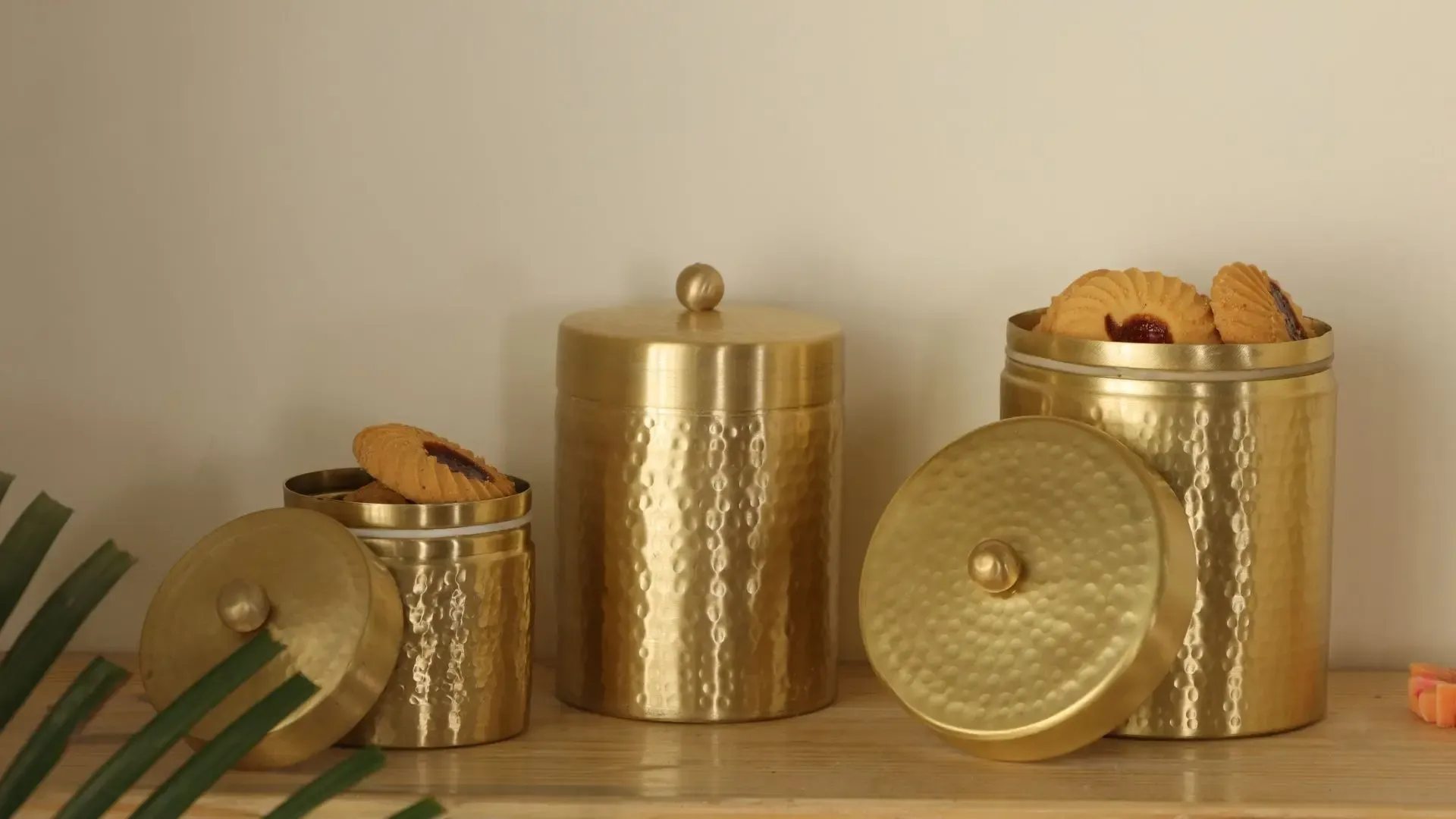
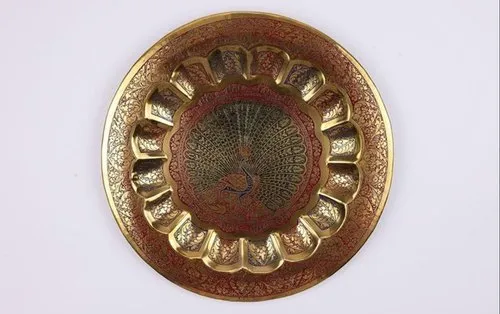
Style Moradabad metal craft is characterised by highly detailed surface decoration applied to cast or beaten metal forms. The style draws on Mughal and Persian ornamental vocabulary, incorporating floral arabesques, geometric patterns, calligraphic elements, and figural motifs of animals, birds, and mythological subjects. Surface treatment through engraving, embossing, and enamelling is a distinguishing feature. Contemporary production ranges from traditional ornate forms to minimalist designs suited to international home decor markets. Lacquering, electroplating, and powder coating technologies were introduced in the 1980s.
Central Motifs and Their Significance The primary motif vocabulary includes floral designs derived from Mughal garden aesthetics, particularly stylised rose, lotus, and arabesque creeper forms. Geometric interlocking patterns, characteristic of Islamic decorative art, are applied to trays, vases, and containers. Animal and bird motifs including peacocks, elephants, and horses appear in figurative pieces. Mythological figures from Hindu iconography feature prominently in idol production. Calligraphic panels in Arabic and Urdu script are produced for Middle Eastern and Indian Muslim consumer markets. Contemporary production also incorporates abstract and minimalist motifs responding to international demand.
Process Production involves several sequential specialist stages. Brass, an alloy of approximately 60 percent copper and 40 percent zinc, is melted in a furnace. The sand-casting process uses fine Ramganga River sand, also called masala or balu, to form moulds in moulding boxes. Molten brass is poured into the sand mould, cooled, and the mould is broken to release the cast object. Following casting, the rough surface is scraped, filed, and ground smooth. In the engraving and embossing stage, skilled engravers use chisels, burins, and punches to incise designs onto the metal surface. Embossing is produced by working the metal from the reverse side to create raised relief on the face. Enamelling applies coloured enamel paste to engraved channels and fires it to produce permanent colour inlay. Lacquering applies coloured lacquer to engraved surfaces to fill designs without firing. Polishing produces a bright reflective finish. Electroplating with gold, silver, or nickel is applied to selected objects. Complex objects require teams of specialised artisans working across separate production stages.
Mediums Used Brass (Copper-Zinc Alloy): The primary metal in a typical 60:40 ratio, used for the majority of decorative and utilitarian production.
Copper: Used in purer form for some traditional objects and decorative applications.
Aluminium: Now the dominant material by volume in the Moradabad cluster for lightweight decorative items.
Nickel Silver (Electroplated): Applied as a coating to produce silver-like finishes on base metal objects. Enamel: Coloured vitreous enamel applied in engraved channels and fired for permanent colour inlay.
Lacquer: Applied to engraved surfaces to fill and colour designs without firing.
Ramganga River Sand: The specific fine river sand used as a mould-making binding material in the traditional sand-casting process.
New Outlook
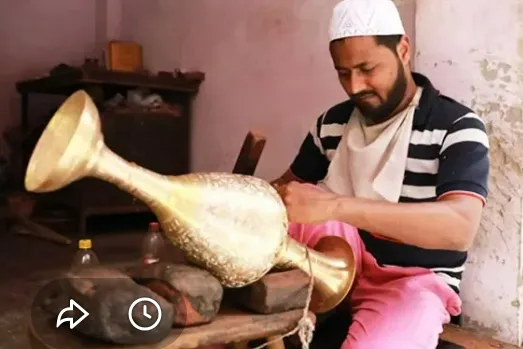
Moradabad's brass industry has adapted through its history. The 1980s saw diversification into iron and aluminium production alongside traditional brass. The EPIP supports manufacturing and export infrastructure. Under the ODOP programme, Uttar Pradesh government recognition provides developmental support. Challenges include declining demand for traditional brass as aluminium captures market share, rising raw material costs, and poor wage structures for artisans at the base of the supply chain, as documented by People's Archive of Rural India. The hazardous working conditions in casting units have been reported. The consecration of the Ram Temple in Ayodhya in 2024 generated a documented surge in orders for brass idols and religious objects from Moradabad.
Learn Moradabad Brass


Bibliography
Sources
Incredible India, Ministry of Tourism, Government of India. “Moradabad Metal Craft.” Incredible India, https://www.incredibleindia.gov.in/en/uttar-pradesh/moradabad-metal-craft
Indian Institute of Technology Kanpur, Design Cell. “Moradabad Techniques.” Design Bank, http://www.iitk.ac.in/designbank/Moradabad/Techniques0.html
“Moradabad’s Brassware Industry.” Drishti IAS, https://www.drishtiias.com/state-pcs-current-affairs/moradabad-s-brassware-industry
People’s Archive of Rural India. “In Moradabad, It’s Down to Brass Tacks.” PARI, https://www.ruralindiaonline.org/article/in-moradabad-its-down-to-brass-tacks
“Pital Nagri: Legacy of Moradabad.” Safexpress, 9 July 2024, https://safexpressblog.com/2024/07/09/pital-nagri-legacy-of-moradabad/
“The Shimmering Legacy: A Story of Moradabad Brass.” Live History India, Dec. 2024, https://www.livehistoryindia.com/story/living-culture/the-shimmering-legacy-a-story-of-moradabad-brass
Image Sources
Chandrashekhar, Mala. “Exquisite Brass Handicrafts of Moradabad: The Timeless Beauty of Uttar Pradesh.” Culture and Heritage, 13 Jan. 2025, https://cultureandheritage.org/2025/01/brass-handicrafts-of-moradabad-in-uttar-pradesh-india.html. Accessed on May 05, 2026.
Chavan, Akshay. “The Shimmering Legacy: A Story of Moradabad Brass.” PeepulTree World, 18 Dec. 2024, https://www.peepultree.world/blog/the-shimmering-legacy-a-story-of-moradabad-brass. Accessed on May 05, 2026.
“Explore Dylaa’s Exquisite Brass Products from Moradabad: The Brass Capital of India.” Dylaa, https://www.dylaa.com/explore-dylaas-exquisite-brass-products-from-moradabad-the-brass-capital-of-india-%F0%9F%8C%9F/. Accessed on May 05, 2026.