

Molela Terracotta - The Handicraft Tradition of Rajasthan
Explore Molela Terracotta, the handicraft tradition of Rajasthan, and learn about its origins, techniques, cultural significance, and artistic heritage.
Molela Terracotta
Molela terracotta is a distinctive form of flat-relief terracotta craft produced exclusively in the village of Molela in Rajsamand district, Rajasthan. The tradition is practiced by hereditary potters of the Kumhar caste and is characterised by hand-modelled, hollow-relief votive plaques that are wall-mounted rather than three-dimensional. These plaques depict Hindu and folk deities, tribal protective figures, and, more recently, scenes from rural life. Molela terracotta plaques have historically served as votive objects purchased by tribal communities of Rajasthan, Gujarat, and Madhya Pradesh, and were awarded the Geographical Indication (GI) tag in 2008.
Etymology The craft takes its name from the village of Molela, which in turn refers to the specific locality in the Rajsamand district on the banks of the Banas river. The terracotta tradition is locally described as murtikala, meaning the art of making images or idols. Kumhar, the caste name of the artisans, translates as 'potter.' The plaques are also referred to as votive plaques or devra plaques, the term devra denoting the semi-open shrine in which tribal communities install purchased images after ritual installation in their villages.
Origin The Molela terracotta tradition is estimated to have originated in the seventeenth century, as documented by the MAP Academy. The artisan community traces its ancestry to Nadol in Pali district to the north, and further to Abu near the Gujarat border. They are believed to have previously lived in the nearby village of Bagol, making everyday earthenware, before relocating to Molela. A founding legend, documented consistently across multiple sources including the MAP Academy, Gaatha, and Memeraki, tells of a blind Kumhar potter who received a divine vision directing him to collect clay from the Molela area and create the image of the folk deity Dharmaraja (also identified as Devnarayan in some accounts). The potter's sight was reportedly restored after completing the image, prompting the community to settle in Molela and begin producing votive plaques. While this legend cannot be historically verified, it provides the mythological charter for the craft and its association with the specific clay sources of the Banas riverbank.
Location Molela village is situated in Rajsamand district, Rajasthan, on the banks of the Banas river, approximately 10 kilometres from the pilgrimage town of Nathdwara and accessible as a day excursion from Udaipur. The village lies within the Mewar region. The craft is produced exclusively in Molela: approximately 30 Kumhar families reside and work there, and the tradition is not practiced elsewhere in comparable form. The Kumhar community uses clay sourced from two specific ponds: the Aasula pond in Molela and the Solah pond in the nearby Sema village, both prized for the fine texture of their clay that resists cracking during drying.
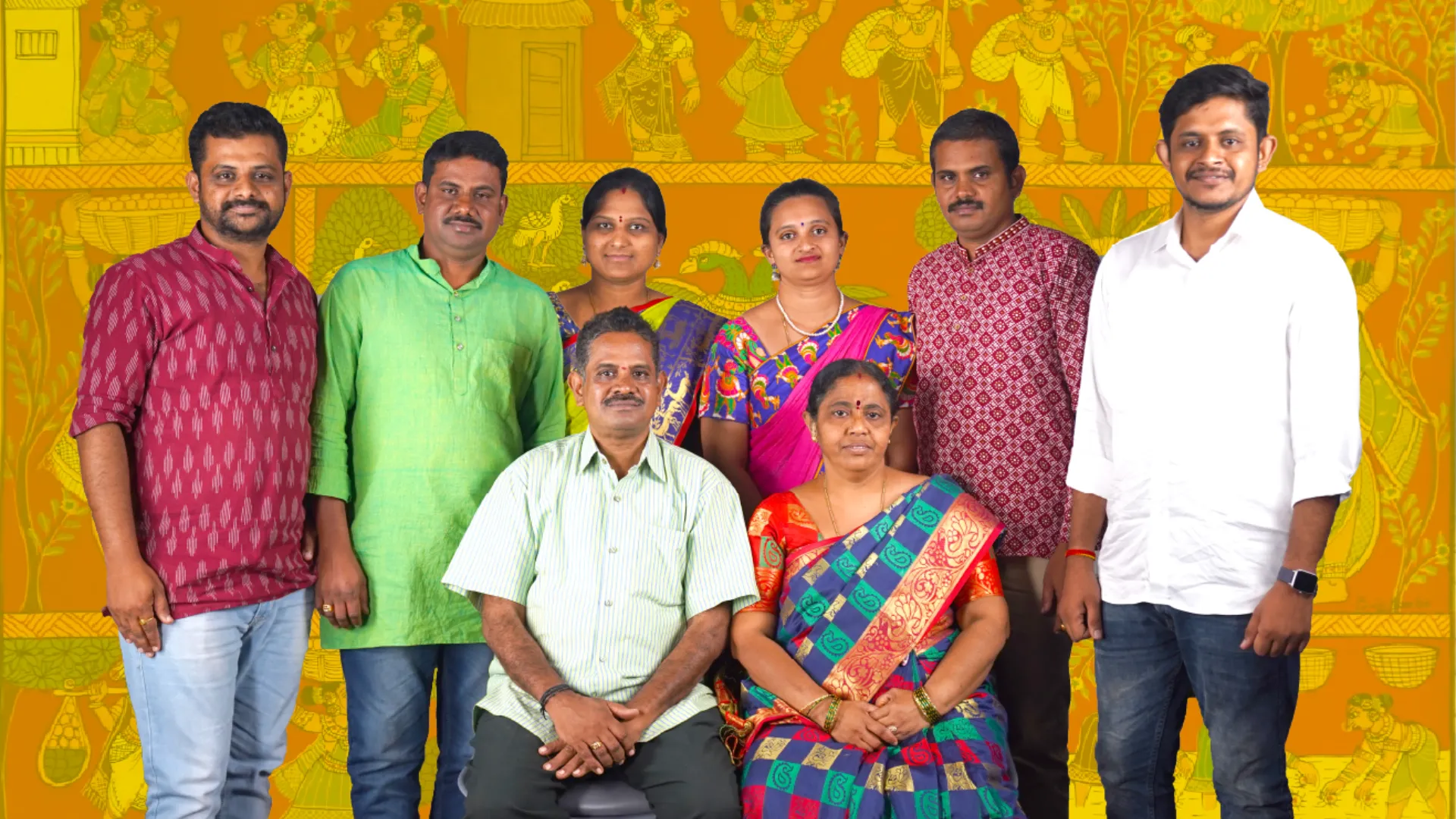
Community The artisans of Molela belong to the Kumhar caste, hereditary potters who practice both everyday pottery and votive plaque production. The 30 Kumhar families of the village constitute the entire producing community for this specific craft. Agriculture and livestock have historically supplemented pottery income during periods when votive commissions are sparse. The most documented practitioner is Mohanlal Chaturbhuj Kumar, who received the Padma Shri in 2012 for terracotta craftsmanship and founded the Mohan Terracotta Art Research and Development Centre in Molela to train younger artisans. His sons Rajendra and Dinesh Kumar continue the tradition; Dinesh Kumar received the National Merit Award 2019 and International Craft Award 2019. Jamnalal Kumhar is another documented practitioner who, along with Mohanlal Kumar, was commissioned to create the large terracotta mural on the facade of the Udaipur railway station. Khemraj Kumhar, father of Ramesh Kumhar, received a Rashtrapati (Presidential) medal for his craftsmanship.
Relevance Molela terracotta plaques occupy a distinct position in Indian craft culture as objects of active ritual use rather than purely decorative or commercial production. The Bhil, Meena, Gujjar, and Garasiya tribal communities from Rajasthan, Gujarat, and Madhya Pradesh travel to Molela during the months of Magh (January-February) and Vaishakh (April-May) to purchase new votive plaques for installation in their community shrines. The plaques are changed every three to five years, ensuring continuous demand. The ritual of purchasing plaques involves tribal priests (bhopas) who advise on deity selection and auspicious timing. The craft was awarded a GI tag in 2008, though the MAP Academy notes that actual benefit to artisans from GI protection has been limited by bureaucratic and organisational challenges. The tradition's integration into public art was marked by the Udaipur railway station commission.
History
Background The 17th-century origin estimate for the Molela tradition is based on the migration history of the Kumhar community from Bagol and genealogical reckoning, as documented by the MAP Academy. According to the Gaatha craft archive, Dinesh Kumar is the 15th generation of his family to practice the craft, which, at an average of approximately 25 years per generation, supports a period of origin several centuries prior to the present. The deities depicted on the plaques include regional protective figures that reflect the specific religious traditions of the Bhil and Meena tribal communities, suggesting that the craft developed in close relationship with tribal religious practice in the Mewar and southern Rajasthan region.
Culture and Societies The social function of Molela terracotta plaques is documented in detail by the MAP Academy, Gaatha, and the 30Stades cultural reporting archive. Tribal communities from multiple states travel to Molela with their bhopas (priests) as part of an annual ceremonial purchase. After selection and purchase, the plaques are carried to the Banas river in a procession, where the deity is worshipped before being transported to the home village. The idol then visits each house in the village to bless its residents before final installation in the community shrine or devra. Some minority communities of Rajasthan and Gujarat historically performed blood offerings during installation ceremonies, though such sacrificial rituals have been banned by conservation authorities. The Kumhars received payment in kind: grains and clothing rather than cash, with agriculture providing supplementary income during the non-festival season. This economic structure has shifted toward monetary exchange and urban market sales in the contemporary period.
Religious Significance The religious significance of Molela terracotta is well-documented and central to the tradition. The plaques function as primary votive objects in the religious practice of the Bhil, Meena, Gujjar, and Garasiya communities. The principal deities depicted include Dharmaraja (Devnarayan), a Rajput hero who is the most important protective deity of the Gujjar tribe and is depicted seated on a horse holding a spear and lotus, attended by a serpent, cows, peacock, and sun; Nagadeva (the snake deity); Chamunda, Kali, Durga, and Ganesha; Bhairavnath, depicted as the deity of opposing cosmic forces; and Gangaur votive plaques for Shiva and Parvati, associated with marital wellbeing. Varnish is not applied to religious plaques because it is considered an organic material inappropriate for use on divine images; instead, the traditional lacquer jala is used for surface finishing. This prohibition is a documented practice, as noted by the Gaatha research archive.
Understanding the Art
Style Molela terracotta is defined by its hollow-relief format: the figures are hand-modelled in raised relief on a flat slab, with the reverse side remaining flat for wall mounting. This distinguishes the craft from three-dimensional sculptural traditions. The plaques are typically rectangular with figures arranged in registers or as single monumental images depending on the deity depicted. The relief is sufficiently deep to create strong shadow and visual definition but remains attached to the slab background. Colours are applied after firing, using natural mineral pigments, producing characteristic combinations of ochre red, white, black, and vivid blues and greens.
Central Motifs and Their Significance The iconographic programme of Molela plaques is governed by the ritual requirements of the commissioning tribal communities. Dharmaraja is depicted on horseback with specific attendant iconography; Nagadeva appears in serpent form as a protective deity; Chamunda and Kali appear in wrathful forms associated with village protection. Contemporary additions to the repertoire include village scenes depicting weddings, agricultural activities, and daily rural life, produced for the urban decorative market. Each deity has specific colour conventions: Devi Parvati is painted orange, Lord Shiva in blue within the Gangaur plaque tradition, as documented by Memeraki. Tribal preference for bright, bold colours is a consistent feature across all documented accounts.
Process The process begins with clay collection from the Aasula pond in Molela or the Solah pond in Sema village. The clay is sieved and soaked, then mixed with rice husk and donkey or horse dung in specific proportions to add strength and reduce cracking. The mixture is thoroughly kneaded. The base slab is formed using a pindi (a rounded stone with a grip groove), and the scene or deity figure is built up on the slab without the use of moulds, relying entirely on hand modelling. A badli (flat, chisel-shaped metal tool) is used to add details and refine forms. Once modelled, the plaques are sun-dried, then fired in a kiln at high temperature. After firing, colours are applied using natural pigments. The palewa (clay slip) serves as the colour base, and pigments are mixed into it: geru (red earth) produces red; other mineral sources produce additional colours. Dawrigund, a locally collected vegetable gum, serves as the binder. The traditional surface finish is jala, a locally produced lacquer applied by only one family in the entire region; commercial varnish is not used on ritual plaques. The entire process from clay collection to final painted product takes several days and must be carried out during cooler months, as summer heat causes cracking during the drying stage.
Mediums Used Clay: Fine clay from Aasula pond, Molela, and Solah pond, Sema village. Clay from the Banas river banks. Specific particle size and mineral content of these sources provides the crack-resistance that distinguishes Molela clay from alternatives. Additives: Rice husk and donkey or horse dung kneaded into the clay to improve structural integrity. Colour system: Palewa (clay slip) as base; geru (red earth) for red; other mineral sources for remaining colours; dawrigund (vegetable gum) as binder; jala (traditional lacquer) for surface sheen. Tools: Pindi (rounded grip stone for slab forming); badli (flat chisel-shaped metal tool for detail work); wooden spatulas and scrapers as supplementary tools.
New Outlook
The Molela terracotta craft occupies an unusual position in that it maintains active ritual patronage from tribal communities while simultaneously developing an urban and export decorative market. The ritual market provides a stable base, but the raw material supply is under pressure: the clay from the two primary ponds is being depleted by commercial brick kiln extraction, and concrete particles contaminating the clay reduce its quality, as documented by the 30Stades reporting on the craft. Artisans have adapted by depicting village scenes and secular subjects alongside traditional votive imagery, broadening the commercial base. The Udaipur railway station mural commission by Mohanlal Kumar and Jamnalal Kumhar represents public art integration of the tradition. Mohanlal Kumar's Mohan Terracotta Art Research and Development Centre provides structured training for younger artisans. International workshops and craft fair participation have raised the profile of Molela terracotta globally. Despite GI tag status since 2008, institutional benefit to artisan families has been limited by lack of organised representation and bureaucratic access challenges, as documented by the MAP Academy.
Learn Molela Terracotta
Bibliography
Sources
D.Source. “Molela.” D'Source Digital Online Learning Environment for Design, Indian Institute of Technology Bombay, https://www.dsource.in/
Gaatha. “Molela: Terracotta Plaque.” Gaatha Craft Archive, https://gaatha.org/
MAP Academy. “Molela Terracotta.” MAP Academy Encyclopedia of Art, 2021, updated Oct. 2025, https://mapacademy.io/
Parampara Project. “Traditional Craftmanship of Rajasthan.” Parampara Project, https://paramparaproject.org/
Image Sources
Jaswal, Misha. “Molela Terracotta Craft.” Memeraki, 11 July 2024, https://www.memeraki.com/blogs/posts/molela-terracotta-craft. Accessed on May 05, 2026.
“Molela Terracotta Craft.” Molela Clay Works, https://molelaclayworks.com/blog-details.php?id=8. Accessed on May 05, 2026.
“Unveiling the Mystique of Molela Craft of Rajasthan: Secrets of Its Creation.” Terracotta by Sachii, https://www.terracottabysachii.com/blogs/blogs/unveiling-the-mystique-of-molela-craft-of-rajasthan-secrets-of-its-creation. Accessed on May 05, 2026.