


Meenakari - The Handicraft Tradition of Rajasthan
Explore Meenakari, the handicraft tradition of Rajasthan, and learn about its origins, techniques, cultural significance, and artistic heritage.
Introduction
Meenakari, also transliterated as minakari, is a form of enamel painting applied to metal surfaces, primarily used in fine jewellery but also on decorative and functional objects including trays, bowls, vases, and household items. Of Persian origin, the craft was introduced to India in the sixteenth century through Mughal court patronage and was established as a significant production tradition in Jaipur, Rajasthan, by Raja Man Singh of Amber. Jaipur remains the primary centre of traditional meenakari production in India, with additional regional variants practiced in Varanasi, Lucknow, Pratapgarh, Delhi, Bikaner, and Udaipur.
Etymology The word meenakari is composed of two Persian-origin words: mina or meena, meaning 'paradise' or 'heaven,' and kari, meaning 'work on an object.' The compound term therefore translates approximately as 'placing paradise onto an object.' This etymology is confirmed in multiple institutional sources, including the MAP Academy Encyclopedia of Art and the D.Source Kundan Meenakari Jewellery documentation produced by IIT Bombay. An alternative rendering, minoo meaning heaven, is cited in some sources as the root of meena. In Persian art history, Isfahan and related enamel-producing centres of Iran used the term mina for the same tradition.
Origin Meenakari originated in Persia, where enamel work on metal has a history stretching back several centuries. The MAP Academy Encyclopedia identifies the craft as originally Persian, with introduction to India occurring in the sixteenth century. Some Iranian sources place the art's origins in Persia as far back as 5000 years, with documented refinement during the Seljuk period, though independent verification of these specific dates is not available in the sources consulted. The art reached India through Mughal patronage: Raja Man Singh I of Amber, who served as a military commander under Emperor Akbar, brought five skilled meenakars from the Mughal court at Lahore to establish workshops in Jaipur. This event is consistently cited in the D.Source IIT Bombay survey, the Rajasthan government's water department cultural documentation, and the MAP Academy. There is a separate attribution, noted by some sources, crediting Raja Ram Singh with inviting further artisans from Lahore during the Shah Jahan period in the mid-17th century; these two accounts are not necessarily contradictory, as patronage may have occurred in multiple phases.
Location Jaipur, Rajasthan, is the primary centre of meenakari production in India, particularly for gold-based enamel work and panchranga (five-colour) designs. Within Rajasthan, silver enamelling is predominant in Udaipur and Bikaner, while glass enamelling characterises the Pratapgarh style. Lucknow is associated with green-and-blue enamel on silver. Varanasi artisans practice gulabi mina, using pink enamel, a style introduced to the Avadh court by Persian craftsmen in the 17th century. Delhi is associated with gold enamelling. Hyderabad also has documented meenakari production, though secondary to the Rajasthan centres.
Community The artisans who practice meenakari are called meenakars. Traditional meenakari production, particularly for kundan jewellery, involves a division of labour across specialists: the naqqash (designer), the sonar or goldsmith, the ghaaria (engraver), and the jediya (gem setter). The meenakar applies enamel within the engraved channels created by the ghaaria. In Jaipur, the Muslim Rana community has historically been associated with meenakari production, though the craft has been practiced across communities. The Rhmani community is documented in some accounts as hereditary mojari producers in Jaipur, but meenakari has been associated with specialised artisan families whose craft knowledge has been transmitted within family units.
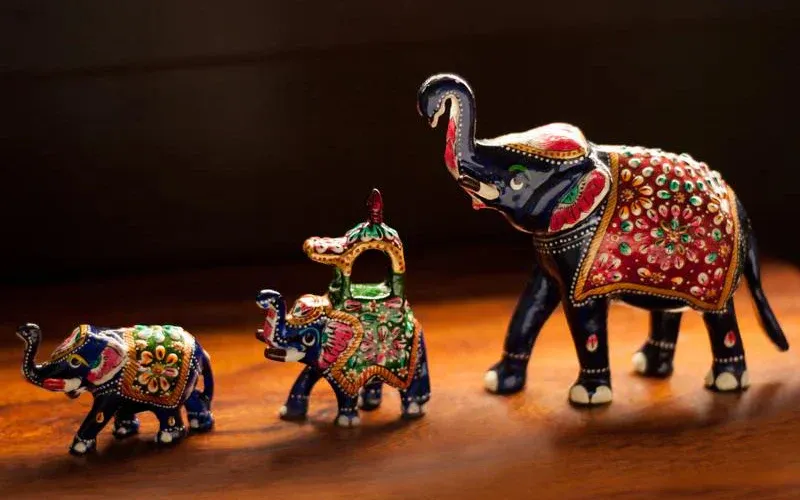
Relevance Meenakari is among the most formalised of Rajasthan's court crafts, historically associated with Mughal and Rajput royal patronage and reserved for high-value jewellery and decorative objects. It is consistently paired with kundan jewellery, where meenakari is applied to the reverse face of the jewel, creating a two-sided object of which the front bears gemstones set in gold foil and the reverse bears enamel painting. This combination is documented in museum collections including the Los Angeles County Museum of Art (LACMA), which holds verified historical examples. In contemporary practice, meenakari is applied to a broader range of objects including decorative elephants, masks, jewellery boxes, and wall hangings. Jaipur meenakari has GI tag recognition as part of the broader Jaipur Jewellery GI cluster.
History
Background The documented introduction of meenakari to Rajasthan is placed in the reign of Raja Man Singh I of Amber, who governed as a mansabdar under Emperor Akbar. His administrative role as governor of Afghanistan, which required close contact with the Mughal court at Lahore, is identified by historians as the vector through which he encountered Persian enamel work and subsequently transferred it to Rajasthan. The D.Source account specifies that five skilled enamel artists were brought from Lahore and established in Jaipur, where the art gained patronage from Mughal and Rajput nobility. By the reign of Shah Jahan, meenakari had expanded from architectural decoration to jewellery, driven in part by court demand for enamelled personal ornaments. The Avadh court at Lucknow attracted Persian meenakars in the 17th century, introducing a distinct regional variant.
Culture and Societies From the 16th through the 19th century, meenakari jewellery was a marker of elite identity within Mughal and Rajputana courts. The integration of meenakari with kundan jewellery, which sets uncut diamonds, rubies, and emeralds into a gold foil base, produced objects of exceptional material value and technical complexity. The LACMA collection includes documented examples from Jaipur (c. 1879), Lucknow (c. 1800), and Varanasi (late 19th century), providing physical evidence of the regional diversity of the craft in the historical period. The French traveller Jean Chardin's account of Persian enamel work in Isfahan, as cited in the D.Source survey, provides contextual documentation of the parent tradition from which Indian meenakari derives. Regional distinctions in colour use and technique reflect the different court aesthetics that developed independently after the initial Mughal introduction.
Religious Significance Meenakari has documented associations with religious contexts in certain applications. It is used as decorative elements in temples and gurdwaras, as noted in the Delhi meenakari documentation. Historically, meenakari decorated the jewellery worn by deities in temple settings. The terminology used by artisans contains references to colour and aesthetic concepts with Persian-Mughal heritage, including Lal Zameen (red ground), Sabz Zameen (green ground), and Teh Zameen (transparent colour over engraved reverse). These terms do not carry explicit religious meaning but reflect the craft vocabulary inherited from the Persian Islamic court tradition. For kundan bridal jewellery, meenakari carries social and ceremonial significance within Hindu marriage traditions, though this is contextual rather than intrinsic to the craft itself.
Understanding the Art
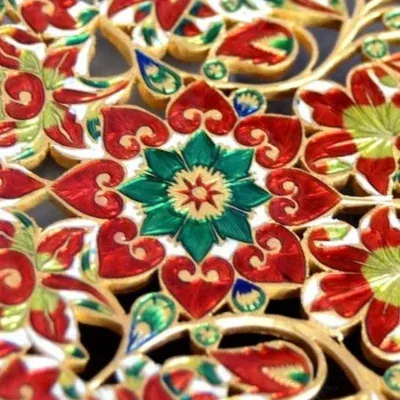
Style Jaipur meenakari is characterised by the champlevé technique, in which channels or depressions are engraved into the metal surface and filled with enamel. The dominant palette is the panchranga (five-colour) combination: red, green, blue, white, and yellow applied to a gold base. Gold is the preferred base metal because it can hold the full range of available colours; silver is limited to pink, green, and blue. The enamel colours are rendered in both transparent and opaque variants: translucent colours include red, blue, and green; opaque colours include white, pink, yellow, and grey. Specific stylistic terms distinguish approaches: ek rang khula mina uses a single transparent colour; bandh mina khaka uses an opaque outline surrounding transparent enamel. The regional styles of Lucknow (green and blue on silver), Varanasi (gulabi mina, pink on silver), and Pratapgarh (glass enamelling) represent distinct aesthetic traditions.
Central Motifs and Their Significance Motifs in meenakari derive from a combination of Persian floral vocabulary and Mughal court decorative conventions. Flowers, vines, birds, parrots on swings, peacocks, and abstract geometric compositions are documented in historical examples across museum collections. Colour choices carry established conventional meanings in some traditions: red is associated with passion, green with prosperity, and blue with the divine, though these attributions are contextual rather than universally fixed. Peacocks are among the most recurring motifs in Jaipur meenakari, reflecting their prominence in Rajasthani visual culture. Figural representations of Hindu deities appear in temple-use objects and devotional items.
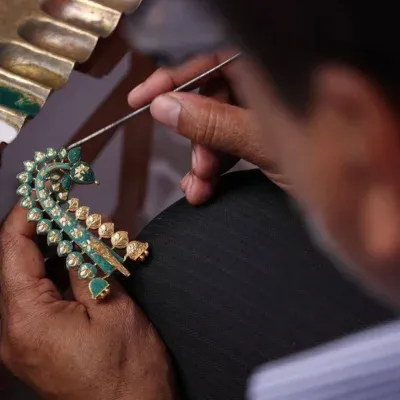
Process Meenakari production in Jaipur follows a documented multi-stage process. The naqqash (designer) first creates the design in the form of grooves or depressions on the metal sheet. The sonar (goldsmith) refines the metal form. The ghaaria (engraver) cuts the channels that will hold the enamel. The meenakar then applies enamel: glass or mineral pigments are crushed using a mortar and pestle and mixed with a liquid made from pomegranate seeds and water to produce a workable paste. The enamel is applied with thin needles, spokes, or brushes into the engraved areas. The object is then fired in a kiln or on a domestic heater coil. Each colour must be fired separately. After all colours are applied and fired, the piece is polished to sharpen the metal outline, and finished by boiling in a mild acid solution to produce lustre. For jewellery, the jediya (gem setter) then applies stones to the front face in the kundan technique.
Mediums Used Base metals: Gold (primary, can hold all enamel colours), silver (limited to pink, green, and blue), copper (used in lower-value decorative objects). Enamel: Crushed glass mixed with metallic oxides: cobalt oxide for blue, copper salts for green, ferrous salts for specific hues. Natural minerals have been used historically; commercial chemical compounds are documented in the D.Source survey as a contemporary substitution. Firing temperature: Approximately 750 to 850 degrees Celsius, as cited in the craft documentation sources. Finishing: Agate burnishing and mild acid boiling for final lustre.
New Outlook
Meenakari production in Jaipur continues at a commercial scale, though the craft is classified as endangered due to the declining number of master meenakars with full proficiency across all techniques. The complexity of the craft, which requires coordination among multiple specialists and years of skill development, makes it difficult to sustain in an economy offering faster returns. Contemporary demand for meenakari has expanded beyond jewellery to decorative objects such as elephants, masks, bowls, and wall hangings, diversifying the product base. The combination of meenakari with kundan jewellery remains the highest-value application. International market interest, particularly in bridal jewellery, provides demand but also creates pressure toward cost-reduction that may compromise traditional techniques. The MAP Academy and government documentation through the Rajasthan handicrafts department represent the primary institutional efforts to preserve technical knowledge.
Learn Meenakari

Bibliography
Sources
Baral, Bibhudutta, et al. “Kundan Meenakari Jewellery, Jaipur.” D'Source Digital Online Learning Environment for Design, Indian Institute of Technology Bombay, https://www.dsource.in/
Government of Uttar Pradesh. “Banaras Gulabi Meenakari Craft.” Varanasi District Official Website, https://varanasi.nic.in/
Los Angeles County Museum of Art (LACMA). “Collection Records: Tray (Lucknow, c. 1800); Box (Lucknow, c. 1800); Scent Vial (Lucknow, c. 1800); Pendant Attributed to Ghuma Singh (Jaipur, c. 1879); Pair of Bracelets with Peacocks (Delhi or Jaipur, c. 1900s); Parrot on a Swing (Varanasi, Late 19th Century).” LACMA Collections, https://collections.lacma.org/
MAP Academy. “Meenakari.” MAP Academy Encyclopedia of Art, 21 Apr. 2022, https://mapacademy.io/
Image Sources
“Art of Enameling: The Origin of Meenakari.” ExclusiveLane, 14 July 2022, https://exclusivelane.com/blogs/handmade/art-of-enameling-the-origin-of-meenakari. Accessed on May 04, 2026.
“Enduring the Allure of Meenakari: A Fusion of Fire, Colour and Fashion.” Rachnaa, 19 July 2025, https://rachnaa.co.in/enduring-the-allure-of-meenakari-a-fusion-of-fire-colour-and-fashion/. Accessed on May 04, 2026.
“Meenakari Craft Explained.” Zishta, https://zishta.com/blogs/bodha/meenakari-craft-explained. Accessed on May 04, 2026.