

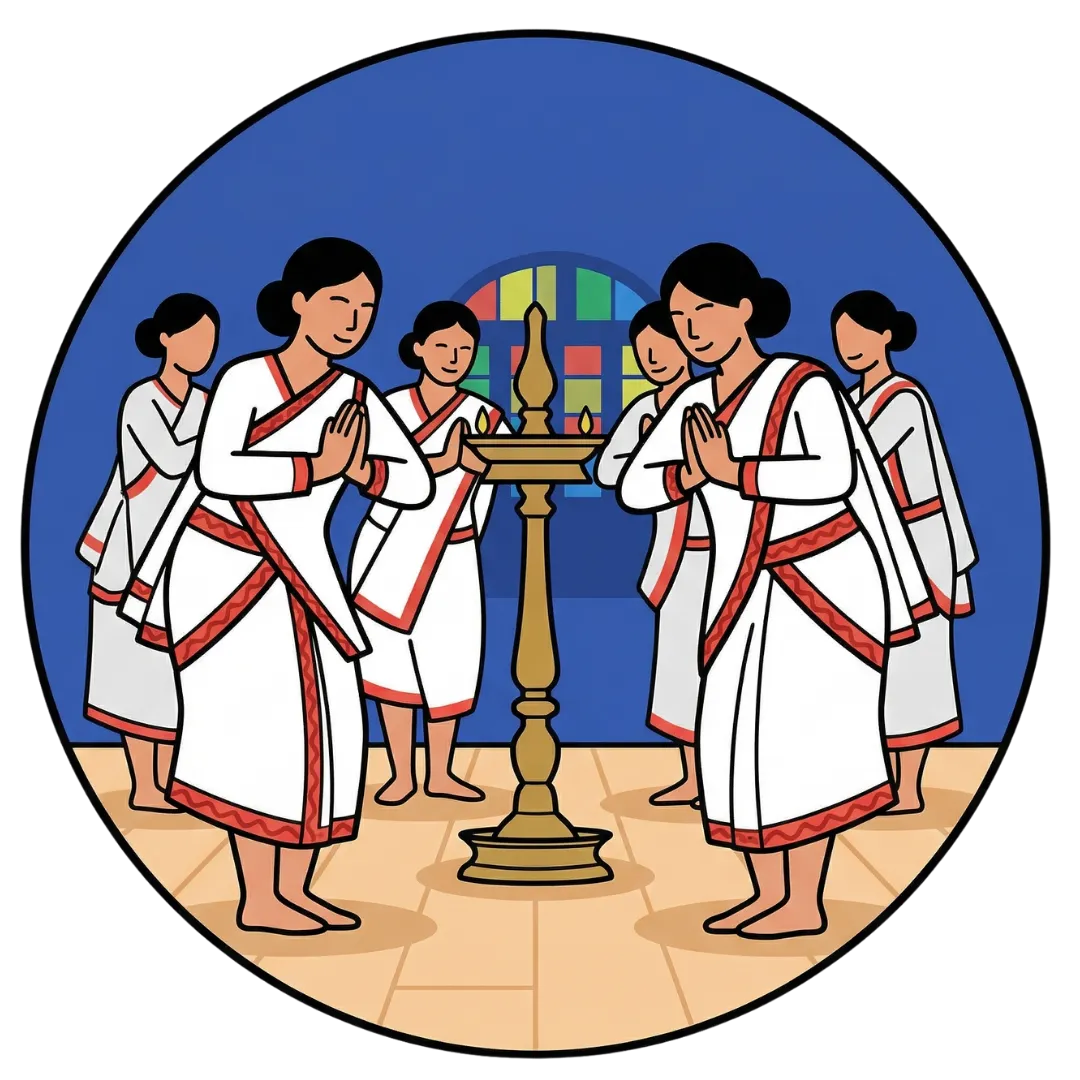
Margamkali - The Folk Dance Tradition of Kerala
Explore Margamkali dance, the performance tradition of Kerala, and learn about its origins, techniques, cultural significance, and artistic heritage.
Introduction
Margamkali is a traditional circular group dance form practiced by the Saint Thomas Christian communities of Kerala, India. It narrates the arrival of Apostle Thomas and the early spread of Christianity in the region through rhythmic movement and devotional song. The dance is historically associated with the Knanaya sect within Kerala's Syrian Christian community and has been performed at weddings, church festivals, and community gatherings for several centuries. It is also known as Margam Kali or Margam Pattu, the latter referring specifically to the text of songs that form the lyrical core of the performance.
Etymology The word "margam" in Malayalam translates to "path," "way," or "road." In a religious context, it refers to the Christian faith itself, as the early Christian community in Kerala used the phrase "margam koodal" (joining the path) to describe conversion to Christianity. The term is also connected to the Syriac liturgical tradition, in which the word carries similar connotations of a spiritual way or discipline. "Kali" means play or dance. The full term thus means "the dance of the path," describing a performance that enacts the story of the faith's arrival.
Origin Margamkali originated among the Saint Thomas Christians of Kerala, whose founding narrative is the first-century arrival of the Apostle Thomas on the Malabar Coast in approximately 52 CE. The narrative content of Margamkali is drawn from the Acts of Thomas, an apocryphal text that circulated in Syria around the third century CE. The Knanaya sect, an endogamous group within the Syrian Christian community that arrived in Kerala around 345 CE under the leadership of Thomas of Cana, is identified as the primary custodian of the tradition. Scholars including folklorist Chummar Choondal, in a 1973 survey, found that approximately 70 percent of the communities in which Margamkali remained strong were from the Knanaya Catholic community and 25 percent from the Knanaya Jacobite community. Some scholars, including P.M. Jussay and Dr. Shalva Weil, have identified connections between Margamkali and Jewish wedding dance traditions from the Malabar Jewish diaspora.
Location Margamkali is most densely associated with the Kottayam and Thrissur districts of central Kerala, where the Knanaya community has historically been concentrated. The 1973 survey by Chummar Choondal found that the dance had not taken root in parts of central Kerala such as Thrissur and Pala, despite those regions having high Syrian Christian populations. The Institute of Folklore Studies in Thrissur later conducted annual training courses that helped spread the form to central Kerala. Today the dance is performed across Kerala.
Community Margamkali was historically performed exclusively by men, particularly by Knanaya Christian men. Folklorist O.D. Varkey, in a recorded interview at the Institute of Folklore Studies in 2018, stated that the dance was practiced by Syrian Christian men since the fourth century. Women were introduced to the performance following the inclusion of Margamkali in the Kerala State School Youth Festival in 1984. Today the female version of the performance is more widely staged, particularly in competitions and church festivals.
Relevance Margamkali received significant scholarly and institutional attention from the 1960s onward through the research of Chummar Choondal and Jacob Vellian. The establishment of Hadusa, a center for Christian performing arts in Kottayam under Bishop Mar Kuriakose Kunnassery, provided institutional support. The Kerala Folklore Academy has offered the Diamond Jubilee Fellowship to support practitioners. The art form's inclusion in the Kerala State School Youth Festival in 1984 was a defining event in its modern dissemination.
History
Background The earliest documented phase of Margamkali predates the Portuguese arrival in Kerala, placing the performance tradition at least within the pre-16th century period. The Synod of Diamper (1599), convened by the Portuguese to bring Kerala's Syrian Christians under Roman Catholic authority, is documented as having suppressed indigenous performance traditions including Margamkali. A revival of the textual component is attributed to the 17th-century priest Kallissery Itti Thoman Kathanar (also identified as Itti Thomman Kathanar in some sources), a Knanaya priest who is credited with refashioning the Margam Pattu text into its present fourteen-stanza structure.
Culture and Societies Margamkali has functioned as a medium for the transmission of community identity, theological narrative, and historical memory among Kerala's Syrian Christians. The performance was traditionally staged at weddings, on the eve of major church festivals, at house blessings, and at community gatherings. Folklorist Chummar Choondal, cited in research published by Sahapedia, has noted that the songs of Margamkali follow the metric patterns of Kakali, Unakakali, and Misrakakali and that their musical character is analogous to the chanting style of Syriac liturgy. No musical instruments are used in the traditional performance.
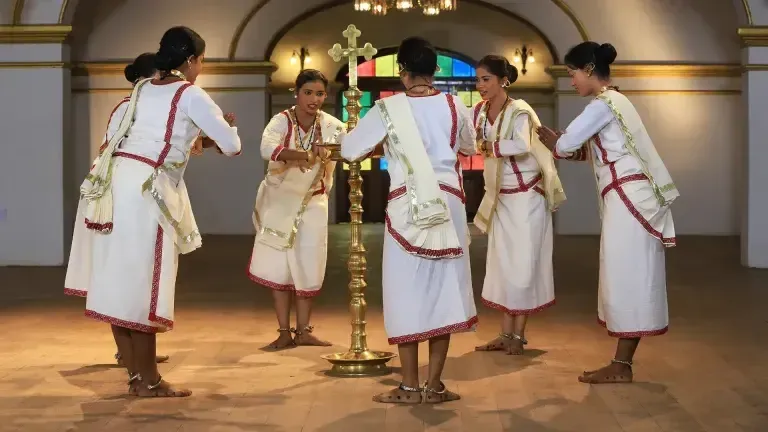
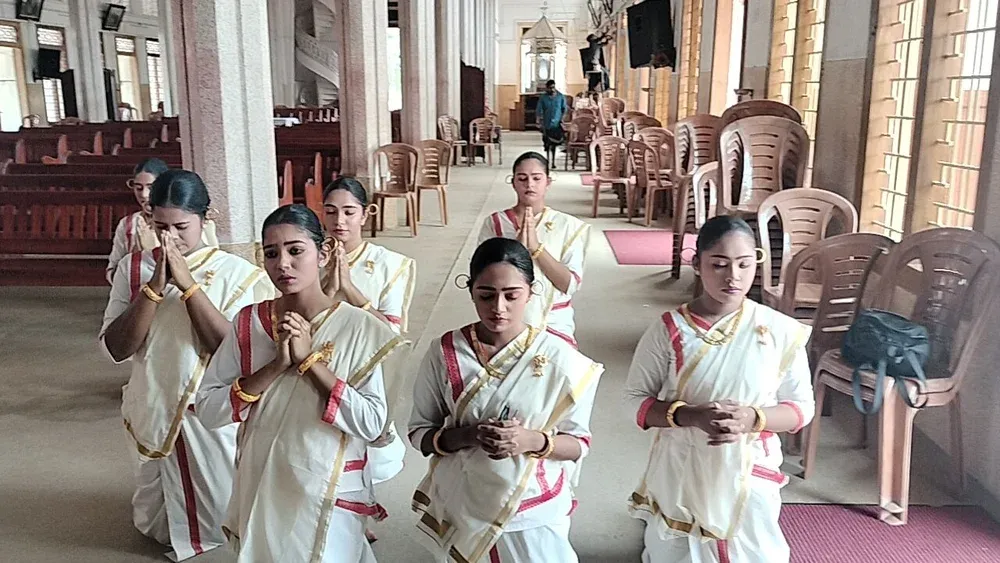
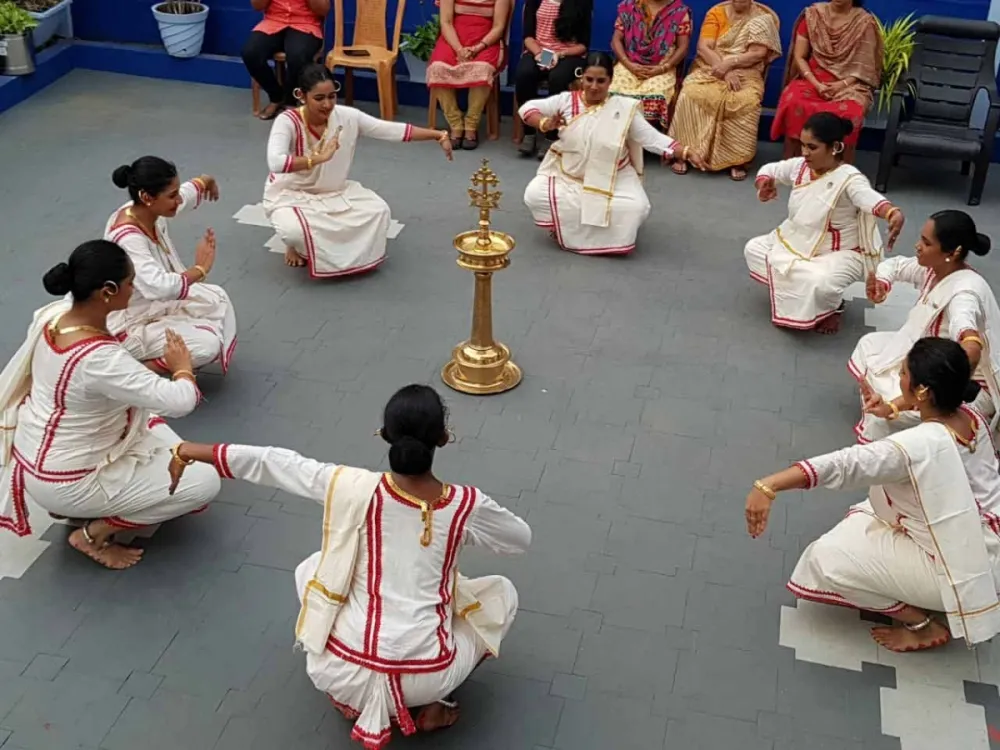
Religious Significance Margamkali is explicitly a devotional and catechetical art form. The lyrical content, drawn from the Acts of Thomas, narrates the Apostle Thomas's arrival in the Chola-Kerala kingdoms, the miracles he performed, the communities he converted, the churches and crosses he established, and his eventual martyrdom. The dance is performed around a Nilavilakku (traditional Kerala wick lamp), which symbolizes the presence of Christ, while the performers represent his disciples. A prayer to Saint Thomas begins the performance. The entire structure of the form is designed to transmit Christian theological narrative through movement and song, making its religious function inseparable from its artistic form.
Understanding the Art
Style Margamkali is performed in a circular formation around a lit Nilavilakku. A lead singer intones each verse of the Margam Pattu, and the ensemble repeats it as a chorus while maintaining synchronized circular movement. The footwork incorporates elements connected to the indigenous martial arts tradition of Kerala, and practitioners in earlier periods were often also trained in Kalaripayattu. The movements range from vigorous and fast to slow and graceful, involving hand gestures (mudras) and neck movements. No musical instrument other than small cymbals played by the lead singer accompanies the performance.
Central Motifs and Their Significance The central motif of Margamkali is the narration of Saint Thomas's apostolic mission in India: his arrival, his miracles, his encounters with Brahmin and Jewish communities in Kerala, the churches and crosses he established in specific locations along the Malabar Coast, and his ultimate martyrdom. The fourteen stanzas of the Margam Pattu cover these events in structured verse. The circular formation itself has been interpreted by scholars as representing the gathered community of believers moving along the path of Christ.
Process The performance is divided into two parts (padham). The first narrates the life and mission of Saint Thomas; the second covers later events including the martyrdom. The lead singer performs from memory and sets the pace. The group performs circular clockwise and counterclockwise movements while clapping and maintaining the sung chorus. In traditional contexts, the performance could last through the night on the eve of a wedding or major festival.
Mediums Used The performance medium is the body in circular movement and the voice in choral singing. The Nilavilakku serves as the ritual center of the performance. Small cymbals (chengila) provide minimal percussion. The language of the Margam Pattu has been identified by scholars as a form of early Tamil or Middle Tamil free of Sanskrit influence, which folklorist O.D. Varkey has described as the language of the Chera Kingdom.
New Outlook
Academic research on Margamkali has grown substantially since the 1990s. Work by scholars including Ann Ipe (published in the Xavierian Research Journal, 2015) and researchers at institutions including Savitribai Phule Pune University has examined gender transitions in the performance and questions of cultural hybridity. The Knanaya Christian community organization Hadusa and the Kerala Folklore Academy continue to support the art form institutionally.
Learn Margamkali
Bibliography
Sources
Chummar Choondal. Kerala Folklore. National Folklore Support Centre, 2005.
George Karukaparambil. Marganitha Kynanaitha: Knanaya Pearl. Deepika Book House, 2005.
Jacob Vellian, and Chummar Choondal. Related works on Margamkali, Institute of Folklore Studies, Thrissur.
Jacob Vellian. Crown, Veil, Cross: Marriage Rights. Vol. 15, Syrian Church Series, Anita Printers, 1990.
Internet Sources
“Margomkali.” Kerala Tourism, Department of Tourism, Government of Kerala. Accessed on May 20, 2026.
“Margamkali.” Sahapedia. Accessed on May 20, 2026.