

Manipuri - The Classical Dance Form of Manipur
Explore Manipuri dance, the performance tradition of Manipur, and learn about its origins, techniques, cultural significance, and artistic heritage.
Introduction
Manipuri is one of the eight classical dance forms of India, recognised by the Sangeet Natak Akademi under the Ministry of Culture, Government of India. It originates from Manipur in northeast India and is associated with the Meitei civilisation of the Imphal valley. The tradition is a confluence of four distinct ritual performance forms: Lai Haraoba, Huyen Langlon, Meitei Nata Sankirtana, and Raas Leela. It is characterised by continuous, fluid movement, a near-absence of sharp percussive footwork, and an emphasis on circular and elliptical body patterns. In December 2013, UNESCO inscribed Sankirtana, the congregational singing and dancing tradition closely related to Manipuri dance, on its Representative List of the Intangible Cultural Heritage of Humanity.
Etymology The name derives directly from Manipur, the northeastern Indian state of origin. The Meitei word for dance is Jagoi; accordingly, Manipuri dance is also called Jagoi in the region. The Raas Leela variant is known as Jagoi Raas or Raas Jagoi.
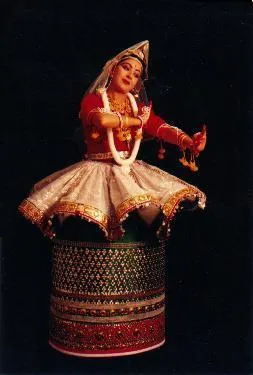
Origin The oldest layer of Manipuri dance is Lai Haraoba, a pre-Vaishnavite ritual festival rooted in the pre-Hindu Meitei religion called Sanamahism. The first reliably dated written descriptions of the art form trace to the early 18th century. The formal codification of the classical Raas Leela repertoire is attributed to Meitei King Rajarshi Bhagyachandra (Ching-Thang Khomba), who reigned from 1759 to 1798 CE. He adopted Gaudiya Vaishnavism and composed three of the five principal Raas forms: Maha Raas, Basanta Raas, and Kunja Raas. He is also credited with designing the Kumil costume for female dancers and composed the Govinda Sangeet Lila Vilasa, a foundational text of the dance.
Location Manipur state, northeast India. The primary geographic context is the Imphal valley. Significant institutions include the Sri Sri Govindajee Temple in Imphal and the Jawaharlal Nehru Manipuri Dance Academy, established in 1954. Rabindranath Tagore witnessed a Manipuri performance in the period 1917–1919 and invited teachers to introduce the form at Visva-Bharati University, Shantiniketan.
Community The Meitei community of Manipur are the primary custodians. Within the Lai Haraoba ritual, maibas (priests) and maibis (priestesses) are the lead performers. Nata Sankirtana is practised predominantly by Vaishnava Meitei men. Successive kings including Gambhir Singh (r. 1825–1834) and Chandrakirti Singh (r. 1849–1886) contributed major compositions to the repertoire. British annexation of Manipur in 1891 ended royal patronage and confined the dance primarily to temple practice.
Relevance The Sangeet Natak Akademi annually honours Manipuri with a dedicated Sangeet Natak Akademi Award. The UNESCO Sankirtana inscription (2013) provided international recognition. The dance has appeared at the Asian Games opening ceremony in Seoul (1986) and the London International Festival of Theatre (1989). India and Armenia issued a joint commemorative stamp in 2018 featuring Manipuri Raas Leela.
History
Background Vaishnavism reached the Manipur court in the 15th century. In 1704, King Pitambar Charairongba formally adopted Vaishnavism. In 1717, King Gareeb Nawaz converted to Chaitanya-style devotional Vaishnavism, emphasising congregational singing and dancing. The reign of Bhagyachandra (1759–1798) initiated the golden era of Manipuri classical composition. Gambhir Singh composed the Goshtha Bhangi Pareng and Goshtha Vrindaban Pareng; Chandrakirti Singh composed 64 Pung Choloms and the Vrindaban and Khrumba Bhangi Parengs. Chandrakirti's reign also saw the presentation of 64 Rasas over 32 days. The 1891 British annexation ended royal patronage. The cultural revival associated with the Indian independence movement and Tagore's engagement with Manipuri dance led to the form's national reintroduction.
Culture and Societies Manipuri dance pervades the life-cycle events of Vaishnava Meitei society. Nata Sankirtana is performed at births, upanayanam ceremonies, weddings, and mortuary rites. Lai Haraoba is a multi-day ritual occurring between February and June, led by maibas and maibis, dedicated to over 300 Umang Lai (nature deities). The repertoire of Raas Leela draws from the Srimad Bhagavata Purana, Govinda Leelamritya, and the Ashtapadis of Jayadeva's Gitagovinda.
Religious Significance The Raas Leela tradition is centred on the worship of Krishna. Nata Sankirtana practitioners regard it as the visible manifestation of God. The Lai Haraoba ritual enacts Meitei cosmogony through worship of Lainingthou (male divine principle) and Lairembi (female divine principle). The Thang-ta (sword and spear dance) is associated with funeral rites.
Understanding the Art
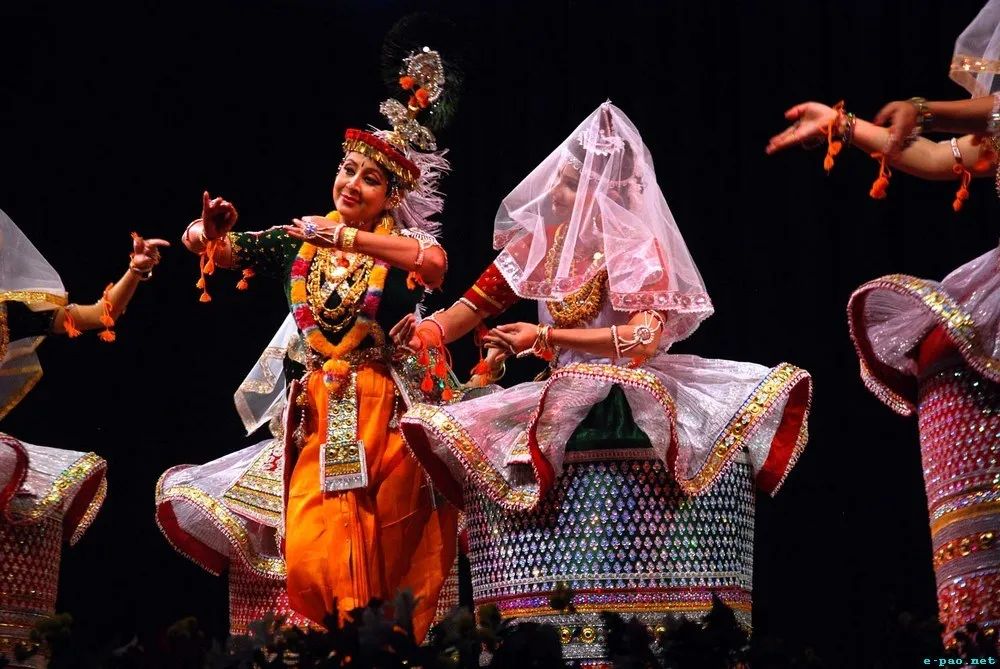
Style Manipuri dance is characterised by continuous, unbroken movement described as sarvangabhinaya (expression through the entire body). Facial expression remains subtle and natural, not externalised as in other classical forms. Body lines are curvilinear rather than angular. Female Raas dancers do not wear ghungroo (ankle bells) and do not strike the floor with force. The classical music style is called Nat, distinct from Hindustani and Carnatic systems, featuring high-pitched open-throated singing with characteristic trills and modulations.
Central Motifs and Their Significance The primary theme of Raas Leela is the divine love of Radha and Krishna and the devotion of the gopis. The five Raas forms are linked to specific seasons and ritual occasions. Pung Cholom (drum dance) and Kartal Cholom (cymbal dance) of Nata Sankirtana are vigorous male performance traditions. In Lai Haraoba, hand gestures (khutthek) reference agrarian practices such as champra okpi (picking of lemon), carrying both literal agricultural meaning and symbolic devotional significance.
Process Training follows the guru-shishya parampara. Hand gestures are codified in Hindangmayum Thambal Sharma's text Jagoi-Khut-Thek. The entire tala system derives from Nata Sankirtana practice. Raas Leela structure is determined through councils (loishang) involving composers (oja), scholars (maichou), and community elders.
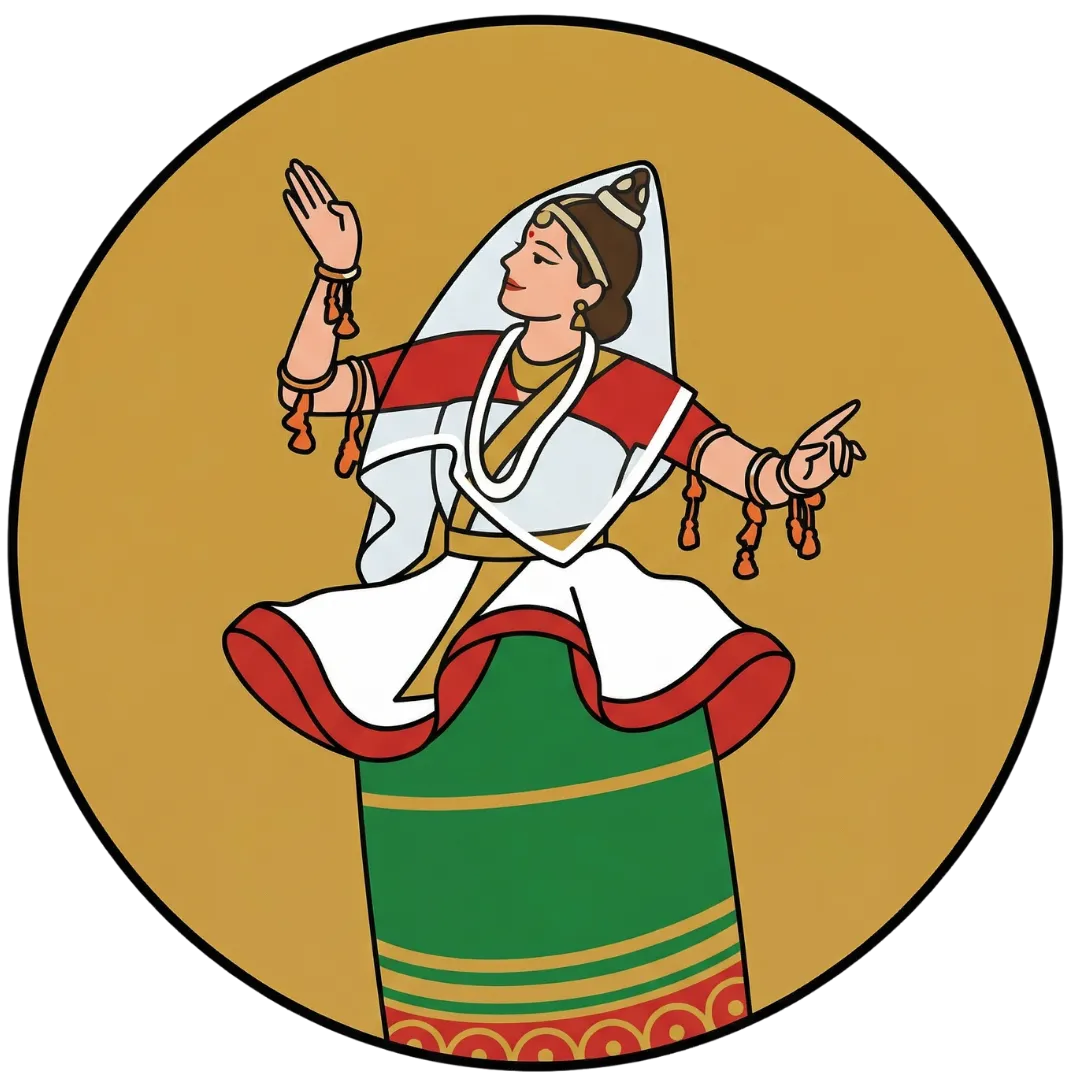
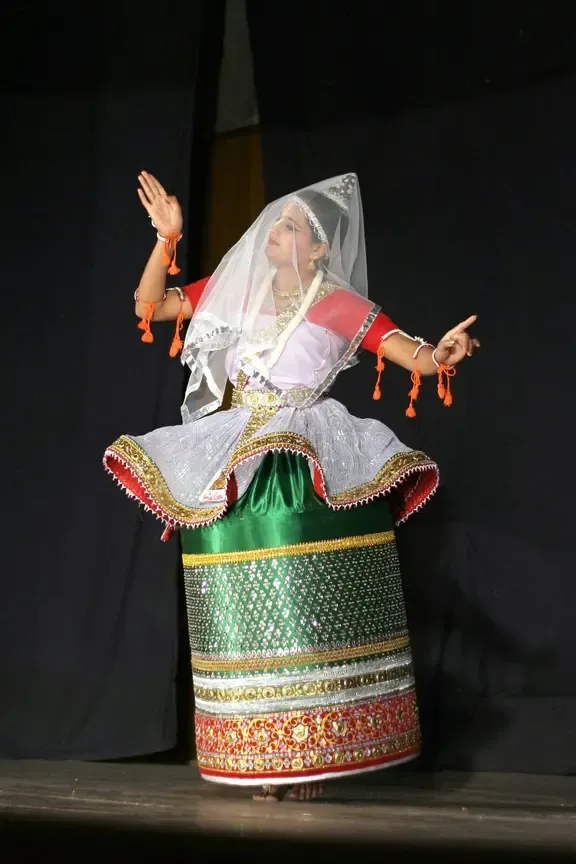
Mediums Used The Pung (Manipuri classical barrel drum) is the primary instrument. Additional instruments include the Pena (bowed string instrument for Lai Haraoba), cymbals (kartal, manjira), flute, and conch. The female Raas costume is the Kumil (cylindrical, embroidered, stiffened skirt with mirror work) with a velvet blouse and translucent white veil.
New Outlook
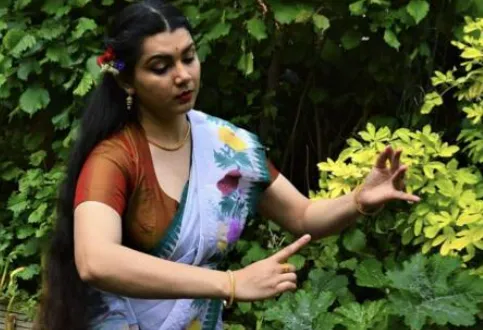
Post-independence, the Sangeet Natak Akademi Award for Manipuri, the Ministry of Culture's Cultural Functions Grant Scheme (2010), and the IGNCA digital preservation initiative (from 2020) have supported the tradition. Urban migration and youth disinterest have been identified as challenges. Female performers have entered all performance domains in the contemporary period.
Learn Manipuri
Bibliography
Sources
Parratt, Saroj Nalini, and John Parratt. The Pleasing of the Gods: Meitei Lai Haraoba. Vikas Publishing House, 1997.
Richmond, Farley P., Darius L. Swann, and Phillip B. Zarrilli. Indian Theatre: Traditions of Performance. Motilal Banarsidass, 1993.
Singh, E. Nilakanta. Manipuri Dance. Omsons Publications, 1997.
Singh, Kh. Ratan. Lai Haraoba of Manipur: Indigenous Festival of the Meitei. Manipur, 2001.
Vatsyayan, Kapila. Indian Classical Dance. Sangeet Natak Akademi, 1974.
Image Sources
Akademi. “Hasta in Manipuri.” Akademi, https://www.akademi.co.uk/hasta-in-manipuri/. Accessed on May 19, 2026.
“Manipuri Dance.” WordPress.com, https://manipuridance.wordpress.com/. Accessed on May 19, 2026.
“Manipuri Dance Stock Photos.” Dreamstime, https://www.dreamstime.com/photos-images/manipuri-dance.html. Accessed on May 19, 2026.