

Maheshwar Weaves - The Handicraft Tradition of Madhya Pradesh
Explore Maheshwari Weaves, the handicraft tradition of Madhya Pradesh, and learn about its origins, techniques, cultural significance, and artistic heritage.
Introduction
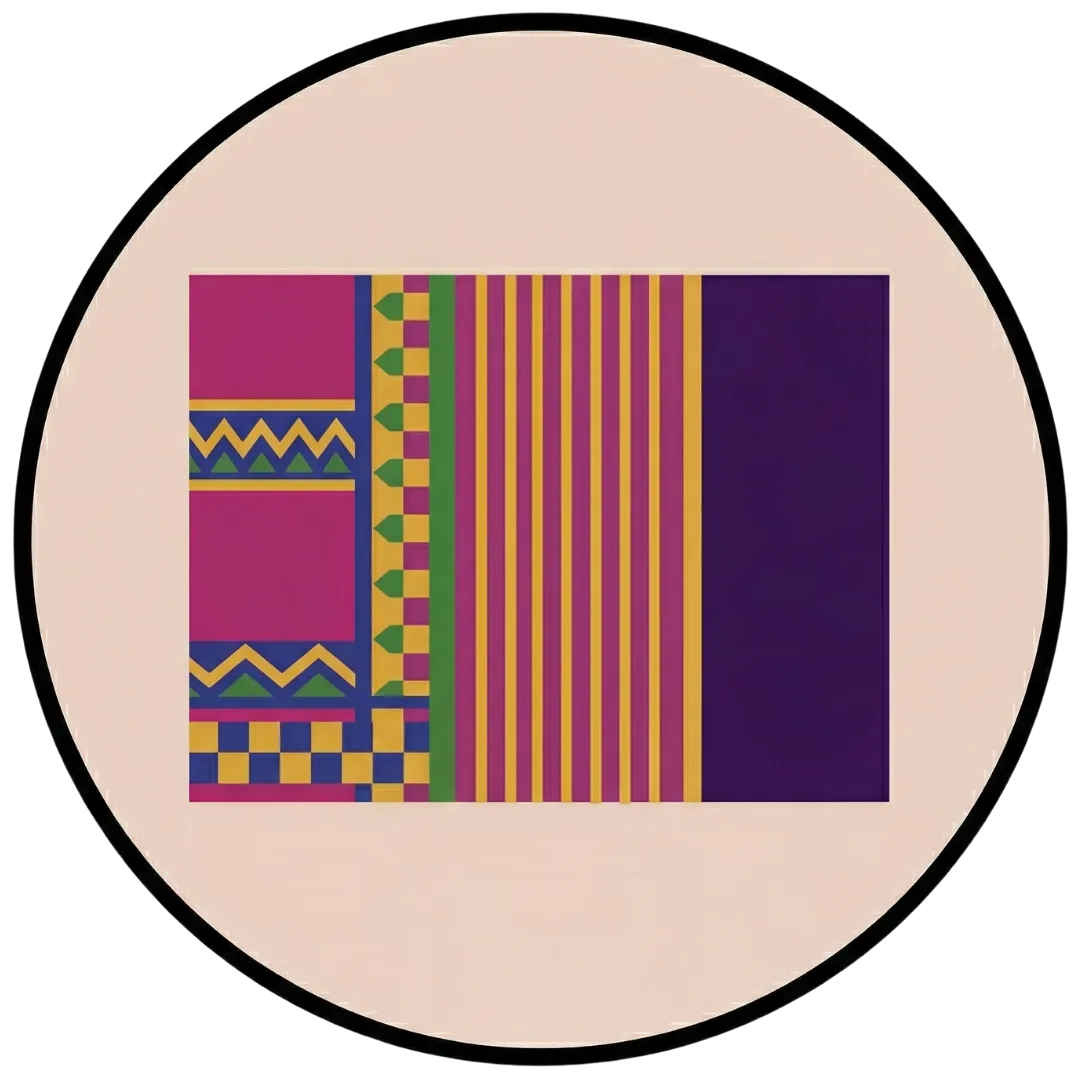
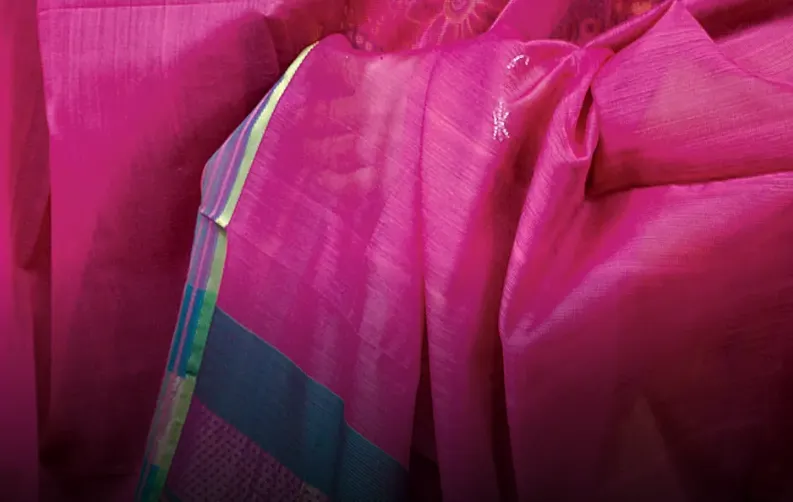
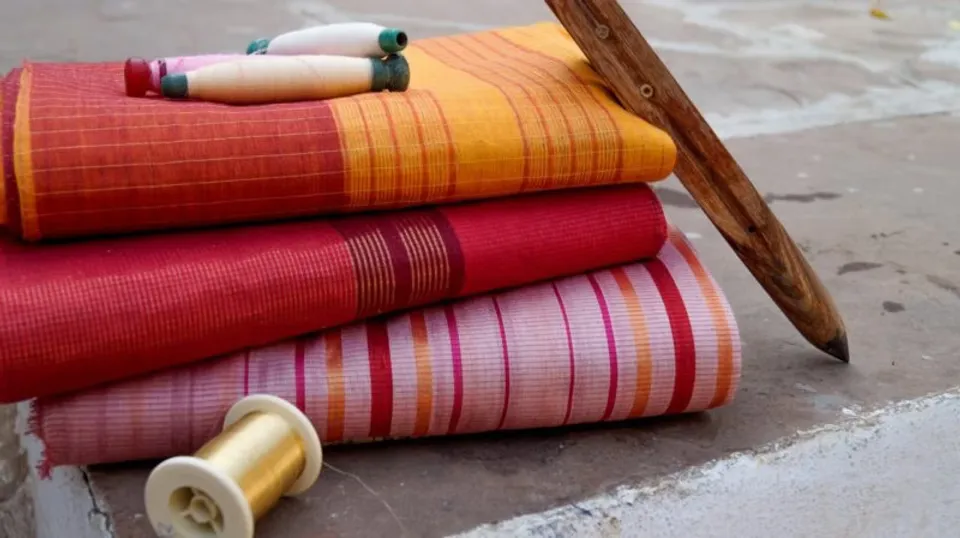
Maheshwar Weaves refers to the handloom textile tradition of Maheshwar, a town on the banks of the Narmada river in Khargone district, Madhya Pradesh. The weaving tradition is particularly associated with the Maheshwari sari, a fine cotton and silk fabric characterised by a reversible quality, a border of five parallel stripes, and distinctive pallav (shoulder-end) patterns. The craft was formally organised and developed by Queen Ahilyabai Holkar in the 18th century, when she invited weavers from various regions to settle in Maheshwar and established the design vocabulary drawn from the local fort architecture.
Etymology The name Maheshwari sari or Maheshwar fabric derives from Maheshwar (historically known as Mahishmathi in ancient references), the town where the weaving tradition is centred. The sari takes its geographic name as its designation, following the Indian tradition of naming textiles after their place of origin.
Origin The Gaatha.org documentation of Maheshwar weaving records that Queen Ahilyabai Holkar made Maheshwar her capital in 1767. She invited skilled weavers from Hyderabad, Mandava, and Gujarat to settle in Maheshwar, integrating their varied weaving skills into a new unified tradition. The artisans were instructed to take design inspiration from the inscriptions and architectural patterns of Ahilyabai's fort. Previously, only grey cotton fabric was locally produced; the arrival of these craftsmen introduced new aesthetics, materials, and techniques.
Location Maheshwar town, Khargone district, Madhya Pradesh, on the northern bank of the Narmada river. The town is approximately 90 kilometres from Indore. Weaving units are distributed across the town, and the craft is closely associated with the historic fort and ghats of Maheshwar.
Community The weaving community at Maheshwar includes descendants of the craftsmen brought from Surat, Bhuj, Patan, and Hyderabad by Ahilyabai Holkar, as well as local weavers who adopted the tradition. According to the Gaatha.org documentation, the Somavaunshiya Sahasrarjun Kshatriaya (SSK) genealogy is historically connected to weaving traditions in the region, with a myth associating the community's weaving practice with the sage Parashuram teaching them the trade. The oral tradition preserved by Bhats (hereditary genealogists) maintains this narrative. In practical terms, the weaving community is multi-community and reflects the diverse geographic origins of its founders.
Relevance Maheshwar Weaves hold GI tag protection. The craft has been featured in publications including Upper Crust India and documented by the Indian Culture portal (indianculture.gov.in) of the Ministry of Culture, Government of India. The craft has attracted international attention from fashion designers who have incorporated Maheshwari fabric into contemporary garment design.
History
Background The Gaatha.org documentation states that after Ahilyabai Holkar established the weaving tradition, it produced saris, fabric by the yard, turbans, dhotis, and chunris. The craft initially used natural dyes. The first challenge came during World War I when dye production declined and lower-quality colours were used, affecting the fabric's reputation. By approximately 1910, royal descendant Naresh Thukojirao Holkar and subsequent organisations took measures to revive the craft by re-establishing dyeing and spinning centres. In 1921, further organisational steps were taken (the Gaatha.org source is truncated at this point). The twentieth century saw several cycles of decline and revival. A significant modern revival came through the Rehwa Society, established in Maheshwar to support artisans and reconnect them with international markets. The Holkar royal family's involvement in preservation efforts is documented.
Culture and Societies Maheshwar has a cultural identity that combines its status as a pilgrimage town (with temples and ghats dedicated to Shiva on the Narmada) with its craft tradition. The interplay between the artisan communities from Maharashtra, Rajasthan, and Gujarat produced a culturally hybrid weaving tradition that reflects the diverse aesthetic origins of its practitioners. The Maheshwari sari's versatility in how it is draped across different regional traditions is documented as a feature of the craft's cross-cultural character.
Religious Significance Maheshwar is a significant pilgrimage town associated with the Narmada river and its Shiva temples. The Sahasrarjun temple at Maheshwar lights eleven lamps in connection with the mythological narrative of Sahasrajuna and Ravana. However, the weaving craft itself does not carry a specific religious ritual function. The myth connecting the SSK community's weaving practice to Parashuram's teaching is a community origin narrative rather than an active religious practice associated with the craft.
Understanding the Art
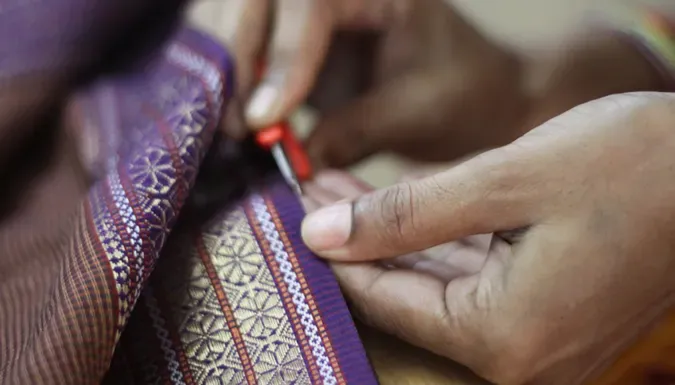
Style The Maheshwari sari is characterised by a fine, lightweight cotton-silk fabric with a reversible quality. The border features five parallel stripes, a design element traditionally attributed to the inspiration drawn from Ahilyabai Holkar's fort architecture. The pallav carries extra-weft motifs in the border area. The fabric is noted for its translucency when layered and for being suitable for starching into stiff pagdis (turbans), described as standing upright without support.
Central Motifs and Their Significance The five-stripe border is the most immediately recognisable design element and is tied to the specific design vocabulary established under Ahilyabai Holkar. Extra-weft patterns in the border include geometric and stylised floral forms. The pallav designs draw from the architectural inscriptions of the Maheshwar fort, creating a direct material link between the fabric and the built heritage of the town. The checks and fancy designs introduced later represent the accumulated aesthetic contributions of weavers from various regional backgrounds.
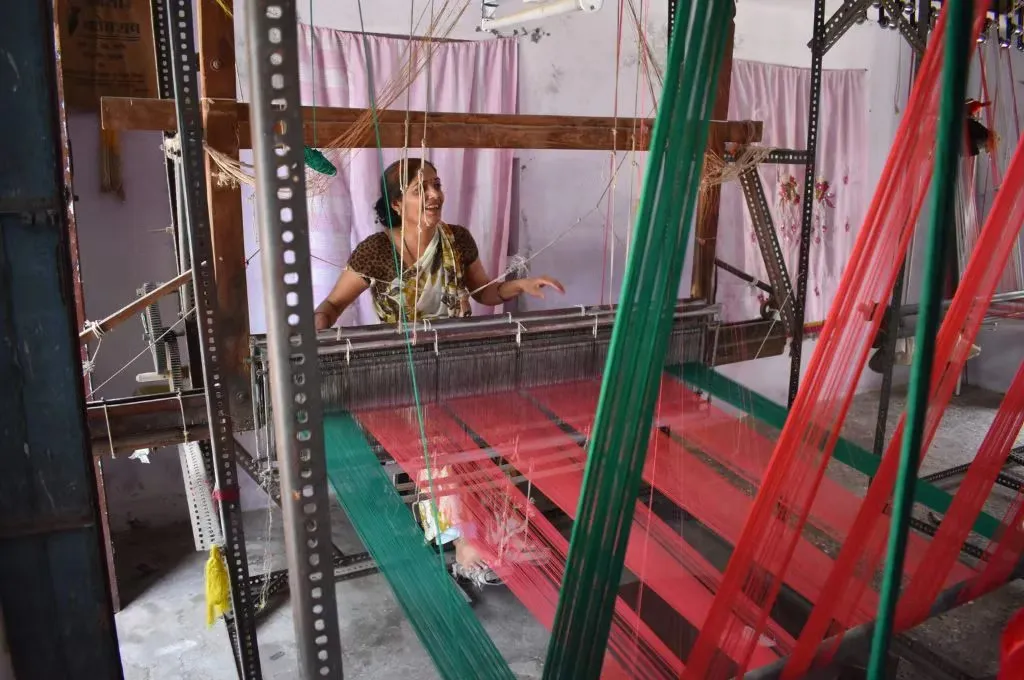
Process The Maheshwari sari is woven on handlooms using a combination of de-gummed silk (processed to remove sericin, making it soft and increasing tensile strength) and fine cotton. De-gumming is a preparatory step that prevents the finished fabric from cracking along folds. The weaving process follows standard handloom procedures: warping, setting up the loom, weaving with shuttle for the body, and using extra-weft techniques for the border patterns. The reversible quality of the fabric results from the specific weave structure employed.
Mediums Used The primary materials are de-gummed silk and fine cotton. Natural dyes were used historically; the present practice includes both natural and chemical dyes. The handloom is the production tool, with no power-loom production qualifying for GI-protected Maheshwari designation.
New Outlook
Contemporary fashion designers from India and internationally have incorporated Maheshwari fabric into garment and accessory design. The Rehwa Society and other organisations work to connect weavers with design and retail markets. The craft faces challenges including competition from power-loom imitations, supply chain issues for quality raw materials, and the need for artisan income support. The GI tag provides legal protection for the authentic handloom product.
Learn Maheshwar Weaves
Bibliography
Sources
“Maheshwar Weaves.” Indian Culture Portal, Ministry of Culture, Government of India, indianculture.gov.in. Accessed 2 May 2026.
“Maheshwar Weaves.” ShodhKosh: Journal of Visual and Performing Arts, Granthaalayah Publication, 2023.
“Weaving of Maheshwar: Detail Documentation.” Gaatha.org, Craft Archive, gaatha.org. Accessed 2 May 2026.
Image Sources
Saha, Shreyoshi. “Magical Weaves of the Maheshwari Women.” Medium, 6 Apr. 2015, https://medium.com/@shreyoshi/magical-weaves-of-the-maheshwari-women-5e10f86055ab. Accessed on May 02, 2026.
Shukla, Akanksha. “Maheshwari Weaving: Leading the Textile Legacy of Central India with Elegance & Heritage.” Craftique Hub, 1 Dec. 2024, https://www.craftiquehub.org/post/maheshwari-weaving-leading-the-textile-legacy-of-central-india-with-elegance-heritage. Accessed on May 02, 2026.
“The Weaving Story of Maheshwari Saris.” Madhya Pradesh Tourism, 30 Mar. 2020, https://www.mptourism.com/maheshwar-tourist-places-and-maheshwari-saris.html. Accessed on May 02, 2026.