


Lippan Kaam - The Handicraft Tradition of Gujarat
Explore Lippan Kaam, the handicraft tradition of Gujarat, and learn about its origins, techniques, cultural significance, and artistic heritage.
Introduction
Lippan Kaam is a traditional mud and mirror relief craft practiced in the Kutch district of Gujarat, India, in which a dough of clay and animal dung is applied to the interior and exterior walls of circular mud houses known as bhungas to create raised decorative compositions inlaid with small cut mirrors. The craft is also known by the names Chhittar Kaam, Chittar Kaam, and Laipo, and is practiced today primarily by women from the Rabari, Kumbhar, Marwada Harijan, and Mutwa communities. Lippan Kaam has both a functional dimension, as the clay relief work provides structural reinforcement and thermal insulation for mud walls, and a decorative dimension, as the embedded mirrors amplify light within dim interiors.
Lippan Kaam does not hold a Geographical Indication tag as a named standalone craft category in the available documentation, and no specific GI registration for Lippan Kaam has been identified in verified sources. However, it is documented as a registered traditional craft within the Gujarat Handicrafts and Handloom Development Corporation's promotional framework.
Etymology: The term Lippan Kaam is composed of two words from the Gujarati and regional dialects of Kutch. As documented in multiple institutional sources, Llippan translates to dung, clay, or the act of applying, with specific reference to the camel or wild ass dung that formed the primary binding material in the traditional preparation. Lippan can also be interpreted as meaning mud or dung in the local dialect. Kaam is the standard Gujarati and Hindi word for work, so Lippan Kaam means, in direct translation, mud work or dung work. The alternative name Chhittar Kaam is used interchangeably in institutional documentation though no formal distinction between the two names has been established in available scholarship. The name Laipo is an alternate regional designation for the same craft practice.
Origin: No document is available to trace the origin of Lippan Kaam with precision. This is explicitly stated in the CSJMU Gyansanchay academic paper on indigenous Lippan art forms of Kutch, which writes that there is no document available to trace the origin of this creative expression. The origins of Lippan Kaam are unknown; it is noted that the variation in practice styles among the multiple communities that practice it makes tracing a single point of origin particularly difficult.
The estimated age of the tradition can be placed between 700 and 800 years, associating its earliest practitioners with the Kumbhar community of Sindh, who were traditionally earthen pot-makers and who are documented as having extended their use of clay from vessel-making to the plastering and decoration of wall surfaces. This community subsequently migrated to the Kutch region of Gujarat. The Rabari community is documented as having arrived in Kutch approximately 700 to 800 years ago, and the Mutwa community approximately 400 years ago, both migrating from the Sindh region of present-day Pakistan.
Multiple sources note that the latest significant wave of community migration influencing Lippan Kaam occurred after the Indo-Pakistan War of 1971, bringing additional craft influences from across the border.
Location: Lippan Kaam is concentrated in the Kutch district of Gujarat, particularly in the Banni grasslands and surrounding areas of northern and central Kutch. The Rann of Kutch, the saline desert shared between India and Pakistan, forms the geographic context within which the majority of practising communities are settled. The art is also practised in the bordering regions of Sindh, Pakistan, among communities maintaining related traditions on the other side of the international border.
Within Gujarat, the craft is associated with villages in the Banni region, where communities including the Rabari live in clustered bhunga settlements. The ICCAUA 2024 conference paper by Himali Gor specifically documents the Marwada Meghwal community in Ramdevnagar village, a cluster in the Kutch region, as an active practitioner group. The Artisans in Architecture (AINA) documentation of bhunga architecture identifies the Banni plain as the core settlement area for these pastoral communities, noting that the area is flat, silty clay soil terrain with no available stone, making mud and thatch the primary building materials and, by extension, the primary medium for Lippan Kaam.
Community Relevance: Four main community groups are documented as active practitioners of Lippan Kaam in Kutch. The Rabari are a pastoral community described in the CSJMU academic paper as living on the outskirts of villages in communal or family groups of bhungas. They are the community most widely associated with the art form in mainstream documentation. The Kumbhar are traditionally a pottery-making caste and are recorded as having originated the practice of applying clay relief to wall surfaces, extending their knowledge of clay working from vessel production to architectural decoration. The Mutwa is a Muslim community that migrated to Kutch from Sindh approximately 400 years ago, as documented in the CSJMU academic paper. The Marwada Harijan (also referred to as Marwada Meghwal) community migrated from the Marwar region of Rajasthan and is documented in the CSJMU paper and the ICCAUA 2024 paper by Himali Gor.
The CSJMU academic paper documents the practice of Lippan Kaam as primarily performed by women, specifically within the Rabari community, while men of the Kumbhar, Marwada Harijan, and Mutwa communities are also noted as creators within their respective communities. Each community maintains a distinct style that is differentiable from the others. Transmission of the craft is intergenerational and domestic: the ICCAUA 2024 paper documents mothers teaching daughters as the primary mode of skill transfer. Practitioner Gani Mara, cited in the CSJMU Gyansanchay academic paper, states that he inherited the craft from his forefathers and that nephews and daughters, including those also in formal education, currently practice it professionally.
History
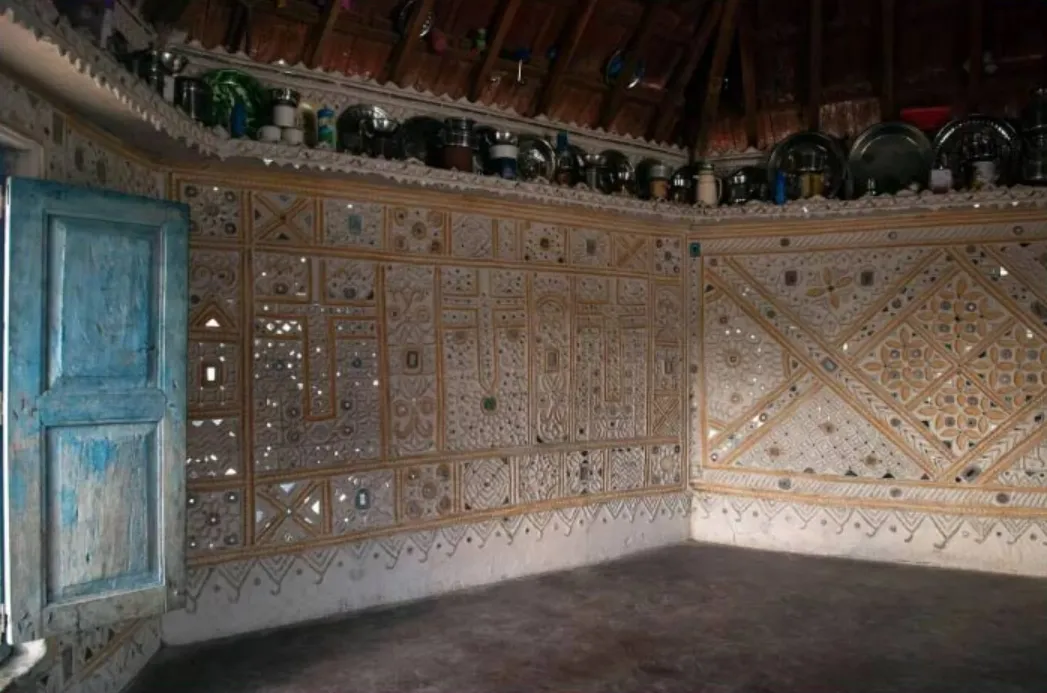
Origin and it’s Importance: The historical context of Lippan Kaam is inseparable from the history of the bhunga, the traditional circular mud house of Kutch, and from the migration histories of the communities who built and decorated these structures. A craftsman cited in the Bhunga Case Study document attributed the origin of the circular bhunga construction form to the period after the 1819 Kutch earthquake, when building craftsmen developed the circular plan as a structurally resilient response to seismic conditions. This account is a practitioner's attribution and is included as documented oral tradition rather than confirmed historical fact.
The bhunga is documented in the Artisans in Architecture (AINA) publication on bhunga vernacular architecture as consisting of a single cylindrical structure with a conical thatched roof, constructed from mud and bamboo with thick walls that provide natural insulation. The India Currents architectural essay and the Enroute Indian History piece on bhunga architecture document that bhunga structures built using traditional mud plastering methods (which includes lippan) were among the few structures to remain standing during the 2001 Gujarat earthquake, which measured 6.9 on the Richter scale, killed more than 20,000 people, and devastated the Kutch region. This structural resilience documented after 2001 increased scholarly and institutional attention to vernacular bhunga architecture and its associated craft traditions including Lippan Kaam. The process for recognition and revival of Lippan Kaam formally began after the 2001 earthquake. Before this, the craft was practiced as a local community tradition with limited external visibility.
Culture and Societies: Lippan Kaam is embedded in the domestic life and household economy of Kutch's pastoral communities. Within the bhunga, the specific domestic structures on which Lippan Kaam is applied: the kotholo (large granary), kotho (grain container), sanjiro (storage for valuables), dhadabla (seats for babies), chula (hearth), and pedlo (storage platforms), as well as walls, plinths, shelves, niches, and windows. The craft covers the functional interior architecture of the home.
Traditional Lippan Kaam required annual maintenance and was passed down as a household inheritance across generations. The shift toward cement and concrete construction, which has increased in Kutch following reconstruction after the 2001 earthquake, has reduced the number of bhungas in which Lippan Kaam continues to be practiced in its traditional wall-based form.
The ICCAUA 2024 conference paper on the Marwada Meghwal community of Ramdevnagar documents lippan alongside embroidery, beadwork, and leather crafts as an integral cultural practice forming a significant source of income for the community. The paper notes that artisan shops established by the community have provided a platform for marketing handmade products. The craft evolved through multiple waves of migration and blended motif traditions brought from Sindh, Rajasthan, and other regions, with the latest significant cross-border exchange occurring after 1971.
Religious Significance: Lippan Kaam carries documented religious associations for certain practising communities.
Among the Mutwa community, who are Muslim, a documented religious constraint applies to the representation of living forms. Sources confirm that Mutwa Lippan Kaam is restricted to geometric and non-figural patterns because depicting human or animal forms is considered contrary to Islamic practice. The Mutwa community's Lippan Kaam motif vocabulary is drawn instead from geometric embroidery patterns.
Beyond these community-specific associations, no documented systematic religious function or ritual use of Lippan Kaam as a ceremonial object or practice has been identified in the available sources. The craft's primary context in the domestic sphere is decorative and functional rather than devotional.
Legends and Myths: The Rabari community's use of mirrors in particular has an associated belief - Rabaris believe mirrors repel negative energy and act as a ward against the evil eye.
Understanding the Art
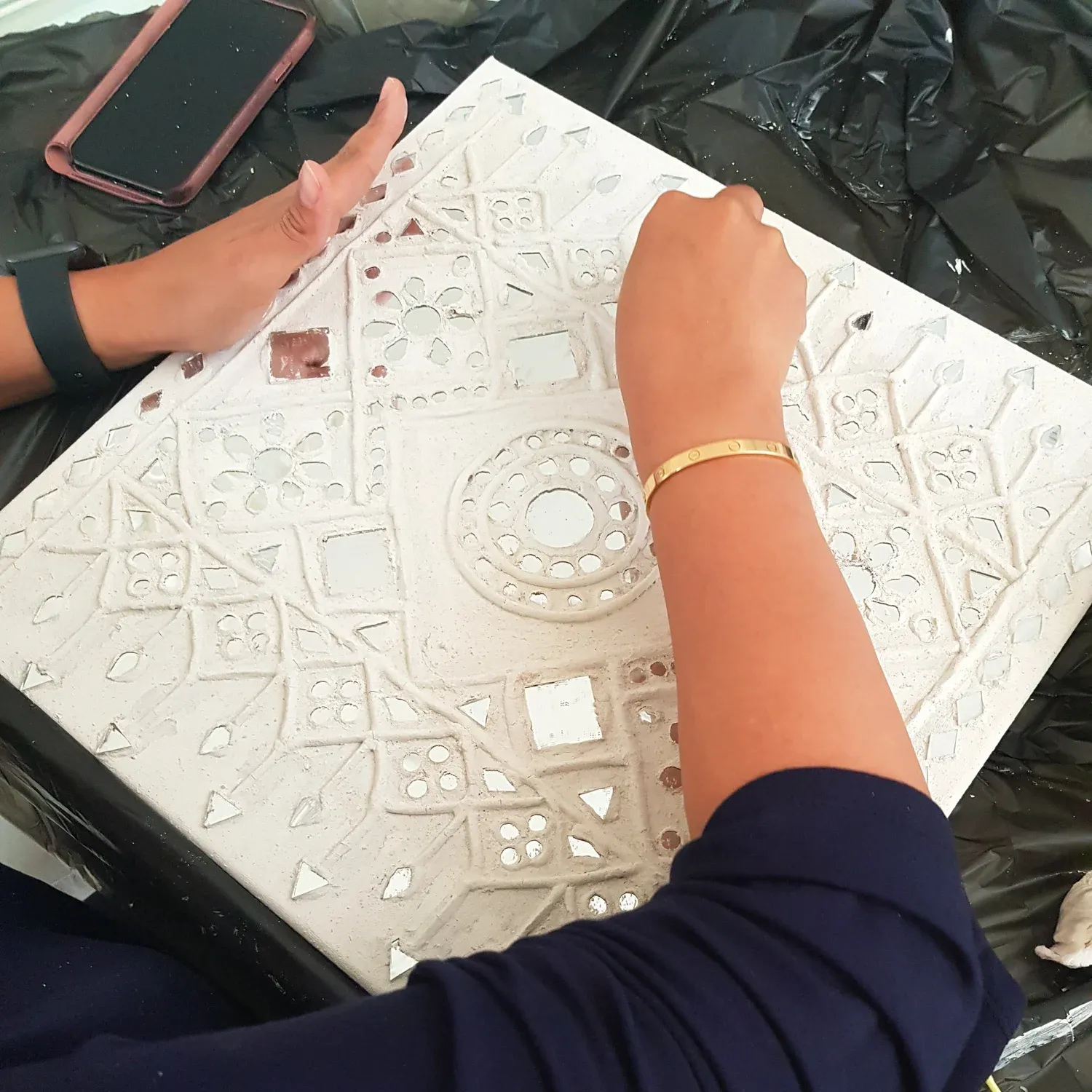
Process: The first stage is preparation of the clay dough. Mud, described across sources as locally sourced from lakebeds and rivers in Kutch, is passed through a sieve to obtain fine particles. This sieved clay is mixed in equal proportion with camel or wild ass dung, which is rich in fibres and acts as a natural binder preventing cracking. Equal proportions of dung and clay are used. Water is added and the mixture is kneaded to form a pliable dough. Goat hair is sometimes incorporated for additional structural reinforcement. Historically, millet husk (bajra husk) has been used as an alternative to dung to reduce the smell and deter termites. Contemporary practitioners have also shifted to newspapers as an internal filler material for the same reasons.
The second stage is surface preparation. The wall or panel surface is moistened so that the clay dough adheres effectively. A border line called kaam or kaamtane is first applied, dividing the working surface into sections within which designs are created.
The third stage is the modelling of relief designs. The clay dough is rolled into strips and cylinders of varying thickness and applied freehand or using basic guidelines to build up motifs in bas-relief directly on the surface. Experienced practitioners do not use drawn templates before beginning work. Finger and palm textures called okli may be pressed into the surface at this stage.
The fourth stage is mirror embedding. Mirrors called aabhla, in round, triangular, diamond, and other shapes, are pressed into the still-pliable clay relief work. Before pre-cut mirrors were commercially available, large mirrors were broken with stones and the pieces arranged as desired.
The fifth stage is finishing. Once the clay has dried, white clay or Rann sand is applied over the surface, giving the work its characteristic white ground. Where colour is applied, it is done at this stage. The entire process from dough preparation to completion takes multiple days, as each stage requires partial drying before the next can proceed.
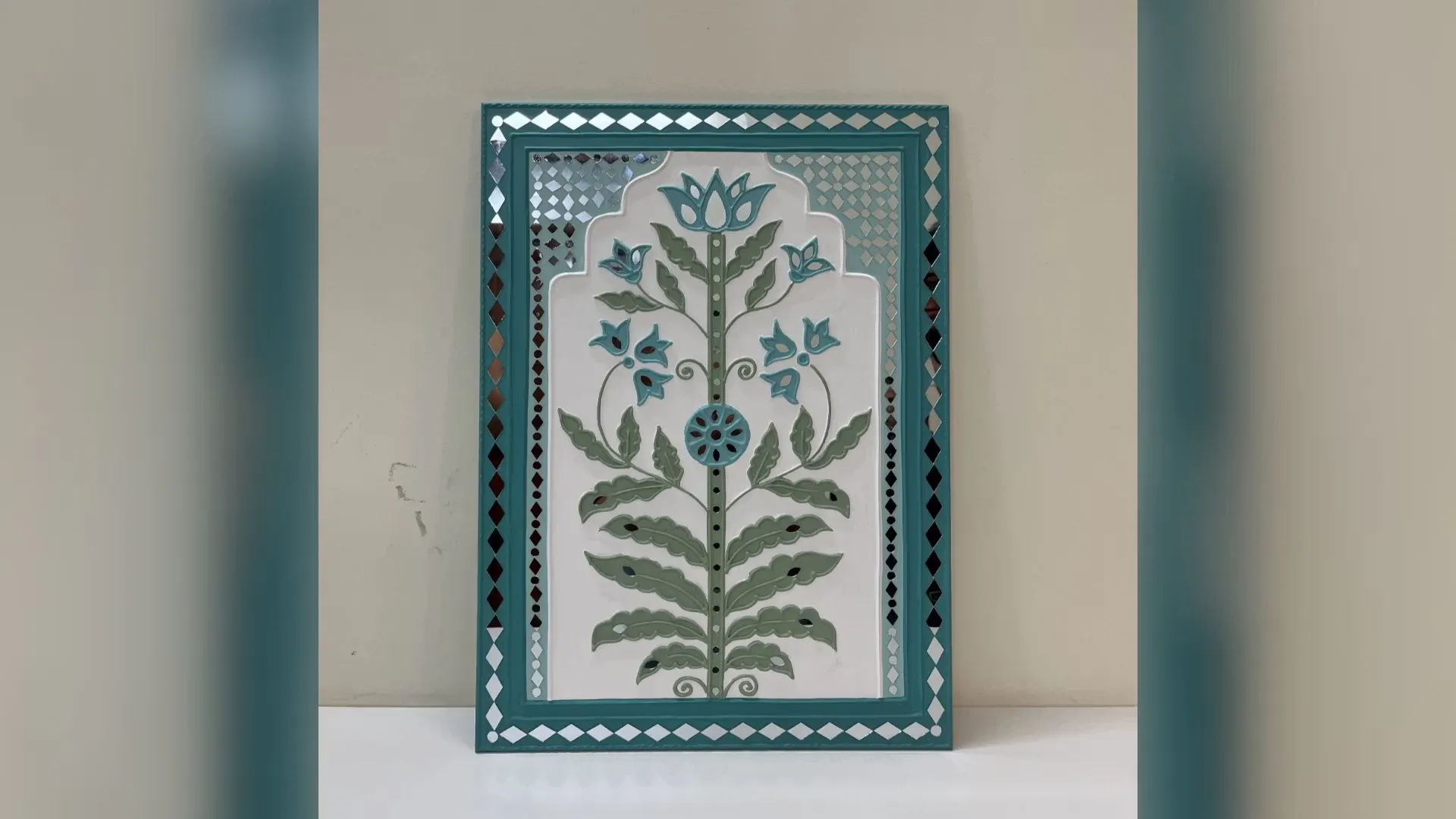
Style: Lippan Kaam is a bas-relief form in which clay dough is built up directly on a wall surface or, in contemporary practice, on portable board panels, to create raised linear and sculptural patterns that are then inlaid with small cut mirrors. The surface texture is formed by the direct application of rolled clay and finger-worked forms rather than by painting or incising. The characteristic visual surface incorporates okli, textures created by the impressions of fingers and palms, alongside sculpted forms that are set with mirrors.
Each community's Lippan Kaam is distinguishable in style. The Rabari style, as documented by the CSJMU paper, features thick lines, a rough surface texture resulting from less careful clay preparation, and an extensive use of mirrors. The Mutwa style is characterised by thin lines and geometric patterns, with no figural content. The Marwada Harijan style draws on embroidery patterns and geometric shapes from embroidery traditions of related communities.
The characteristic ground colour of finished Lippan Kaam is white. The CSJMU paper records that the white tone was traditionally achieved using white clay or white Rann sand applied over the dried relief work. Colour pigments are applied in some contemporary and community-specific variations.
Materials and Mediums: The primary medium of traditional Lippan Kaam is a dough of locally sourced mud and camel or wild ass dung, mixed in approximately equal proportions with water. Clay from lakebeds in the Kutch region is specified as the standard clay source, with fine particles obtained by sieving. Goat hair is an optional reinforcement material. Millet husk and newspaper are documented contemporary substitutes for animal dung. White clay or Rann sand is used for the final white surface coat. Aabhla mirrors of various shapes are the defining decorative element, cut from glass, recycled from broken household mirrors, or now sourced from craft suppliers in standard shapes. In contemporary practice, particularly for portable panels, the base surface is medium-density fibreboard (MDF), with the clay dough applied over it. Binding agents including glue and chalk powder have been introduced into contemporary dough preparations to increase adhesion and durability and to reduce odour.
Common Motifs and Their Significance: Lippan Kaam motifs are derived from the daily life, surrounding landscape, and community-specific embroidery traditions of the practising groups. Primary motif categories are peacocks, camels, elephants, mango trees, temples, and geometric patterns. Women with pots and women churning buttermilk are documented as the most common figural motifs of the Rabari community, reflecting pastoral domestic life.
Among Mutwa community practitioners, the motif vocabulary documented includes fish bone and scales patterns used for borders, geometric kachcho embroidery-derived patterns, and bhori flower forms, all drawn from the desert-grassland landscape of the Banni region and from Mutwa textile embroidery. These are rendered entirely in geometric abstraction without figural content, in accordance with Islamic restrictions on depicting living forms.
The Marwada Harijan community's motifs are documented as drawing on embroidery patterns and geometric designs shared across the inter-community craft network of Kutch. The most auspicious motif of the Harijan community is documented as women with water pots. The ICCAUA 2024 documentation describes the circle as having cultural significance for Kutch communities, representing safety, stability, and wholeness. This is consistent with the circular form of the bhunga itself as a structural and symbolic unit.
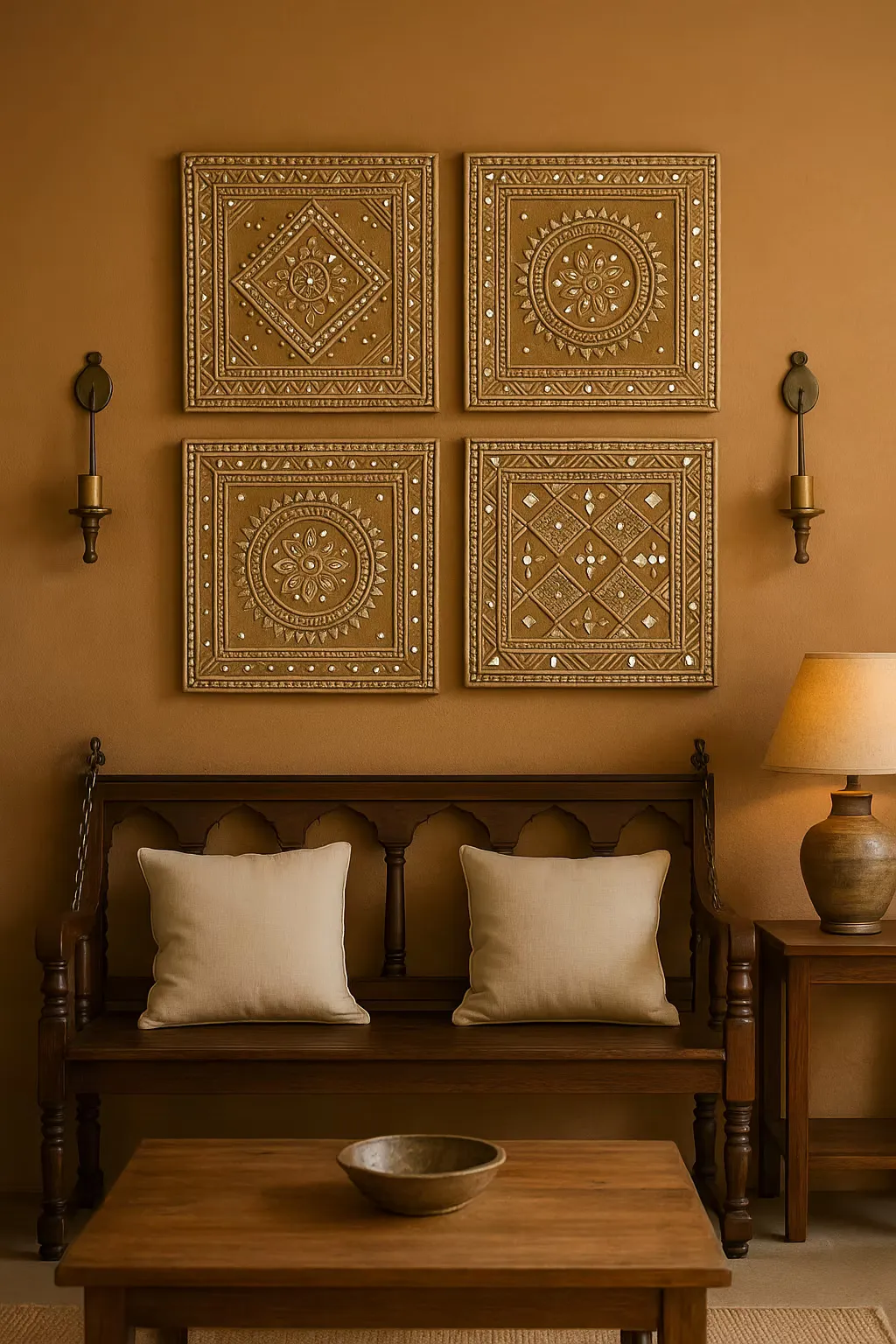
Change in the Art over Time Lippan Kaam has undergone a significant shift from a community-bound, wall-fixed domestic practice toward a portable, marketable craft form produced on MDF panels, canvases, and a range of decorative objects. The Ethnics of Kutch documentation describes this transition: the craft on walls became mud mirror work on plywood, driven both by commercial opportunity and by the decreasing prevalence of bhunga dwellings as Kutch communities shift to concrete construction following post-earthquake rebuilding. The craft has attracted international attention through craft exhibitions and has been adopted in urban interior design contexts in India and abroad.
Colors and Patterns
Current Trends: The 2001 Gujarat earthquake was a pivotal moment. The destruction of bhunga homes during the earthquake raised awareness of traditional craft practices and prompted NGO and governmental intervention for their revival.
The Rann Utsav, a large annual cultural festival in the Rann of Kutch launched in 2005 by the Gujarat government, is documented as a significant platform that increased visibility and commercial demand for Lippan Kaam. The Dastakari Haat Samiti, a national-level craft promotion NGO based in Delhi, holds annual exhibitions in which Lippan Kaam practitioners participate. Khamir, a Kutch-based craft trust established after the 2001 earthquake, is documented as focusing on reviving and conserving Kutch crafts including Lippan Kaam by training local artisans. Shrujan, a Gujarat-based NGO focused on women's empowerment through crafts, is also cited in the same source as having supported post-disaster reconstruction initiatives involving cultural preservation.
Contemporary Outlook, Trending News
The vulnerability of the craft in its traditional form is documented by the University of York PhD researcher Zarna Surendra Shah, who identifies vernacular bhunga architecture and its associated decorative traditions as significantly understudied and inadequately protected, noting that modern documentation fails to capture intangible cultural, environmental, and socio-anthropological factors. The ICCAUA 2024 paper similarly notes that craft skills are sustained by intergenerational transmission but are under pressure from urbanisation and out-migration of younger community members.
The Dastakari Haat Samiti holds annual exhibitions, online workshops have extended artisan reach to national and international consumers, and commercial platforms sell Lippan Kaam work for urban interiors, hotels, offices, and export markets. While these developments have provided income opportunities, they have also produced a proliferation of machine-made or non-traditional imitations of the craft, a concern noted in the Homegrown article on the craft's commercial trajectory.
Learn Lippan Kaam
Bibliography
Text Sources
Edwards, Eiluned. Textiles and Dress of Gujarat. Mapin Publishing and V&A Publishing, 2011.
Elson, Vickie C. Dowries from Kutch: A Women's Folk Art Tradition in India. Museum of Cultural History, University of California, Los Angeles, 1979.
Frater, Judy. Threads of Identity: Embroidery and Adornment of the Nomadic Rabaris. Mapin Publishing, 1995.
Mirza, Viloo, and Vinutha Mallya. Handloom and Handicrafts of Gujarat. Mapin Publishing.
Internet Sources (for Images)
“A Journey through Traditional Kutch Artform.” Gallery Unique Art, https://galleryuniqueart.com/blog/lippan-art/a-journey-through-traditional-kutch-artform. Accessed on April 24, 2026.
Rajvanshi, Nehal. “Lippan Kaam: The Glittering Craft of the Kutch.” Live History India, 9 Apr. 2021, https://www.livehistoryindia.com/story/living-culture/lippan-kaam. Accessed on April 24, 2026.
“Lippan Art for the Living Room: Layout Ideas and Styling Tips.” Prafullas, https://www.prafullas.com/post/lippan-art-for-the-living-room-layout-ideas-and-styling-tips. Accessed on April 24, 2026.
“Lippan Kaam Reflects Kutch Traditions.” Curriculture, https://curriculture.in/blogs-lippan-kaam-reflects-kutch-traditions/. Accessed on April 24, 2026.