

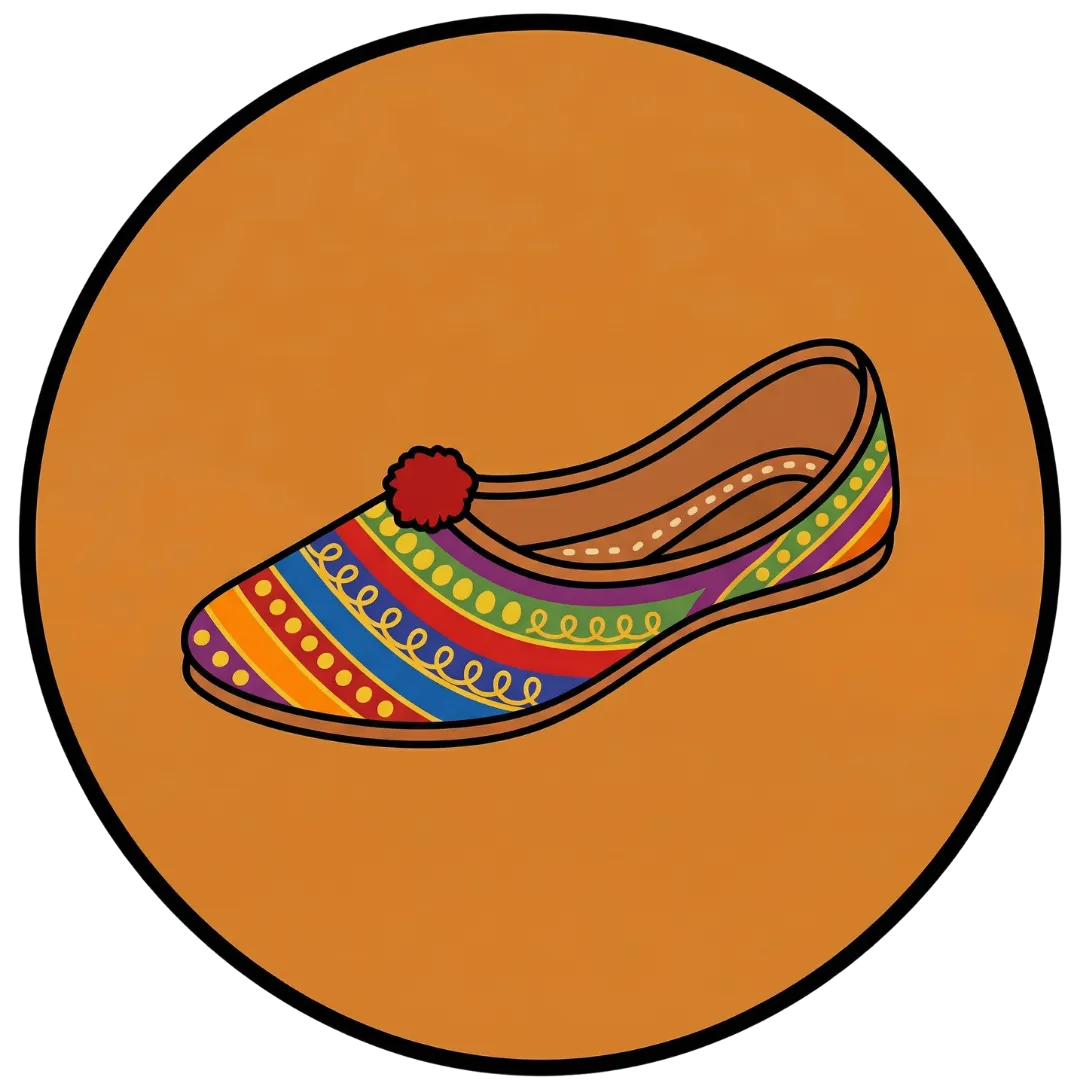
Leather Juti/ Mojari Making - The Handicraft Tradition of Rajasthan
Explore Leather Jutti/ Mojari making, the handicraft tradition of Rajasthan, and learn about its origins, techniques, cultural significance, and artistic heritage.
Introduction
Mojari, also known as jutti or pagarkhi depending on regional usage, is a form of traditional handcrafted leather footwear produced across multiple cities and villages of Rajasthan, with significant production centres in Jodhpur, Jaipur, Bikaner, Jaisalmer, Ajmer, and Jhunjhunu. Constructed from vegetable-tanned leather sourced from camel, buffalo, goat, and cow hides, mojaris are distinguished by their hand-stitching, absence of machine production in traditional practice, and regional styles of surface embroidery. The craft has been documented as essential daily footwear in rural Rajasthan for several centuries and remains a functioning commercial tradition, though it faces structural economic challenges.
Etymology Mojari is a generic term for handcrafted ethnic footwear produced in the Indian subcontinent. The word is used interchangeably with jutti and khussa across regions of northern India and Pakistan. Pagarkhi is a variant term used in certain rural contexts. In Jodhpur, the production neighbourhood Jingar Mohalla takes its name from the word jins, meaning 'saddle,' reflecting the Jingar community's historical connection to leather goods production for equestrian purposes. The term mojari is not exclusive to any single community or technique but describes the category of handstitched, thin-soled, typically curled-toe leather footwear.
Origin Leather craft in Rajasthan has deep historical roots connected to the region's equestrian culture. The Mochi and Jingar communities of Rajasthan were historically the primary leather workers, producing not only footwear but also horse and camel saddles, sword sheaths, shields, reins, water-lifting devices (charas), and body armour. The documented connection between mojari and royal patronage is attested in the records of the Jodhpur family of craftsperson Mohan Lal Gujar, whose ancestors made mojaris for the royal family for over 300 years according to family oral history. The Sahapedia documentation of the Jodhpur mojari and the D.Source survey of Jaipur mojari production are among the most thorough existing accounts of the craft's regional history.
Location Mojari production is distributed across multiple centres in Rajasthan. In Jodhpur, production is concentrated in Jingar Mohalla, Sivanchi Gate, and Girdikort Bazaar, as well as in Patodi village in Barmer district, approximately 112 kilometres from Jodhpur, where over 100 Jingar families practice the craft exclusively using leather without synthetic materials. Jaipur production is centred in the Mochi communities of the old city. Other significant production locations include Jhunjhunu, Ajmer, Bikaner, and Jaisalmer, each with distinct design characteristics. Rajasthan's estimated 100,000 households engaged in traditional leather footwear production, as cited by the D.Source survey, constitutes one of the largest craft production networks in the state.
Community The primary producing communities are the Mochi (cobbler/leather worker caste) and the Jingar (historically saddle-makers). The Jingar of Patodi village in Barmer district trace their occupational identity directly to jins, the saddle, reflecting their historical role serving the cavalry and livestock culture of Rajasthan. In Jodhpur, the craftsperson Chanda Gujar, a National Award winner twice over, and her son Mohan Lal Gujar, recipient of the Rajasthan State Award 2008 and National Merit Certificate 2011, represent notable documented practitioners. The craft has historically been a family-based transmission system, with skills passed from parent to child within the caste occupation.
Relevance Relevance: Mojaris functioned as essential daily footwear across the social spectrum of rural Rajasthan, adapted to the region's hot climate and rocky terrain. Men wore them for agricultural work, livestock herding, and long journeys; women wore them on water-collection walks over long distances. The functional design, characterised by thin soles, airy construction, and ease of removal at homes and temples, was developed in response to specific environmental and social needs. The craft held additional significance as a marker of identity within the wedding and festival contexts of Rajasthani society. Today, mojaris are produced for urban consumer markets, tourism, and export, with Jaipur and Jodhpur varieties commanding significant commercial demand.
History
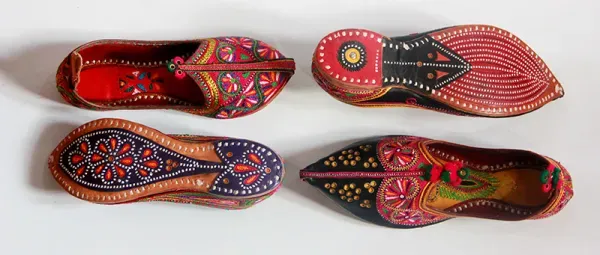
Background Leather craft in Rajasthan was a structured, village-level institution in which every settlement had resident Mochi families supplying leather goods to the community. The Sahapedia account of the Jodhpur mojari documents the range of products historically associated with the craft: military equipment including shields, saddles, and sheaths, as well as domestic tools such as the charas water-lifting device. The shift toward footwear as the primary product occurred as Rajasthan's military economy changed following the colonial period. The royal family of Jodhpur was among the principal patrons of mojari-makers, and accounts of the Gujar family's 300-year connection to royal production are among the clearest documented instances of continuous craft patronage in the region.
Culture and Societies The mojari in Rajasthan carries distinct social meaning depending on regional style and context. In Jaipur, embroidery is executed on velvet material attached to the leather upper, creating a more decorated and festival-appropriate product. In Jodhpur, embroidery is worked directly on the leather surface with golden thread. Mojaris are produced in gender-specific styles. Documented women's styles in Jaipur include Phavadi, Kholo, Kashiba, Lacto Chapel, Dhadi Chapel, and Lucky Mojari; men's styles include Phatiala Kush, Vaevadi Kusha, Jodhpuri, Kanpuri Chapel, and Ghar Dholma. These style distinctions, recorded in the government handicrafts database and the D.Source survey, reflect both functional differences and community aesthetic standards developed over generations.
Religious Significance No specific religious significance has been formally documented for the mojari craft tradition itself. Mojaris are removed before entering Hindu temples and mosques as part of general religious practice, and their exchange during weddings carries social and auspicious significance within Rajasthani custom. However, no established ritual, votive, or devotional function specific to the craft has been identified in the academic or institutional sources consulted.
Understanding the Art
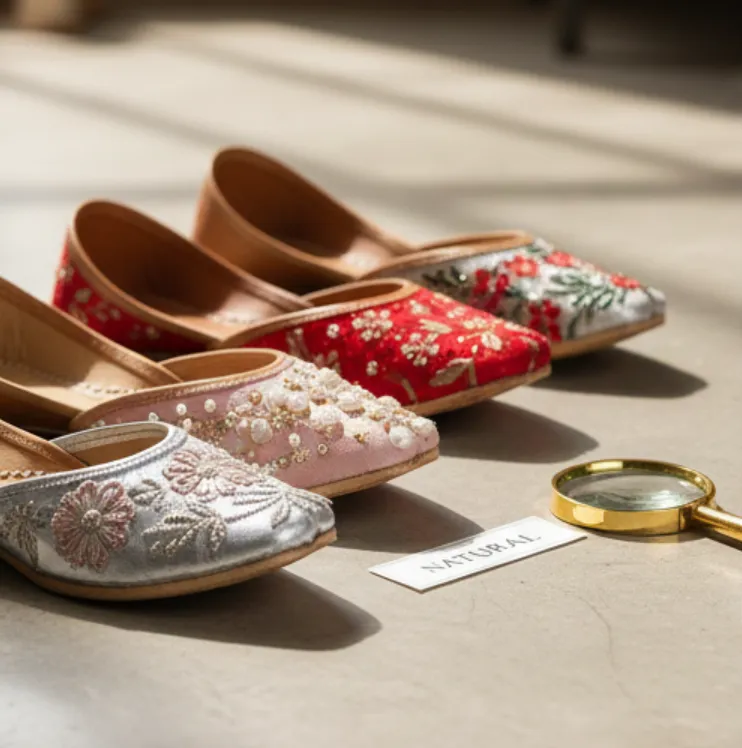
Style The mojari is characterised by a thin, flat sole, a turned-up toe tip, and an upper that covers the foot without a heel counter, allowing the shoe to be slipped on and off easily. Traditional Jodhpur mojaris from Patodi village are made entirely from natural leather without synthetic materials, using buffalo hide for the outer sole (the component most subject to wear), and lighter hides from camel, goat, or cow for the upper and lining. Jaipur mojaris typically feature velvet uppers with embroidery using zardozi, gota patti, or tilla work incorporating metallic threads, mirrors, and beads. The embroidery tradition in Jaipur reflects Mughal-period aesthetic influences that have been sustained through continuous craft practice.
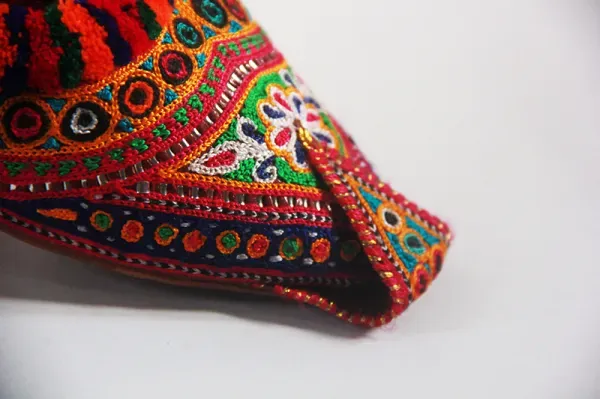
Central Motifs and Their Significance Motif systems in mojari embroidery are primarily decorative and follow regional conventions. Floral and geometric patterns dominate. Zardozi work, which uses metal threads woven into the surface, produces designs with birds, flowers, and abstract forms derived from Mughal decorative vocabulary. Regional differences are significant: Jodhpur work features bold golden embroidery on leather; Jaipur work displays finer embroidery on velvet; Bikaner and Jaisalmer styles have their own localised conventions. No universally standardised symbolic system has been documented; motif selection is primarily an aesthetic decision made within local tradition.
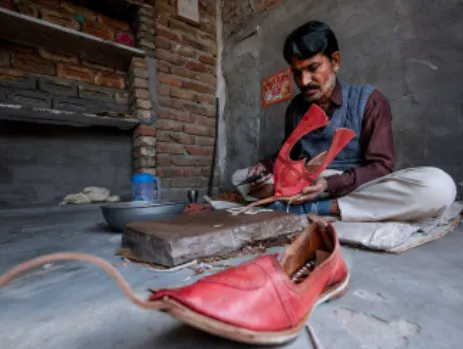
Process The production of a traditional mojari involves multiple stages. The leather is first cut to the pattern dimensions required for sole, upper, and lining components. In Patodi village, as documented by Sahapedia, different leather types are selected according to their location in the shoe: buffalo leather for the outer sole, finer hides for the upper. The components are assembled using a hand-stitching technique with waxed cotton thread, which reinforces the leather while remaining eco-friendly. For embroidered varieties, surface decoration precedes the final assembly and sole attachment. No adhesive-based construction or machine stitching is used in traditional production. Finishing involves final stitching of the sole and polish treatment.
Mediums Used Leather: Buffalo, camel, goat, and cow leather. In Patodi village, buffalo leather is reserved for outer soles due to its density and durability; camel leather is used for uppers. Embroidery materials: Cotton and silk threads, metallic zardozi threads, mirrors, cowry shells, brass nails, and beads are documented surface decoration materials. Velvet: Used as the upper material in Jaipur mojaris, replacing leather as the primary embroidery ground.
New Outlook
The mojari craft faces documented structural challenges including competition from machine-produced footwear, rising raw material costs, shortage of skilled embroiderers to replace retiring artisans, and limited institutional support. The Sahapedia documentation of the Jodhpur mojari notes that these pressures have led to income decline among craft families, worsened by the 2020 pandemic's impact on Rajasthan's tourism sector. Both NGOs and the Rajasthan State Tourism Department have initiated programmes addressing design update, marketing, and technology training. Online commerce has opened new markets: individual families increasingly sell directly through e-commerce platforms, and export demand exists for artisan mojaris. Rajasthan Studio's experiential craft programmes, which offer hands-on mojari-making workshops with Mohan Lal and Chanda Gujar in Jodhpur, represent the integration of craft into experiential tourism as an income-supplementation strategy.
Learn Leather Jutti/ Mojari
Bibliography
Sources
D.Source. “Mojari Making, Jaipur, Rajasthan.” D'Source Digital Online Learning Environment, Indian Institute of Technology Bombay, https://www.dsource.in/
Government of India, Office of the Development Commissioner (Handicrafts). “Mojari.” Handicrafts of India, https://handicrafts.nic.in/
Sahapedia. “A Stitch in Time: The Jodhpur Mojari.” Sahapedia, https://www.sahapedia.org/
Image Sources
Chatterjee, Tania. “A Stitch in Time: The Jodhpur Mojari.” Sahapedia, https://www.sahapedia.org/stitch-time-jodhpur-mojari. Accessed on May 04, 2026.
Choudhary, Pramila. “Mojari: The Golden Shoe.” Learning Deeds (WordPress), 13 July 2015, https://choudharypramila.wordpress.com/2015/07/13/mojari-the-golden-shoe/. Accessed on May 04, 2026.
“Compare Leather Jutti and Synthetic Shoes.” Jutti Crafts, https://jutticrafts.online/compare-leather-jutti-and-synthetic-shoes/. Accessed on May 04, 2026.