

Kuchipudi - The Classical Dance Form of Andhra Pradesh
Explore Kuchipudi, the traditional dance of Andhra Pradesh, and learn about its origins, techniques, cultural significance, and artistic heritage.
Kuchipudi
Kuchipudi is one of the eight major Indian classical dance forms, originating in Kuchipudi village in the Krishna district of Andhra Pradesh. It is a dance-drama tradition that integrates nritta (pure rhythmic dance), nritya (expressive dance), and natya (dramatic storytelling), performed to Carnatic music. Kuchipudi's thematic content is primarily drawn from Vaishnavite devotional literature, particularly narratives associated with Krishna. It is classified among India's classical dance forms by the Sangeet Natak Akademi and has been performed on national and international stages since the mid-twentieth century.
Etymology The dance derives its name from the village in which it was historically practised and transmitted. The village name Kuchipudi is a shortened form of Kuchelapuram or Kuchilapuri. Scholar Ragini Devi notes that this derives from the Sanskrit Kusilava-puram, meaning 'the village of actors,' Kusilava being a term in ancient Sanskrit texts for 'travelling bard, dancer, or newsmonger.' The term thus reflects the performance identity of the community that inhabited the village.
Origin The dance form traces its foundational systematisation to Tirtha Narayanayati (also called Narahari Tirtha), a Dvaita Vedanta sanyassin associated with Narahari Tirtha matha at Srikurmam and Simhachalam, and his disciple Siddhendra Yogi in the seventeenth century. Siddhendra Yogi composed Bhama Kalapam, a dance-drama centred on Satyabhama, one of Krishna's consorts. He trained Brahmin boys from Kuchipudi village to perform it. Earlier antecedents include tenth-century copper inscriptions documenting Shaivism-associated dance dramas called Brahmana Melas in Telugu-speaking regions, and the fifteenth-century text Machupalli Kaifat, which contains evidence of the art form's existence in an earlier form.
Location Kuchipudi village, Krishna district, Andhra Pradesh, is the historical centre. Significant institutional activity is based in Hyderabad and Chennai. The Kuchipudi Art Academy, founded in 1963 in Chennai (then Madras), and the Andhra Pradesh Sangeeta Nataka Akademi have been the primary institutional supporters of the form.
Community Historically, the practitioner community was exclusively composed of Brahmin male performers from Kuchipudi village, who inherited performance rights through family lineage and performed all roles including female characters. In the seventeenth century, the Qutb Shahi ruler Abul Hasan Tana Shah granted the village and surrounding lands to these Brahmin families in recognition of their performance of Bhama Kalapam, with the stipulation that they continue the tradition. Female performers were introduced in the early twentieth century by Vedantam Lakshminarayana Sastry, transforming both the performer base and the solo recital format.
Relevance Kuchipudi is recognised by the Sangeet Natak Akademi as one of the eight classical Indian dance forms. It is performed across India and internationally, taught at government academies and private institutions, and is a subject of academic research including doctoral studies at the University of Chicago (Rumya Sree Putcha, 2011) and comparative studies in Dance Research Journal (Cambridge University Press). It is categorised as Very High Priority and Thriving.
History
Background The dance-drama tradition in the Andhra region has documented origins extending to the pre-Christian era. The Natya Shastra of Bharata Muni, estimated to have been compiled between 200 BCE and 200 CE (with broader scholarly estimates ranging from 500 BCE to 500 CE), mentions the Andhra region explicitly. Bharata Muni attributes the graceful movement style Kaishiki vritti to the Andhra region and identifies a raga called Andhri originating there. Bruno Nettle and other scholars have placed the origins of Kuchipudi-related performance traditions as early as the third century BCE.
The form's medieval development is documented through tenth-century copper inscriptions recording Brahmana Melas: dance-drama performances associated with Shaivism, performed by Brahmins in Telugu-speaking parts of South India. These were absorbed into Vaishnavite practice as the Bhakti movement grew in the second millennium, and the Andhra version evolved into Kuchipudi while the Tamil version became Bhagavata Mela Nataka. Scholar Saskia Kersenboom notes that both Kuchipudi and Bhagavata Mela Nataka are related to Yakshagana from Karnataka, all three sharing Carnatic musical accompaniment but differing in costume, structure, and creative tradition.
The Vijayanagara Empire, under rulers including Krishnadevaraya (1510–1530), provided significant patronage to dance traditions. After the fall of Vijayanagara around 1565, many performance artists migrated south to Tanjore; historical records from the Tanjore kingdom note the arrival of approximately 500 Kuchipudi artist families, settled by the Hindu king Achyutappa Nayak at what became modern Melattur near Tanjore. The artists who remained in Kuchipudi village became the sole custodians of the tradition in Andhra.
The seventeenth century marked a period of near-extinction for the tradition in Andhra, interrupted when the last Shia Muslim Sultan of Golkonda, Abul Hasan Tana Shah, witnessed a Kuchipudi performance in 1678 and, impressed by its artistry, granted land to the Brahmin dancer families and formalised their continuing obligation to perform.
The early twentieth century brought two significant transformations. Vedantam Lakshminarayana Sastry introduced female performers, breaking the exclusively male performance tradition. Subsequently, Vempati Chinna Satyam (Padma Bhushan) founded the Kuchipudi Art Academy in Chennai in 1963, systematised solo recital formats, choreographed numerous compositions, and shaped the modern training and performance structure. Researcher Rumya Sree Putcha (Ph.D., University of Chicago, 2011) has documented how Kuchipudi's classicisation became entangled with identity politics around Telugu language regionalism, caste, and gender, following Andhra Pradesh's formation as India's first linguistically defined state.
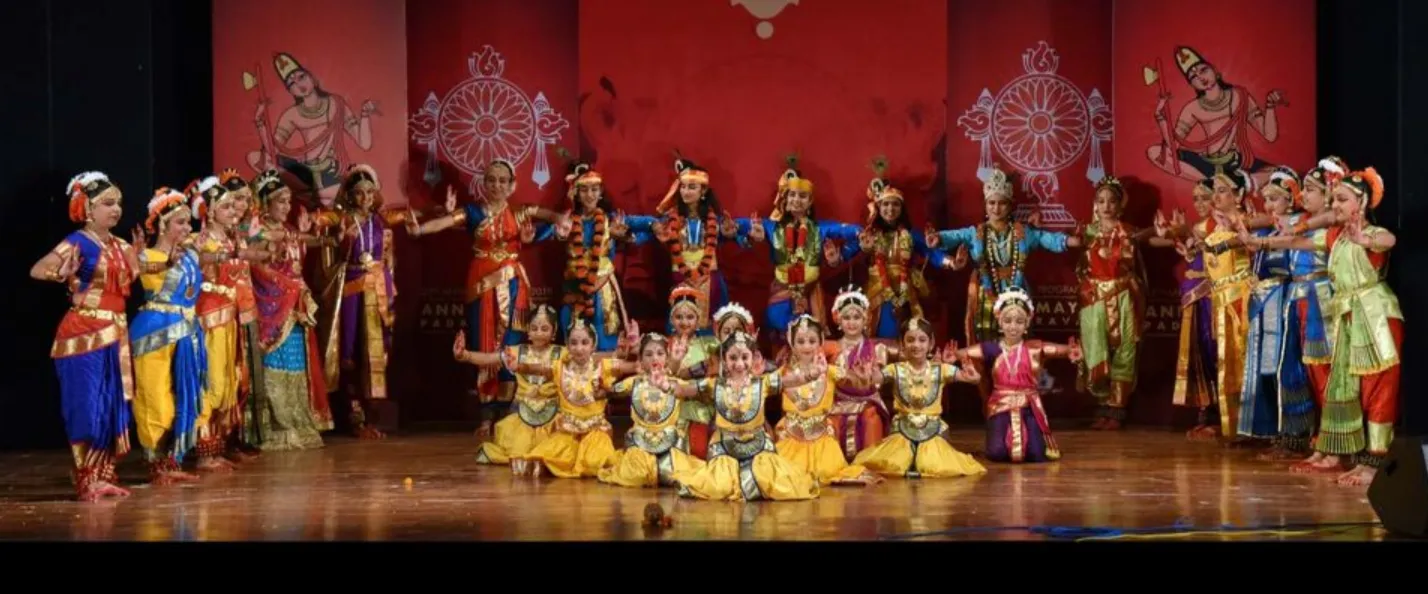
Culture and Societies Kuchipudi's historical social organisation was centred on the village of Kuchipudi, where Brahmin families held hereditary performance rights and transmitted the tradition through the gurukula system. The Andhra Pradesh Sangeeta Nataka Akademi formalised institutional support and held a Kuchipudi Natya Seminar in 1959. The Kuchipudi Art Academy (Chennai, founded 1963) became the primary modern training institution. Today, Kuchipudi is taught at government-affiliated academies in Andhra Pradesh and Telangana, as well as at private institutions across India and internationally.
Religious Significance Kuchipudi is a Vaishnavite tradition, with Krishna as the central deity. The form evolved from the Bhagavata Mela tradition, in which performances of stories from the Srimad Bhagavata Purana were conducted as acts of devotion. Performances begin with an invocatory piece, typically Ganesha Vandana or a hymn to another deity. The central composition in classical Kuchipudi is the Bhama Kalapam, authored by Siddhendra Yogi, which narrates the jealousy and devotion of Satyabhama toward Krishna; this has been performed continuously since the seventeenth century as both a devotional and a theatrical act. Tirtha Narayanayati, Siddhendra Yogi's teacher, composed Sri Krishna Leela Tarangini, comprising 302 shlokas, 153 songs, and 31 choornikas dealing with the life of Krishna.
Understanding the Art
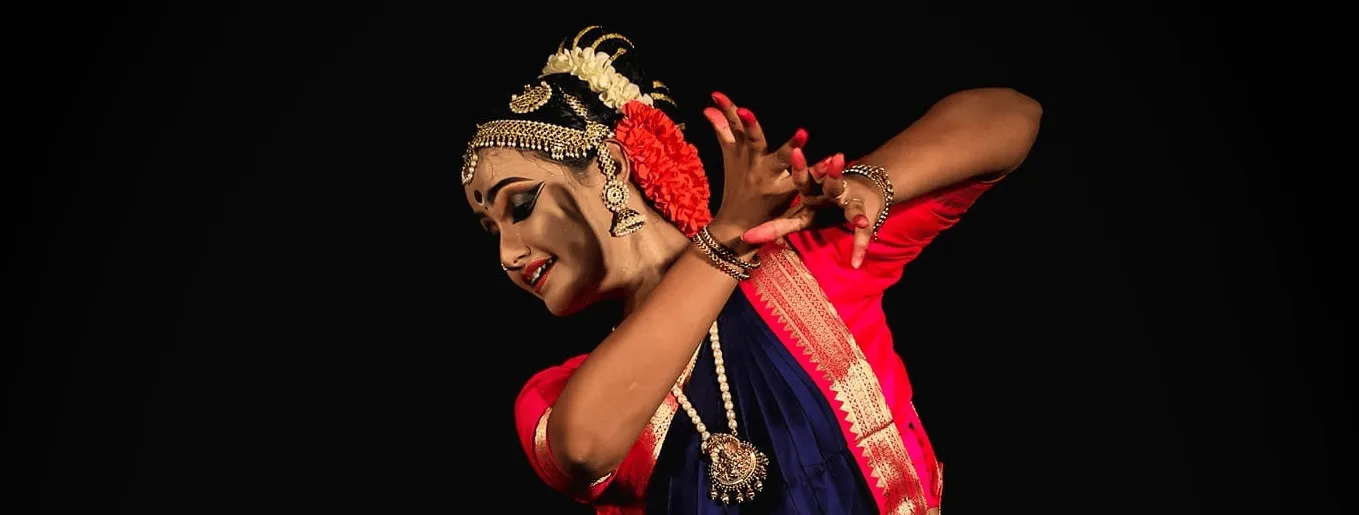
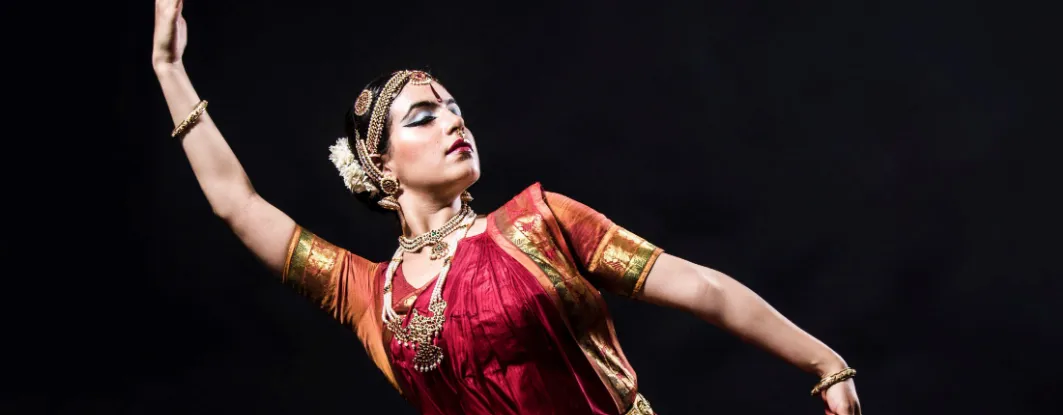
Style Kuchipudi integrates all three components recognised in the Natya Shastra: nritta (rhythmic abstract dance), nritya (expressive dance communicating narrative), and natya (drama involving spoken dialogue). Unlike many other classical forms that distinguish strictly between pure dance and narrative segments, Kuchipudi performances often include moments where the dancer breaks into spoken dialogue, adding a theatrical dimension absent from most other Indian classical traditions. The form combines elements of Tandava (energetic, masculine) and Lasya (graceful, feminine) styles.
The characteristic feature distinguishing Kuchipudi from all other Indian classical dances is the tarangam sequence, in which the dancer balances on the rim of a brass plate (a flat brass disc) while simultaneously carrying a water-filled pot balanced on the head and dancing, often to compositional pieces by Tirtha Narayanayati. This technically demanding sequence requires considerable practice in weight distribution, proprioception, and synchronisation with Carnatic musical rhythms.
Two major stylistic genealogies or sampradayam exist, traceable to specific guru lineages and village families. The Kidangoor style and Kalluvazhi style, documented in Kathakali, are structurally analogous to the transmission patterns in Kuchipudi, which similarly operates through gurukula-based lineages.
Central Motifs and Their Significance Kuchipudi's narrative repertoire is primarily drawn from the life of Krishna, with emphasis on his divine and romantic aspects: the Bhama Kalapam (Satyabhama's jealousy and devotion), Krishnalila episodes, Parijatapaharana (the stealing of the parijata flower), and compositions from the Ramayana and Mahabharata. Compositions called padams explore themes of devotion and separation, while javalis address romantic union. The dancer's hairstyle in certain compositions, particularly a braided form, is described by practitioners as symbolic of Satyabhama and represents the individual soul's tether to the divine.
The performance sequence begins with invocation, proceeds to jatiswaram (rhythmic pure dance highlighting footwork), then shabdam (narrative sections), the central kalapam (where Satyabhama is portrayed through abhinaya), padams, javalis, tillana (energetic footwork piece), and concludes with mangalam (prayer and gratitude offering) and the tarangam.
Process Training follows the gurukula model, in which students study under a single guru over an extended period, typically years. The Sangeet Natak Akademi, in its early documentation (Appa Rao, 1958), recorded the pedagogical methods of Kuchipudi transmission. Modern institutional training at the Kuchipudi Art Academy and state academies involves structured curricula integrating theory, composition study, and performance practice. Training covers abhinaya (expressive language including eye movements, facial expressions, and hand gestures), nritta (footwork and body positions), and natya (dialogue delivery and character inhabitation).
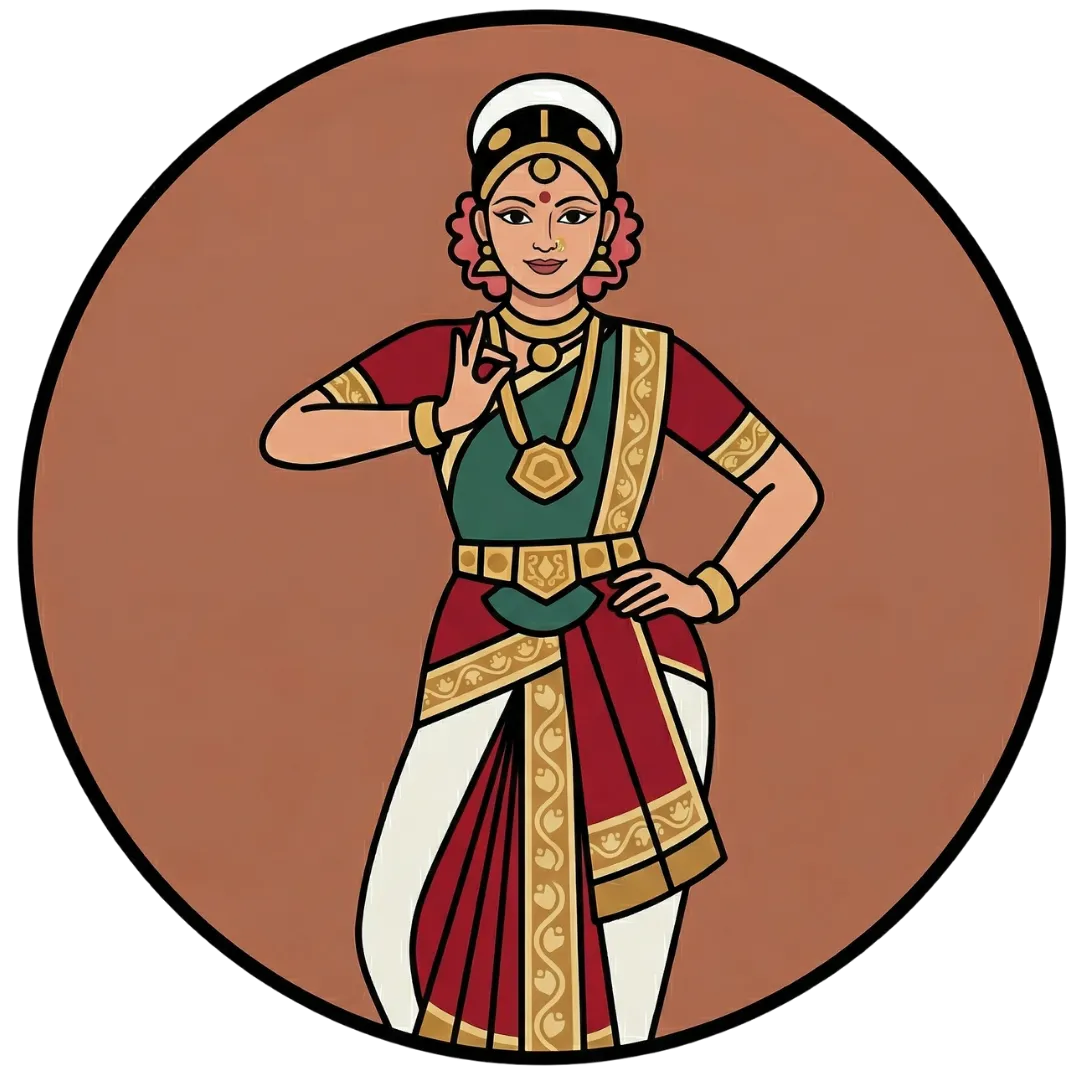
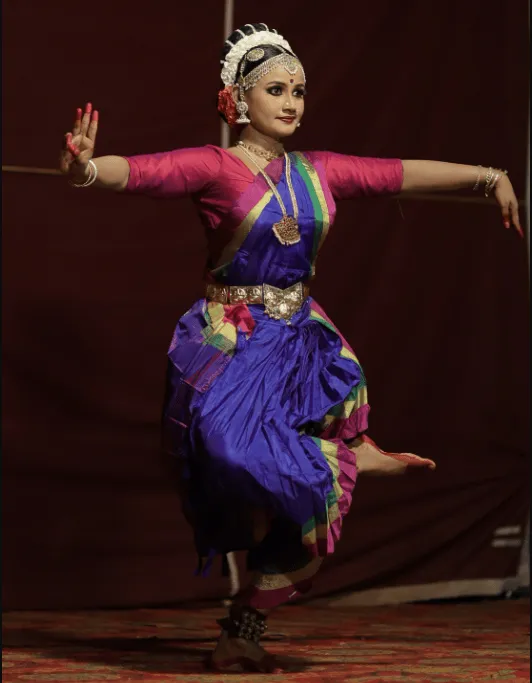
Mediums Used Performances are accompanied by a live Carnatic music ensemble including mridangam (barrel drum for percussion), violin, flute, cymbals, and tambura (drone instrument). A vocalist performs Sanskrit and Telugu compositions as the dancer performs abhinaya. A nattuvanar, or conductor, recites rhythmic syllables (solkattu) and guides the dancer's footwork synchronisation. Female dancers traditionally wear a pachabottu (nine-yard sari in a specific draping style allowing leg movement), paired with a choli. Jewellery is made of light wood (boorugu) to minimise weight during performance. Ghungroos (anklet bells) mark rhythmic footwork. Makeup includes bold eye-lining to accentuate eye movements visible to audiences at a distance.
New Outlook
Contemporary Kuchipudi has expanded significantly beyond its Vaishnavite devotional origins. Choreographers including Vempati Chinna Satyam, Raja and Radha Reddy, Yamini Krishnamurti, and Ananda Shankar Jayant have introduced compositions on non-mythological and contemporary themes. The Kuchipudi Art Academy's systematisation enabled the teaching of the form in regions without historical connection to Andhra Pradesh, expanding the performer base across India and in diaspora communities in North America, Europe, and Australia. Female performers now constitute the majority of practitioners. Scholars including Rumya Sree Putcha and the Cambridge Dance Research Journal contributor Anurima Banerji have examined the political dimensions of Kuchipudi's classicisation in the context of Andhra's linguistic identity formation.
Learn Kuchipudi
Bibliography
Sources
Andhra Pradesh Sangeeta Nataka Akademi. Kuchipudi Natya Seminar Souvenir. Andhra Pradesh Sangeeta Nataka Akademi, 1959.
Appa Rao, Vissa. Kuchipudi School of Dance. Sangeet Natak Akademi, Apr. 1958.
Banerji, Anurima. Odissi Dance: Paratopic Performances of Gender, State, and Nation. PhD dissertation, New York University, 2010.
Kothari, Sunil. Kuchipudi: Indian Classical Dance Art. Abhinav Publications, 2001.
Mansingh, Sonal. Classical Dances. Wisdom Tree, 2007.
Putcha, Rumya Sree. Revisiting the Classical: A Critical History of Kuchipudi Dance. PhD dissertation, University of Chicago, 2011.
Raghavan, Venkataraman. Splendours of Indian Dance: Forms, Theory, Practice. 2004.
Image Sources
“Kuchipudi Blog.” Kuchipudi Dance, https://www.kuchipudidance.org/blog. Accessed on May 06, 2026.
“Kuchipudi.” Harpeggio Academy, https://harpeggioacademy.com/kuchipudi/. Accessed on May 06, 2026.
“Kuchipudi.” iPassio Wiki, https://www.ipassio.com/wiki/dance/indian-classical-dance/kuchipudi. Accessed on May 06, 2026.