


Kondapalli Toys - The Handicraft Tradition of Andhra Pradesh
Explore Kondapalli Toys, the handicraft tradition of Andhra Pradesh, and learn about its origins, techniques, cultural significance, and artistic heritage.
Introduction
Kondapalli Toys, also known as Kondapalli Bommalu in Telugu, are traditional handcrafted wooden figurines and toy sets produced in Kondapalli, a town in the NTR (formerly Krishna) district of Andhra Pradesh, India. The craft involves carving lightweight local softwood into figurines, animals, and thematic sets, which are then assembled with a paste of tamarind seed powder and sawdust and painted with natural or synthetic dyes. Kondapalli Toys received a Geographical Indication (GI) tag under the Handicrafts category in 2005, registered under the Geographical Indications of Goods (Registration and Protection) Act, 1999. The GI application was filed jointly by LANCO Institute of General Humanitarian Trust (LIGHT) and Kondapalli Wooden Toys Manufacturers.
Etymology: The name Kondapalli derives from the Telugu language. According to the D'Source documentation by J.N. Somya, published through the Industrial Design Centre, IIT Bombay, the word Kondapalli originates from the shepherd named Kondadu, who showed the site to King Kondaveedu Reddy, after whom the location came to be called Kondapalli. Bommalu means figurines or dolls in Telugu, making Kondapalli Bommalu a direct designation for the figurines produced in this locality. The artisan settlement within the town where production is concentrated is referred to as Bommala Colony, translating to Toys Colony.
Origin: The craft tradition of Kondapalli Toys is conventionally dated to approximately the 16th century, placing its established practice across a span of roughly 400 years. The D'Source institutional documentation, the NTR district government portal, and the ResearchGate-published academic paper by multiple faculty authors on Kondapalli artisans all consistently cite that the artisan community known as the Aryakshatriyas migrated to Kondapalli from Rajasthan around the 16th century, bringing with them woodcraft and toy-making techniques. The academic paper also references oral accounts attributing an earlier phase of patronage to Annavema Reddy, who reportedly brought craftsmen from Rajasthan for temple sculpting commissions, and to King Krishna Devaraya of the Vijayanagara Empire, who is said to have further encouraged the occupation. These accounts are drawn from artisan oral histories recorded during field interviews and have not been independently corroborated through surviving administrative records. The Aryakshatriyas community claims textual reference in the Brahmanda Purana and traces its lineage to the sage Muktharishi, who, according to community tradition, was endowed with skills in arts and crafts by Lord Shiva. These are community-held narratives rather than independently verified historical facts.
Location: Kondapalli is situated approximately 20 kilometres from Vijayawada on National Highway 221 and on the Hyderabad to Vijayawada railway line, within the NTR district of Andhra Pradesh. The artisan production zone within the town is concentrated in the Bommala Colony. The Tella Poniki wood essential to the craft is sourced from the forests surrounding Kondapalli, specifically from areas including Gangineni, Adlapadu, Konduru, Chevuturu, and Madhavaram, as documented in the D'Source field study. The town also contains the 14th-century Kondapalli Fort, which stands on an adjacent hill and is administratively recognised as a heritage site.
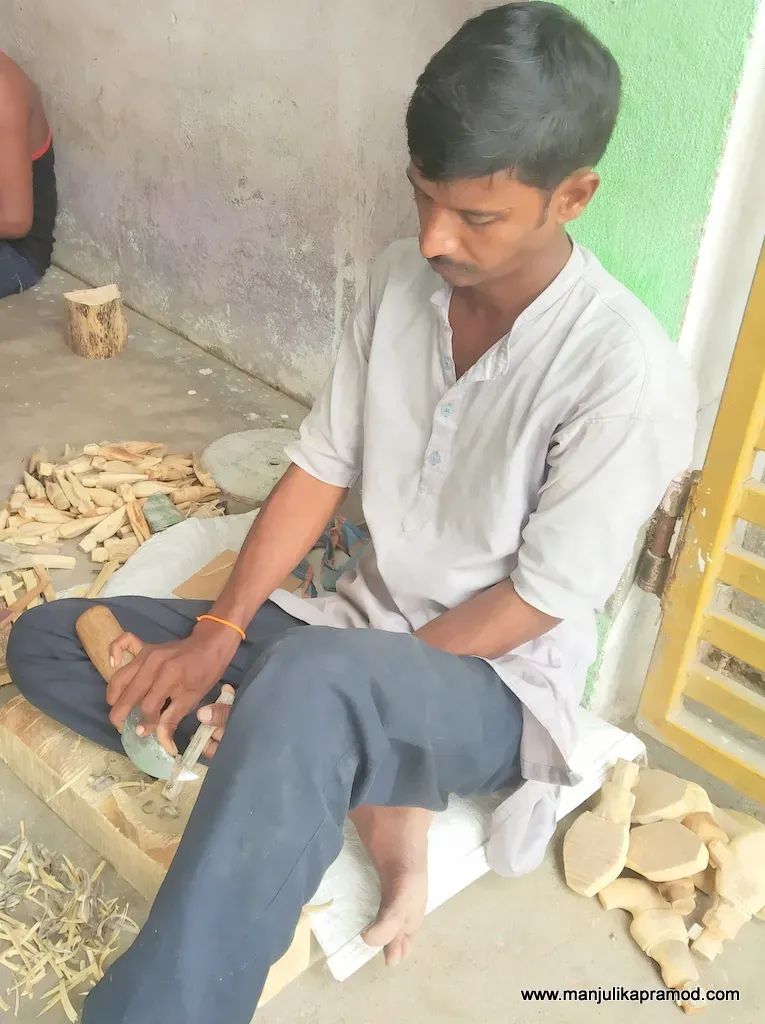
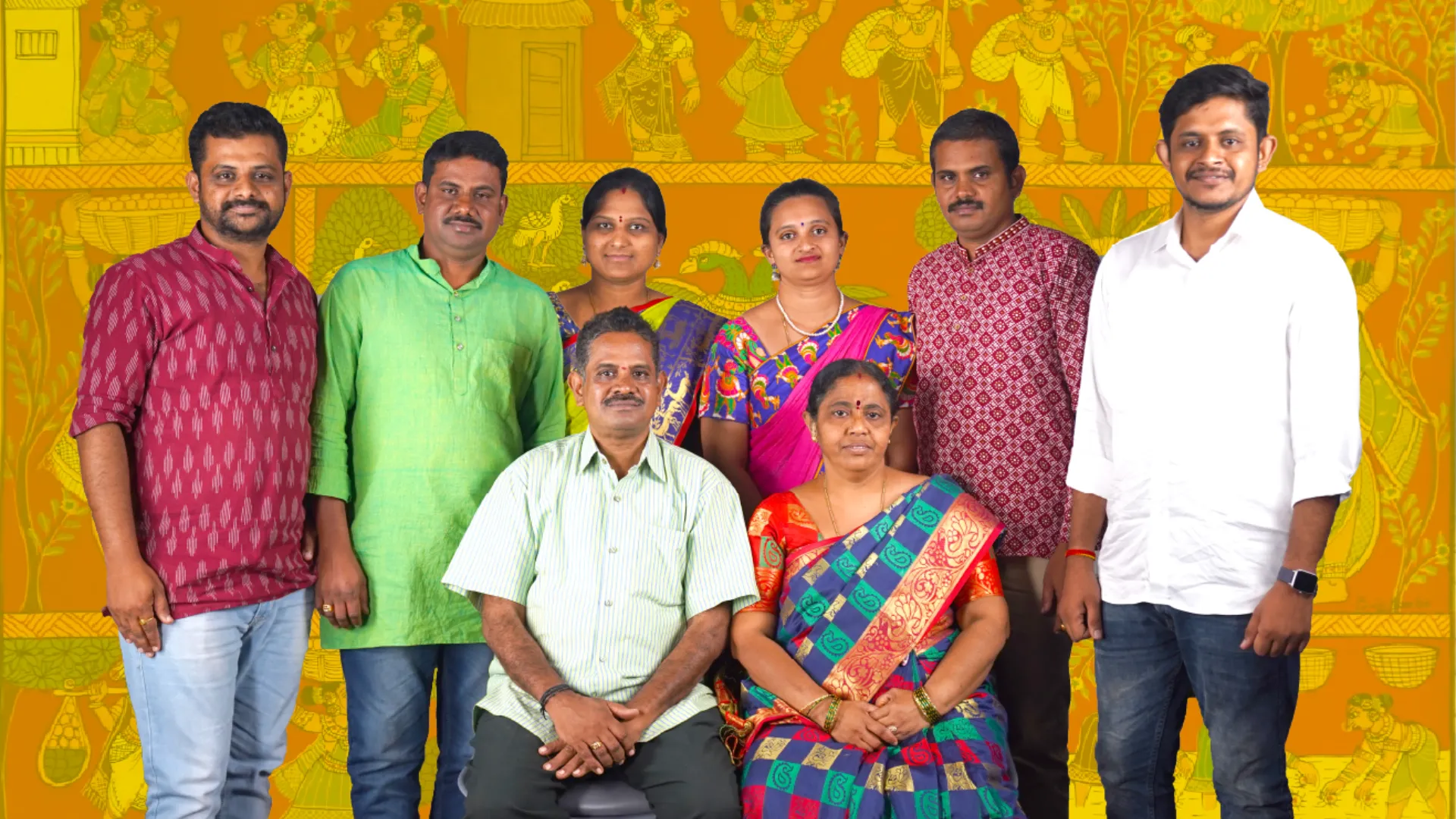
Community: The primary artisan community associated with the origin and historical continuity of Kondapalli Toys is the Aryakshatriyas, also referred to as Nakarshalu. Multiple government and craft documentation sources confirm that this community has maintained the craft across generations, with all family members, men, women, and children, traditionally participating in different stages of production. Men typically undertake carving and cutting, while women and other family members are involved in the painting and finishing processes. Over time, artisans from other communities and from areas including Jaipur and Koraput have also joined the craft in Kondapalli. The artisan base, as recorded by government reports under the Fund for Regeneration of Traditional Industries (SFURTI) scheme, comprises approximately 206 artisans organised into 27 societies, which have since been merged into a single body called Kondapalli Sfurthi Bommala Panivarla Sangam to streamline production, raw material procurement, and marketing.
Relevance: Kondapalli Toys hold documented cultural, economic, and institutional recognition at national and international levels. The craft is listed under the One District One Product initiative of the Government of Andhra Pradesh. The GI registration provides legal protection against imitation products. The Ministry of Culture of the Government of India has publicly acknowledged the craft's significance. The toys are exported to multiple countries and are particularly in demand during the South Indian festival seasons. The craft is also supported by Lepakshi Handicrafts, the state-run retail arm of the Andhra Pradesh Handicrafts Development Corporation Limited, which markets Kondapalli Toys through its outlets. The NTR district administration and institutions like LANCO Institute have contributed to preservation and market outreach efforts.
History
Background*: The earliest documented accounts of the craft's history rely on oral traditions of the Aryakshatriyas community, recorded during field interviews by researchers including J.N. Somya. These accounts describe royal patronage during the pre-colonial period, with references to support from the Vijayanagara-era rulers and local zamindars of Kondapalli. The craft experienced sustained decline during and after the colonial period, as mechanised and factory-produced toys displaced demand for handmade wooden objects. In the post-independence period, low prices, restricted market access, and the gradual scarcity of Tella Poniki wood drove many artisan families to abandon the profession. At its lowest point, the total active artisan base contracted severely, with only a small number of families continuing production.
Revival efforts from the late 20th century onwards involved multiple institutional actors. Lepakshi Handicrafts provided a government-backed retail and marketing channel. LANCO Institute of General Humanitarian Trust supported artisan welfare and co-filed the GI application. The Central Government's SFURTI scheme provided financial and infrastructural support, funding workshops and training facilities in Kondapalli and allocating subsidies to offset the increasing cost of procuring Tella Poniki wood from distant forest areas as local supply diminished. The Ministry of Commerce and Industry, under its Department for Promotion of Industry and Internal Trade, registered the GI tag, formally protecting the craft's geographic provenance and commercial identity.
Culture and Societies: Kondapalli Toys are deeply embedded in the domestic and festival culture of Andhra Pradesh and the broader Telugu-speaking community. The toys serve a central function in the Bommala Koluvu tradition, which is the ceremonial display of figurines during the Hindu festivals of Dussehra and Sankranti. During Dussehra and Navratri, figurines are arranged on tiered stepped structures called ‘padis’ in an odd number of steps, typically narrating scenes from Hindu mythology, court life, or everyday domestic activity. During Sankranti, the display honours the observance of Sankranti Purusha. The Wikipedia article on Golu (festival) specifically identifies Kondapalli Toys, and particularly the Dasavatara series, as one of the craft traditions preserved and sustained through the practice of Bommala Koluvu in South India.
Beyond their festival function, Kondapalli Toys have historically served as gifts at weddings and auspicious ceremonies and as household decorative items. They have also functioned as collectibles for diaspora Telugu communities internationally, particularly in the United States, where demand during Navratri and Dussehra celebrations is documented by craft retailers and institutional sources.
Religious Significance: Kondapalli Toys have documented use within Hindu religious festival contexts. The Bommala Koluvu display, which incorporates Kondapalli figurines, is an established ritual practice during Navaratri and Dussehra, centred on the worship of the goddesses Durga, Lakshmi, Parvati, and Saraswati. The Dasavatara set, depicting the ten incarnations of Lord Vishnu, is one of the most recognised product categories of the tradition. Figures of deities including Lord Ganesha, Lord Krishna, Goddess Durga in her nine avatars, and other mythological subjects are standard production items. The community's own origin narrative, referencing Muktharishi and the Brahmanda Purana, frames the craft itself within a religious genealogy, though this is a community tradition rather than a textually established fact.
The use of Kondapalli figurines in temple displays during Navratri is also documented. However, no institutional or peer-reviewed scholarly source has established a formalised or institutionally sanctioned religious ritual requiring Kondapalli Toys specifically, as distinct from other figurine types used in Bommala Koluvu. Their religious association is primarily functional and contextual, embedded in domestic festival practice, rather than doctrinal.
Understanding the Art
Style: The visual style of Kondapalli Toys is characterised by lightweight, compact forms with smooth carved surfaces, expressive facial features, and bold painted colour schemes dominated by red, yellow, blue, green, black, and white. The art shows a strong influence of the Islamic style and the pointed noses of human figures are reminiscent of the 17th-century Rajasthani style. This dual influence reflects the community's Rajasthani origin and the subsequent cultural environment of Andhra Pradesh, which historically included Golconda Sultanate and Vijayanagara Empire. Human figures are depicted with stylised proportions, expressive poses, and painted clothing in regional attire. Animal figures, particularly elephants with decorative howdahs (called Ambari), bulls, and horses, are rendered with attention to characteristic posture and physical detail. The overall visual approach emphasises clear outline, bright colour, and accessible representation of recognisable subjects rather than anatomical precision.
Central Motifs and Their Significance: The documented thematic categories of Kondapalli Toys, as recorded across institutional, government, and craft documentation sources, are as follows.
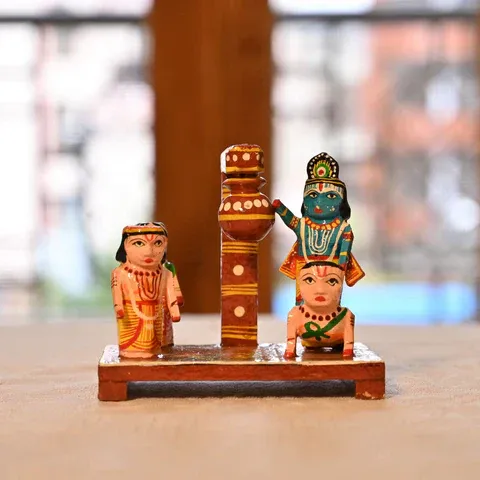
Mythological subjects form one major category. The Dasavatara set, depicting the ten avatars of Lord Vishnu, is the most iconic product of the tradition and a standard reference point in all documentation of the craft. Other deity figures including Lord Krishna, Goddess Durga, Lord Ganesha, and Lord Hanuman are regularly produced. These figures serve the functional demand of the Bommala Koluvu festival tradition.
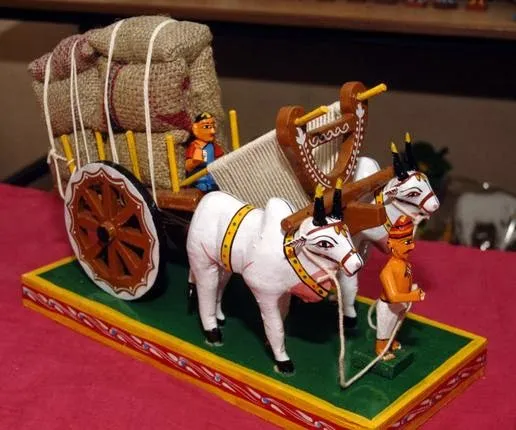
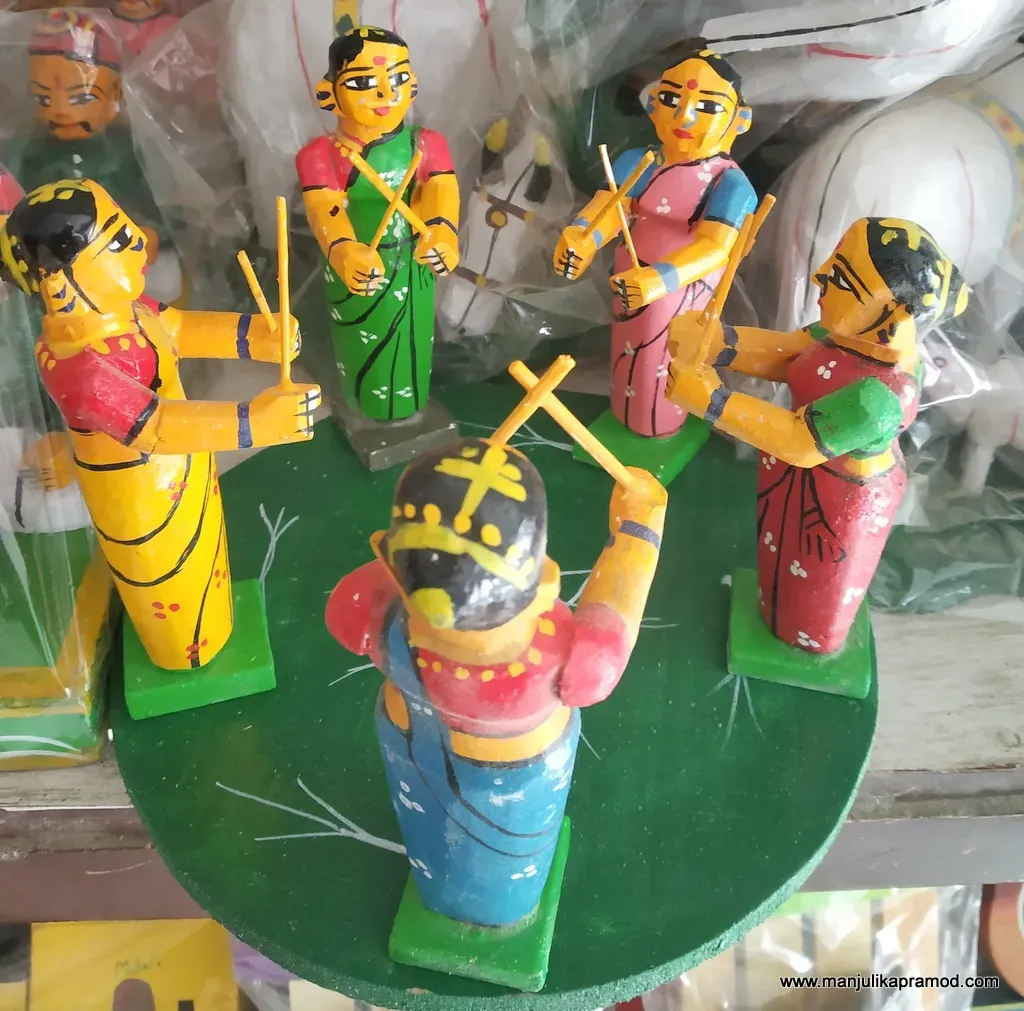
Rural life scenes constitute a second major thematic category. Documented subjects include women drawing water from wells, farmers with bullock carts, village headmen, toddy tappers, market vendors, women engaged in domestic activities such as grinding, cooking, and childcare, wedding processions with palanquin bearers, and musicians. These figurines narrate the everyday social life of rural Telugu communities.
The Ambari Elephant, depicting a caparisoned elephant bearing a ceremonial howdah, is one of the most widely produced and recognisable single objects of the tradition. The palm tree is another standard production item. The Village Set, comprising 24 figures, is a documented ensemble product representing a cross-section of rural community life.
Contemporary adaptations, documented in craft and press sources, include figures depicting subjects such as people working on computers and scenes from modern domestic life. These are produced in response to changing market preferences while retaining the same wood, tools, and basic construction techniques.
Process: The production process of Kondapalli Toys follows a multi-stage sequence, documented in detail in a study by J.N. Somya and corroborated by multiple institutional sources.
First, wood selection and seasoning: Tella Poniki logs are collected from nearby forest areas. The wood is dried under the sun or in a well-ventilated place to reduce moisture content. Traditionally, the wood is left for approximately 20 days of sun exposure before carving begins.
Second, carving: Individual components of each toy are carved separately using a set of hand tools. Documented tools include the drill, hammer, axe, Bahudara (a carving tool), Aakurai (file), and various chisels for finer work. Some cylindrical components are also turned and finished on a lathe. The separate construction of parts and subsequent assembly is a defining feature of the process.
Third, application of Aakra paste: A mixture of tamarind seed powder and sawdust, called Aakra or Aakra paste in documentation, is applied to the carved surfaces. This paste fills cracks, smooths uneven surfaces, and is specifically used to build up physical features on animal figurines, such as the dewlap and underbelly of the bull. The paste is allowed to dry before painting proceeds.
Fourth, painting: The dried, assembled figurines are painted in successive layers. Traditionally, natural vegetable dyes were used, and a coat of sheen-lac polish was applied over natural dyes to prevent them from becoming sticky in humid or air-conditioned environments. In contemporary practice, many artisans have shifted to synthetic enamel paints due to cost and availability considerations, reserving natural dye products for the export and premium market segments.
Fifth, finishing: Completed toys are inspected and finishing touches are applied. The labour division within artisan families typically assigns carving to men and painting to women, though this is a generalised pattern rather than a strict rule.
Mediums Used: The primary raw material is Tella Poniki wood, botanically identified as Jiuotia Rotteri Fromis in the D'Source documentation. This softwood is lightweight and has a smooth texture that facilitates carving of detailed forms. It is found in the forest areas around Kondapalli, though its supply has become increasingly restricted. Other materials used in production include tamarind seed powder and sawdust for the Aakra bonding and smoothing paste, natural vegetable dyes for traditional finishing, enamel and oil paints for the domestic and commercial market segments, and sheen-lac polish applied over natural dye finishes. The research publication on Kondapalli Toys notes subsidiary materials including aluminium, zinc, waste coir, cotton, and mogali (kewra) leaves used in certain specialised product configurations, though these are not part of the standard construction process. Tools include hand chisels of various types, a drill, axe, hammer, and lathe for turned cylindrical components.
New Outlook
The contemporary status of Kondapalli Toys involves both documented challenges and active institutional interventions. The primary material challenge is the scarcity of Tella Poniki wood, which is now sourced from increasingly distant forest areas due to the depletion of local supplies raising production costs. Competition from factory-produced plastic toys and low-cost imitations continues to reduce the price point achievable by hand-crafted products. A generational succession problem has also been noted, with younger
community members showing reduced interest in pursuing the craft as a livelihood. On the support side, the SFURTI scheme of the Government of India has funded 16 workshops within a consolidated facility in Kondapalli, benefiting 80 artisan families, and has provided subsidies on wood procurement. The state government recognises the craft under the One District One Product programme for NTR district. Tata Trust has been identified as a prospective partner for international marketing support. Online retail platforms have significantly expanded the reach of authentic Kondapalli products to domestic and diaspora markets.
The craft has also shown adaptability in design. While classical subjects such as the Dasavatara and the Ambari Elephant remain the most recognised and commercially stable products, artisans have developed contemporary figurine designs reflecting modern everyday life, allowing the tradition to remain commercially relevant beyond its original festival-season market cycle.
Learn Kondapalli Toys



Bibliography
Books
“Kondapalli Toys: An Insight into the Crafts and the Artisans of Andhra Pradesh.” ResearchGate, Dec. 2020.
Ravikanth, Y. “Toys and Their Significance in Early Childhood Education.” Teachers of India, 2012.
Somya, J. N. “Traditional Toys of Kondapalli.” D'Source Digital Online Learning Environment for Design, Industrial Design Centre, Indian Institute of Technology Bombay, 2022.
Internet Sources (For Images)
“Kondapalli Bommalu.” NTR District Government of Andhra Pradesh, n.d., https://ntr.ap.gov.in/kondapalli-bommalu/. Accessed on April 20, 2026.
“The Making of Kondapalli Toys: A Look into the Artisan’s Craft of Andhra Pradesh.” LoveNspire, 10 Apr. 2026, https://lovenspire.com/blogs/lovenspire-blog-corner/the-making-of-kondapalli-toys-a-look-into-the-artisans-craft-of-andhra-pradesh. Accessed on April 20, 2026.
Pramod, Manjulika. “Photo Story: The Bright and Cheery Toys of Kondapalli.” Manjulika Pramod Travel Blog, n.d., https://www.manjulikapramod.com/travel/photo-story-the-bright-and-cheery-toys-of-kondapalli/. Accessed on April 20, 2026.