


Kinnauri Shawl Craft - The Handicraft Tradition of Himachal Pradesh
Explore Kinnauri Shawl, the handicraft tradition of Himachal Pradesh, and learn about its origins, techniques, cultural significance, and artistic heritage.
Introduction
The Kinnauri Shawl is a handwoven woollen textile produced in the Kinnaur district of Himachal Pradesh, India, characterised by geometric patterned borders woven in tapestry weave over a twill ground in natural shades of wool. It is among the oldest documented weaving traditions in the western Himalayan region and is regarded by scholars and craft institutions as the predecessor to the more widely commercialised Kullu shawl tradition. The Kinnauri Shawl received Geographical Indication (GI) registration under the Government of India's GI Act 1999, protecting it as an intellectual property specific to the Kinnaur region.
Etymology: The name Kinnauri Shawl derives directly from Kinnaur, the south-eastern district of Himachal Pradesh from which the textile originates and to which it is geographically bound under GI registration. The people of Kinnaur have traditionally been referred to as Kinners or Kinnauras, and the region is referred to in ancient texts as Kinnerdesh or Kimpurusha Khand. The GI application submitted by the H.P. Patent Information Centre and the Kinnaur Handloom Weavers' Association, Kalpa, documents the local Kinnauri term for the shawl as chhali, with women's patterned shawls referred to as chhali toproo (shawl of designing pattern) and men's plain shawls as plain chhali. The word shawl itself entered common usage in the subcontinent through Persian and ultimately derives from the Sanskrit shal, meaning a woollen wrap.
Origin: The documented origin of Kinnauri Shawl weaving is rooted in the geographical and climatic conditions of the Kinnaur district. The GI application document prepared by the H.P. Patent Information Centre states that the harsh winters of Kinnaur, which last from October to May with heavy snowstorms, compelled local communities to develop wool weaving as a functional industry. The document also records that the weaving activity in Himachal Pradesh is supposed to have originated in Kinnaur, with some weavers later migrating to other parts of the state, a claim supported by the academic record of Kinnauri weavers introducing their patterning techniques to the Kullu valley in the 1830s.
Suzette R. Copley Patterson, in her paper "Weaving Traditions along the Wool Road in India" published in the Textile Society of America Symposium Proceedings (University of Nebraska Digital Commons, 2002), records the oral testimony of master weaver Dhuni Chand of Manali, who stated that the art of weaving decorative motifs on wool garments originated in the Kinnauri village of Shubnam, and that the craft reached Kinnaur from Tashkent, in Uzbekistan, via China and Tibet. This oral account locates Kinnauri weaving within a broader network of Central Asian textile exchange, consistent with the documented Central Asian stylistic influence visible in the geometric motifs of the tradition. No archival document independently corroborates the specific village or Central Asian route identified in this oral account, and it is presented here as documented oral testimony rather than confirmed historical record.
The GI application records that the trade of Kinnauri Shawl flourished in the erstwhile state of Rampur Bushahar, and that the rulers of that state paid attention to developing and sustaining the craft. The application further notes that British administrator reports in the mid-nineteenth century led to the revocation of transit duties in 1847, which encouraged inter-border trade between Bushahr and Tibet and benefited wool-based cottage industries across the region. The explorer and geographer Sven Hedin's account from his work Trans-Himalayas, cited in the GI application, records the movement of Indian wool trading caravans through Gertse (in Tibet) toward Gartok and India, indicating the scale of historical wool trade through these routes.
Location: Kinnauri Shawl is produced in the entire Kinnaur district of Himachal Pradesh and in the adjoining Rampur Bushahar tehsil of Shimla district, as documented in the GI application. Kinnaur is the south-eastern district of Himachal Pradesh, bordering Tibet to the east, with altitudes ranging between 2,320 and 6,816 metres above sea level. The Sutlej River and its side valleys divide the district, which has two distinct climatic zones: the wet zone south of the Great Himalayan range (Sutlej and Baspa valleys) and the arid zone toward Tibet and Spiti. The district headquarters Reckong Peo (also spelled Recong Peo) is the principal administrative centre of the weaving industry. The GI application records 15,000 weavers and 10,000 looms in Reckong Peo and adjoining areas.
Historically, the region's position along what scholars of Central Asian trade have called the wool road, connecting the Punjab plains to Tibet, Central Asia, and China via the Hindustan-Tibet Road (National Highway 22), shaped the design vocabulary of the tradition. Patterson's 2002 paper documents this trade route as distinct from the more widely known Silk Road but equally significant for textile exchange in the region.
Community: The Kinnauri people are the principal weavers of the Kinnauri Shawl. The GI application document records that the Kinnauras consist of two broad groups: the Rajputs or Khosias, and the Berus. The Khosias include both Hindus and Buddhists, with Hindus dominant in the Nichar, Sangla, and Kalpa areas, and Buddhists dominant in the tracts adjoining Tibet and Spiti. The Berus are composed of four artisan castes: the Lohar (blacksmiths), the Badhi (carpenters), the Koli, and the Nanglu. The GI application does not attribute Kinnauri Shawl weaving specifically to any single caste, noting instead that weaving is a household activity across the community.
The Gaatha.org craft archive documents that weaving is a way of life among Kinnaris, with each household keeping a small quantity of wool to meet its own requirements. The archive records that after sheep are sheared, wool is washed, dried, combed with wooden combs, and then spun during leisure periods, particularly in winter, on a local spindle called the takli, before banuras or julahas weave it on traditional looms. The GI application records that most weavers are women, who act as job workers receiving dyed yarn from traders, carrying out pre-weaving activities, weaving the product, and receiving piece-rate wages. The application notes the average wage earning at the time of submission as approximately eighty rupees per day.
Notably, the Gaatha.org archive documents a documented historical rupture in the community's relationship with external commercialisation: the Kinnauri weaving technique was introduced to the Kullu valley in the 1830s when weavers from Rupa village in Kinnaur fled to escape persecution by the local king, as recorded by Patterson, citing an interview with master weaver Tanjen Ram Bhagat of Sarsei village, Himachal Pradesh. Following this migration, these techniques were commercialised in the Kullu valley independent of Kinnaur, a development which the Gaatha.org archive frames as Kinnaris' technique being, in their view, taken without consent.
Relevance: The Kinnauri Shawl was registered under the Geographical Indications of Goods (Registration and Protection) Act, 1999 of the Government of India. The Wikipedia article on Kinnauri Shawl records the GI registration as occurring in October 2010 under this Act. The GI application document submitted to the Geographical Indications Registry Office, Chennai, records the applicants as the H.P. Patent Information Centre (State Council for Science, Technology and Environment, Shimla) and the Kinnaur Handloom Weavers' Association, V.P.O. Kalpa, District Kinnaur, Himachal Pradesh, registering the goods under Class 24 (Textile and Textile Goods). The GI registration prohibited unauthorised production of the shawl, with violations attracting a penalty of two lakh rupees or three years imprisonment, as documented in the Wikipedia entry.
The academic significance of Kinnauri Shawl weaving is confirmed by its inclusion in the Textile Society of America Symposium Proceedings (Patterson, 2002) and by a project report on the study of Kinnauri Shawl produced by the Indian Institute of Handloom Technology, Varanasi (Sharma, Vivek and Anand, Suresh, 1991 to 1992), cited in Patterson's bibliography. The craft is also documented in the D'Source digital resource produced by IIT Bombay's Industrial Design Centre, which provides a structured technical resource on Kullu and Kinnauri shawls. The Gram Disha Trust's field documentation of the craft in the Pangna area of Himachal Pradesh records its vulnerability, noting that unprofitable returns are causing the tradition to die out among the few remaining craftsmen.
History
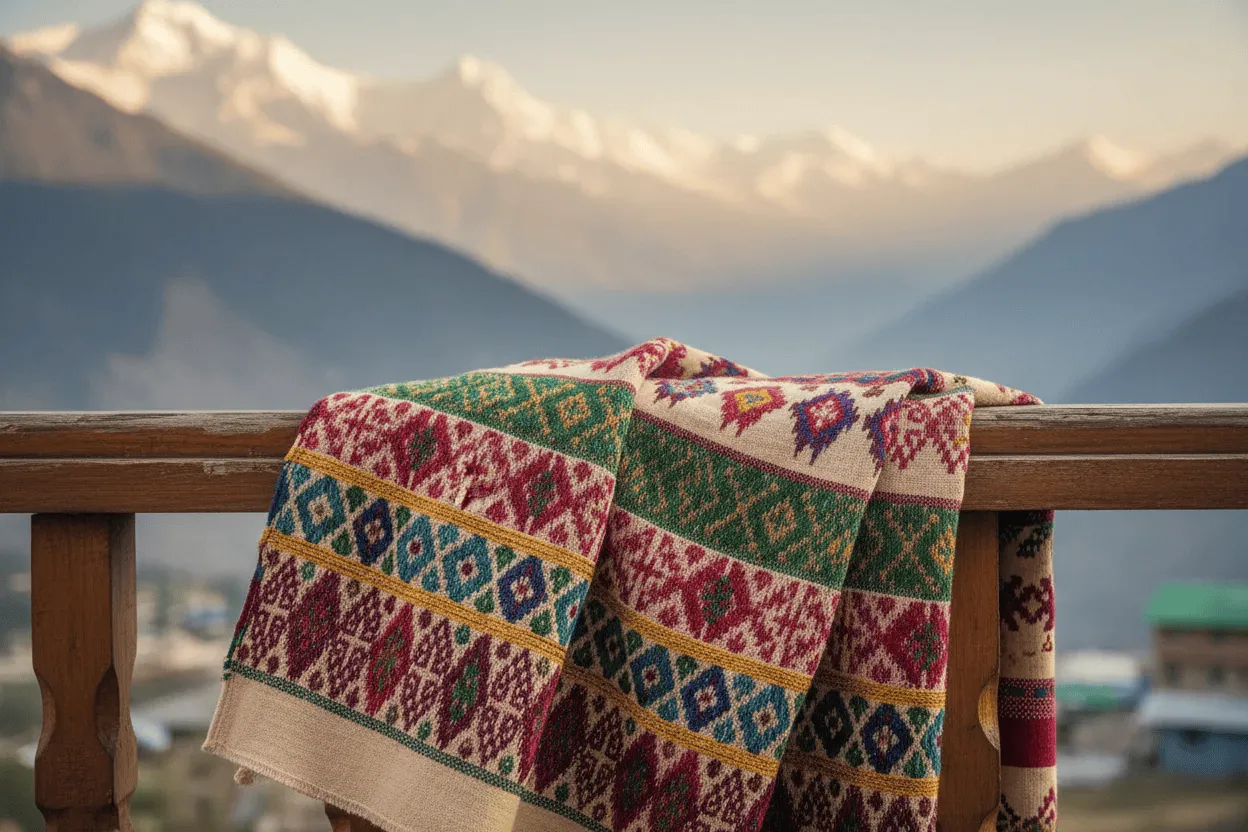
Background: The weaving history of Kinnaur is documented as extending over several centuries, though the precise historical origin of the patterned tradition cannot be fixed to a specific period on the basis of currently available archival evidence. The GI application records that the region's contacts and trade relations with both the Indian plains and western Tibet historically shaped a culture influenced by Tibetan and Hindu traditions in parallel. The application also records that Kinnaur was successively ruled by the Magadha Kingdom, the Mauryan Empire, and the Guge Kingdom of Tibet before the twelfth century, after which local kings gained more autonomy, and the region later became part of Bushahr State before coming under nominal British control in the twentieth century.
The GI application cites the H.P. State Gazetteer as a documentary source for references to the shawl (referred to as chhanli) in historical records, including descriptions of men wrapping chhanli during inclement weather and fastening it near the breast with a silver hook called digra. The application also cites Sven Hedin's Trans-Himalayas for documentation of the wool trade caravans connecting Kinnaur-adjacent regions to Tibet, dating the trade activity described to the period of Hedin's Himalayan explorations in the early twentieth century.
Patterson's 2002 paper, drawing on the work of scholars including Subashini Aryan and R.K. Gupta Dutta (Crafts of Himachal Pradesh, Mapin Publishing, Ahmedabad, 1993), and O.C. Handa (Textiles, Costumes and Ornaments of the Western Himalaya, Indus Publishing Company, New Delhi, 1998), situates Kinnauri weaving within a 5,000-year oral tradition of weaving in Himachal Pradesh, though she notes this figure derives from oral testimony by master weavers and not from archaeological or archival documentation. The migration of Kinnauri weavers from Rupa village to the Kullu valley in the 1830s represents the most precisely dated historical event in the documented record of the craft's influence on the broader Himachali weaving tradition.
Culture and Societies: The Kinnauri Shawl is embedded in the daily and ceremonial life of Kinnaur. The GI application documents the range of woven garments worn by the Kinnauri community: women wear the dohru (a woollen fabric resembling a saree), chhali (shawl), gachi (a garment), pattu (a stole-like woollen fabric draped over the body), and topu (a cap); men wear suthan (a lower garment), choba, gachi, and the cap called thepang. The thepang cap, locally called Thepang, has a green velvet strip called patika on it, with a floral decoration on the strip called chaanoku. The application records that it is a common sight to see Kinnauri men and women wearing caps with chaanoku.
The Gaatha.org archive records that the Kinnauri Shawl is regarded as an article for festivals and auspicious occasions, and that when a baby is born, the child is first wrapped in a soft pashmina shawl, indicating the material's embeddedness in birth customs. The Bhuttico cooperative's documentation records the shawl's ceremonial role at weddings, where it is worn by both women and men, and at the Phulaich festival (Festival of Flowers), a harvest celebration during which community members dress in traditional outfits including Kinnauri shawls and mufflers to honour ancestors. The Wikipedia article notes that wool is considered pure by Himachalis and must be worn during all rituals, including marriage ceremonies, where the bride and groom are wrapped in a wool shawl as protection.
The Kinnauri Shawl also carries social markers. The Bhuttico cooperative's documentation notes that a denser and finer motif set has traditionally been associated with higher social status, though the primary sources for this observation are community-based rather than academic.
Religious Significance: Kinnauri Shawl weaving has a documented connection to religious symbolism at the level of colour and design. The GI application document submitted to the Government of India states explicitly that the colours used in the patterning of traditional Kinnauri shawls carry symbolic and religious significance rooted in the representation of the five classical elements: white stands for water, yellow for earth, red for fire, green for air, and blue for ether (aether). This five-colour elemental system is consistently documented across the GI application, the D'Source IIT Bombay resource, and the Wikipedia article on Kinnauri Shawl.
The GI application also records that the traditional designing on Kinnauri Shawls is the outcome of a complex amalgam of religious influence, the aesthetics of rulers, the elemental experience of craftspeople, and the natural environment. The application states that objects of religious importance are woven into these shawls, and that many of the motifs woven have a special symbolic and religious significance. Kinnaur has historically been a site where Hinduism and Buddhism coexist, and the GI application notes that this dual religious context has shaped the design vocabulary of the tradition, though it does not specify which particular motifs correspond to Hindu or Buddhist iconography beyond the elemental colour system.
Wool itself carries ritual significance in the broader Himachali context. The documentation compiled by Patterson (2002) records that wool is regarded as pure among Himachalis and must be worn during all rituals. No formal academic study has been published that systematically maps the religious iconography of individual Kinnauri Shawl motifs to specific deities, scriptures, or liturgical functions. The documented religious significance remains at the level of colour symbolism and general elemental representation as stated in the GI application.
Understanding the Art
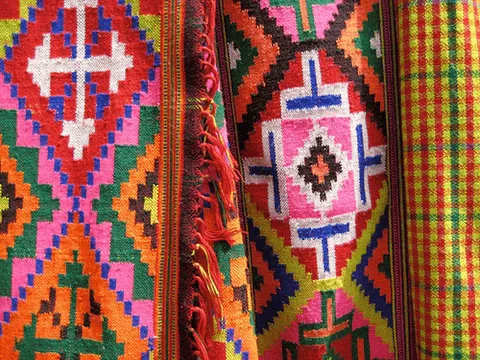
Style: Kinnauri Shawl is technically defined by two weave structures used in combination. The body or ground of the shawl is woven in a 2/2 twill weave using natural wool in shades of white, black, natural grey, and brown. The patterned borders are woven in a tapestry technique, also described as a weft-rib or extra-weft technique, in which additional coloured threads are inserted to build up the geometric pattern separately from the ground weave. The Gram Disha Trust documentation describes this as a tapestry-woven border in multicoloured geometric forms over a twill-woven body. The D'Source IIT Bombay resource and the GI application both confirm that the base weave is 2/2 twill, and the patterning technique uses weft rib or dove-tailing (slit tapestry).
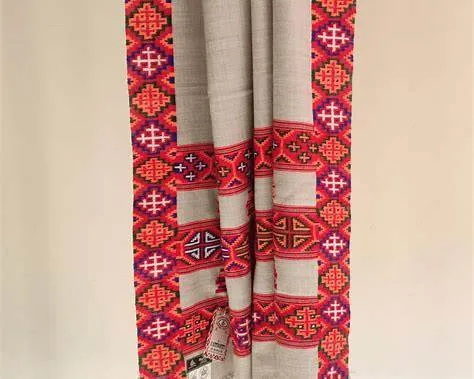
The GI application categorises Kinnauri Shawls into three types based on the placement and extent of patterning. The first type is the Single Border, in which Kinnauri geometric pattern appears along both ends of the shawl. The second type is the Single Export, in which Kinnauri pattern runs across all four edges; this type takes approximately one month to weave. The third type is the Full Export, also called Kinnauri teen (three) patti, in which three Kinnauri patterns are woven in horizontal stripes at both ends of the shawl along with another pattern running across the remaining two sides; these are the most labour-intensive and can take forty-five to sixty days to complete a single piece.
Patterson's 2002 paper, drawing on field documentation, describes the women's chhanli as measuring two metres in length by one metre in width, with three lines of continuous motifs called phools interspersed with three lines of separated motifs called taras running across each end of the shawl. The selvedge edges often carry a border running the length of the shawl on both sides. Patterson also documents the lengcha, a smaller variant measuring approximately one metre by one metre with phools and taras distributed across the body, worn draped over the shoulders and fastened in front with a brooch called a digra.
The pit loom and the fly shuttle frame loom are both in use, with the pit loom used for locally consumed shawls and the frame loom used for commercial production. The GI application specifies that on the pit loom, the weaver weaves two pieces of half width each and later joins them at the centre with hand stitching, which serves both a functional and ornamental purpose.
Central Motifs and Their Significance: The geometric motifs of traditional Kinnauri Shawl weaving are documented in the GI application as carrying symbolic and religious significance, though the application does not provide a comprehensive named catalogue of all historical motifs. The commonly referenced contemporary motifs cited in the GI application include tanga and more panja. The D'Source IIT Bombay resource and the Gram Disha Trust documentation refer to a range of pattern names including patti (stripe), phool (flower form), and mandir (temple form), the last of which suggests architectural or devotional referencing in the design vocabulary.
Patterson's 2002 paper records the motif diwar-e-chine (meaning the Great Wall of China) as a documented traditional Kinnauri motif, citing this as direct evidence of the influence of Central Asian trade routes on the Kinnauri design vocabulary. This motif name, cited from the oral testimony of master weaver Dhuni Chand, indicates a named geometric pattern whose designation records a historical memory of trans-Himalayan trade contact.
The five-colour system documented in the GI application organises the colour choices of patterning motifs around elemental symbolism: white for water, yellow for earth, red for fire, green for air, and blue for ether. The application notes that these five colours are not the only ones in use, and that red, orange, pink, blue, green, yellow, black, and white are all used in contemporary patterning, with the symbolic five-colour core supplemented by additional shades according to design requirements.
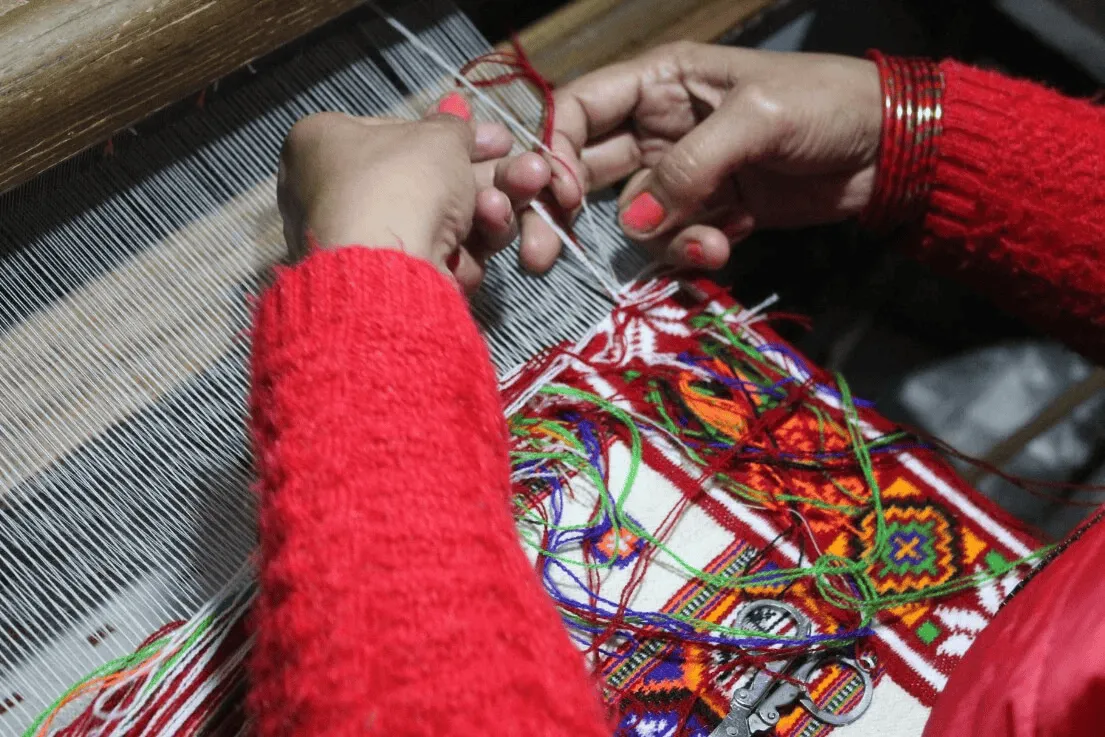
Process: The production process of Kinnauri Shawl weaving, as documented in the GI application, begins with raw material preparation. After sheep are sheared, the wool is washed, dried, and combed. During leisure periods, particularly winter months when agricultural work is not possible, families spin the wool on the takli (local spindle). The prepared yarn is then used by weavers on traditional looms. The GI application records that most weavers are women who receive dyed yarn from traders and carry out all pre-weave activities before weaving and delivering completed pieces on a piece-rate basis.
The GI application provides the following technical specifications for Kinnauri Shawl construction. The warp uses 2/48s woollen worsted yarn. The weft uses 2/32 or 2/48s woollen worsted, hand-spun Indian wool, pashmina, Angora (rabbit wool), or yak wool. The patterning uses 2/32s woollen worsted or acrylic yarn. The weave structure is 2/2 twill for the ground and weft rib in patterning. Standard dimensions are: ladies' shawl 1m by 2m; gents' shawl 1.25m by 2.5m; muffler 0.75m by 2m. Shawls woven in 2/48 count wool weigh between 360 and 390 grams for a ladies' shawl depending on yarn count and design.
The Gram Disha Trust field documentation provides a simplified account of the process as observed in the Pangna area: threads are sourced and laid out on the ground, patterns are chosen and adjusted into the loom and threads are transferred accordingly, the weaver weaves at regular intervals while incorporating geometric designs by hand, and the finished product is separated from the loom and cleaned before sale. The tapestry-woven border sections require the weaver to insert coloured weft threads by hand following a coloured graph of the design as a reference, using the dove-tailing or slit-tapestry technique, as documented in the D'Source IIT Bombay resource.
Mediums Used: The primary fibre used in Kinnauri Shawl weaving is wool, with several distinct varieties documented in the GI application. Local wool from sheep bred in Himachal Pradesh is available in natural white, black, grey, and brown and is used for the ground of the shawl. The application identifies two breeds of local sheep: the Desi breed, and a cross between Desi and Merino; the Desi breed's highest-quality wool from Kinnaur district is known as Bayangi, with a staple length of five to six inches. Merino wool (the warp is typically 2/48s woollen worsted) provides the ground structure of most commercial shawls.
Pashmina, the wool taken from the under belly of the pashmina goat available in Tibet, is used for finer and superfine quality shawls. The GI application records that pashmina shawls are sheer, light, and warm. Angora wool, from the Angora rabbit, is spun only on the takli spindle due to its fineness and is used in combination with Merino for the warp in Angora shawls, as the fibre cannot sustain the tension of a warp independently. Yak wool is also documented as a weft material in the GI application. Synthetic (acrylic or cashmelon) yarn is used for patterning in commercially produced shawls.
The looms used are of two types. The traditional pit loom (pitloom) is used for locally consumed shawls, with the weaver weaving two half-width pieces that are later joined at the centre with hand stitching. The fly shuttle frame loom is used for commercially produced shawls and is described in the GI application as simple in design, comprising a warp of longitudinal threads and a weft of horizontal threads, with a heald (thin wire or cord with an eye) guiding each warp thread.
New Outlook
The contemporary status of Kinnauri Shawl weaving is classified as vulnerable. The Gram Disha Trust's field documentation from the Pangna area of Himachal Pradesh notes that the craft is slowly dying out among the few remaining craftsmen due to unprofitable returns. The GI registration in October 2010 provided a legal framework to prevent unauthorised production and protect the geographical designation of the craft, but the structural economic challenges documented at the community level indicate that legal protection alone has not reversed the decline in practitioner numbers.
The Gaatha.org craft archive documents a significant cultural concern held by Kinnauri weavers: the migration of weavers from Rupa village to the Kullu valley in the 1830s, which introduced Kinnauri patterning techniques to Kullu, resulted in the commercialisation of those techniques without the participation of Kinnaur's artisan community. The archive records that Kinnaris refuse to sell their shawls and refuse to commercialise their heritage, positioning themselves in deliberate separation from the commercial market that adapted and scaled their design vocabulary. The GI application by contrast registers the shawl for commercial protection and market recognition, indicating a tension between community attitudes toward commercialisation and institutional efforts at craft promotion.
The GI application records 15,000 weavers and 10,000 looms in Reckong Peo and adjoining areas at the time of submission, indicating a substantial artisan population. Whether this figure reflects the current state of the craft is not documented in the sources available for this article. The Wikipedia article records that the GI registration prohibits unauthorised production with penalties of two lakh rupees or three years imprisonment. Contemporary producers including the Bhuttico cooperative distribute Kinnauri shawls and mufflers commercially, maintaining traditional motifs, colours, and weaving techniques on handlooms.
Learn Kinnauri Shawl


Bibliography
Text Sources
Aryan, Subashini, and R. K. Dutta Gupta. Crafts of Himachal Pradesh. Mapin Publishing, 1993.
Hedin, Sven. Trans-Himalayas. Publication details not available.
Handa, O. C. Textiles, Costumes and Ornaments of the Western Himalaya. Indus Publishing Company, 1998.
Himachal Pradesh Patent Information Centre, State Council for Science, Technology and Environment, and Kinnaur Handloom Weavers’ Association. Application for the Registration of Kinnauri Shawl under the Geographical Indications Act, 1999. Submitted to the Geographical Indications Registry Office, Chennai.
Patterson, Suzette R. Copley. “Weaving Traditions along the Wool Road in India.” Textile Society of America Symposium Proceedings, University of Nebraska Digital Commons, 2002.
Sharma, Vivek, and Suresh Anand. “Project Report on Study of Kinnauri Shawl.” Indian Institute of Handloom Technology, 1991–1992.
Internet Sources (for Images)
“Himachali Shawls — That’s Where We Got the Colors from for Our New Collection!” Lai Designs, 15 Mar. 2015, https://www.lai-designs.com/blogs/journal/himachali-shawls-thats-where-we-got-the-colors-from-for-our-new-collection. Accessed on April 24, 2026.
“Kinnauri Shawl: A Simple Guide — Meaning, Colors, Patterns, and Importance.” Bhuttico Shawls, 19 Nov. 2025, https://bhutticoshawls.com/blogs/culture/kinnauri-shawl-a-simple-guide-meaning-colors-patterns-and-importance. Accessed on April 24, 2026.
“Kinnauri Shawl: Himalayan Handloom Legacy Woven in Time.” Krafteria, 22 Jan. 2026, https://krafteria.com/blogs/news/kinnauri-shawl-himalayan-handloom-legacy-woven-in-time. Accessed on April 24, 2026.
“Kinnauri Shawls.” Proudly Made in India, https://proudlymadeinindia.com/kinnauri-shawls/. Accessed on April 24, 2026.