

Kutch Pottery/ Khavda - The Handicraft Tradition of Gujarat
Explore Khavda Pottery, the handicraft tradition of Gujarat, and learn about its origins, techniques, cultural significance, and artistic heritage.
Introduction
Khavda pottery is a traditional wheel-thrown and hand-painted earthenware craft produced in and around the village of Khavda in the Kutch district of Gujarat, India. It is characterised by a distinctive reddish-brown surface, achieved through immersion in geru (red ochre soil), and decorated with geometric and naturalistic designs in black and white natural pigments. The craft is practiced by Muslim Kumbhar families who trace their lineage to potters who migrated from Sindh several generations ago, and it represents one of the most geographically specific and socially concentrated surviving pottery traditions in western India.
Etymology: The name Khavda pottery derives directly from the village of Khavda, located in northern Kutch, Gujarat. The village name itself appears in administrative records from the early period of Jadeja rule: the Wikipedia entry on Khavda records that the area came into possession of the Raos of Cutch State through an agreement involving Rao Desalji I (ruling 1718 to 1741). Khavda is alternately spelled Khavda, Khavada, or Havda in different sources, with Khavda being the most consistent official usage in government and institutional documentation.
The craft is referred to as Khavda pottery or Kutch pottery in most institutional and media documentation and does not carry a distinct vernacular craft name beyond the village designation. The activity of pottery making is referred to by practitioners using the local term ghadai, as documented in the India Fellow field account. The potters' wheel is called a chakda and the firing kiln is called a bhatti, as consistently documented across the Khamir institutional page, the India Fellow account, and the iTokri record.
Origin: Khavda pottery does not have a precisely dated founding event or a single documented founding practitioner. The Gaatha.org field documentation explicitly states that there is very little information on the history of Khavda in particular, while acknowledging Kutch's broader place in documented regional history.
The archaeological association most consistently cited across sources is with the Harappan city of Dholavira, located approximately one hour from Khavda on the island of Khadir Bet in the Great Rann of Kutch. Dholavira was identified officially by archaeologist Jagat Pati Joshi of the Archaeological Survey of India in 1967 or 1968, and has been under systematic excavation by the ASI since 1990. UNESCO inscribed Dholavira as a World Heritage Site in 2021 under the designation "Dholavira: A Harappan City." The site's pottery assemblage, as documented in the ASI's excavation reports and discussed in the Vajiram and Ravi archaeological summary based on ASI findings, includes black on red ware pottery, red ware, and buff ware pottery, with the black-on-red type being particularly noted for painted geometric decoration.
The Gaatha.org and Magik India documentation cite surface similarities between the black drawings on red backgrounds found at Dholavira and the painted decoration characteristic of Khavda pottery today. The Magik India source notes that more than a hundred potters' wheels were reportedly found at Dholavira, a detail indicating the scale of pottery production at that Harappan urban site. These observations, while made by institutional sources, do not constitute a directly evidenced continuity of production lineage between Dholavira and present-day Khavda pottery. No published peer-reviewed study has established a demonstrable genealogical connection between the Harappan ceramicists of Dholavira and the Muslim Kumbhar families currently practicing the craft. The Gaatha.org documentation describes the proposed relationship as a possibility given stylistic and geographical proximity, not an established fact.
What can be documented with more certainty is the presence of pottery activity in the Khavda taluka through archaeological surface evidence: the Gaatha.org documentation cites evidence of early historical pottery from Nani Rayan in Gunthri Gadh, in the Khavda taluka, dating to the 1st century CE. The current Kumbhar practitioners trace the arrival of their families to a migration from Sindh, with iTokri and The Better India both recording Abdulla Kumbhar's account that his forefathers migrated from Sindh several hundred years ago.
Location: Khavda is a village in Bhuj Taluka of Kutch district, Gujarat, located approximately 70 to 80 kilometres from Bhuj, the district headquarters. It lies near the western edge of the Great Rann of Kutch, and its geography is shaped by a largely saline, arid environment. The Gaatha.org documentation gives the village's coordinates as approximately 23.85 degrees North and 69.72 degrees East, with a total land area of 774.35 hectares and an average elevation of one metre.
Khavda pottery production has historically also been concentrated in nearby villages. The 30 Stades account identifies Khavda, Lodai, and Tuna as formerly active pottery hubs in the Rann of Kutch region. The Khamir institutional documentation lists artisan clusters in Lodai, Khavda, and Gundiyali as the three pottery-producing localities with which it works directly. Lodai village is documented as approximately 35 kilometres from Bhuj, as noted in the 30 Stades article's profile of Ismailbhai Husain.
The clay source used by Khavda potters is specific to a lake area near the village. All practitioner accounts and institutional sources consistently identify this clay by the name Rann ki Mitti (clay of the Rann), collected from a specific lakeside location near Khavda village. The particularity of this clay source is a recurring element in practitioner testimony.
Community: The practising community of Khavda pottery belongs to the Kumbhar caste, the traditional Indian potter community. What distinguishes the Khavda potters from most other Kumbhar communities in India is their Muslim religious identity and their family accounts of descent from Sindhi migrants. The India Fellow field account states that the potters of Khavda, Bhuj, are Muslims and believe their forefathers migrated from Sindh several hundred years ago. The Magik India documentation describes the family of Abdulla Kumbhar as kumbhars from Sindh (present-day Pakistan), who have been practicing the craft for generations.
The population of Khavda village is documented by the Gaatha.org source as consisting largely of Meghwal Hindus and Muslims who migrated to Kutch from Sindh several years ago, with a total population of 4,062 as per the 2011 Census of India. The village has 885 families and a literacy rate of 52.45 percent, significantly below the Gujarat state average of 78.03 percent.
At the time of reporting by multiple sources including The Better India (2017), iTokri, and India Fellow, only two families continued to actively practice Khavda pottery, reduced from approximately ten families who had practiced it in prior years. The primary practitioners documented by name across these sources are Abdulla Kumbhar (also referred to as Abdulbhai or Abdul bhai) and his wife Rahima Behn, and separately Ismailbhai Husain of Lodai village. The family of Abdulla Kumbhar is documented as one of the two remaining active households. The India Fellow account records that Abdulbhai's mother Saraben is regarded as one of the best pottery painters in Kutch and received the Devi Ahilya National Award from the Government of Madhya Pradesh in 2001-2002 for her work in the clay craft of Kutch.
The production of Khavda pottery follows a documented gender division: men carry out the throwing on the potter's wheel (ghadai), while women are responsible for all surface decoration and painting. The Magik India source states that women are not normally allowed to model objects on the potter's wheel, though the India Fellow account notes that in the Abdulbhai household, Rahimaben and Saraben also participate in throwing. This household-level variation from the normative gendered practice is documented as an exception.
History
Background: The history of pottery making in the Kutch region extends to the earliest phases of the Harappan civilisation, which occupied Dholavira in the Great Rann of Kutch during a period dated by the ASI and referenced in the Grokipedia Khavda entry as running from approximately 3500 BCE through 1800 BCE across seven occupation stages. The Dholavira pottery assemblage, as described in ASI excavation documentation, includes classical Harappan ceramic types such as black on red ware, red ware, and buff ware. The black on red ware type, with its geometric decoration applied in black over a red ground, is the archaeological form to which institutional sources draw stylistic parallels with current Khavda pottery.
The civilisation's decline in the late Harappan phase, attributed by the Grokipedia Khavda source to climatic aridification and shifts in the Indus river system around 1500 BCE, led to the abandonment of peripheral sites, though the same source notes that elements of pottery techniques persisted and influenced later traditions in the region. The Grokipedia source documents the later settlement of Khavda as connected to the arrival of nomadic pastoral communities, including the Rabari and Ahir, from Sindh over subsequent centuries.
By the early eighteenth century, Khavda came under the control of the Jadeja dynasty, rulers of the princely state of Kutch, under Rao Desalji I (ruling 1718 to 1741), as documented in both the Grokipedia Khavda entry and the Wikipedia Khavda article. The Gaatha.org documentation records that in 1775, Sarfaraz Khan, son of Ghulam Shah of Sindh, passed through Khavda en route to Bhuj, indicating the village's role on regional travel and trade routes. The 1880 Gazetteer of the Bombay Presidency is cited by the Grokipedia source as referencing Khavda's status as part of the northern Banni region, describing it as a mahal (administrative division) within the Kutch state. The village's population was 1,720 in 1961 as per the same source. The Muslim Kumbhar potters who currently practice Khavda pottery trace their family origins to migration from Sindh. The exact date or historical episode of this migration is not documented in available sources, with practitioner accounts consistently using the formulation "several hundred years ago" as reported by iTokri and The Better India. No archival or administrative record pinning a specific date to this migration has been identified in the sources available.
The devastating 2001 Gujarat earthquake, with its epicentre in Kutch, disrupted artisan livelihoods and craft production across the district. Khamir was established in 2005 specifically to address the aftermath of this disruption and support revival of regional craft traditions including pottery.
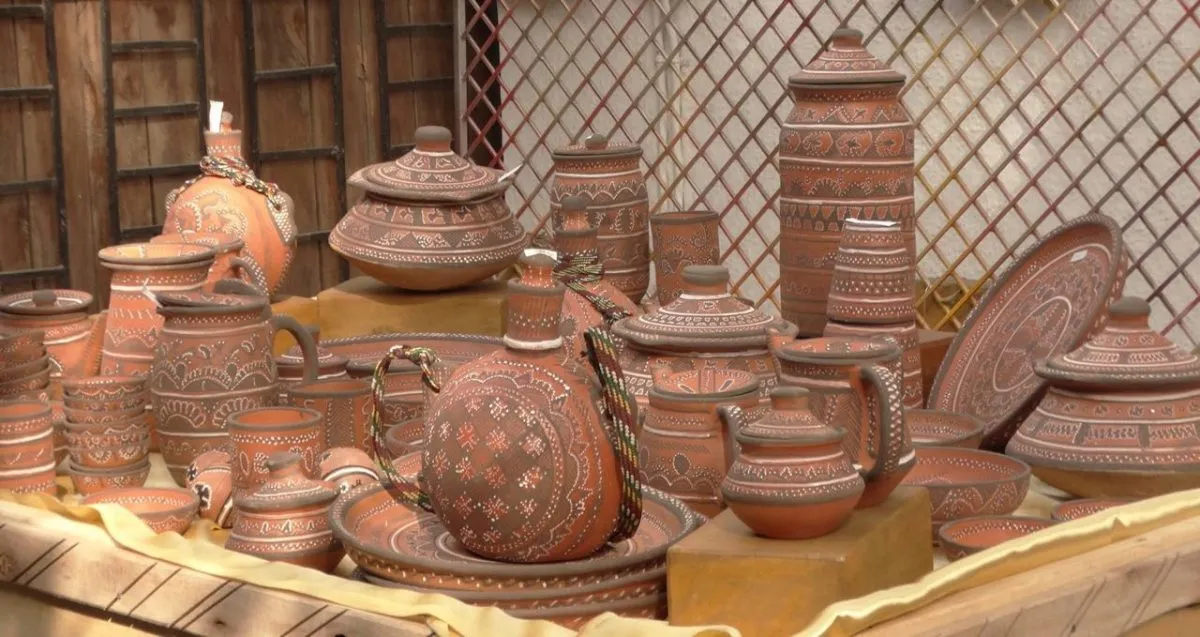
Culture and Societies: Khavda pottery has historically served a primarily functional role within the communities of the Rann of Kutch region. The documented range of traditional vessel forms includes the matka (water storage pot), ketli (tea vessel), kulhada or kulada (buttermilk container), plates, diyas (lamps), boxes, surahi (water jug), and tapla, sanak, and takab (vessels named in the India Fellow account). These objects represent the domestic material culture of the Maldhari pastoral communities of the Banni grasslands, as referenced in The Better India account, which notes that Maldharis formerly stored drinking water in clay pots and flasks to keep the water cool.
The 30 Stades account documents that before the COVID-19 pandemic, tourism to the White Rann of Kutch and associated craft fairs and exhibitions generated supplementary income for potters. The Rann Utsav festival, a large annual cultural event organised in the Rann of Kutch, is referenced in multiple sources as a significant market context for Khavda pottery and other Kutch crafts.
Khavda pottery is documented as one of several craft traditions concentrated in the Khavda area. The Gaatha.org field documentation notes that Khavda is known for pottery, leather, and ajrakh block printing. The ajrakh block-printing community of Khavda is documented in the eSamskriti account of Abdul Pottery as a separate artisan presence within the same village, represented by practitioners Bilal Bhai and Faruk.
Religious Significance: No documented religious association specific to Khavda pottery as a craft practice has been identified in the sources consulted. The craft's production context is secular and functional: vessels are made for domestic water storage, food preparation, serving, and household use, alongside decorative and souvenir production for tourist and craft markets. The India Fellow and Strings of Heritage accounts make no reference to religious function or ceremonial use of Khavda pottery within the practitioner community's Muslim faith.
The Gaatha.org documentation notes that in other pottery traditions of the Indus Valley Civilisation context, terracotta objects including small figurines and ritual items were produced, and that similarities between Harappan pottery and Kutch pottery have been traced from rituals and customs still followed by some communities in the region. However, no specific ritual or ceremonial use of Khavda pottery by current practitioners is documented in available sources. The craft is therefore treated in available documentation as having no established religious significance in its contemporary practice.
Understanding the Art
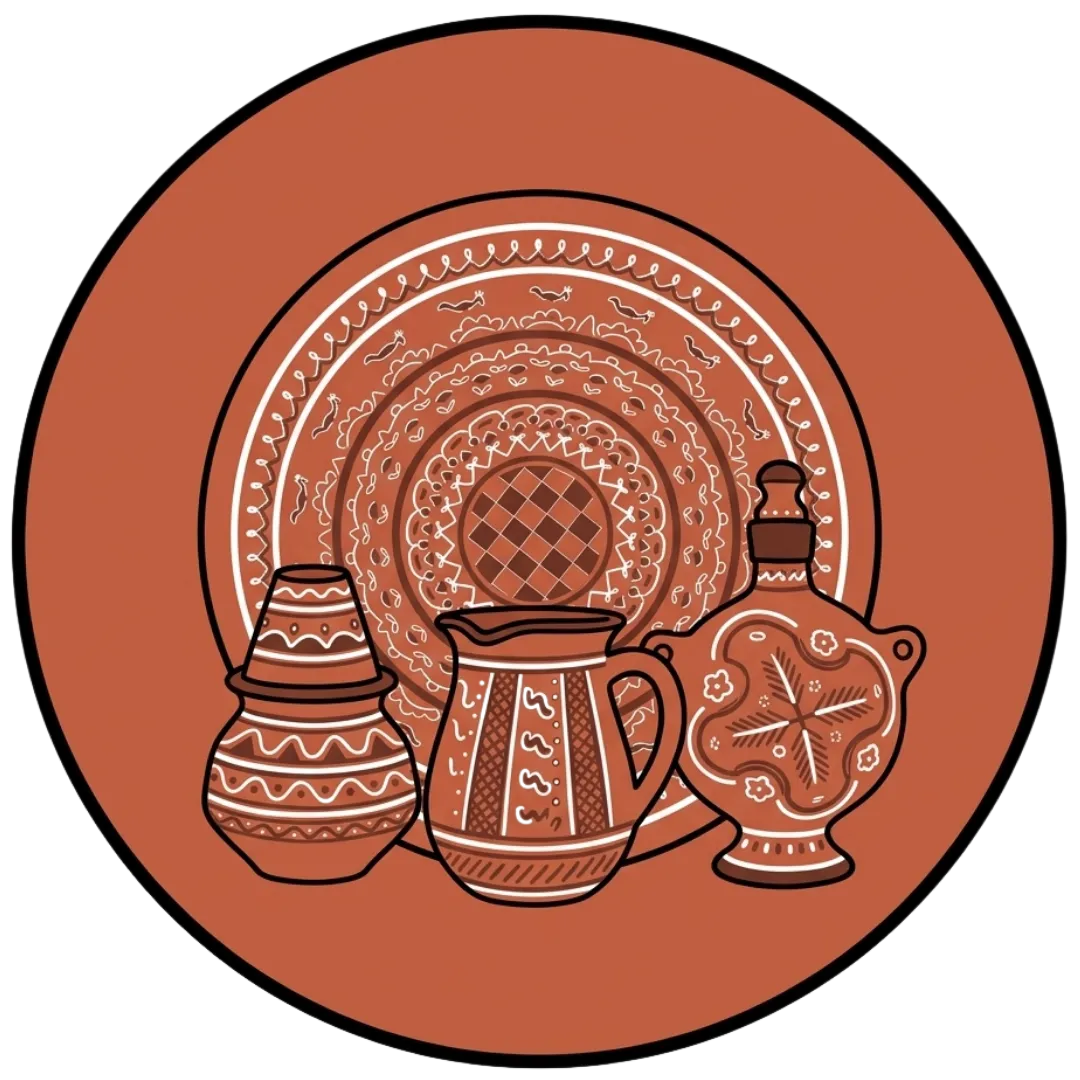
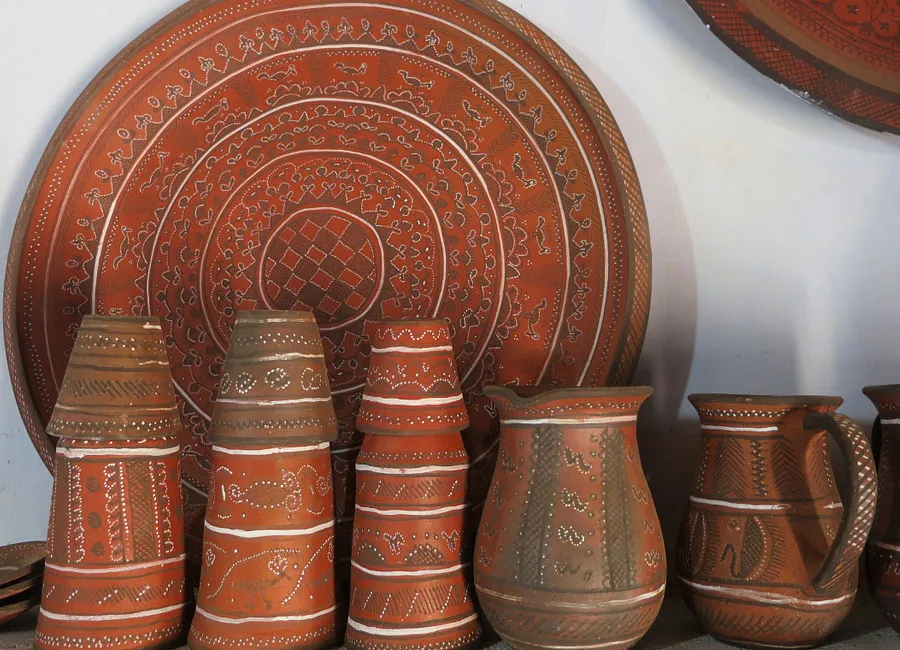
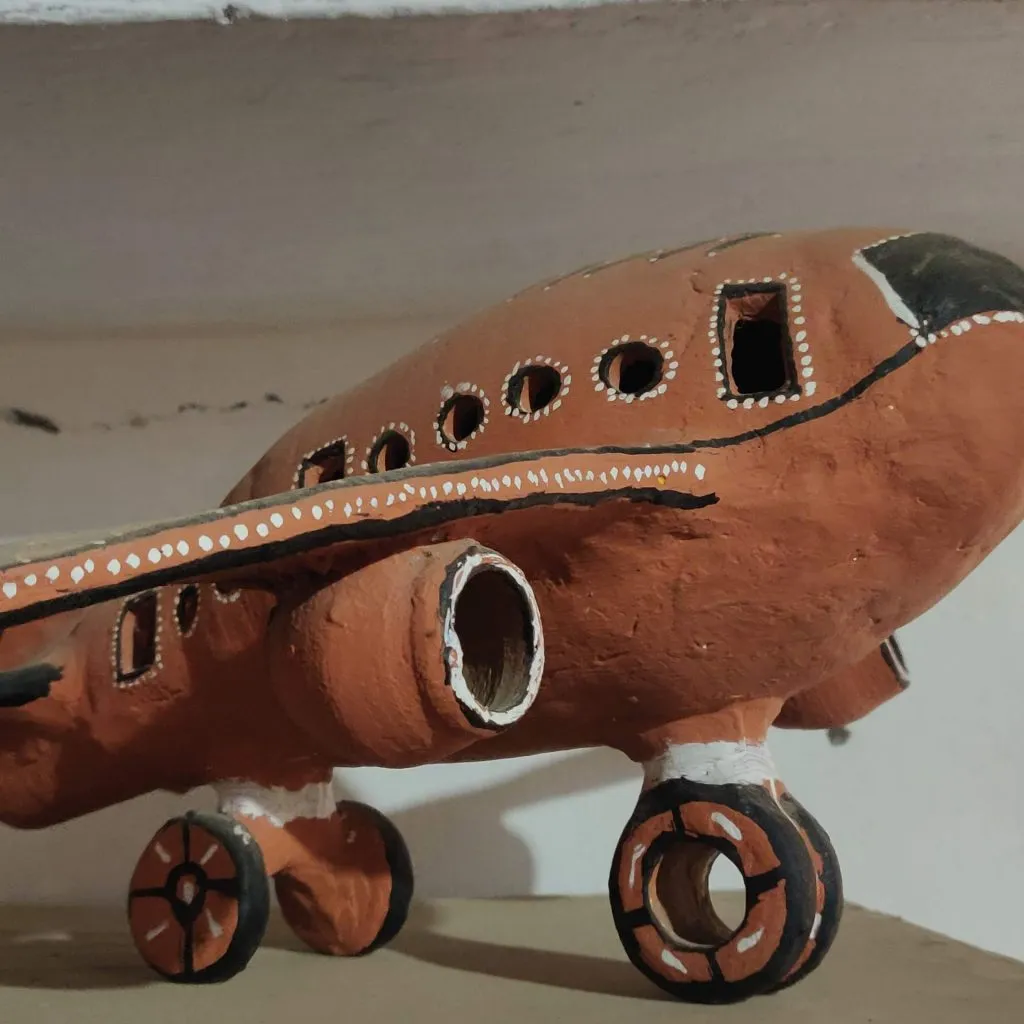
Style: Khavda pottery is immediately identifiable by its reddish-brown ground colour and its painted surface decoration in black and white. The Prosperity Mirra institutional page describes the overall appearance as rustic with a high degree of surface decoration. The characteristic reddish-brown colour is not a clay glaze but a pre-firing immersion treatment using geru, a natural red ochre soil dissolved in water. This is applied before firing, not after, giving the ground colour its matte, earthy quality distinct from glazed ceramics.
The surface decoration is applied over the geru-coated, unfired surface. The Magik India documentation describes the designs as generally abstract and geometric in character, with animal figures (cows, fish), floral motifs, and stylised characters also present. The defining visual feature of Khavda pottery that distinguishes it from other Indian regional pottery is the use of dotted lines rather than solid lines for the depicted forms. The Gaatha.org documentation states that the silhouettes of designs are dotted by paint, so that from a distance, the meaning of a design is not immediately apparent, making it distinctive among Indian ceramic traditions.
The Strings of Heritage account provides the most precise description of the pigment preparation. The black colour is obtained by pounding the stone geru and leaving it in water to create a dark, reddish-black mixture. The white colour is derived from khari mitti, a fine local soil dissolved in water. Additional red and yellow clay-based paints are also documented by the Prosperity Mirra source.
Object forms produced include matka, plates, diyas, bottles, glasses, cups, mugs, bowls, surahi in various forms including a surahi shaped like a donut as documented in the Prosperity Mirra source, and hand-held items. Contemporary forms developed in collaboration with Khamir and design institutions include lamp shades, grills, tiles, and acoustic amplifiers for mobile phones.
Central Motifs and Their Significance: The motif vocabulary of Khavda pottery is drawn from the natural environment of the Rann of Kutch region and from the decorative traditions of the community. The Gaatha.org documentation identifies the primary design categories as waves, flowers, leaves, birds, and fish, all rendered in the signature dotted-line technique. The Magik India source adds cows and stylised characters to the documented repertoire. The Strings of Heritage account records, from direct interaction with practitioner Rahima Behn, that individual artisans also draw from personal observation of nature, with scorpions and flowers given as examples of spontaneous design choices.
No fixed iconographic canon or symbolism attached to specific motifs in Khavda pottery has been documented in the available literature. The designs are described by practitioners as drawn from imagination and observation of the natural surroundings, rather than from a codified system of symbolic meaning. The Khamir documentation describes the designs as community-specific, indicating that the visual vocabulary is a shared tradition within the Kumbhar community of Khavda, but no formal analysis of the motif system's symbolic content has been published in available institutional or academic sources.
Process: The process of making Khavda pottery is consistently documented across multiple sources including Khamir, 30 Stades, Magik India, iTokri, Gaatha.org, and Strings of Heritage and proceeds as follows.
The first stage is clay collection and preparation. Clay called Rann ki Mitti is collected from a specific lakeside area near Khavda village, transported to the village by tractor or donkey cart as documented by Khamir, and then processed. The Khamir documentation describes the clay being beaten into fine powder, then mixed with water and kneaded into an elastic dough. The 30 Stades account describes the clay being pounded and sifted to obtain very fine clay, mixed with the correct proportion of water, and left for twelve hours before a second kneading to remove air pockets. The Gaatha.org documentation gives the soaking period as two to three days for the most thorough softening.
The second stage is throwing on the potter's wheel. Men throw the prepared clay on a chakda, the traditional Kutch potter's wheel, shaping it into the required forms. A thread or dhaaga is used to slice the base of the finished pot from the wheel, as described in the India Fellow account. The third stage is drying. Formed vessels are left to dry in the shade, not in direct sun, to prevent cracking. Once partially dried, surfaces are buffed with sandpaper to achieve a smoother finish, as documented by Prosperity Mirra and 30 Stades.
The fourth stage is geru application. Dried, unfired vessels are immersed in a mixture of geru soil dissolved in water, which gives the pottery its characteristic reddish-brown ground colour. All sources, including Khamir, Magik India, Strings of Heritage, 30 Stades, and iTokri, uniformly document this as a pre-firing immersion in the geru solution.
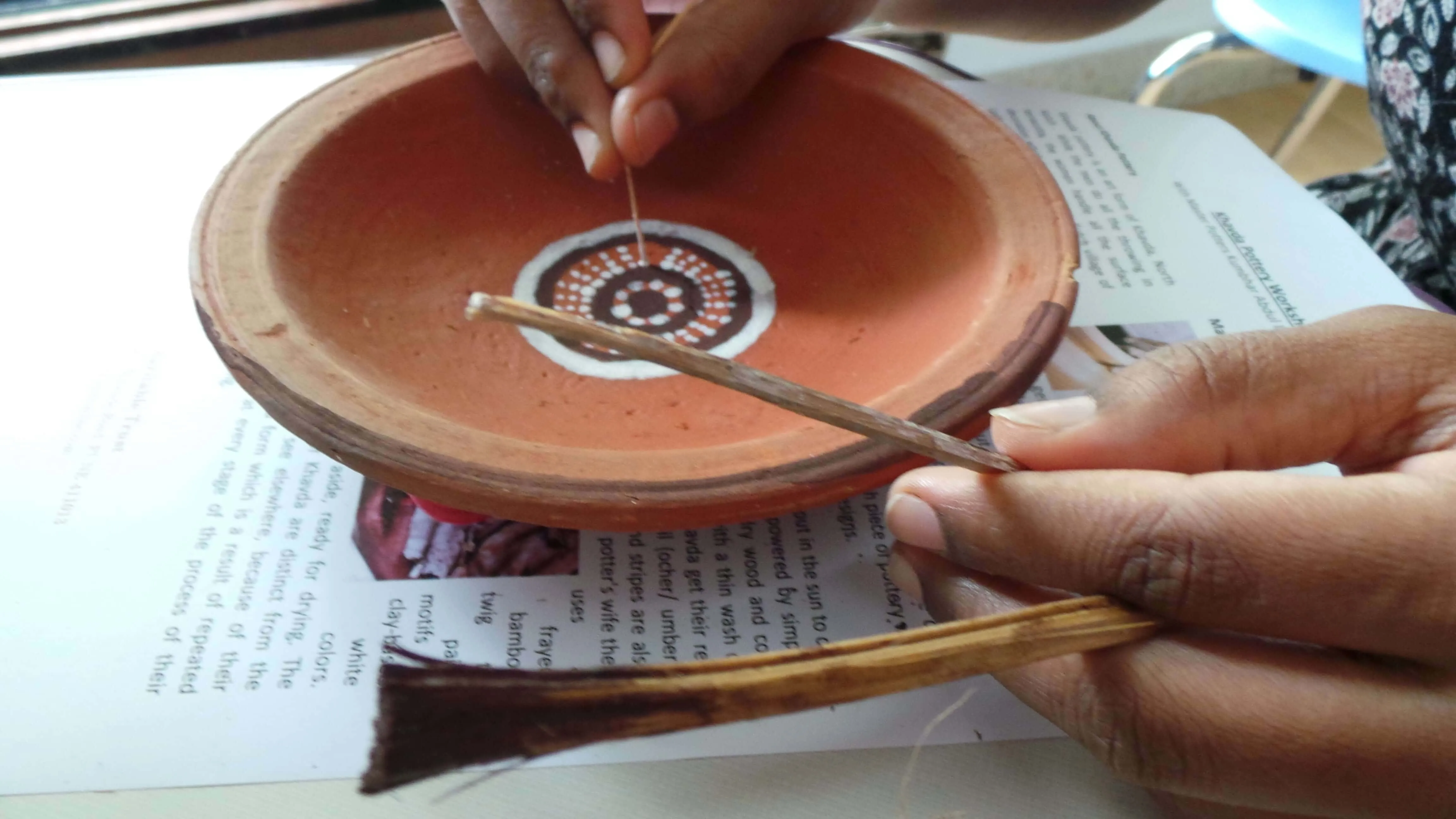
The fifth stage is firing in the bhatti (kiln). The geru-coated vessels are fired using dry wood and cow dung as fuel. The bhatti is described in the India Fellow account as a kiln built from locally available materials. Not all objects survive this stage: the Gaatha.org documentation notes that pieces may crack, break, or explode due to air pockets, uneven drying, or temperature fluctuations. The sixth stage is painting. Women apply the black and white painted decoration to the fired, geru-coated vessels. The black pigment is prepared from ground black stone, as documented by Prosperity Mirra, or by pounding geru stone and dissolving it in water to produce a darker mixture, as described in the Strings of Heritage account. The white pigment comes from khari mitti, a fine local soil dissolved in water, as documented by Strings of Heritage. A bamboo twig is used as a painting implement, as observed in the Magik India account. The designs are applied in the characteristic dotted-line technique rather than solid strokes.
Mediums Used: The primary material of Khavda pottery is Rann ki Mitti, the clay collected from lakeside deposits near Khavda village. This clay is used without documented mineral additives, relying on its natural properties for plasticity and structural integrity. Geru, a natural red ochre soil, is used in dissolved form as a pre-firing surface wash. Black pigment is derived from ground black stone or a form of processed geru. White pigment is derived from khari mitti, a fine white soil. Dry wood and cow dung are the standard fuels for the bhatti kiln. Sandpaper is used in the smoothing stage after initial drying. Bamboo twigs function as the primary painting implement. All pigments and raw materials are natural and locally sourced, with no documented use of synthetic colours or industrial materials in traditional Khavda pottery production.
New Outlook
Khavda pottery faces severe and well-documented threats to its survival. At the time of reporting by The Better India (2017), only two families out of approximately ten who formerly practiced the craft remained active. The 30 Stades account (2021) characterises the situation as pressing, attributing the decline to loss of demand against mass-produced plastic, steel, and aluminium vessels, competition from industrially manufactured ceramics and bone china, loss of land from which clay is sourced due to industrial and agricultural encroachment, the collapse of tourism-based sales during the COVID-19 pandemic, and the disinclination of younger generations to continue the craft.
Khamir has worked directly with potters in Khavda, Lodai, and Gundiyali since its founding. Its documented interventions include workshops facilitated by external ceramicists, notably a workshop with Rakhi Kane of Auroville to develop clay tiles, and a 2013 partnership with the Ceramic Center, Baroda, to address issues of pottery clusters across Kutch. Khamir has also fostered collaborations with the Indian Institute of Crafts and Design (IICD), Jaipur, leading to the development of new product forms including lamp shades and grills. An exhibition organised by the British Ceramics Biennial titled "Stroke on-Trent" featured architectural pottery products produced through these collaborations, as documented by Khamir. Abdulbhai's engagement with the National Institute of Design, Ahmedabad, as a pottery teacher, and participation in consumer workshops in Pune organised by the Heart for Art Public Charitable Trust, represent further channels through which the craft has been introduced to urban audiences.
The development of novel object forms, including an acoustic phone amplifier made from clay and sold commercially, represents the most documented instance of design-led product innovation specific to Khavda pottery. These efforts are ongoing and have extended the range of objects produced beyond traditional domestic vessels to include decorative and contemporary utility items, though the core practitioners remain very few in number.
Learn Khavda Pottery
Bibliography
Text Sources
Burgess, James. Report on the Antiquities of Kutch and Kathiawar: Being the Result of the Second Season's Operations of the Archaeological Survey of Western India, 1874–75. 1876. Reprint, Jam Shoro, Sindh, 1991.
Edwards, Eiluned. Textiles and Dress of Gujarat. Mapin Publishing and V&A Publishing, 2011.
Elson, Vickie C. Dowries from Kutch: A Women's Folk Art Tradition in India. Museum of Cultural History, University of California, Los Angeles, 1979.
Frater, Judy. Threads of Identity: Embroidery and Adornment of the Nomadic Rabaris. Mapin Publishing, 1995.
Mirza, Viloo, and Vinutha Mallya. Handloom and Handicrafts of Gujarat. Mapin Publishing.
Internet Sources (for Images)
“Khavda Pottery.” Divya Blogs, https://divya.lovestoblog.com/?p=240. Accessed on April 24, 2026.
“Khavda Pottery from the Indus Valley.” Strings of Heritage, 17 July 2017, https://www.stringsofheritage.com/khavda-pottery-from-the-indus-valley/. Accessed on April 24, 2026.
“Khavda Pottery, Kutch, Gujarat.” Gaatha: Craft of India, https://gaatha.org/Craft-of-India/khavda-pottery-kutch-gujarat/. Accessed on April 24, 2026.
“Khavda Pottery.” Divya Blogs, https://divya.lovestoblog.com/?p=240. Accessed on April 24, 2026.