


Kavad Art - The Handicraft Tradition of Rajasthan
Explore Kavad, the handicraft tradition of Rajasthan, and learn about its origins, techniques, cultural significance, and artistic heritage.
Introduction
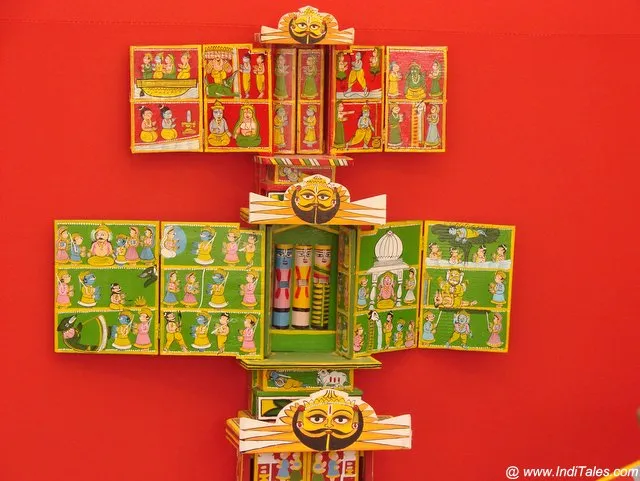
Kavad art is a traditional form of painted portable wooden shrine originating from Bassi village in Chittorgarh district, Rajasthan. The kavad functions as both a storytelling device and a temporary mobile temple, with multiple hinged panels that open sequentially to reveal visual narratives of Hindu deities, saints, genealogical histories, and mythological episodes. The tradition integrates the skills of carpentry, painting, and oral narration into a single ceremonial performance called kavad banchana.
Etymology The word kavad most likely derives from the Sanskrit terms kavaat, kapaat, or kivaad, meaning 'half a door' or 'panel of a door.' This derivation reflects the object's defining structural feature: a series of folding panels that open and close like doors. An alternative folk etymology links the term to the concept of 'carrying on the shoulders,' connecting it to the mythology of Shravan Kumar, to whom the kavadiya bhats trace their lineage. As recorded by the MAP Academy Encyclopedia of Art, the Sanskrit derivation is the more widely accepted scholarly position.
Origin The kavad tradition is documented as approximately 400 years old based on analysis of artisan lineages, though its oral origins may predate written records. Multiple sources, including documentation by Dastkari Haat Samiti and the craft research archive Gaatha, place the formal tradition in the 16th to 17th centuries. One account, cited by Inditales, suggests the Suthar community of Bassi was brought to the region from Nagaur in Shekhawati by Prince Jaimal of Devgarh sometime in the 16th century. Since worn or broken kavads were traditionally immersed in Pushkar Lake by the kavadiya bhats, no physical examples predating recent centuries have survived. Some scholars suggest the popularity of kavads expanded after the Bhakti movement of the 15th century, given the prominence of Bhakti saints such as Mirabai, Kabir, and Ravidas in the painted narratives.
Location The practice of kavad-making is exclusively concentrated in Bassi village, located in Chittorgarh district, Rajasthan, on the Chittor-Kota road in the Mewar region. Bassi is situated approximately 236 kilometres from Jaipur. The kavadiya bhats who use the kavads for storytelling travel from this base across Rajasthan and, historically, to other parts of northern India.
Community Three communities are central to the kavad tradition. The Suthar community of Bassi makes the kavads, combining carpentry and painting in a single artisan role. Suthars use the surname Suthar, and some add Jangid to signify descent from Vishwakarma, the divine architect of Hindu mythology and patron deity of craftspeople. The kavadiya bhats, also called bhanwar bhats, are the hereditary storytellers who carry and narrate the kavads. They trace their lineage to the mythological figure Shravan Kumar. The jajmans are the hereditary patrons whose family histories are preserved in the painted panels and to whose homes the kavadiya bhats travel to perform.
Relevance The kavad tradition integrates oral genealogy, religious storytelling, and visual art into a single functioning system of cultural transmission. As documented by Dastkari Haat Samiti and the MAP Academy, kavads served a social function for communities who could not undertake physical pilgrimages, bringing the deity directly to the patron's home. The kavadiya bhat role also served as an early records-keeping institution, preserving family histories and community narratives across generations. In the contemporary period, the craft faces significant decline owing to reduced patronage for oral storytelling and competition from other media. Satyanarayan Suthar of Bassi won the National Award in 2014 for kavad-making, and the tradition has been documented by filmmaker and animator Nina Sabnani, among others.
History
Background The kavad tradition is estimated to be approximately 400 years old based on genealogical records of the Suthar artisan community. The Gaatha craft research archive notes that precise origins are difficult to chart due to the tradition's deep association with mythology, which obscures historical chronology. The Suthar community, as hereditary carpenters and painters, produced kavads for the kavadiya bhats, who in turn maintained relationships with jajman families across multiple generations. The practice of immersing worn kavads in Pushkar Lake means that no historical examples from before the modern period are known to survive.
Culture and Societies The kavad tradition functioned within a three-part social structure involving makers, narrators, and patrons. The kavadiya bhats inherited their patron families, ensuring that storytelling relationships were sustained across generations. The tradition served both religious communities seeking mythological narration and aristocratic families wishing to commission records of their genealogies. Jaya Jaitly, writing for Dastkari Haat Samiti, has documented how the jajmans were historically drawn from local nobility and landholding communities. The kavadiya bhats would travel to patron homes, perform the narration by sequentially opening the kavad panels, accept dakshina (payment), and carry the tradition to the next household. As documented by Inditales, at the base of the kavad there is a donation chamber with two receptacles: one directed toward a patron saint, Kundana Bai, for cow welfare, and one toward the bhats themselves.
Religious Significance The kavad has established and documented religious significance. The object functions as a portable shrine and is treated as sacred during the performance. The panels contain images of Hindu deities including Ram, Sita, Laxman, Krishna, Durga, and Ganesha, as well as Bhakti saints and regional heroes. The top of the kavad traditionally bears an image of Surya, the sun god. The structural architecture of the kavad mirrors temple design: successive thresholds of doorways lead inward toward an inner sanctum, reflecting the spatial organisation of Hindu sacred architecture. The ritual context of kavad banchana was specifically developed for those unable to undertake pilgrimages, making the kavad a devotional substitute for physical temple visits. The kavadiya bhats' mythological descent from Shravan Kumar, who is venerated for filial devotion, further embeds the tradition within a religious framework.
Understanding the Art
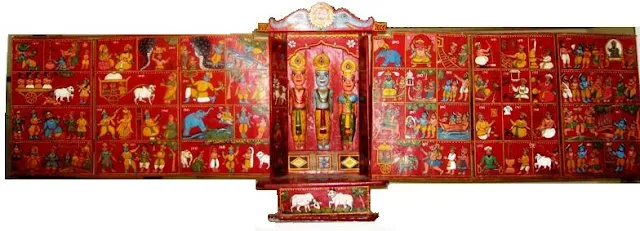
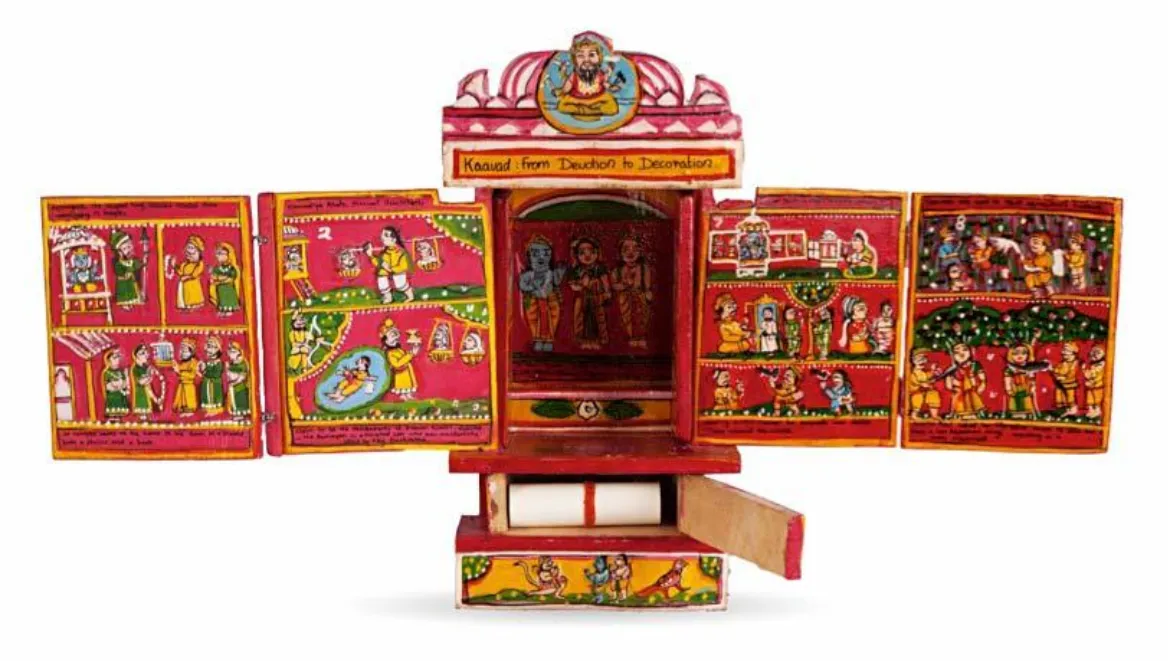
Style The kavad is a three-dimensional painted wooden object composed of multiple hinged panels arranged around a central inner sanctum. A standard kavad is approximately 12 inches in height and consists of 10 to 16 panels depending on the narrative scope. Larger kavads may reach 2.5 feet in height. The structure resembles a closed shrine or cupboard when folded; when opened, the sequence of panels creates a linear narrative path that the storyteller follows during performance. Traditionally, the base colour was deep red, though contemporary kavads are produced in a wider range of colours to suit different markets. Figures are rendered in a flat, iconic style consistent with Rajasthani folk painting traditions.
Central Motifs and Their Significance The panels of a kavad typically depict episodes from the Hindu epics, particularly the Ramayana and Mahabharata, as well as stories of Krishna, devotional saints of the Bhakti movement, and the genealogies of patron families. Scenes documented by Gaatha include Krishna stealing the garments of gopis, episodes from the Holika legend, devotees such as Kabir and Ravidas, and narratives concerning temple pilgrimages such as Badrinath. Regional heroes and deities also appear. The final inner panel of a traditional kavad reveals the image of Ram, Sita, and Laxman, serving as the culminating devotional revelation of the performance. Surya with a moustache appears at the apex. The donation chamber at the base is a functional component, not merely decorative.
Process The construction of a kavad begins with the Suthar selecting low-density wood from species such as mango, semal (silk cotton), adulsa, or neem. The artisan measures, saws, drills, joins, and smooths the wood to create the multi-panel hinged structure. Metal hinges secure the panels, which are arranged on wooden pivots. Once the individual components are prepared, they are painted before final assembly. For large kavads, the artisan first applies a base coat, then outlines the figures in pencil or charcoal before painting. For smaller kavads, the figure painting may proceed without a preliminary outline. Mineral-based pigments mixed with tree resin have been the traditional colour medium; more recently, poster colours have been adopted. The colour sequence proceeds systematically: each colour is applied across all relevant areas before the next colour is introduced. Black outlines are applied last, defining figure contours and adding details. A final coat of varnish finishes the piece. Women in the household traditionally assist with colour mixing and flat colour filling.
Mediums Used Wood: Mango, semal (Bombax ceiba), adulsa, and neem are the documented species used. These low-density woods are locally available in the Chittorgarh region. Pigments: Mineral-derived powders mixed with tree resin (gum) constitute the traditional colour medium. The palette consists of white, red, blue, yellow, green, and black. Some artisans use a base layer of khaddi, a fine soil from the Bhilwara region, as a painting ground. Hardware: Metal hinges and wooden pivots are used to secure the panels.
New Outlook
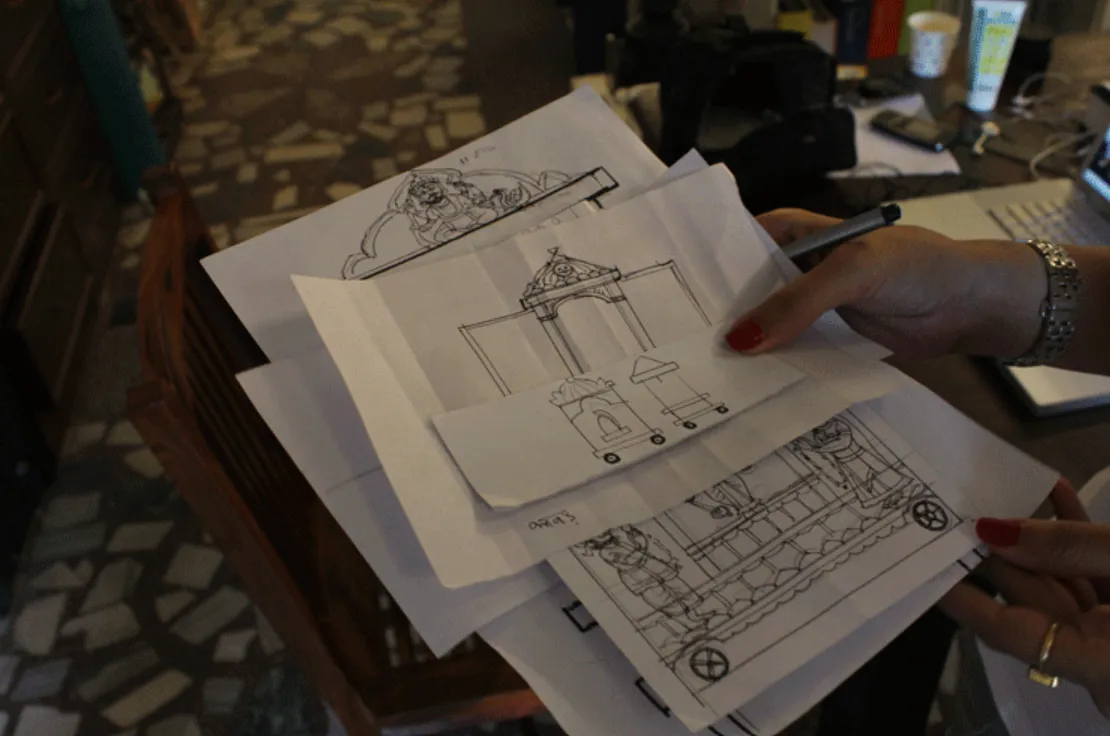
The kavad tradition faces serious pressures from declining oral storytelling patronage and changing social structures. The kavadiya bhats' traditional circuit of jajman households has contracted significantly, reducing the primary economic base for the craft. Artisans in Bassi have adapted by repositioning kavads as decorative objects, toys, and souvenir items for the tourist and export markets. Contemporary kavad-makers including Mangilal Mistri have introduced non-traditional content such as civic awareness and government programme messaging to expand the relevance of the format. The animator Nina Sabnani has produced documentary films on the kavad tradition. Artist Akshay Gandhi's Kavad Project represents an attempt to adapt the narrative format for contemporary contexts. Educational institutions have also commissioned kavads as teaching tools for children. Despite these adaptations, formal institutional support remains limited, and the number of active kavad-making families in Bassi has declined.
Learn Kavad
Bibliography
Sources
Gaatha. “Kaavad, Bassi: Craft Archive Research on Indian Handicrafts and Handloom.” Gaatha, https://gaatha.org/
Jaitly, Jaya, and Aloka Hiremath. Kavad Art. Google Arts & Culture, 2017, https://artsandculture.google.com/
MAP Academy. “Kavad Mobile Shrines.” MAP Academy Encyclopedia of Art, c. 2021, https://mapacademy.io/
Image Sources
Delhi Magic. “Have You Ever Seen a Kavad? I Saw One in Udaipur.” Delhi Magic Blog, 2009, https://delhimagic.blogspot.com/2009/09/have-you-ever-seen-kavad-i-saw-one-in.html. Accessed on May 04, 2026.
Goyal, Anuradha. “Kavad: Colorful Storytelling Box of Rajasthan.” IndiTales, 19 Apr. 2018, https://inditales.com/kavad-storytelling-box-of-rajasthan/. Accessed on May 04, 2026.
Khosla, Ishan. “Story: Kaavad – Devotion & Decoration.” Ishan Khosla Design, https://ishankhosla.com/work/story-kaavad-devotion-decoration. Accessed on May 04, 2026.