

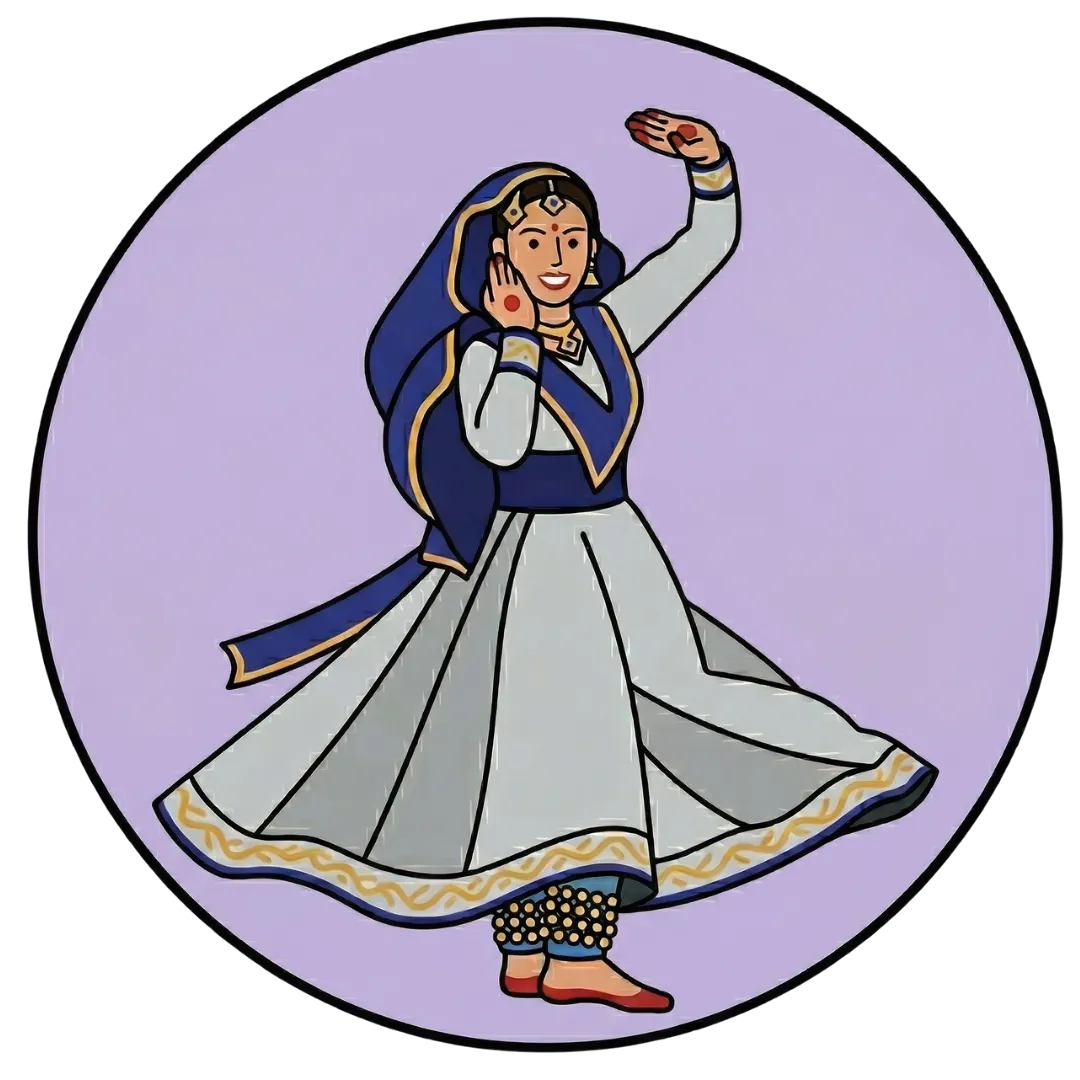
Kathak - The Classical Dance Form of Uttar Pradesh
Explore Kathak dance, the performance tradition of Uttar Pradesh, and learn about its origins, techniques, cultural significance, and artistic heritage.
Introduction
Kathak is one of the eight classical dance forms of India, originating in the north Indian state of Uttar Pradesh and developing over several centuries under the combined influence of Hindu devotional traditions and Mughal court culture. It is characterised by precise and fast footwork, swift pirouettes (chakkar), expressive storytelling through facial gestures (abhinaya), and rhythmic dialogues between dancer and percussion musician. Kathak is transmitted through distinct schools called gharanas, the principal ones being the Lucknow, Jaipur, and Banaras gharanas, each named after the city in which its stylistic lineage consolidated.
The Sangeet Natak Akademi has recognised Kathak as one of the major classical dance forms of India. It is performed solo, in pairs, or in groups, and is accompanied by Hindustani classical music. Training follows the guru-shishya (teacher-disciple) tradition, and the oldest Kathak department at a degree-granting institution was established at Indira Kala Sangeet University, Khairagarh, in 1956.
Etymology The word Kathak derives from the Sanskrit katha (story or narrative) through the term kathakar (one who tells a story). The Kathaks were historically a community of travelling bards and storytellers who performed narratives drawn from the epics Mahabharata and Ramayana and from Puranic traditions through dance, music, and gesture. Early references to storytelling traditions associated with the Kathaks appear in the Adi Parva of the Mahabharata and in inscriptions from the Mauryan period (4th to 3rd century BCE), as documented by Britannica. The female equivalent of the kathakar was referred to in some sources as a kathika.
Origin Textual studies suggest that Kathak as a classical dance form likely started in Varanasi (Banaras) and from there spread to Lucknow, Jaipur, and other parts of north and north-western India, as documented in Wikipedia's entry on Kathak drawing on academic sources. The Lucknow gharana traces its lineage to a devotee named Ishwari (also referred to as Ishwari Prasad) from the Handia region of Prayagraj, described in the gharana's oral tradition as a Krishna devotee who received divine inspiration. Ishwari's descendants transmitted the tradition over several generations before it reached Lucknow, where it was further developed under the patronage of the Nawabs of Awadh. The Jaipur gharana traces its origin to Bhanuji, a practitioner of Tandava (vigorous Shaiva dance) who received training in Natvari Nritya at Vrindavan. The Banaras gharana was developed by Janakiprasad on the banks of the Ganges and is sometimes called the Janakiprasad gharana.
Location The three principal gharanas correspond to their cities of origin and continued development: Lucknow in Uttar Pradesh, Jaipur in Rajasthan, and Banaras (Varanasi) in Uttar Pradesh. A fourth minor school, the Raigarh gharana, emerged in the early 20th century at the court of Raja Chakradhar Singh of Raigarh in present-day Chhattisgarh, who invited representatives of all three major gharanas to his court, resulting in a synthesis of styles. Contemporary Kathak is practised and taught across India and internationally, with major centres in Mumbai, Delhi, and Bengaluru, and diaspora communities in North America, Europe, and the United Kingdom.
Community Kathak was historically practised by the Kathak-Misra community, a Brahmin caste of hereditary performers concentrated in Uttar Pradesh. Under the Mughal court system, Kathak attracted Muslim patronage and was performed by both Hindu and Muslim artists, a dual participation that has continued to the present. As noted in a BBC Arts article cited by Wikipedia, Kathak is unique among Indian classical forms in its documented practice by Muslim communities, and scholars have described it as a confluence of Hindu and Mughal cultural traditions. The British colonial period, which restricted public dance performances and associated court dance with moral impropriety, led to a decline in patronage. The 20th-century revival was driven primarily by male artists of the major gharanas.
Relevance Kathak is significant as the primary classical dance form of north India and as a form that demonstrably synthesised Hindu devotional and Islamic courtly aesthetics over several centuries. Its improvisatory dimension, in which the dancer engages in rhythmic dialogue with the tabla player, distinguishes it from the more structured margam format of south Indian classical forms. The coexistence of Hindu and Muslim performance traditions within the form has made it a subject of scholarly interest in discussions of syncretic cultural practice in north India.
History
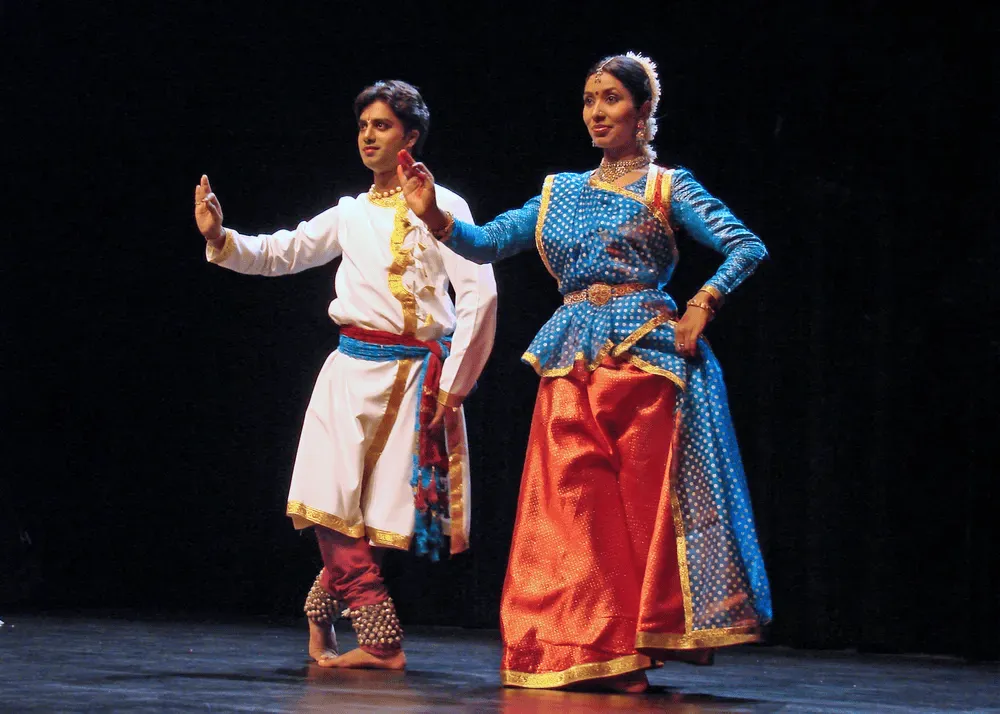
Background The early history of Kathak is connected to the Bhakti movement (roughly 15th to 17th centuries), during which devotional compositions centred on Krishna's life and his relationship with Radha and the gopis became the primary thematic material. Ras Leela, a form of dance-drama enacting Krishna's divine play in Vrindavan, was a significant formative influence. The Lucknow gharana traces its narrative lineage through Ishwari Prasad to his son Adguji, and from there through Pragas, Durga Prasad, Thakur Prasad, Bindadin Maharaj, and Kalka Prasad to Birju Maharaj (1938 to 2022), who became the best-known exponent of the Lucknow style in the 20th century.
The Nawabs of Awadh, particularly Asaf-ud-Daula and Wajid Ali Shah (who ruled until 1856), were central patrons of the Lucknow tradition. Wajid Ali Shah was himself a trained Kathak dancer and a composer of ghazals; his patronage, as described by Teri Skillman of the University of Hawaii, brought about a maturation of the Lucknow style that emphasised grace, elegance, and lyrical expressiveness over technical athleticism. The decline of the Mughal Empire and the Nawabi system following the 1857 Sepoy Mutiny disrupted this patronage, and Kathak artists gradually moved from palace to public (kota) settings. The Jaipur gharana developed under the patronage of the Kachchwaha Rajput rulers of Jaipur, who favoured a style closer to temple tradition and emphasised vigorous footwork, complex rhythmic compositions (layakari), and multiple fast spins. As the gharana remained under Hindu royal patronage, it retained a stronger connection to classical temple performance aesthetics and less of the Persian influence visible in the Lucknow style.
Culture and Societies The synthesis of Hindu devotional content and Mughal aesthetic refinement in Kathak is most visible in the Lucknow gharana, where the lasya (graceful, feminine quality) predominates and the dance is matched with thumri, dadra, ghazal, and hori compositions from Hindustani classical music. The Jaipur gharana's emphasis on tandava (vigorous, masculine quality) and complex rhythmic compositions reflects a different cultural emphasis rooted in Rajput martial aesthetics. The Banaras gharana, centred at the sacred city of Varanasi, maintained a strong connection with temple practice and is known for distinctive natwari or dance bols (rhythmic syllables specific to this gharana). Post-independence, the Sangeet Natak Akademi's recognition of Kathak enabled institutional support. The Kathak Kendra in New Delhi, established under government patronage, became a major training institution. World Kathak Day is observed on February 4, the birth anniversary of Birju Maharaj.
Religious Significance Kathak's devotional origins are rooted in Vaishnavism, specifically in the tradition of Ras Leela, which enacts the love between Krishna and Radha. The Bhakti movement compositions that formed the early repertoire were acts of devotion addressed to Krishna. The Lucknow gharana, while incorporating Persian aesthetic influences under Muslim patronage, retained devotional bhajans, geets, and thumris as the expressive core of the nritya section. The Jaipur and Banaras gharanas maintained a stronger temple-worship connection. Within Muslim performance traditions in Kathak, the devotional opening invocation (vandana) is replaced with a salami (salutation), representing a structural adaptation of the form's religious dimension.
Understanding the Art
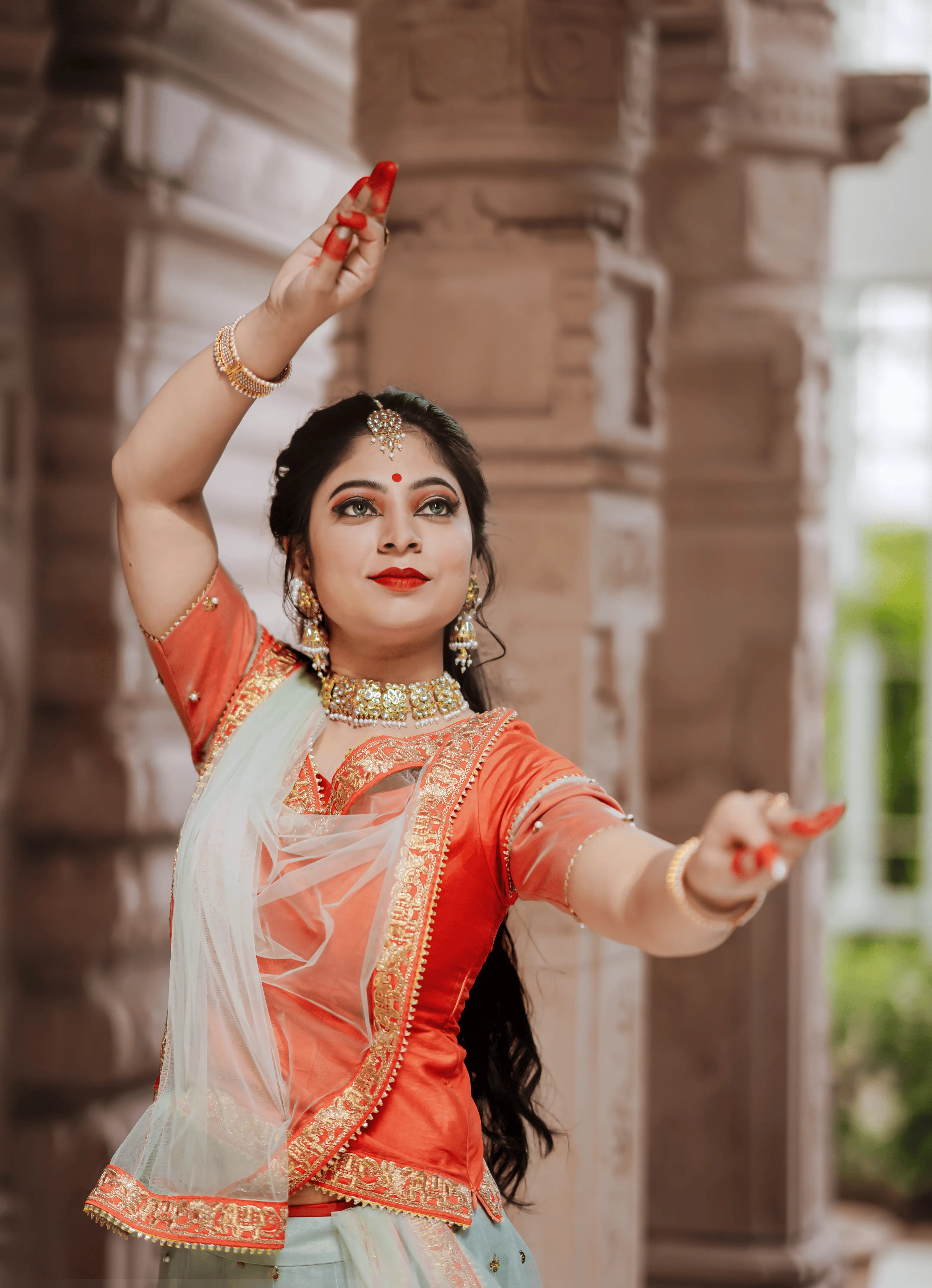
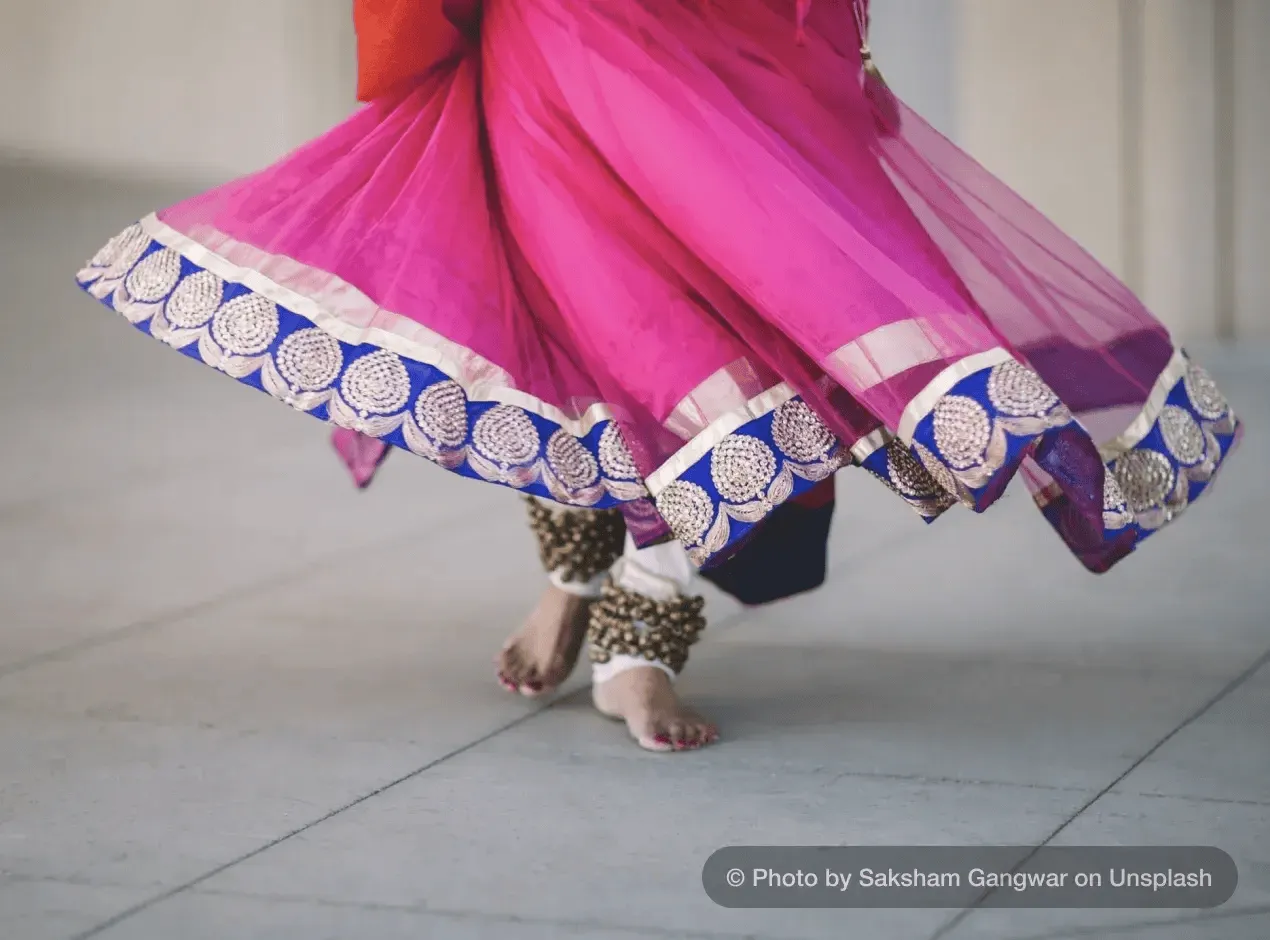
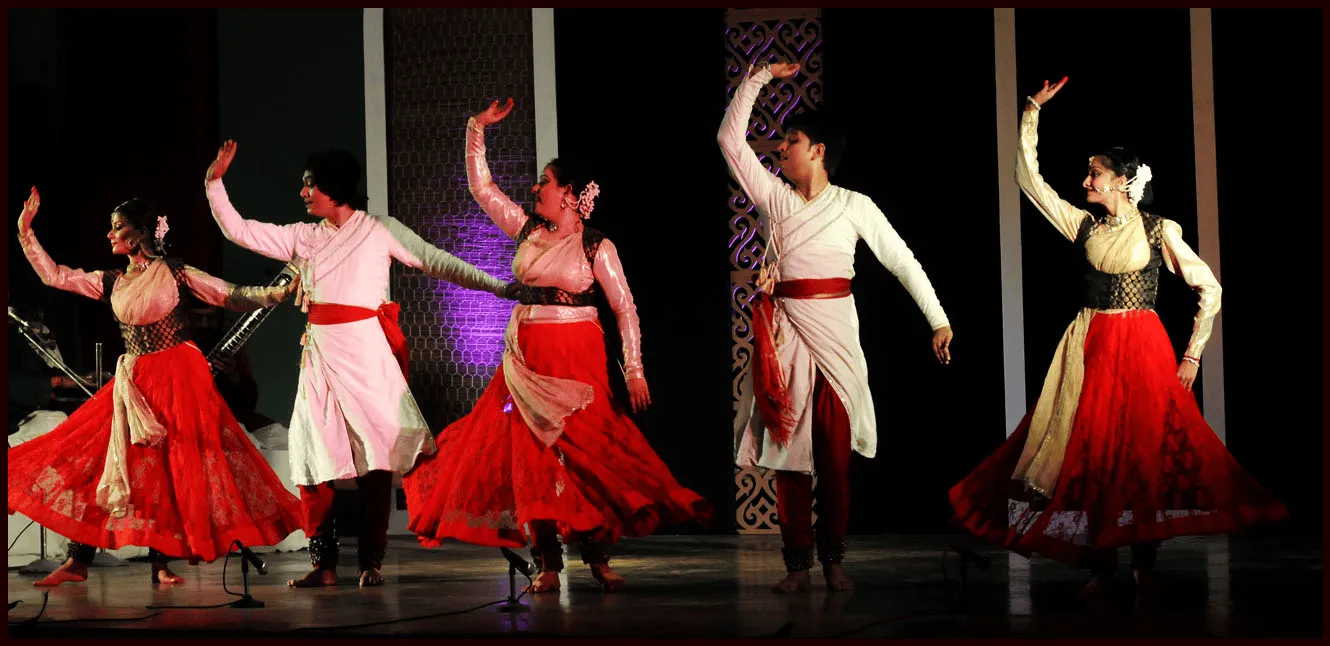
Style A Kathak performance is typically structured in three phases: an invocation (vandana or salami), pure dance (nritta), and expressive dance (nritya). Within this structure there is significant room for improvisation, particularly in the rhythmic exchanges between dancer and tabla player. The dancer begins with slow compositions and progressively introduces faster and more technically demanding elements. The signature Kathak element is tatkar (footwork), executed with ghungroo (brass bells, typically 150 to 200 on each ankle, more than in other classical forms). Fast chakkar (spins or pirouettes) are another defining technical feature. The dancer's legs and torso are generally held straight, with the narrative conveyed through arm gestures, facial expression, and eye and neck movements.
The Lucknow style is known for its emphasis on abhinaya (expression), grace, and use of thumri as the expressive vehicle. The Jaipur style prioritises technical complexity in footwork and layakari (rhythmic proportionality). The Banaras style uses its own distinctive set of natwari bols and has more floor-based work. In all styles, the dancer engages in a rhythmic conversation with the tabla player, who may respond to or challenge the dancer's rhythmic phrases.
Central Motifs and Their Significance The primary thematic material of traditional Kathak nritya is drawn from Vaishnava devotional poetry, particularly narratives of Radha and Krishna as described in the Bhagavata Purana and in compositions by poets such as Surdas, Mirabai, and Bihari. Seasonal themes (monsoon, spring) and the eight moods of the heroine (ashtanayika) are frequently depicted in abhinaya. Compositions called thumri, dadra, and hori represent the principal lyrical vehicles for abhinaya in the Lucknow tradition. The concept of bhav (emotional state) communicated through precise facial and bodily technique is central to all three gharana traditions.
Process Kathak training traditionally follows the guru-shishya system, in which a student trains under a single guru within a specific gharana. The transmission is primarily oral, with rhythmic compositions (bols, parans, tukdas, toras) taught verbally and repeated until internalised. Formal degree programmes are available at Indira Kala Sangeet University (Khairagarh), Bhatkhande Sangeet Vidyapith (Lucknow), and Kathak Kendra (New Delhi). Training covers both the technical nritta component and the interpretive nritya component, as well as theoretical knowledge of tala (rhythmic cycle) and raga within Hindustani classical music.
Mediums Used Kathak is accompanied by Hindustani classical music. The primary instrument is the tabla (paired drums), whose player engages in rhythmic dialogue with the dancer. The pakhawaj (a single-headed barrel drum, older than the tabla) is used in some performance contexts, particularly in the Jaipur gharana. Additional instruments include the sarangi or harmonium (melody), sitar or sarod (melody), and tabla or pakhawaj (rhythm). The vocalist performs compositions in genres appropriate to the performance context: thumri, dadra, and ghazal for lyrical sections; pure rhythmic compositions (parans, tukdas) require no vocal accompaniment. Female dancers in the Hindu tradition typically wear a lehenga (full skirt), choli (fitted blouse), and dupatta (scarf); Muslim-influenced costume uses a salwar or anarkali suit with churidar. Male dancers wear dhoti and kurta. Both genders wear ghungroo on both ankles.
New Outlook
Contemporary Kathak includes a substantial body of non-mythological choreographic work. Sitara Devi (1920 to 2014), Kumudini Lakhia (1930 to 2024), and Birju Maharaj introduced significant choreographic expansions, with Lakhia in particular developing Kathak-based group compositions performed by her Kadamb Centre for Dance in Ahmedabad. Fusion works combining Kathak with Flamenco (similarities in footwork and improvisation have attracted both communities) and with contemporary dance have been presented internationally. The form has also attracted attention from scholars of religion and gender for the way in which its history illustrates the interplay of Hindu, Mughal, and colonial modernity in north Indian performance culture.
Learn Kathak
Bibliography
Sources
Kothari, Sunil. Kathak: Indian Classical Dance Art. Abhinav Publications, 1989.
Massey, Reginald. India’s Dances: Their History, Technique and Repertoire. Abhinav Publications, 2004.
Nettl, Bruno. The Study of Ethnomusicology: Thirty-one Issues and Concepts. University of Illinois Press, 2005. Includes material on Kathak performance structure.
Samson, Leela. Rhythm in Joy: Classical Dance Traditions of India. Lustre Press, 1987.
Vatsyayan, Kapila. Indian Classical Dance. Ministry of Information and Broadcasting, Government of India, 1974.
Image Sources
Encyclopaedia Britannica. “Kathak.” Encyclopaedia Britannica, https://www.britannica.com/art/kathak. Accessed on May 19, 2026.
iPassio. “How to Learn Kathak at Home.” iPassio Blog, https://www.ipassio.com/blog/how-to-learn-kathak-at-home. Accessed on May 19, 2026.
iPassio. “Indian Classical Dance – Kathak.” iPassio Wiki, https://www.ipassio.com/wiki/dance/indian-classical-dance/kathak. Accessed on May 19, 2026.
Sangeet Natak Akademi – Kathak Kendra. “Kathak Kendra.” Sangeet Natak Akademi, https://www.sangeetnatak.gov.in/constituent-units-akademi/kathak-kendra. Accessed on May 19, 2026.