
Karma Naach - The Folk Dance Tradition of Bihar
Exploring the legacy of Karma Naach, the traditional folk dance of Jharkhand that celebrates harmony between nature and cultural community.
Introduction
Karma Naach is a tribal dance performed during the Karam festival, observed on the eleventh day of the month of Bhadra (August to September) in the Hindu calendar. It is practiced by multiple indigenous communities of the Chota Nagpur Plateau and adjoining regions, including the Munda, Ho, Oraon, Baiga, Bhumij, Kharia, and Kudmi communities of Bihar, Jharkhand, Chhattisgarh, Odisha, and West Bengal. The dance is performed around a branch of the Karam tree (Nauclea parvifolia), which is ritually installed as a representation of Karam Devta, the deity associated with fate, fortune, and well-being. Karma Naach is simultaneously a harvest-thanksgiving ritual, a coming-of-age ceremony for unmarried youth, and a communal celebration of the tribe's relationship with the forest.
Etymology
The word 'Karma' in this context derives from the Mundari and related tribal languages, where it signifies fate or fortune rather than the Sanskrit philosophical concept of karma (action and consequence). 'Karam' is the local name of the Nauclea parvifolia tree, also called the kadam tree in some regions, and the festival takes the name of this sacred tree. 'Naach' is the Hindi-derived word for dance. The compound term 'Karma Naach' therefore refers to the dance performed at the festival of the Karam tree and its presiding deity, Karam Devta.
Origin
Karma Naach is indigenous to the Munda, Ho, and Oraon communities of the Chota Nagpur Plateau, a region spanning parts of present-day Jharkhand, Bihar, Chhattisgarh, Odisha, and West Bengal. The specific origins of the festival and dance are embedded in the oral traditions of these communities. Several origin narratives exist across different tribal groups, all centering on the power of the Karam tree and its deity to bestow good fortune, protect siblings, and ensure the prosperity of the community. The Karam festival and its associated dance form part of a complex of agricultural and forest-related rituals specific to the adivasi (indigenous) communities of this plateau region.
Location
Karma Naach is practiced primarily in Jharkhand, Bihar, Chhattisgarh, Odisha, and West Bengal, wherever the Munda, Ho, Oraon, Baiga, Bhumij, Kharia, and Kudmi communities have historically been settled. It is most concentrated in the districts of the Chota Nagpur Plateau: Ranchi, Hazaribagh, Singhbhum, Gumla, Lohardaga, Surguja, and Sambalpur districts, and extends into southern Bihar districts including Gaya and Nawada.
Community
Karma Naach is performed by unmarried young men and women of the Munda, Ho, Oraon, Baiga, Bhumij, Kharia, Kudmi, and related communities. In several communities, the festival is specifically a ceremony for unmarried youth, with its songs and dances addressed to the Karam deity for blessings of prosperity, good marriage, and siblings' welfare. The ritual includes a specific figure, the jaan-guru or community elder, who performs the puja (worship) of the installed Karam branch. The dance itself is a communal act in which the entire village participates.
Relevance
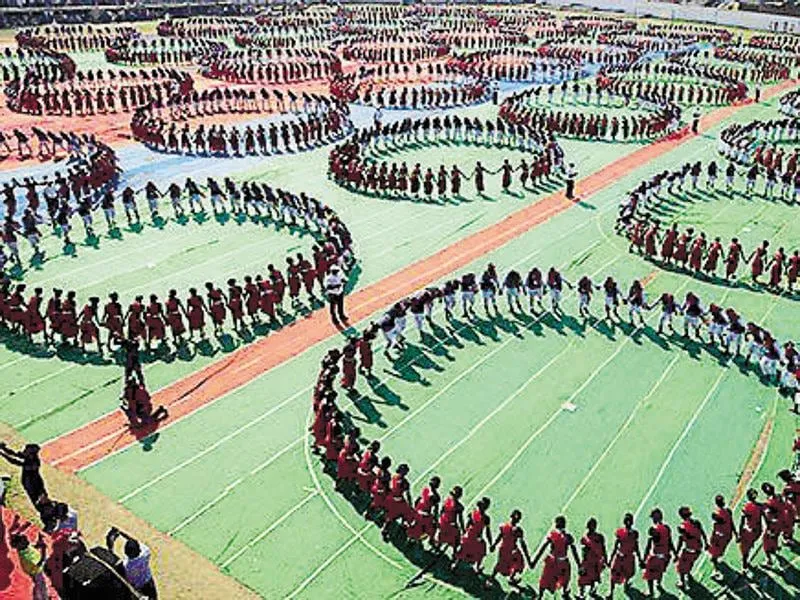
Karma Naach is one of the most widely distributed festival dances among the adivasi communities of central-eastern India. In 2015, a group of 3,049 Gond community members performed Karma Naach and set a Guinness World Record for the largest performance of the dance. This event highlighted both the vitality of the tradition in some communities and the potential for its contemporary reframing. The dance is integral to the social and ritual calendar of the participating communities, marking the transition from the monsoon season to harvest and providing a structured occasion for inter-community celebration.
History
The Karam festival and Karma Naach belong to the pre-Hindu religious traditions of the adivasi communities of the Chota Nagpur Plateau. While the broader culture of the region has absorbed influences from Hinduism over several centuries, the Karam worship tradition is documented as indigenous to the Munda and related communities. It does not appear in Sanskrit literature and is not derived from Brahmanical Hindu practice. Ethnographic documentation of the tradition begins in the colonial period, with British administrators and anthropologists recording the festivals and ritual practices of the Chota Nagpur communities from the mid-nineteenth century onward. Verrier Elwin's fieldwork among central Indian tribes in the 1930s to 1950s provides ethnographic context, though Elwin did not focus specifically on the Karam festival.
Culture and Societies
The Karam festival is a night-long event. On the day of the festival, young men bring a freshly cut branch of the Karam tree from the forest to the village. The branch is installed in the central gathering space (akhra) with ritual honors. The jaan-guru conducts the puja, offering germinated grains (jawa, composed of nine varieties of seed), rice, milk, rice liquor, and in some communities fowl blood. After the puja, the dancing begins and continues through the night. The following morning, the Karam branch is carried to a river and immersed, a ritual act symbolizing the completion of the deity's visit to the village. Songs sung during the festival narrate the origin mythology of the Karam deity and address themes of fraternal and sibling love, agricultural fertility, and community welfare.
Religious Significance
Karma Naach has direct and primary religious significance. Karam Devta is worshipped as the deity of fate and fortune, and the entire festival is a structured religious ceremony. The installation of the Karam tree branch, the offerings, the singing, and the dance are all components of the worship ritual. The dance itself is not merely entertainment but a form of devotional participation in the puja. The germinated grain offering (jawa) represents agricultural fertility and the hope for a good harvest. The immersion of the branch at dawn marks the formal conclusion of the deity's ritual presence in the village.
Understanding the Art
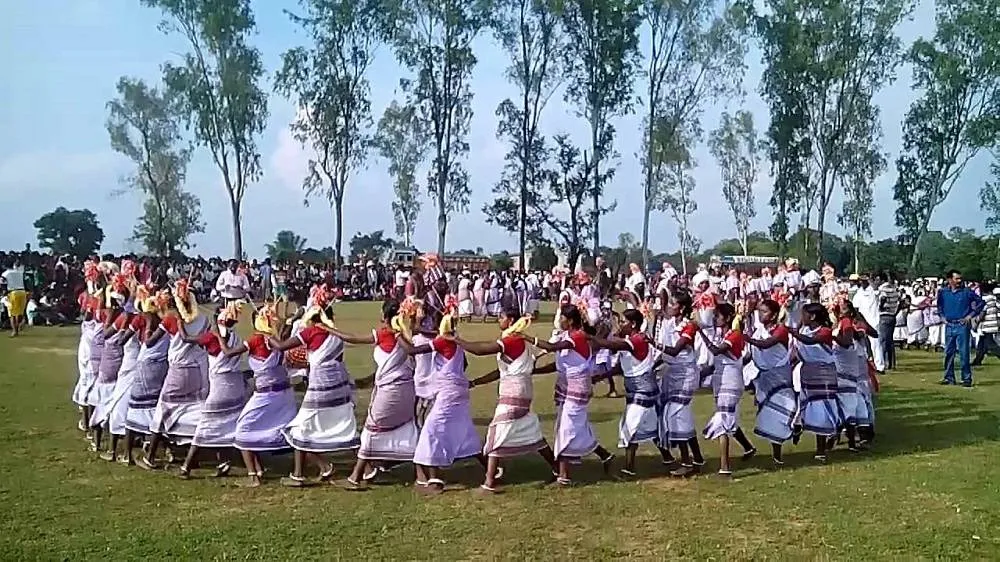
Karma Naach is performed in a linked-arm circle around the installed Karam branch. Men and women form a large circle, link arms at the shoulder, and move in a synchronized pattern of steps to the beat of the accompanying drums. The movement is primarily footwork-based, with stamping, stepping, and circular movement. The songs are in the tribal languages of the respective communities and are sung in a call-and-response structure. The overall effect is of communal, sustained rhythmic motion, with the dancing and singing continuing in cycles through the night.
Central Motifs and Their Significance
The central motif is the Karam tree branch, which serves as the temporary residence of Karam Devta during the festival. The circle of dancers around the branch enacts the communal embrace of the deity and the collective petition for his blessings. The jawa offering, consisting of germinated seeds, symbolizes agricultural fertility and the generative power of the earth. The night-long duration of the dance enacts the community's sustained devotion. The festival also encodes the relationship between the adivasi communities and the forest, from which the Karam branch is taken with specific rituals.
Process
The festival preparation begins with the collection of germinated seeds (jawa) nine days before the main festival. On the day itself, young men enter the forest to select and cut a Karam tree branch, which is carried to the village with ceremony and singing. The jaan-guru conducts the puja with specified offerings. After the puja, the community gathers for the night of Karma Naach, dancing in circles around the branch. Musicians play dhol, mandar (a barrel drum), timki (a small drum), and chhalla. The dance continues through the night. At dawn, the community carries the Karam branch in a procession to the nearest river or body of water and immerses it.
Mediums Used
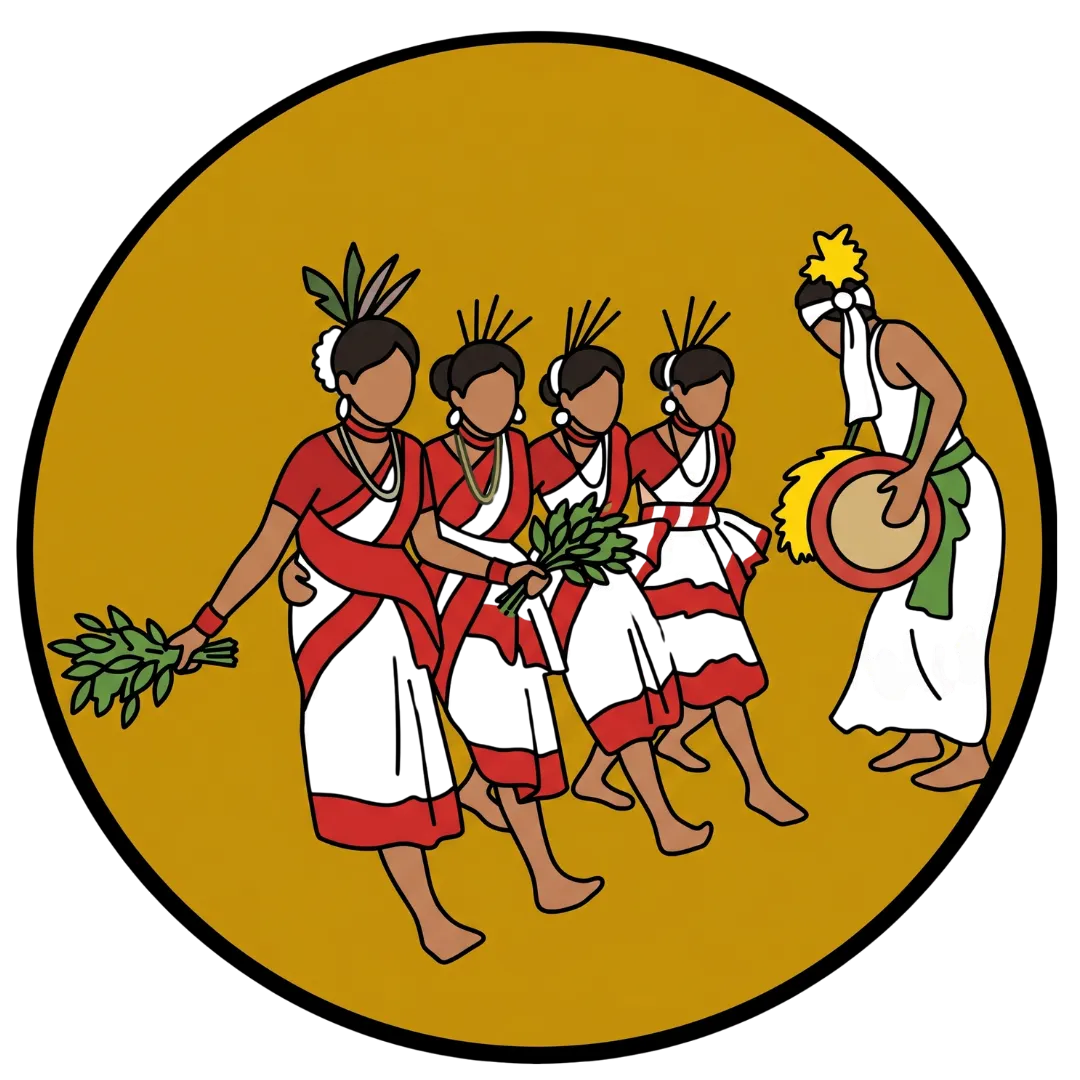
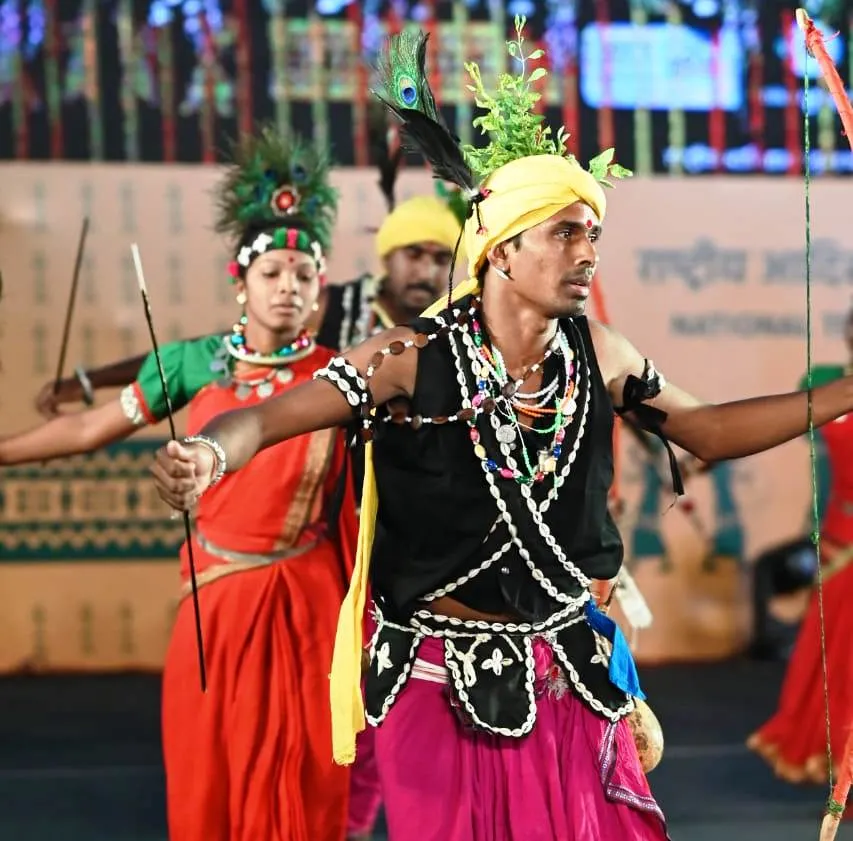
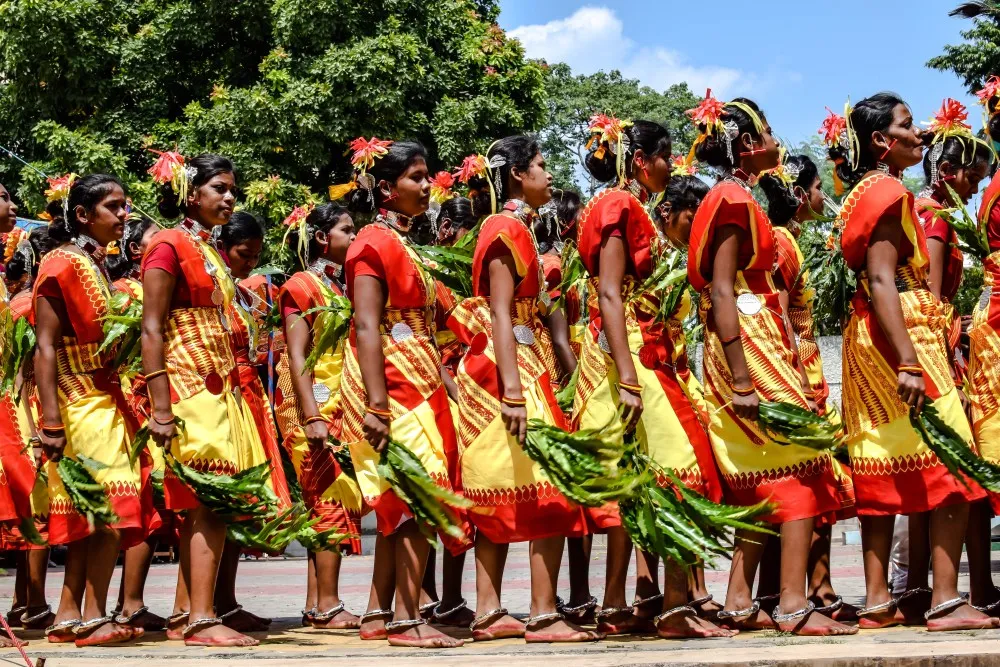
Instruments used in Karma Naach include the dhol, mandar, timki, and chhalla (a frame drum or ring drum). The dance requires no props beyond the installed Karam tree branch and the ritual items of the puja. Performers wear traditional tribal dress specific to their community: for Munda and Ho women, this includes a saree worn in the tribal style with specific ornaments such as brass earrings, armlets, and beaded necklaces; men wear traditional lungis, gamchas, and community-specific adornments. Feathers and flowers are commonly worn in the hair during festival dances.
New Outlook
Karma Naach remains an active tradition in many communities of Jharkhand, Chhattisgarh, Odisha, and West Bengal, and is regarded as a medium-visibility tradition. However, it is classified as vulnerable due to pressures including the displacement of adivasi communities from forest lands, cultural assimilation, and the diminishing authority of traditional ritual practices among younger generations. The Guinness World Record achieved in 2015 generated some public attention but did not result in sustained institutional documentation programs. State cultural bodies in Jharkhand have included Karma Naach in festival programming, and the Sangeet Natak Akademi has documented it among other adivasi performance traditions, but formal training programs and comprehensive archiving have been limited.
Learn Karma Naach

Bibliography
Sources
Elwin, Verrier. Tribal Songs of Middle India. Oxford University Press, 1944.
Fuchs, Stephen. The Aboriginal Tribes of India. Macmillan India, 1973.
Mahto, Sarada Prasad. Karma Festival and Traditions of Jharkhand. Jharkhand Cultural Documentation, various editions.
Roy, Sarat Chandra. The Mundas and Their Country. City Book Society, 1912.
Singh, K. S., editor. Tribal Situation in India. Indian Institute of Advanced Study, 1972.
Image Sources
"Karam Naach." Bharatpedia, https://en.bharatpedia.org/wiki/Karma_Naach. Accessed 3 July 2026.
"Karma Nacha." GoSahin, https://www.gosahin.com/places-to-visit/karma-nacha/. Accessed 3 July 2026.
"Karma Naach Dance Makes It to Guinness World Records." Hindustan Times, https://www.hindustantimes.com/bhopal/mp-karma-naach-dance-makes-it-to-guinness-world-records/story-BePSq4NVNwlXn20gvfln9N.html. Accessed 3 July 2026.
"करम नाच." हिन्दी विकिपीडिया, https://hi.wikipedia.org/wiki/%E0%A4%95%E0%A4%B0%E0%A4%AE_%E0%A4%A8%E0%A4%BE%E0%A4%9A. Accessed 3 July 2026.
"Karma Dance Gives Wonderful Message of Environmental Protection." Shor Sandesh, https://shorsandesh.in/cg/karma-dance-gives-wonderful-message-of-environmental-protection. Accessed 3 July 2026.