

Kanchipuram Toys - The Handicraft Tradition of Tamil Nadu
Explore Kanchipuram Toys, the handicraft tradition of Tamil Nadu, and learn about its origins, techniques, cultural significance, and artistic heritage.
Introduction
Kanchipuram Toys refers to a range of traditional handcrafted wooden and clay objects, particularly lathe-turned lacquered wooden toys, produced in the temple city of Kanchipuram in the Kanchipuram district of Tamil Nadu. These objects encompass small figurines, domestic utensils in miniature, devotional items, and secular playthings distinguished by their bright lacquer finishes and use of locally sourced timber. The craft sits within a broader tradition of Tamil toy-making that has coexisted with the region's sustained temple-building culture across dynasties.
Etymology The term 'Kanchipuram Toys' derives from the city name Kanchipuram, itself rooted in the Tamil and Sanskrit word 'Kanchi,' historically denoting a sacred city. 'Kanchi' appears in early Sanskrit literature including the poem Janakaharana by the 6th-century poet Kumaradasa, which references Kanchi as a place renowned for textiles and craftsmanship. The association of city-name with product is the standard regional classification applied by craft documentation bodies including the Craft Revival Trust and India InCH.
Origin The precise historical origin of Kanchipuram's wooden toy tradition has not been independently dated through archaeological or archival evidence. However, the broader tradition of wood carving and lathe-turned wooden objects in Kanchipuram is documented as part of a multi-generational craft associated with the Vishwakarma community. Wood carving in the Kanchipuram region is organically connected to the temple economy, which has supported skilled carpenters across centuries. The toy-specific branch of this tradition has limited formal academic documentation.
Location Kanchipuram district, Tamil Nadu. The city lies approximately 72 kilometres southwest of Chennai.
Community The primary practitioners are members of the Vishwakarma community, an artisan caste whose hereditary occupations include carpentry, bronze-casting, goldsmithing, and stone carving. Wood-turning is also practised by Asari artisans, the traditional woodworkers of Tamil Nadu. Within Kanchipuram and surrounding villages, these families produce both large ceremonial wooden objects for temples and smaller secular items including toys.
Relevance The craft holds moderate cultural relevance within Tamil Nadu's broader toy-making tradition. India InCH and Asia InCH list Kanchipuram as a known centre for clay toy production and wooden lathe-turned objects within the state's craft geography, alongside Chennai, Karigiri, Kumbakonam, Panruti, and Madurai. The craft is classified as vulnerable due to competition from mass-produced plastic alternatives and declining intergenerational transmission.
History
Background Kanchipuram's status as a major pilgrimage and cultural city across Pallava, Chola, and Vijayanagara periods created sustained demand for a range of artisanal products. The Pallava dynasty (6th to 9th centuries CE) developed the temple complex infrastructure of the city, including the Ekambareswarar and Varadaraja Perumal temples, which in turn supported communities of specialist artisans. Wood carving, one of the principal craft traditions of Tamil Nadu documented in the Shilpa Shastras, was practised within these artisan communities. India InCH records that in Kanchipuram, intricately carved wooden objects including manuscript covers, spice and kumkum boxes, games, and toys were part of the repertoire of skilled woodworking families. Lathe-turned and lacquered toys, particularly miniature cooking vessels and pull-along walking toys locally called kadasal, are documented as a product category within this tradition.
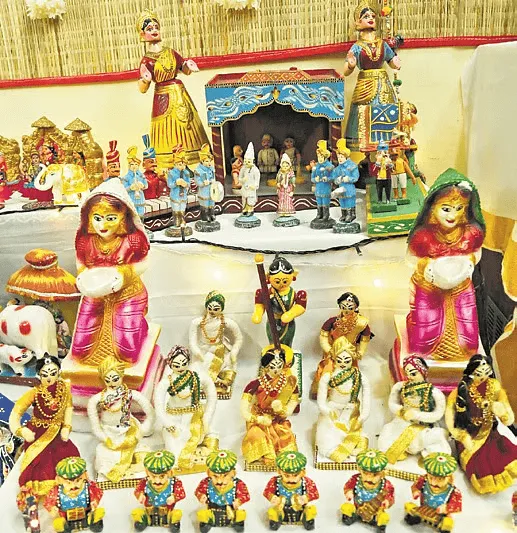
Culture and Societies Tamil toy-making traditions are culturally embedded in ritual contexts, particularly the Navratri festival known as Golu or Kolu, during which arranged displays of dolls and figurines are central to household observance. Wooden and clay toys produced in temple towns including Kanchipuram have historically served this festival market. The Vishwakarma and Asari communities producing toys in the region claim lineage from the divine craftsman Vishwakarma, lending a sacred identity to their craft practice. The broader social structure of Kanchipuram, shaped by temple patronage, sustained multiple specialist artisan communities across weaving, metalwork, stone carving, and wood working.
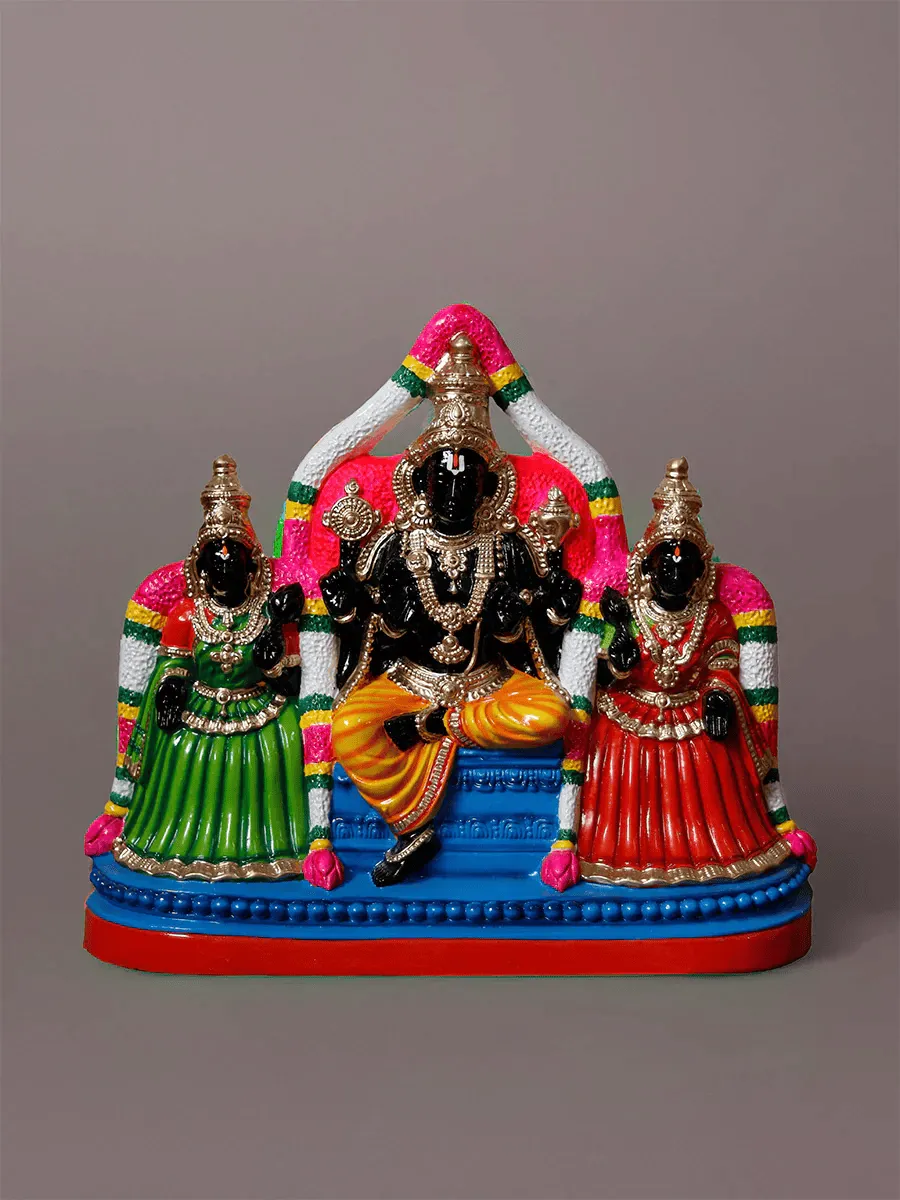
Religious Significance Wooden objects from Kanchipuram's craft tradition include devotional items used in temple ceremonies. Panels carved with deities and mounted on poles, known locally as kavadi, are produced for use in religious vows to Lord Murugan. Small carved shrines, decorative fans for temple deities, and fertility couple figurines are documented as part of the region's ceremonial woodcraft. To the extent that toys serve as ritual objects in Golu displays, they carry devotional function. However, the specific toy category within Kanchipuram's production is primarily secular in character.
Understanding the Art
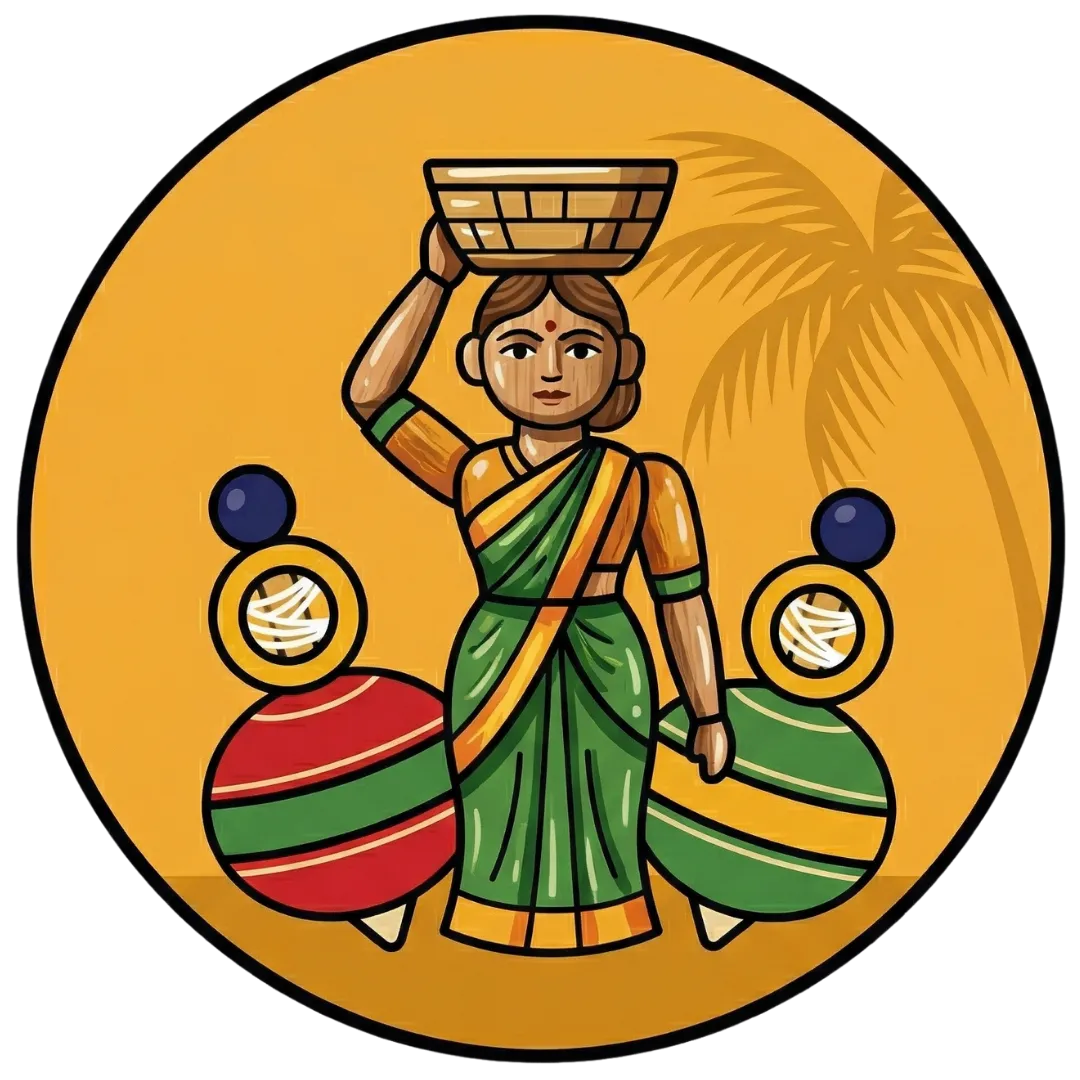
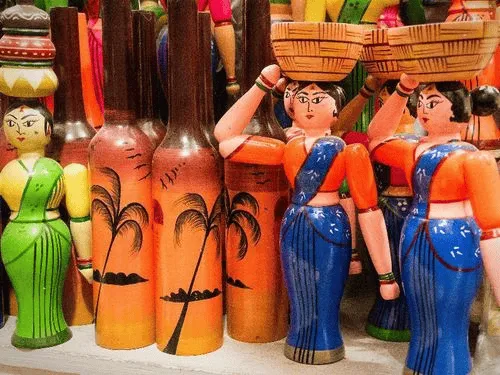
Style Kanchipuram wooden toys are lathe-turned and lacquered. The dominant style features smooth, rounded forms in miniature scale, brightly coloured with lacquer finishes. Common product forms include small cooking vessels, animals, kadasal walkers, and geometric decorative pieces. The use of colour is bold and contrasting. Clay toys from the Kanchipuram region follow a naturalistic style depicting human figures, animals, and village scenes, consistent with the broader Tamil clay toy tradition documented across Tamil Nadu by Asia InCH.
Central Motifs and Their Significance Motifs in Kanchipuram's wooden toys are derived from everyday life and temple iconography. Small figurines of deities, animals particularly elephants and horses, birds, and domestic scenes are common. Colour usage in Tamil clay toy traditions, as documented by Asia InCH, follows symbolic conventions: orange tones represent priestly figures, grey and russet indicate manual laborers, and bright colours with embellishments denote wealthy characters. These conventions extend to some degree to Kanchipuram's clay toy production, though specific documentation for Kanchipuram alone is limited.
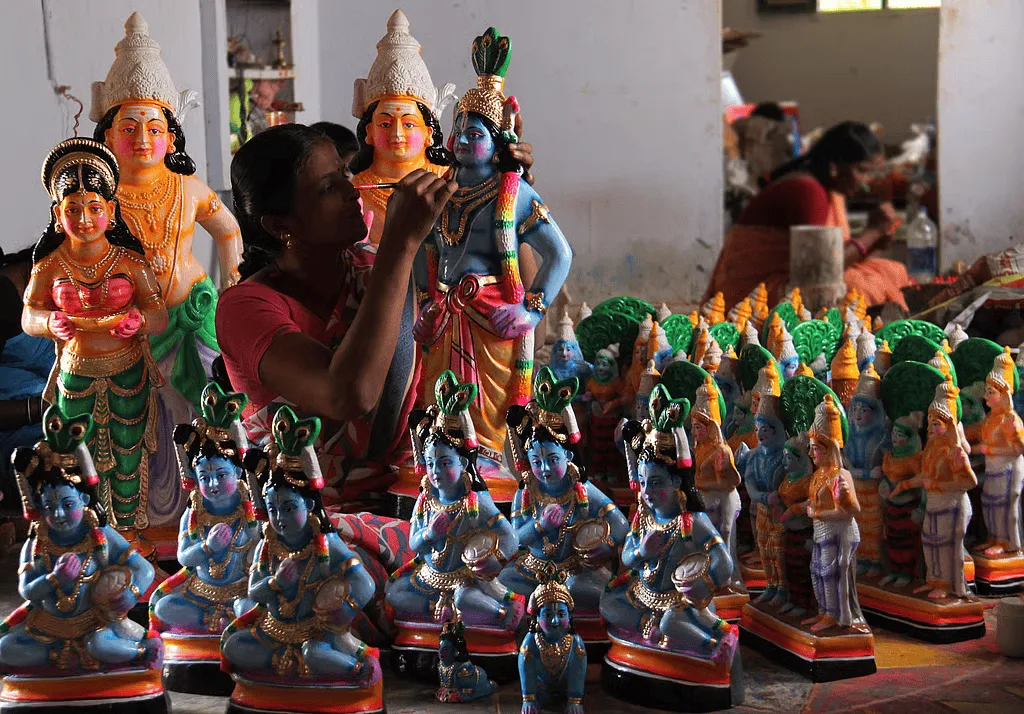
Process For lathe-turned wooden toys, the artisan begins by selecting suitable timber. The wood block is mounted on a lathe, where it is shaped through rotation using chisels and turning tools into the required cylindrical or rounded form. Once shaped, the surface is smoothed. Lac is applied to the spinning wooden object: lac sticks are heated and pressed against the rotating wood, melting evenly across the surface to produce a coloured lacquer coating. Multiple lac colours are applied in sequence to create banded or patterned finishes. The finished toy is detached from the lathe and any final detailing is added by hand. For clay toys, local clay is hand-modelled or pressed into moulds, dried, fired in kilns, and painted with mineral or synthetic pigments.
Mediums Used Wood: Local softwoods suitable for lathe-turning are used for wooden toy production. Jackfruit wood, mango wood, and other regionally available timbers are employed depending on the object.
Lac (Lacquer): Coloured lac in stick form is the finishing medium applied to lathe-turned objects. Red, yellow, green, and black lac are commonly used.
Clay: For clay toy variants, local earthen clay is shaped by hand or mould, fired, and finished with paints.
Paints: Mineral-based and synthetic paints are used for surface decoration.
New Outlook
Kanchipuram's toy craft is classified as vulnerable. Demand from the Navratri Golu market remains the primary domestic consumption driver, but competition from inexpensive plastic and mass-manufactured toys has reduced market share. Documentation by craft bodies including India InCH and Asia InCH has preserved descriptive records, but economic incentives for younger artisans to remain in the trade have diminished. Some artisans have adapted by producing larger decorative wooden objects oriented toward the tourist and export market. Government initiatives under the Office of the Development Commissioner (Handicrafts) offer limited institutional support.
Learn Kanchipuram Toys

Bibliography
Sources
Chattopadhyay, Kamaladevi. Handicrafts of India. Indian Council for Cultural Relations, 1975.
Craft Revival Trust. “Clay Toys of Tamil Nadu.” Asia InCH: Encyclopedia of Intangible Cultural Heritage, 1999–, https://asiainch.org/craft/clay-toys-of-tamil-nadu/
India InCH. “Wood Carving of Kanchipuram, Tamil Nadu.” India InCH, https://www.indiainch.org/craft/wood-carving-of-kanchipuram-tamil-nadu/
Jaitly, Jaya, and Ruchira Verma, editors. Crafts of India: Handmade in India. Lustre Press/Roli Books, 2007.
Image Sources
“CM Naidu, Lokesh, Jagan Hail BJP Win in Assam, Bengal and Vijay’s Success in TN.” The New Indian Express, 5 May 2026, https://www.newindianexpress.com/states/andhra-pradesh/2026/May/05/cm-naidu-lokesh-jagan-hail-bjp-win-in-assam-bengal-and-vijays-success-in-tn. Accessed on May 05, 2026.
Jaswal, Misha. “The Traditional Toy-Making Heritage of India: Dolls, Stories and Regional Craftsmanship.” Memeraki, https://www.memeraki.com/blogs/posts/the-traditional-toy-making-heritage-of-india-dolls-stories-and-regional-craftsmanship. Accessed on May 05, 2026.
“The Timeless Art of Toy Making at Vilachery.” The New Indian Express, 6 Apr. 2026, https://www.newindianexpress.com/cities/chennai/2026/Apr/06/the-timeless-art-of-toy-making-at-vilachery. Accessed on May 05, 2026.
“Wooden Toys in Kanchipuram.” TradeIndia, https://www.tradeindia.com/kanchipuram/wooden-toys-city-198885.html. Accessed on May 05, 2026.