

Jhumur - The Folk Dance Tradition of Assam
An exploration of the origins, artistic features, and cultural legacy of Jhumur, one of eastern India's most celebrated folk dance traditions.
Introduction
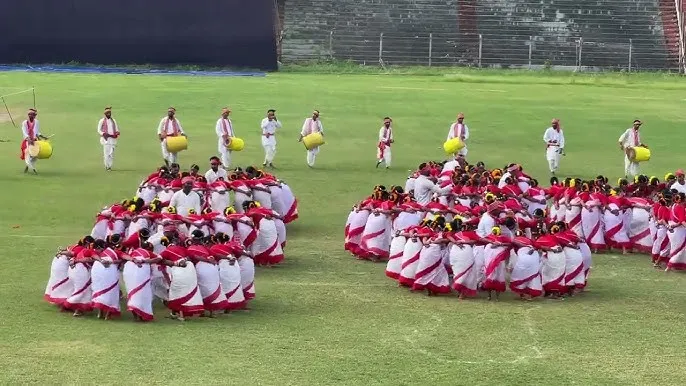
Jhumur (also written Jhumoir, Jhumair, or Jhumar) is a folk dance and song tradition practised by the Tea Tribe or Adivasi communities of Assam's tea gardens, as well as in parts of Jharkhand, Odisha, Chhattisgarh, West Bengal, and Bihar. In Assam, Jhumur is primarily associated with the Tea Tribe communities, who are descendants of labourers brought from the Chotanagpur Plateau region under British colonial rule during the 19th century to work in Assam's newly established tea plantations. The dance is performed mainly by young women in synchronised formations, accompanied by male musicians playing traditional instruments, during harvest festivals and agricultural celebrations.
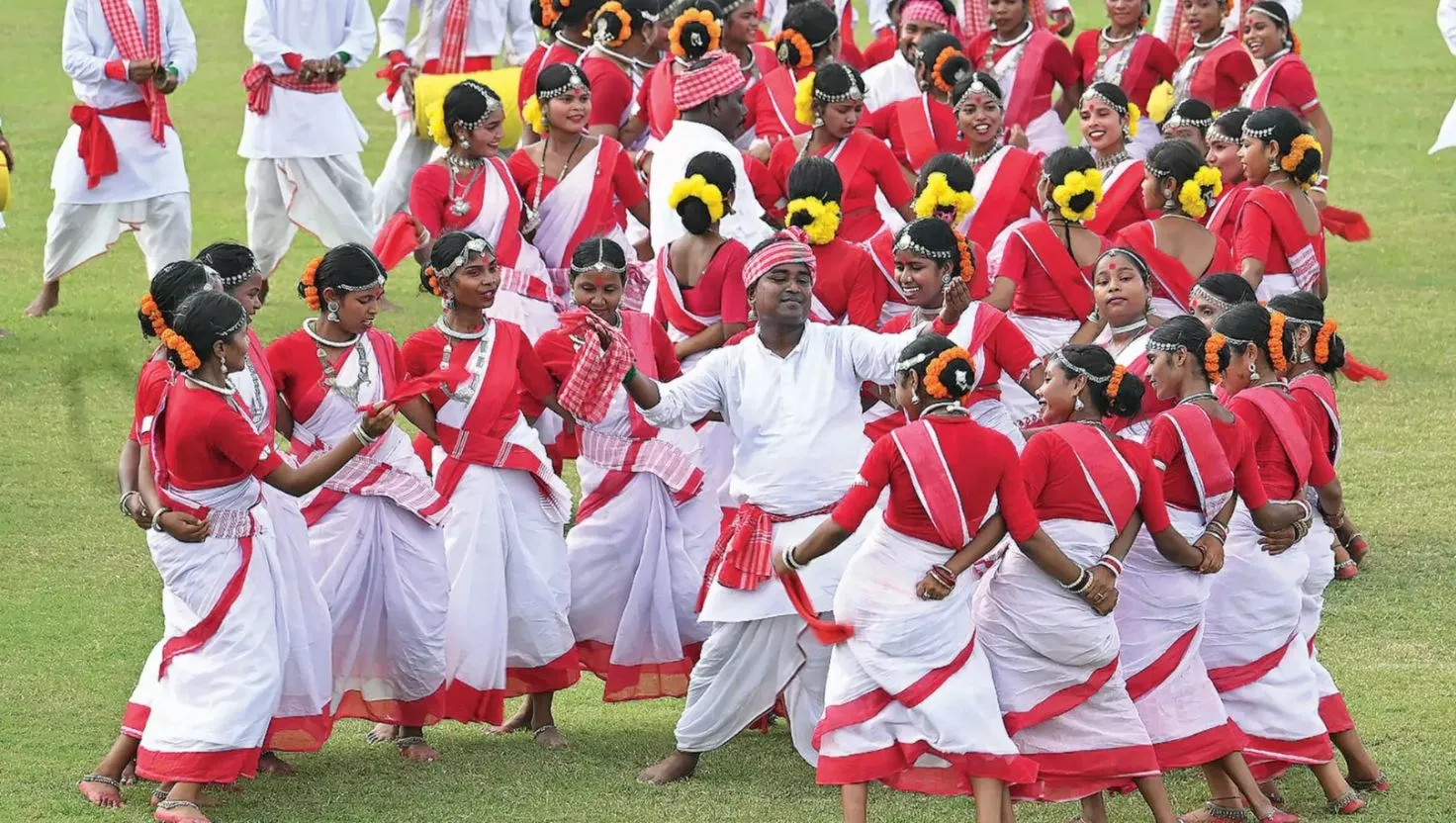
A significant national event occurred when Prime Minister Narendra Modi attended the Jhumoir Binandini 2025, a cultural celebration in Guwahati held to mark 200 years of Assam's tea industry, which featured a large-scale Jhumur performance by Tea Tribe artists as its centrepiece.
Etymology
The word Jhumur (or its variants Jhumoir, Jhumair, Jhumar) is used across multiple regions of eastern India and northeast India to denote related folk performance traditions. In the Chotanagpur region of Jharkhand, the term describes the folk song and dance traditions of the Sadan ethnolinguistic group (the Indo-Aryan communities of the plateau). The word is also associated with the Kurmali and Nagpuri languages of the region. In Assam, the Tea Tribe communities use the term to describe the performance tradition they brought with them from their ancestral homeland, which has since been adapted in the Assamese context.
Origin
The Jhumur tradition originates from the Chotanagpur Plateau region, specifically from the communities of Jharkhand, Odisha, Bengal, and Chhattisgarh, and is primarily identified with the Sadan ethnolinguistic group, as documented in the Drishti IAS and Civilsdaily analyses of the Tea Tribe tradition. Some sources reference Mesolithic cave paintings as possible evidence of ancient Jhumur-like dance traditions. The tradition was brought to Assam from the mid-19th century onward when British colonial tea plantation owners brought labourers from the Chotanagpur Plateau under the colonial Inland Emigration Act and related legislation. These workers, coming from over 100 aboriginal Indian tribes and castes, brought their cultural practices with them, including the Jhumur tradition, which they maintained in the tea garden communities of Upper Assam and the Barak Valley.
Location
In Assam, Jhumur is concentrated in Upper Assam tea garden districts: Tinsukia, Dibrugarh, Golaghat, Sonitpur, and Sivasagar. The Tea Tribe communities are also present in the Barak Valley districts of Cachar and Karimganj. The tradition is also found in its original form in Jharkhand, Odisha, Chhattisgarh, West Bengal, and Bihar. The first large-scale national public presentation of Assam's Jhumur tradition was the Jhumoir Binandini 2025 event in Guwahati, attended by the Prime Minister.
Community
The primary practitioners of Jhumur in Assam are the Tea Tribe communities, classified as Other Backward Classes (OBC) in Assam, though many sub-groups including Munda, Santhal, and Oraon hold Scheduled Tribe status in their original states. These communities represent approximately 17 percent of Assam's population, according to analyses in The Study IAS, and influence around 40 of the 126 Assembly constituencies in the state. The Tea Tribe population is concentrated in the tea garden estates, which continue to be their primary economic and social context. Women are the primary performers of Jhumur dance, while male community members provide musical accompaniment.
Relevance
Jhumur is significant as the primary cultural expression of the Tea Tribe community, which forms a major demographic and economic constituency in Assam. The dance functions as a vehicle for cultural memory, preserving the oral history of migration and labour under colonial conditions while also celebrating the community's agricultural and spiritual traditions. As a form that bridges Assam's Tea Tribe identity and the broader folk traditions of eastern India, Jhumur represents the multicultural character of Assam's contemporary cultural landscape.
History
Background
The Tea Tribe communities were brought to Assam by the British through a system of indenture and contract labour that involved what historians describe as forced migration under exploitative conditions. Workers from diverse tribal and caste backgrounds from Jharkhand, Odisha, Chhattisgarh, West Bengal, and Andhra Pradesh were recruited and relocated to work in the tea gardens established by the British East India Company and subsequent colonial enterprises. The original Jhumur tradition, associated with the Sadan ethnolinguistic group of Chotanagpur, was part of the cultural heritage these communities carried with them. As tea garden communities stabilised over generations, Jhumur evolved to incorporate Assamese linguistic and musical influences while retaining core elements from the communities' ancestral traditions.
The earliest well-documented evidence for the Jhumur tradition in India as a whole comes from Mesolithic cave paintings (cited in iasgyan.in), though specific historical documentation of the form in Assam's tea gardens does not predate the colonial period. The tradition was transmitted through community practice within the closed social world of the tea garden estate.
Culture and Societies
Jhumur in Assam's tea communities is performed primarily during the festivals of Karam Puja and Tushu Puja. Karam Puja, a week-long celebration to worship Karam Raja (a nature deity), involves nightly song-and-dance rituals (jagaran) including Jhumur dance throughout the festival week. The final night before the deity's ritual arrival involves Jhumur dance until approximately 1 am, as described in bookmetickets.com's documentation. Tushu Puja, a harvest festival celebrated by women, is another principal context for Jhumur performance. Songs are composed in the regional languages of the performers' ancestral communities: Nagpuri, Khortha, and Kurmali, with Assamese influences incorporated over generations. The songs narrate themes of migration, agricultural labour, love, and the exploitation experienced by tea plantation workers, making them a significant source for the oral history of the community.
Religious Significance
Jhumur has documented religious associations within the community's festival calendar. Karam Puja involves the worship of a Karam tree as a representation of Karam Raja, a deity invoked for prosperity and good harvests. The nightly jagaran (night-long prayer and performance) during the festival period integrates Jhumur dance as part of ritual worship. Tushu Puja similarly involves devotional practice directed toward a female deity associated with the harvest season. The religious functions of Jhumur are therefore rooted in the animistic and nature-worship traditions brought from the Chotanagpur plateau, combined with influences from the Hindu religious calendar.
Understanding the Art
Style
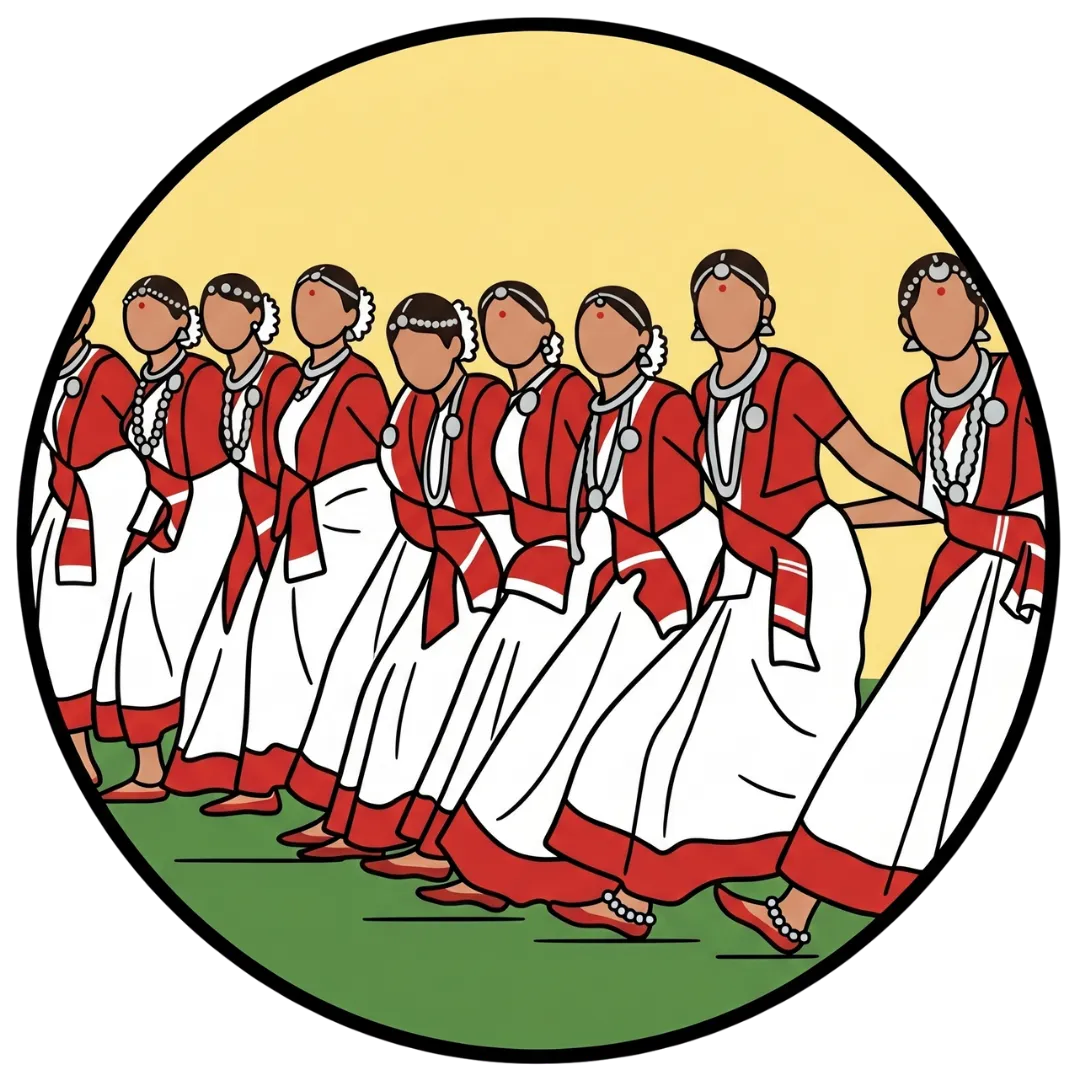
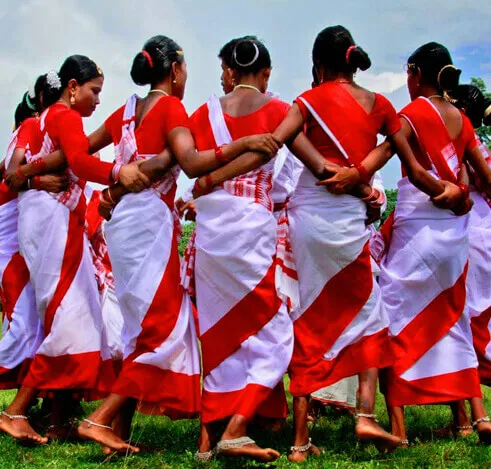
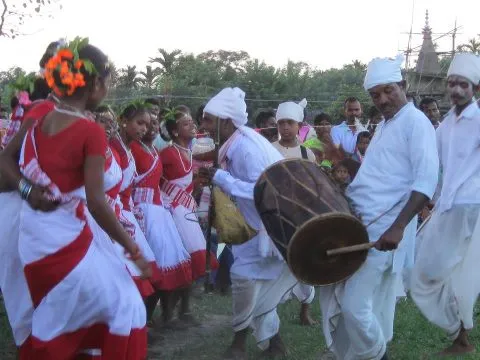
Jhumur performance involves women standing in a line or shoulder-to-shoulder formation, holding each other's waists and moving their hands and legs in synchronised patterns, advancing forward and backward in coordinated sequence. Male performers play instruments while standing or walking alongside. The synchronised footwork and precise formation movements are the primary aesthetic quality of the dance. A call-and-response structure characterises the singing, with a lead singer providing the opening lines and the group responding.
Central Motifs and Their Significance
The thematic content of Jhumur songs encompasses love and nature (seasonal changes, harvest, and romance), the hardships of tea workers (migration, exploitation, and manual labour), and community celebrations (festivals and communal gatherings). The songs also reflect the community's agricultural heritage and spiritual relationship with nature. Scholars have analysed Jhumur songs as a source for reconstructing the oral history of migration and labour that official records have often overlooked. The genre classification of Jhumur songs is detailed: types include Adivasi Jhumar, Kathi Jhumur, Nachni Jhumur, Darbari, Pala, and Dand, reflecting a complex internal differentiation of the tradition.
Process
Jhumur is transmitted informally within the tea garden community through participation in festival celebrations. There is no formal institutional training system. Community practice and family transmission maintain the tradition. The Assam Association and Tea Tribe cultural organisations periodically organise community Jhumur performances at cultural events, providing a more structured public context for the tradition's expression.
Mediums Used
The instruments accompanying Jhumur include the madal (a two-headed drum used in Chotanagpur tribal traditions), dhol (a large double-sided drum), dhak (a large frame drum), cymbals, flute, and shehnai. Women wear white sarees with red borders (representing traditional aesthetics) in many performance contexts, while men wear kurta-dhoti with gamusa (the traditional Assamese cloth marker of identity). The synthesis of ancestral community clothing with Assamese textile traditions in the performance costume reflects the cultural integration that has occurred over generations in the tea garden communities.
New Outlook
Jhumur's visibility has increased significantly with government recognition of the Tea Tribe community's cultural heritage. The Jhumoir Binandini 2025 event and the commemoration of 200 years of Assam's tea industry have positioned Jhumur as a symbol of the community's contribution to Assam's cultural and economic history. Scholarly analysis of Jhumur songs as oral historical documents of migration and labour is a developing area of academic engagement. The community's ongoing demand for Scheduled Tribe status in Assam is connected to broader questions of recognition and preservation of indigenous cultural practices including Jhumur. Documentation initiatives by academic and civil society organisations are important for the form's long-term archive, given its primary transmission through oral tradition.
Learn Jhumur


Bibliography
Sources
Barpujari, H. K., editor. The Comprehensive History of Assam. Publication Board of Assam, 1990.
Ghosh, Bharat. Tea Industry in India. Mittal Publications, 2011.
Gogoi, N. Jhumur Folk Tradition: A Socio-Cultural Identity of the Tea Community in Assam. 2022.
"Jhumair." Wikipedia, https://en.wikipedia.org/wiki/Jhumair.
Image Sources
"Here's All You Need to Know about Jhumur Dance." Northeast Live, https://northeastlivetv.com/around-ne/assam/heres-all-you-need-to-know-about-jhumur-dance/. Accessed 3 July 2026.
"Jhumair." Wikipedia, https://en.wikipedia.org/wiki/Jhumair. Accessed 3 July 2026.
"Jhumur: The Legacy of Assam's Tea Tribes." Oaklores, https://oaklores.com/2025/06/05/jhumur-the-legacy-of-assams-tea-tribes/. Accessed 3 July 2026.
"Tea Folk Jhumur Nach." Tour My India, https://www.tourmyindia.com/states/assam/tea-folk-jhumur-nach.html. Accessed 3 July 2026.