

Jhora - The Folk Dance Tradition of Himachal Pradesh
An exploration of the origins, artistic features, and enduring cultural significance of Jhora, a timeless folk dance
Introduction
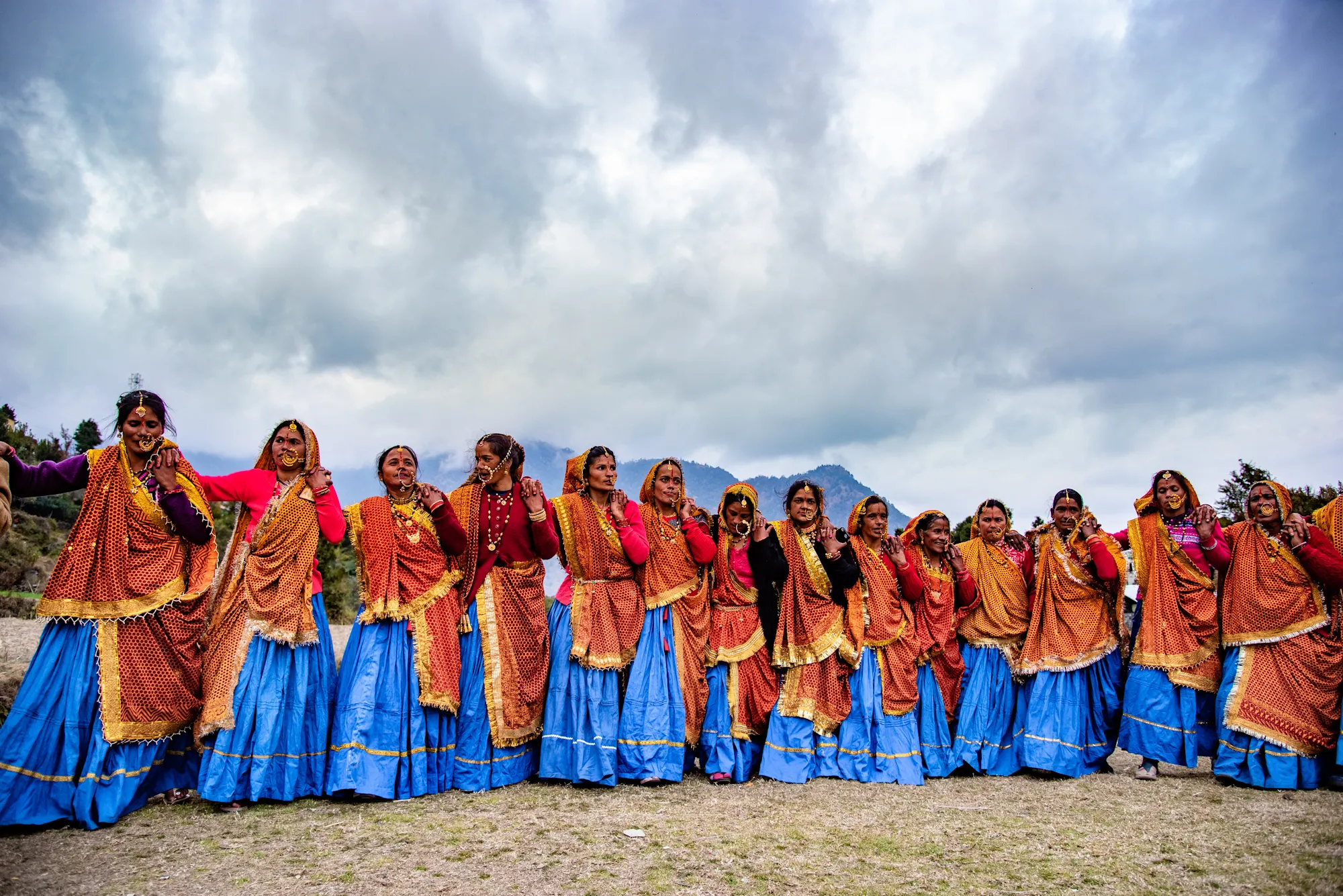
Jhora is a community folk dance of the Kumaon region, performed primarily in Uttarakhand and in adjoining hill areas of Himachal Pradesh where Kumaoni cultural influences extend. It is a springtime celebration dance performed by men and women of all communities, irrespective of caste boundaries, who link arms and move in a slow, synchronized circle to the beat of the hurka drum. Jhora is notable for its social inclusivity: it is one of the few hill folk forms in which high and low castes participate together, with the caveat noted in some sources that in villages with strict caste practices, separate Jhoras may be held. The dance is performed during the Holi season and in the spring months, and also at weddings, fairs, and community celebrations. It can last from a few hours to an entire night or longer, with new participants joining as the dance continues.
Etymology
The word 'Jhora' is the primary name for this dance form in Kumaoni usage. It is also known by variant names in different areas: 'Jhadawa,' 'Jhawad,' and 'Chachari' are recorded as alternate names for the same or closely related forms. Some sources use 'Jhoda and Chachari' as a combined descriptor for a tradition in which song and dance are performed simultaneously, with participants linking arms and moving in a synchronized circle. The names vary by location and community but all refer to the same basic choreographic structure of arm-linked circular movement.
Origin
Jhora originates in the Kumaon region of what is now Uttarakhand, which was historically known as Uttaranchal. Available sources consistently attribute the dance to the Kumaon hills, where it developed as a springtime celebration dance. The Kumaon region has a long tradition of community gathering at fairs and festivals, and the Holi season is described in regional sources as a period of extensive communal singing and dancing. Jhora's spread into adjoining hill areas, including parts of Himachal Pradesh, reflects the cultural overlap between the Kumaoni and Pahari hill communities of the western Himalayan foothills.
Location
Jhora is most strongly associated with the Kumaon region of Uttarakhand, including the districts of Almora, Nainital, Bageshwar, Champawat, and Pithoragarh. It is also practiced in the Garhwal region of Uttarakhand and in parts of Himachal Pradesh where Kumaoni communities are present. Village Jhoras are community events organized in the akhra (open village gathering space) or in open fields.
Community
Jhora is a community dance in the fullest sense: it is not the property of any single caste, tribe, or occupational group, and is performed by all community members regardless of social position. This inclusive character is one of the most frequently noted features of the form in available documentation. Available sources note that while Jhora breaks caste boundaries in the abstract, some villages with strict caste practices hold separate Jhoras for different caste groups. The minimum number of participants required is six, but Jhora gatherings commonly grow to hundreds as spectators join the dance.
Relevance
Jhora is a medium-visibility tradition that represents the broader category of north Indian hill community dances organized around the agricultural and seasonal calendar. Its social significance lies in its function as a space of communal integration, where the usual social hierarchies of village life are temporarily suspended in shared celebration. The form is practiced both in traditional village contexts and at government-sponsored cultural events in Uttarakhand and Himachal Pradesh.
History
Jhora belongs to a family of Kumaoni community dances that includes Chanchari, Chhapeli, and Jhoda, all of which involve circular or semi-circular movement, linking of arms, and collective singing. These forms are part of the folk performance culture that developed in the agricultural communities of the Kumaon hills over many centuries and is transmitted orally. No historical texts specifically documenting the origins of Jhora have been identified. Wandering bards (known as bhatt or bard communities) have been associated with announcing the arrival of spring through song and dance, providing one possible origin narrative for Jhora's seasonal function, though this connection is noted in folk sources rather than academic documentation.
Culture and Societies
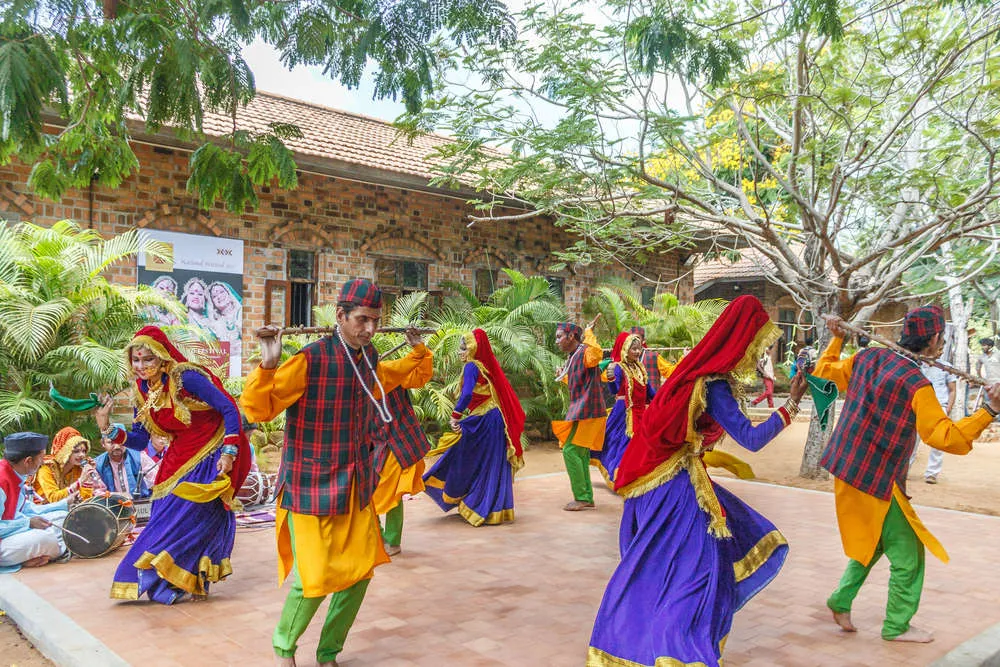
Jhora is performed typically in the evening, though it can be performed in the morning as well during spring festivals. The Holi season is the primary festival context, with Jhora dances organized across multiple evenings during the month-long Holi celebrations of the Kumaon region. At weddings and village fairs, Jhora performances provide the central communal entertainment. The dance has no fixed time limit: a Jhora can continue for twenty-four hours or more, with participants joining and resting in rotation. When performers are particularly enthusiastic, the 'Do Manjila Jhora' (double-story Jhora) is performed, in which the standard formation is doubled.
Religious Significance
Jhora does not have a specific devotional or ritual function in the available documentation. It is a secular celebration dance whose social function is communal integration and joyful expression. It is performed during festival seasons that have religious significance (Holi, Baisakhi) but the dance itself is not a religious act. Some sources describe the spring season in Kumaon as a time when community members express gratitude for the land's renewal, giving the dance a general cultural and seasonal significance, but no specific deity or ritual is associated with the form.
Understanding the Art
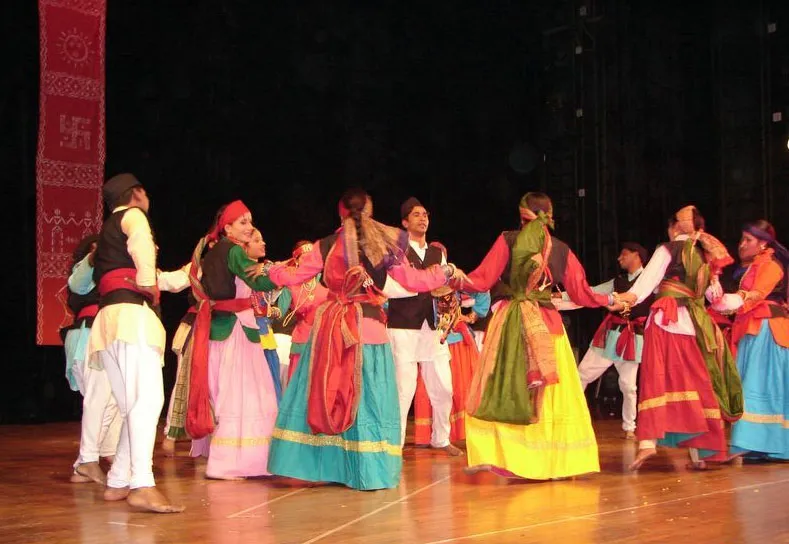
Jhora is performed with participants linking arms at the shoulder and moving in a slow but precisely synchronized circular pattern. The movement is gentle and flowing rather than athletic: the body bends forward slightly, and the characteristic step sequence involves crossing the right leg over the left on the first beat, then stepping the left leg sideways with a slight jump and dip on the second beat, then returning to the starting position. This step sequence is repeated continuously for the duration of the dance. The speed of the hurka drum sets the pace; as the evening progresses, the tempo may increase slightly.
Central Motifs and Their Significance
The central motif of Jhora is community unity: the linked-arm formation physically enacts the joining of individuals into a collective body, and the dance's inclusive character makes it a practical expression of communal solidarity. The springtime context gives the form an agricultural significance: it celebrates the renewal of the land and the community's collective hope for a productive growing season. The call-and-response songs that accompany the dance are part of the broader Kumaoni oral musical tradition and preserve the language and imagery of hill community life.
Process
A Jhora begins when a musician starts playing the hurka drum. Participants link arms and begin moving in a circle. As the music continues, additional participants join the outer edge of the circle, expanding it until the entire community present is included. Songs are sung in Kumaoni, typically in a call-and-response structure. The tempo is set by the hurka player and remains relatively steady, though it may increase at moments of high energy. A Jhora continues until the community is satisfied, with no fixed endpoint.
Mediums Used
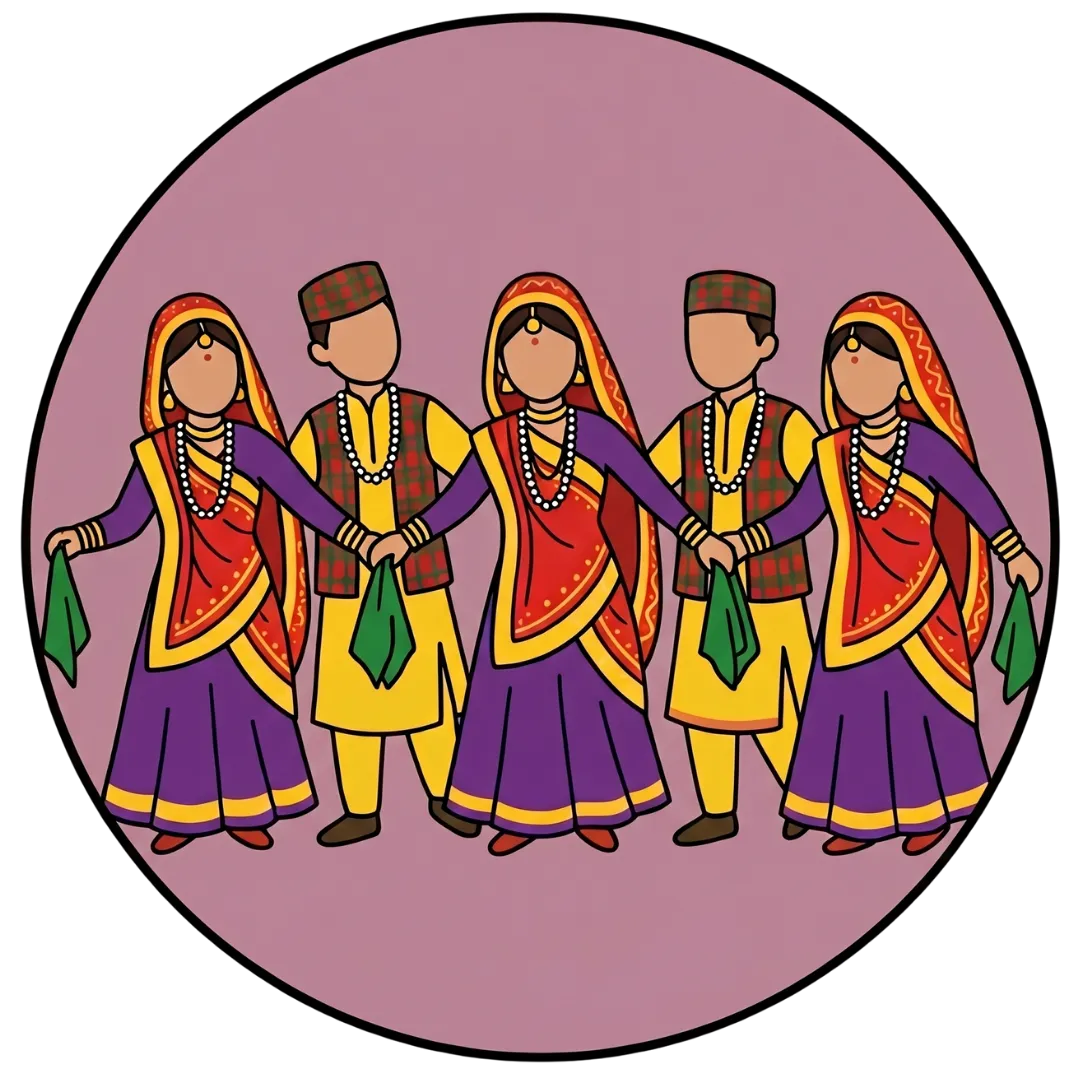
The primary instrument of Jhora is the hurka, a small double-headed hand drum specific to the Kumaoni tradition, shaped differently from the standard dhol and played with the hands. When more participants are present, cymbals (manjira) accompany the hurka. Performers wear traditional Kumaoni attire: men in dhoti, kurta, and turban; women in ghaghra-choli, dupatta, and traditional hill jewelry including silver earrings, necklaces, bangles, and anklets. Costumes are functional and community-specific; elaborate ornamentation is not required for Jhora, which is a community celebration rather than a formal performance.
New Outlook
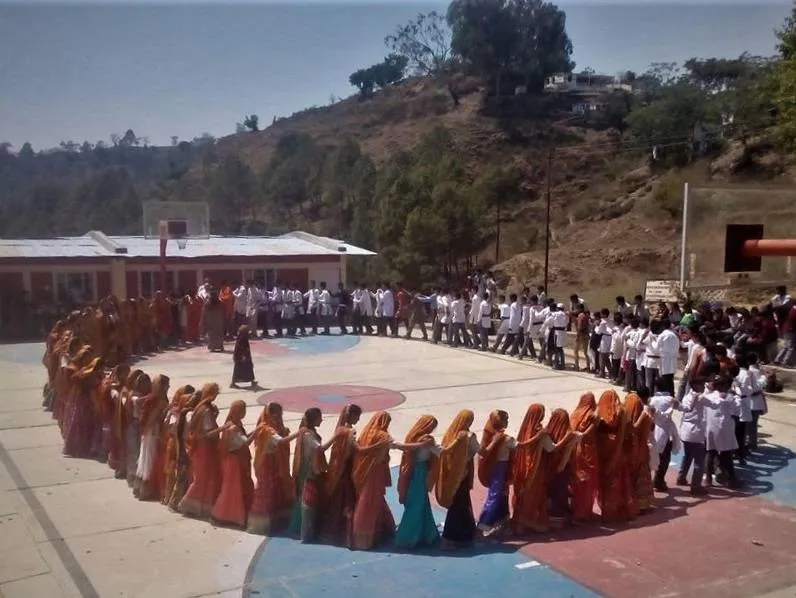
Jhora is a medium-visibility tradition with active practice in the Kumaon region. It is included in Uttarakhand state cultural programming and in the cultural curriculum of hill schools. Tourist interest in the form during the spring festival season provides some incentive for its continuation. The principal challenges are urbanization, the migration of younger generations from hill communities to cities, and the displacement of community gathering practices by electronic entertainment. The Uttarakhand and Himachal Pradesh state governments have included the form in folk festival programming. Comprehensive academic documentation of the form in English-language scholarship remains limited.
Learn Jhora

Bibliography
Sources
Himachal Pradesh Directorate of Language and Culture. Himachal Pradesh Cultural Documentation Series. Directorate of Language and Culture, various volumes.
Pant, Nandini. Folk Culture of Kumaon. Shree Almora Book Depot, various editions.
Sanwal, R. D. Social Stratification in Rural Kumaon. Oxford University Press, 1976.
Youngintach.org. “Folk Dances of India: Jhora Dance.” Young India Intangible Cultural Heritage Documentation Project, https://youngintach.org/.
Image Sources
“Folk Dances of India: Jhora.” StageBuzz, https://stagebuzz.in/2022/05/18/folk-dances-of-india-jhora/. Accessed 4 July 2026.
“Jhora Folk Dance.” Destination Uttarakhand Hills, https://destinationuttarakhandhills.wordpress.com/2021/02/12/112/. Accessed 4 July 2026.
“Jhora Folk Dance.” GoSahin, https://www.gosahin.com/places-to-visit/jhora-folk-dance/. Accessed 4 July 2026.