
Hudo - The Folk Dance Tradition of Gujarat
Explore the evolution and enduring significance of Hudo in Gujarat's folk heritage.
Introduction
Hudo is a competitive folk dance of the Bharwad community, the traditional shepherd and pastoral community of Gujarat, practiced primarily in the Surendranagar region of the state. The dance is defined by its competitive clapping sequences, in which pairs of male dancers face each other and strike their own palms and each other's hands in complex rhythmic patterns while shuffling forward and backward. Its central imagery derives from the behavior of rams in combat: the term 'hudo' refers to competition, and the dancers mimic the confrontational stance and repeated forward thrust of male sheep fighting for dominance. Hudo is most closely associated with the Tarnetar Fair, a large regional gathering held annually in Surendranagar district.
Etymology
The word 'hudo' derives from the Gujarati word 'hod,' meaning competition or rivalry. The name directly describes the competitive dynamic that is central to the performance. The Bharwad community's intimate familiarity with the behavior of sheep and goats in their pastoral work is encoded in the dance's mimetic action. The confrontational head-butting and territorial behavior of male sheep ('hudo' behavior in Gujarati pastoral terminology) is the specific behavioral model for the dance's movements.
Origin
Hudo is indigenous to the Bharwad community of Saurashtra and Kathiawar in Gujarat. The Bharwad are a pastoral caste whose traditional occupation involves the herding of sheep and goats, and their folk culture, including dress, music, and dance, is closely connected to pastoral life. The dance originated in the Surendranagar region, which has historically been a center of Bharwad settlement and activity. The specific date of origin has not been established through documentary sources; the dance is transmitted orally within the community.
Location
Hudo is practiced primarily in Surendranagar district and in other Bharwad-inhabited areas of Saurashtra and North Gujarat. The Tarnetar Fair, held annually at the Trinetreshwar Mahadev temple in Thangadh taluka of Surendranagar district, is the principal performance occasion for Hudo, and the fair draws large crowds specifically to witness this and other Bharwad performances. The form is also performed at community events and celebrations within Bharwad villages.
Community
Hudo is the specific dance of the Bharwad community. The performance is traditionally male, with young men competing in pairs to demonstrate their speed, agility, and rhythmic precision. The Tarnetar Fair has historically been a social event at which young Bharwad men and women assemble, with the dances serving a social function in mate selection and community display. The tradition that Hudo performances at Tarnetar culminate with opportunities for the selection of life partners is documented in descriptions of the fair.
Relevance
Hudo is one of the most distinctive folk dance forms of Gujarat in terms of its specific community origin and performance technique. Its association with the Tarnetar Fair gives it a defined performance context and an annual occasion that sustains its practice within the Bharwad community. However, the form has limited visibility outside the specific community and region, and is classified as a low-visibility, vulnerable tradition at the state and national level.
History
Hudo belongs to the body of occupational and community-specific folk performances that characterize the cultural life of Gujarat's pastoral and agricultural communities. It has not been documented in classical or medieval texts and is entirely an oral tradition. The Tarnetar Fair, with which Hudo is most associated, is itself a major institution in Saurashtra culture, centered on the Trinetreshwar Mahadev temple and described in various Gujarat government and tourism publications as one of the state's most significant rural fairs. The fair's role in bringing pastoral and farming communities together for trade and social interaction has given Hudo a dedicated annual platform.
Culture and Societies
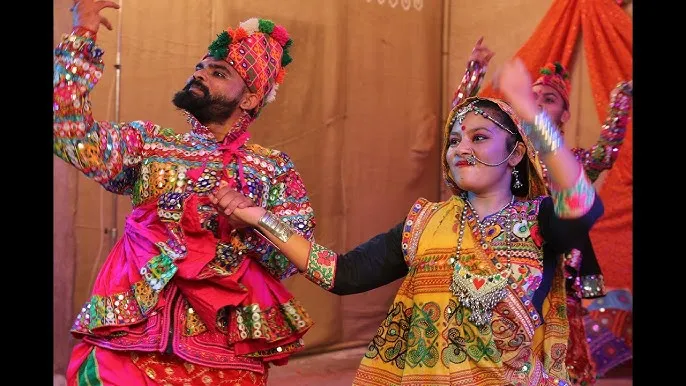
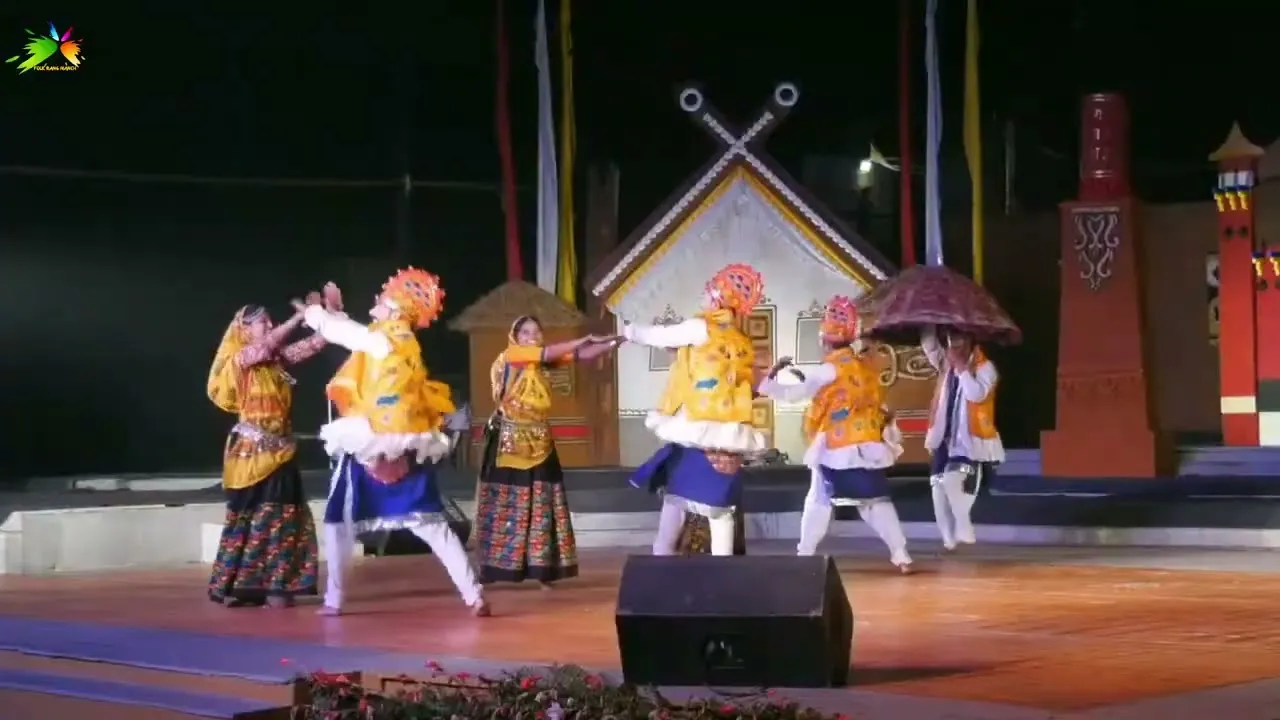
At the Tarnetar Fair, Bharwad performers in full traditional dress engage in Hudo competitions and performances before large audiences. The dance is performed in pairs, with the two dancers facing each other. They begin by striking their own palms together, then strike their partner's palms in increasingly rapid and complex patterns, while shuffling forward and backward in imitation of rams testing each other's strength. The absence of song lyrics in Hudo is notable: the only sound is the powerful rhythmic echo of the dhol, the hand clapping of the dancers, and the crowd's response. The performance communicates competition, physical skill, and community pride.
Religious Significance
Hudo does not have a documented primary religious significance. The Tarnetar Fair is a religious event centered on the Trinetreshwar Mahadev (a form of Shiva) temple, and the fair as a whole takes place in a religious context. Bharwad identity is informed by Hindu devotional practice, and Shiva is venerated by the community. However, Hudo as a specific performance form is not documented as a devotional act but as a competitive social display. No specific ritual or religious function for Hudo has been established in the available sources.
Understanding the Art
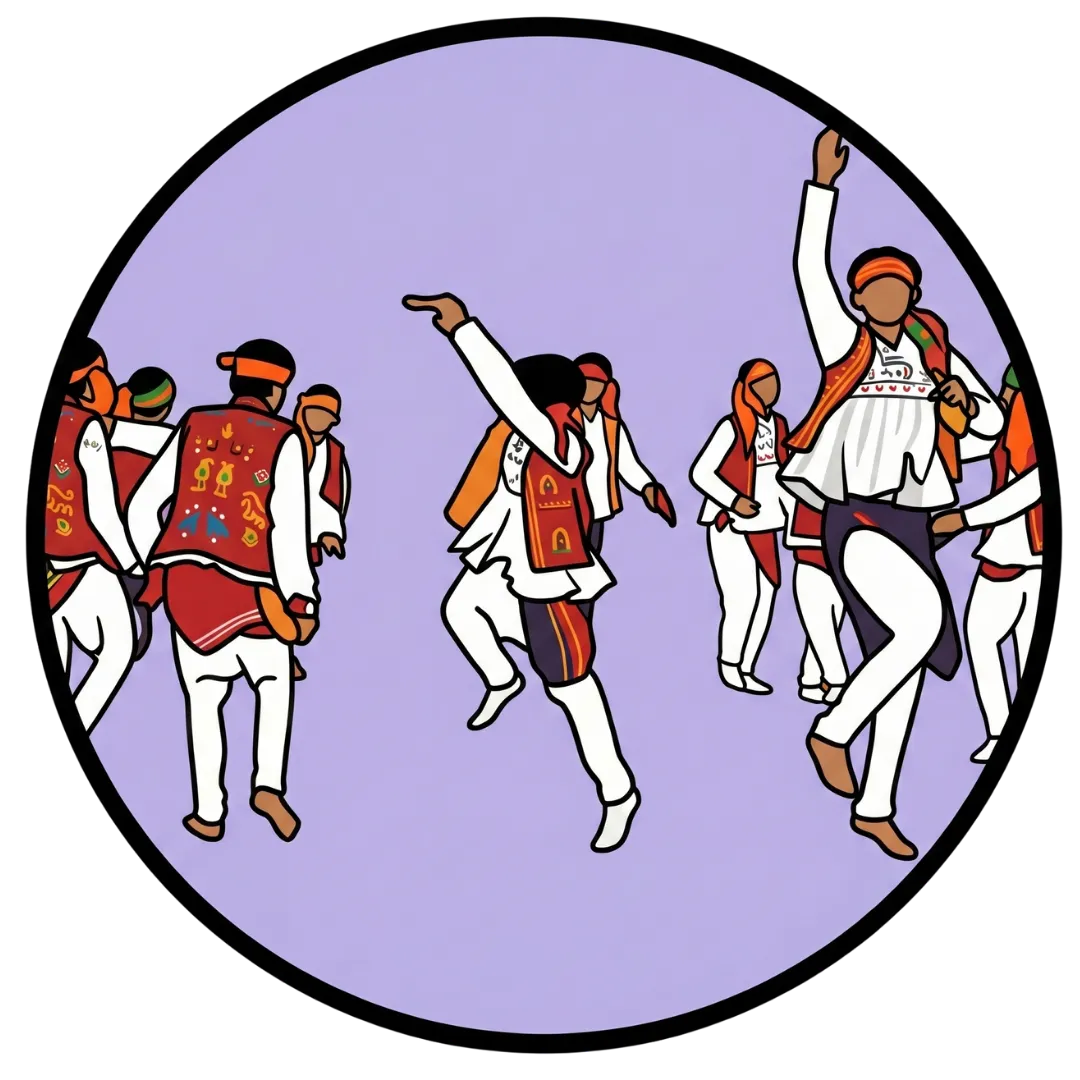
The performance style of Hudo is competitive and athletic. Two dancers face each other, standing approximately an arm's length apart. They hold their arms at chest height and begin a rapid exchange of clapping movements: striking their own hands together, then striking the partner's hands, following a sequence that escalates in speed and complexity. The footwork consists of a shuffle step in which the dancers move forward and backward, closing and retreating in imitation of rams in combat. The dhol provides the rhythmic structure, and the tempo increases through the performance. There are no song lyrics; the dance is purely percussive.
Central Motifs and Their Significance
The central motif of Hudo is the competition between rams. The Bharwad community's pastoral identity is encoded in the choice of the sheep ram as the behavioral model for the dance. Competitive dance as a mode of displaying physical prowess and community membership is a common feature of pastoral and nomadic folk performance traditions globally, and Hudo exemplifies this pattern within the Gujarat context. The sound of the dhol and the amplified echo of clapping hands in the open-air fairground setting are themselves significant, creating an immersive sonic environment.
Process
Hudo performances at the Tarnetar Fair are organized informally, with groups of Bharwad men competing in pairs in an open space surrounded by spectators. Participants wear full traditional Bharwad dress. The dhol player sets the tempo, which begins at a moderate pace and accelerates. Pairs of dancers face off and execute the clapping sequences, which are evaluated informally by the community audience based on speed, precision, and endurance. The dance may continue for extended periods with different pairs taking turns.
Mediums Used
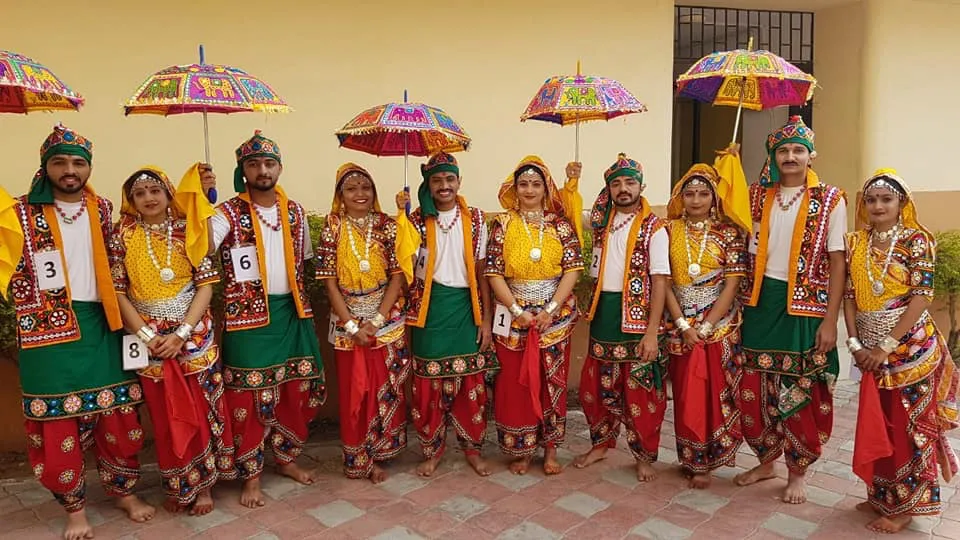
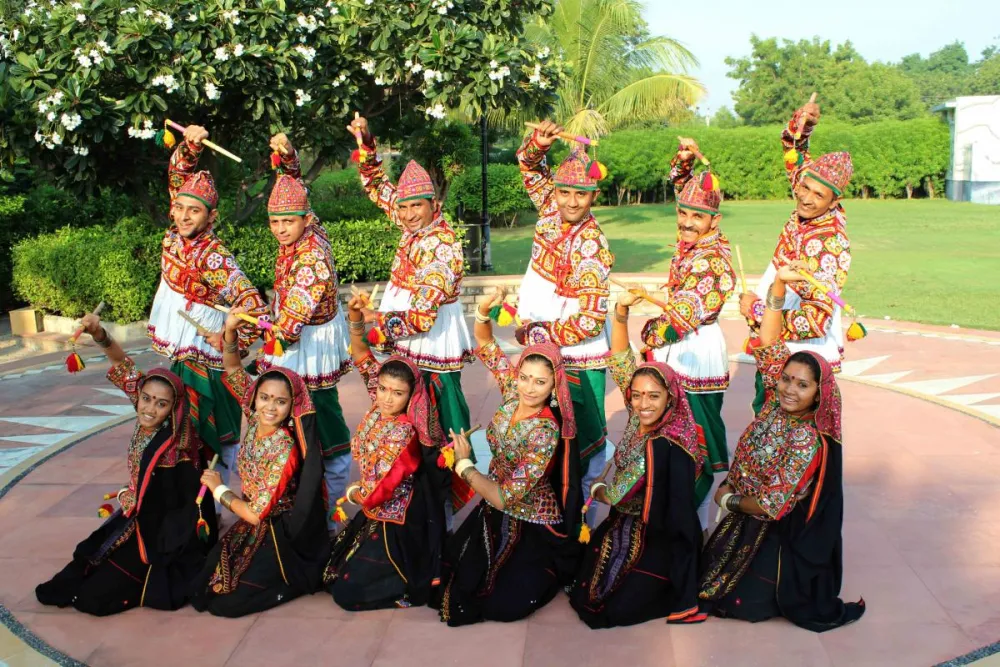
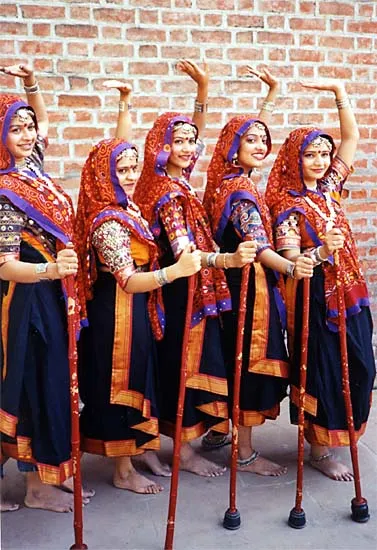
Hudo requires no props beyond the dancers' own hands. The musical accompaniment is provided by dhol, dholak, flute, kansi (small cymbals), joda (larger cymbals), and manjira (finger cymbals). Bharwad traditional costume for men includes boris (a specific type of upper garment), bandi (waistcoat), and traditional jackets in the community's style, which features distinctive embroidery and bright colors. Women's Bharwad dress includes jimi (upper garment), kapadu (lower garment), and fumta (head covering), with the community's characteristic silver and brass jewelry. The umbrella decorated with embroidery, mirror work, and lace is a notable prop carried by some performers.
New Outlook
Hudo is a vulnerable tradition with limited institutional support. Its practice is largely confined to the Bharwad community and to the Tarnetar Fair context. The Gujarat Tourism Department promotes the Tarnetar Fair as a cultural tourism destination, which provides some incentive for the continuation of Hudo performances, but this visibility has not translated into formal preservation or training programs. Younger members of the Bharwad community, particularly those who have migrated to urban areas, are less engaged with the tradition. Documentation of the form has been undertaken by organizations such as Sahapedia and in academic studies of Gujarat's folk traditions, but comprehensive institutional support is absent.
Learn Hudo
Bibliography
Sources
Doshi, Saryu, editor. Dances of Gujarat. Marg Publications, 1971.
Gujarat Tourism. Documentation of Tarnetar Fair. Government of Gujarat, various years.
Kothari, Sunil. Folk Dances of India. Marg Publications, 1994.
Sahapedia. “Raas Traditions of Gujarat.” Sahapedia, https://www.sahapedia.org/.
Image Sources
“Folk Dances of Gujarat.” Caleidoscope, https://caleidoscope.in/art-culture/folk-dances-of-gujarat. Accessed 4 July 2026.
“Hudo Dance – Folk Dance of India.” Dance India Blog, https://blog-city.info/en/danceindia.php?Page=5. Accessed 4 July 2026.
“Rās Traditions of Gujarat.” Sahapedia, http://www.sahapedia.org/r%C4%81s-traditions-of-gujarat. Accessed 4 July 2026.
“Traditional Hudo Dance.” YouTube, https://www.youtube.com/watch?v=J9zHapT9w1Q. Accessed 4 July 2026.
“Traditional Hudo Dance Performance.” YouTube, https://www.youtube.com/watch?v=OHQOq_j5EL4. Accessed 4 July 2026.