
Ghoomar - The Folk Dance Tradition of Rajasthan
From royal courts to community festivals, explore the evolution and enduring cultural significance of Ghoomar in Rajasthan.
Introduction
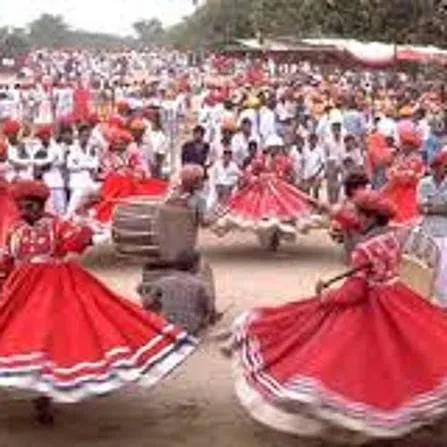
Ghoomar is a traditional folk dance of Rajasthan, India, widely recognized as the state's most emblematic performing art form. It is performed primarily by women, who wear flowing circular skirts called ghaghra and dance in a group formation, entering and exiting a wide circle while pirouetting to create a kaleidoscopic display of color and movement. The name derives from the Hindi word ghoomna, meaning to spin or turn, and the characteristic twirling movement remains the defining physical gesture of the dance. Ghoomar was originally developed by the Bhil tribe of the Marwar region (present-day Jodhpur and surrounding areas) as a devotional performance offered to Goddess Saraswati, and was subsequently adopted by Rajput communities over centuries, eventually spreading across all social strata of Rajasthan.
Etymology
The term Ghoomar is derived from the Hindi verb ghoomna, which means to revolve, spin, or turn around oneself. The word directly describes the central technical element of the dance: the circular twirling movement in which the dancer's ghaghra spreads outward to create a wide, colorful arc. The term is also sometimes rendered as Ghumar or Jhumar in regional variations. The circumference of the ghaghra as it spreads during the spin is referred to locally as ghumm, pointing to the etymological connection between the skirt's movement and the dance's name.
Origin
Ghoomar originated among the Bhil tribe, an indigenous community of the Marwar region of Rajasthan. Multiple sources, including the Wikipedia article on Ghoomar and academic cultural surveys, attribute the initial creation to the Bhil community, who performed it as an offering to Goddess Saraswati. Following a period of conflict and subsequent peaceful coexistence between Bhil communities and Rajput rulers (notably the Kachhwaha clan of Jaipur), the dance was adopted into Rajput court culture. Royal women of Jaipur began performing Ghoomar on auspicious occasions, and the tradition subsequently spread to other Rajput clans and eventually to broader Rajasthani society.
Location
Ghoomar is practiced across Rajasthan, with regional variations documented in Udaipur, Jodhpur, Kota, Bundi, and Jaipur. The Kota-Bundi variation is considered particularly lively and is regarded by some practitioners as the most popular regional style. In Udaipur, the dance resembles elements of Garba, the neighboring folk dance of Gujarat, and is performed with a musical emphasis. In Jodhpur, limb movements are characterized as more angular. The Jaipur style reflects the dance's historical association with the royal women of the Kachhwaha Rajputs. The dance was originally developed in Marwar, the southwestern historical region of Rajasthan centered on Jodhpur.
Community
Ghoomar is performed by women across caste and community lines in Rajasthan. Its origins in the Bhil tribal tradition, its adoption by Rajput royalty, and its subsequent spread to middle-class and agricultural communities demonstrate a cross-social trajectory unusual among Indian folk dance forms. The newly married bride is expected to perform Ghoomar upon arriving at her marital home, a ritual function that is documented across regional accounts. Men do not typically perform the dance, and historically the performances were restricted to ladies' gatherings. The Gangaur Ghoomar Dance Academy, established in 1986 by Maharani Rajmata Goverdhan Kumari of Santrampur, represents institutionalized effort to preserve and transmit the form; the Maharani received the Padma Shri in 2007 for her contributions to arts.
Relevance
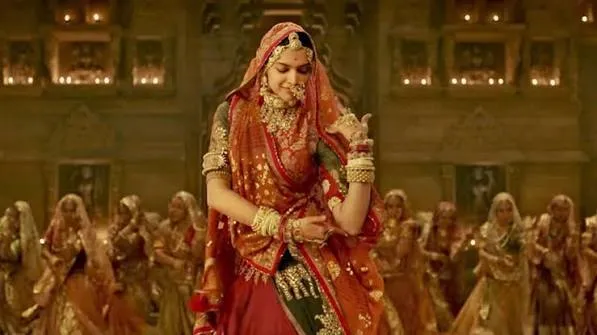
Ghoomar is designated as the state dance of Rajasthan and is considered the most widely recognized folk dance form of the state. It is performed at weddings, the festival of Teej, Gangaur, Holi, Diwali, and during the monsoon season. The dance has received international exposure through cultural festivals such as the Rajasthan International Folk Festival in Jodhpur (RIFF) and the Jaipur Literature Festival. UNESCO recognizes Ghoomar as part of Rajasthan's intangible cultural heritage, though it is not separately inscribed on UNESCO's Representative List. The 2017 Bollywood film Padmaavat featured a song titled Ghoomar, performed by actress Deepika Padukone, which significantly raised the dance's profile among younger urban audiences nationally and internationally.
History
Background
The historical trajectory of Ghoomar spans at least several centuries and is interwoven with the political history of Rajputana. The Bhil community's role as the originating tradition is documented consistently across cultural sources. The Bhils were a major community in the Marwar and Mewar regions of Rajasthan and were frequently in military conflict with Rajput kingdoms. The period of accommodation following such conflicts included the adoption of Bhil cultural practices, including Ghoomar, by Rajput women. The Kachhwaha Rajputs of Jaipur are specifically documented as having integrated the dance into their royal ceremonial culture. From the royal household, the dance spread to aristocratic and merchant families and eventually to general Rajasthani society, following a pattern of elite adoption and trickle-down diffusion documented in multiple folk art traditions of India.
Culture and Societies
Within Rajasthani culture, Ghoomar serves as a marker of womanhood, cultural belonging, and communal joy. The requirement for newly married brides to perform Ghoomar functions as a rite of passage, integrating the bride into her new family and community through shared artistic expression. In some parts of Rajasthan, the dance also marks a girl's transition into womanhood. Ghoomar is inseparable from the visual culture of Rajasthan: the ghaghra and choli worn during performances, heavily embroidered with mirrorwork and zari, have influenced regional textile and fashion traditions. The Unnati Silks blog and similar cultural sources note that the Ghoomar ghaghra style popularized the Chaniya Choli and Ghagra Choli garment forms beyond Rajasthan.
Religious Significance
Ghoomar has a documented religious origin as a devotional dance performed by the Bhil tribe for Goddess Saraswati, the Hindu deity of wisdom, knowledge, and the arts. This devotional origin is recorded consistently across academic and institutional sources. In its later evolution, the dance retained an auspicious character: it is performed during religious festivals such as Teej, Gangaur (a festival dedicated to Goddess Gauri), and Navratri, and is considered a way to invoke blessings for prosperity. However, in its current practice across Rajasthan, Ghoomar functions primarily as a celebratory cultural performance rather than a strictly devotional ritual. The distinction between its originating religious function and its contemporary social function is noted in multiple cultural surveys.
Understanding the Art
Style
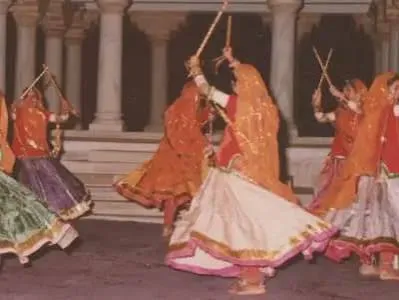
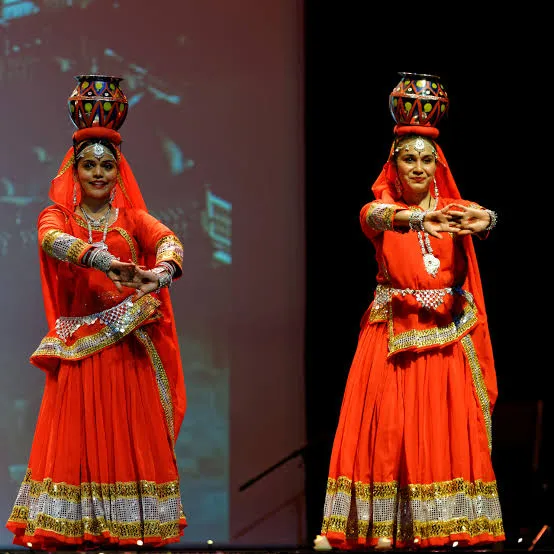
The defining movement of Ghoomar is the pirouette performed while moving in and out of a circular formation. Dancers enter the circle, twirl with the ghaghra fanning outward, and exit in continuous rotation. The technical elements include clapping of hands, snapping of fingers, graceful hand maneuvering (hasta mudras adapted from folk rather than classical tradition), and footwork synchronized with the musical rhythm. The pace of the music accelerates as the performance progresses, and the dancers match the increasing tempo. Performers wear a ghoonghat (veil covering the face), and the interplay of veiled faces with spinning color creates the characteristic visual effect. Regional styles introduce variations: the Kota-Bundi style is fast and lively, the Jodhpur style involves more angular limb movements, and the Udaipur style incorporates elements resembling Garba.
Central Motifs and Their Significance
The primary symbolic content of Ghoomar centers on femininity, fertility, and communal celebration. The circular formation and the inward-outward movement pattern are interpreted by practitioners as representing the circle of life, unity, and the cyclical nature of time. The act of spinning in colorful garments has been compared by some cultural commentators to a kaleidoscope, expressing the idea of beauty in collective motion. The folk songs performed during Ghoomar, including Gorband, Podina, Rumal, and Mor Bole Re, describe themes of conjugal life, love, and the seasonal rhythms of Rajasthani domestic culture. These songs contextualize the dance within a feminine social world and reinforce its function as an expression of women's community.
Process
Ghoomar is typically performed in group formations of five to twenty or more women. One woman may lead the song while others join in chorus, or a separate group of men may provide the musical accompaniment while women dance. The instruments used include the dholak (double-headed drum), manjira (hand cymbals), and harmonium. In some formal presentations, the sarangi (bowed string instrument) and nagada (kettledrum) are also used. The dance begins at a moderate tempo and accelerates, with the spinning increasing in speed to match the music. The performance may last for hours at festive occasions, with dancers entering and exiting the circle in rotation.
Mediums Used
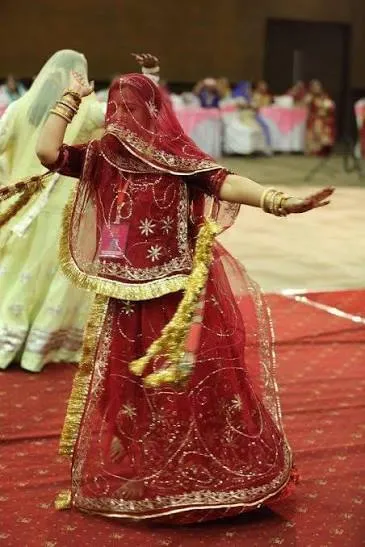
The ghaghra is the central material element of the performance: a long, heavily pleated circular skirt of cotton or silk, typically embroidered with gota work, zari (gold or silver metallic thread), and mirror (shisha) embellishments. Colors include deep reds, pinks, yellows, and blues. The choli (fitted blouse) and odhni (veil or headscarf) complete the ensemble. Traditional Rajasthani jewelry, including necklaces, bangles, maang tikka (forehead ornament), and Kundan (glass-set gold) pieces, accompanies the costume. The heaviness and fullness of the ghaghra is integral to the visual effect: garments are designed to maximize the circular spread during spinning. The quality of embroidery and the proportion of silk or zari in the ghaghra historically indicated the wearer's economic status.
New Outlook
Ghoomar is in an actively thriving state. Its recognition as the state dance of Rajasthan, its integration into school curricula, its visibility at national and international cultural festivals, and its popularization through cinema have sustained its relevance among younger generations. Cultural organizations and academic institutions in Rajasthan continue to document and teach the form. The Rajasthan government's tourism-related cultural programs regularly feature Ghoomar performances. Concerns exist among practitioners and scholars about the dilution of regional stylistic distinctions as standardized stage-performance versions become dominant over community-based variations. The Bollywood rendering of the dance, while increasing its visibility, has also introduced choreographic elements not native to the folk tradition.
Learn Ghoomar
Bibliography
Sources
Devi, Ragini. Dance Dialects of India. Rev. ed., Motilal Banarsidass, 1990.
Kothari, Komal. Folk Musical Instruments of Rajasthan. Rupayan Sansthan, 1977.
Leavitt, John. Musical Gestures: Sound, Movement, and Meaning. Routledge, 2008.
Mathur, U. B. Treasure-trove of Rajasthan. Folklorists, 2002.
Image Sources
“Ghoomar.” SoundCloud, https://soundcloud.com/ritaadhirani/ghoomar-veena-original-rajasthani-traditional-ghoomar-dance. Accessed 4 July 2026.
“Ghoomar.” Stuti Agrawal, https://www.stutiaga.com/portfolio/ghoomar/. Accessed 4 July 2026.
“Ghoomar: Traditional Dance of the Community.” RajpurohitM, https://rajpurohitm.com/blog/ghoomar-traditional-dance-of-community. Accessed 4 July 2026.
“Rajput Woman Performing Ghoomar.” Wikimedia Commons, https://commons.wikimedia.org/wiki/File:Rajput_Woman_performing_Ghoomar_01.jpg. Accessed 4 July 2026.
“Everything about Ghoomar You Need to Know – History, Styles, Attire & More.” Unnati Silks, https://www.unnatisilks.com/blogs/celebrating-india/15700-2?srsltid=AfmBOopXa_5joKG4jD92p1v9iM77Ly64tX2Ba_kI75pFHuZ7naMXjSR1. Accessed 4 July 2026.