
Garba - The Folk Dance Tradition of Gujarat
Delve into the timeless appeal of Garba, Gujrat's iconic folk dance.
Introduction
Garba is a circular folk dance of Gujarat, performed primarily by women during the nine-night Navaratri festival in honor of Goddess Amba (also known as Shakti or Durga). It is named from the Sanskrit compound 'Garbha Deep,' meaning lamp in the womb, referring to the earthen pot with a lamp inside that traditionally occupies the center of the dance circle. In December 2023, UNESCO inscribed Garba on the Representative List of Intangible Cultural Heritage of Humanity, making it India's fifteenth element on this list. The form is practiced across Gujarat and by Gujarati communities worldwide, and is considered one of the most significant expressions of Shakti worship in the Indian folk tradition.
Etymology
The name 'Garba' is derived from the Sanskrit terms 'garbha,' meaning womb, and 'deep' or 'deepa,' meaning lamp. The full compound 'Garbha Deep' refers to the lamp placed inside a perforated earthen pot, which is placed at the center of the dance circle. The lamp inside the pot is understood to represent the divine light of the Goddess contained within the womb of creation. Alternative names used in different contexts include 'Garbi,' 'Garbha,' and 'Garbha Deep.' Over time, the name 'Garba' came to refer to the entire dance form rather than only the central object.
Origin
Garba is rooted in the worship of Goddess Amba (Jagdamba), the primary form of the Mother Goddess in Gujarat's folk religion. The dance is associated with the Shakti Peetha tradition and with the Bhakti movement that flourished in Gujarat from the fifteenth century onward. Its origins as a women's devotional dance around the Garbha Deep pot are described in medieval Gujarati devotional poetry, including compositions attributed to the saint-poet Narsinh Mehta (1414 to 1481), who is considered the first major poet of the Gujarati bhakti tradition and is known to have composed songs specifically for Garba. The UNESCO inscription situates the origins of Garba in the ancient practice of fertility worship and the veneration of the Mother Goddess, which predates the Bhakti period in the region.
Location
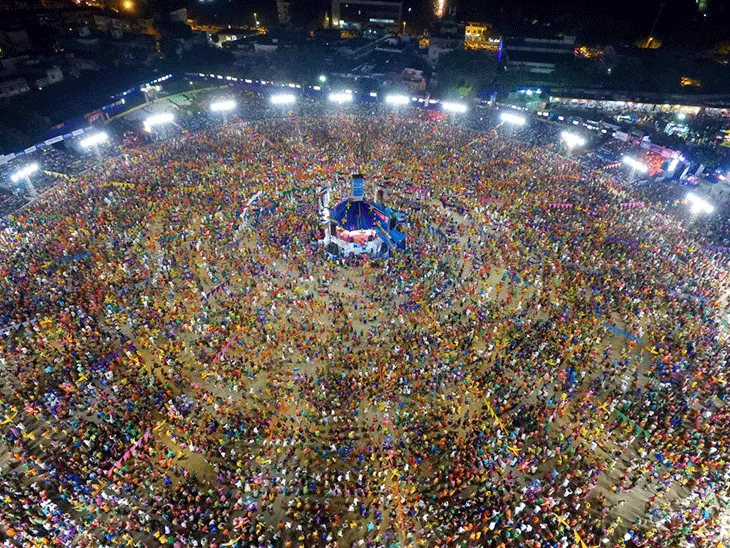
Garba is practiced statewide in Gujarat, with concentrations in all major cities and towns. It is also practiced in Rajasthan, Madhya Pradesh, and Maharashtra, and by Gujarati diaspora communities in the United Kingdom, the United States, Canada, East Africa, Australia, and the Middle East. The annual Navaratri festival in Vadodara and Ahmedabad attracts some of the largest Garba gatherings in India, with events organized in open grounds and stadiums drawing hundreds of thousands of participants over the nine festival nights.
Community
Garba was historically a women-only practice, performed by women of all communities within the broadly Hindu Gujarati cultural zone. Over the course of the twentieth century, men began to participate in public Garba events, and the form has become largely inclusive of all genders in contemporary practice. The UNESCO documentation specifically notes the tradition's social function in promoting gender inclusivity and equal participation. In traditional village settings, gender-segregated forms of Garba persist alongside mixed community events.
Relevance
Garba is the most widely recognized cultural product of Gujarat and one of the best-known folk dances of India. Its UNESCO inscription in 2023 confirmed its international significance and placed it within the global framework of intangible cultural heritage protection. The form functions simultaneously as a devotional practice, a community celebration, and a vehicle for cultural identity among Gujarati communities worldwide. The scale of Navaratri Garba events in India and internationally has grown substantially over the past three decades, and the form has received sustained governmental, institutional, and media attention.
History
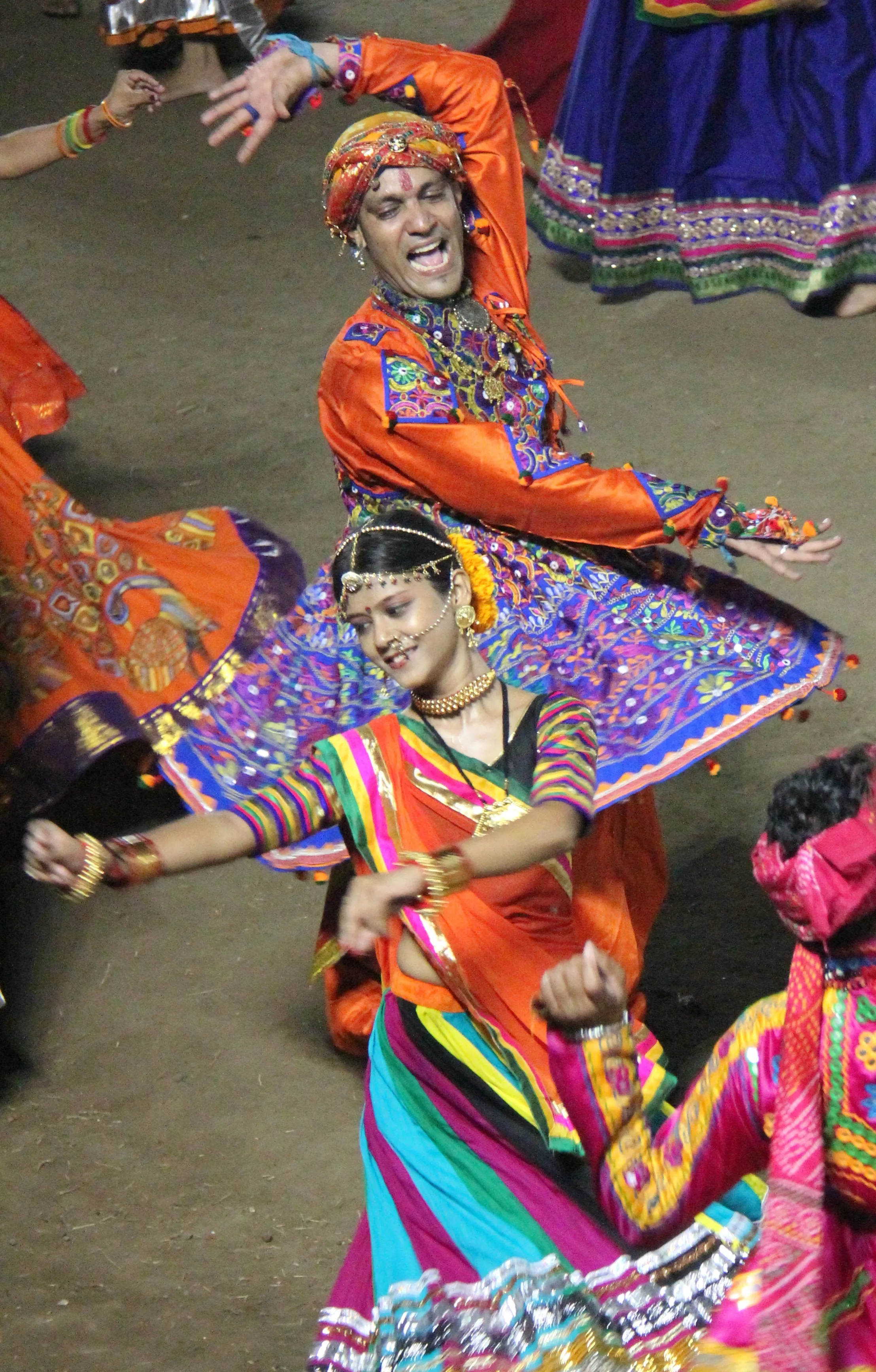
The earliest textual evidence for the Garba tradition is found in the compositions of Narsinh Mehta and subsequent Gujarati bhakti poets. The form developed within the Vaishnava bhakti context, with songs addressing both Goddess Amba and Krishna, and it integrated the Raas Lila tradition from the Krishna devotional corpus. By the nineteenth century, Garba was an established part of Navaratri celebrations across Gujarat.
In the twentieth century, urbanization and the growth of large public Navaratri events transformed Garba from a village practice into a mass cultural event. The merger of Dandiya Raas and Garba in modern urban performances, where both are performed at the same venues during Navaratri, is a development of the latter half of the twentieth century.
Culture and Societies
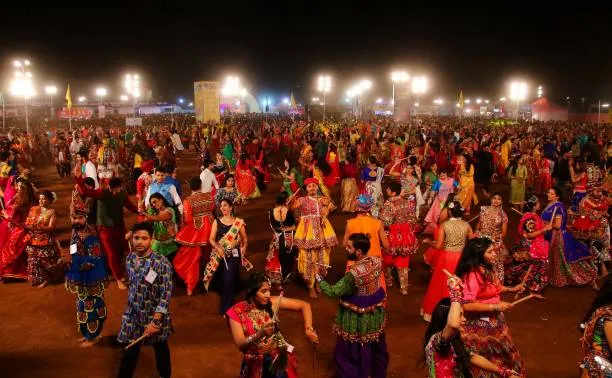
During Navaratri, Garba is performed every evening for nine nights. The traditional village Garba is organized by women who carry decorated clay pots or goddess images to the performance site, establish the Garbha Deep at the center, and dance in concentric circles around it. Songs are sung in Gujarati in the bhakti tradition. In contemporary urban settings, large events are organized by temples, civic bodies, and community organizations, with music provided by live orchestras, dhol players, or amplified recordings. The nine nights of Navaratri culminate in Dussehra, and the Garba danced on each night corresponds thematically to different aspects of the Goddess's nine forms (Navadurga).
Religious Significance
Garba is a devotional act directed to Goddess Amba as Shakti, the divine feminine principle. The circular formation symbolizes the cycle of creation, preservation, and dissolution, with the Goddess at the unchanging center. The dancers' counterclockwise movement encodes a specific cosmological orientation in Gujarat's folk religious understanding. The Garbha Deep at the center of the circle represents the divine womb and the light of consciousness. Songs sung during Garba address the Goddess in her nine forms and narrate her battles with demons and her blessings upon devotees.
Understanding the Art
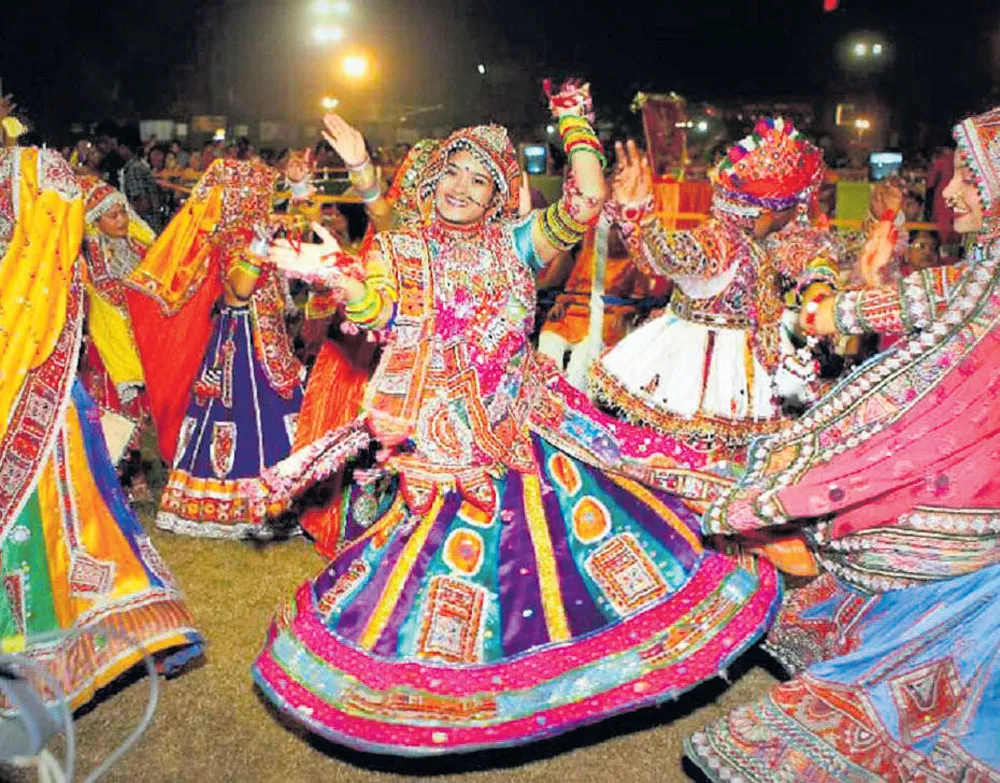
Garba is performed in counterclockwise circles around the Garbha Deep or the Goddess image. The basic movement involves two and three-step patterns executed with specific hand gestures (mudras) and clap sequences. There are several recognized regional styles of Garba within Gujarat, including the Suraseni style of Saurashtra, the Gujarati Gharana style, and the Tali-Kudi style. Traditional Garba is performed with hand clapping and gestures as the only percussion; in contemporary large events, drums and amplified music accompany the dance.
Central Motifs and Their Significance
The central motif of Garba is the circular formation around the Goddess, which encodes the cyclical nature of time and existence as understood in the Shakta religious tradition. The Garbha Deep lamp represents the divine light within the darkness of the womb, a symbol of potential and creation. The counterclockwise movement of the dancers corresponds to the pradakshina (ritual circumambulation) tradition in Hindu temple worship. Mirror embroidery on the women's costumes reflects light during the performance, amplifying the luminous symbolism of the form.
Process
Garba preparations for Navaratri begin weeks in advance in Gujarat. The Garbha Deep pot is prepared and decorated. The performance space is established with the Goddess icon or the Garbha Deep at the center. Participants dress in traditional Gujarati attire and gather at the designated space as evening falls. The performance begins with invocatory songs and prayers, then proceeds through the nine traditional Garba patterns, which increase in tempo and complexity. Songs are in Gujarati and address the Goddess. The performance continues for several hours each evening.
Mediums Used
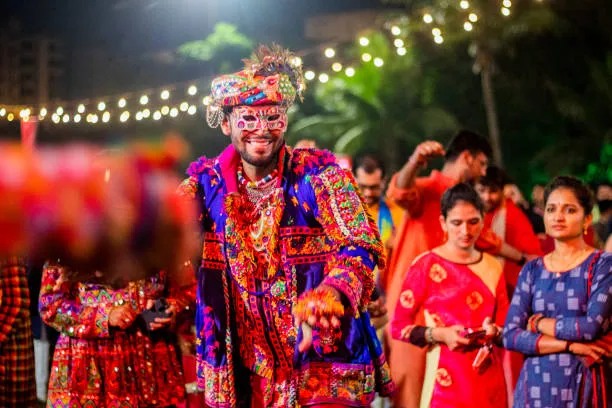
The Garbha Deep is a perforated earthen pot with a lamp inside, traditionally made by local potters and decorated with colors and patterns. Women's traditional costumes include chaniya choli with mirror embroidery (bandhani or gharchola fabric), traditional Gujarati jewelry including the tikka (forehead ornament), nath (nose ring), haar (necklace), bangles, and anklets. Men wear the kediyu (embroidered upper garment) with churidars. Musical instruments in traditional settings include dhol, dholak, cymbals, shehnai, and harmonium.
New Outlook
Garba is one of the most actively preserved and promoted folk traditions in India. The UNESCO inscription of 2023 has generated renewed international attention and has prompted the Gujarat government and cultural organizations to undertake formal documentation, training, and promotion programs. The tradition is taught in schools and dance academies in Gujarat and is central to diaspora community programming globally. Contemporary challenges include the risk of commercialization and the homogenization of diverse regional Garba styles into a single standardized form promoted at large public events. Scholars and practitioners have noted the tension between the devotional character of the form and its transformation into a spectacular entertainment event in large urban contexts.
Learn Garba
Bibliography
Sources
Doshi, Saryu, editor. Dances of Gujarat. Marg Publications, 1971.
Kothari, Sunil. Folk Dances of India. Marg Publications, 1994.
Shah, A. M., and R. G. Shroff. “The Vahivanca Barots of Gujarat.” Traditional India: Structure and Change, edited by Milton Singer, American Folklore Society, 1959.
UNESCO. Garba of Gujarat. Inscription on the Representative List of the Intangible Cultural Heritage of Humanity, 2023.
Vyas, Rasiklal. Folk Dances of Gujarat. Gujarat Vidyapith, various editions.
Image Sources
“Dancing the Garba of Gujarat.” Deccan Herald, https://www.deccanherald.com/features/dancing-the-garba-of-gujarat-558879.html. Accessed 4 July 2026.
“Garba (Dance).” Wikipedia, https://en.wikipedia.org/wiki/Garba_%28dance%29. Accessed 4 July 2026.
“Indian Men and Women Perform Garba & Dandiya Dance During the Navratri Festival.” Getty Images, https://www.gettyimages.in/detail/news-photo/indian-men-and-women-perform-garba-amp-dandiya-dance-during-news-photo/1052146334. Accessed 4 July 2026.
“The Biggest Garba Celebration in Vadodara.” Dainik Bhaskar, https://www.bhaskar.com/news/indias-biggest-garba-celebration-in-vadodara-by-united-way-0984758.html. Accessed 4 July 2026.
“Gujarat Garba.” iStock, https://www.istockphoto.com/photos/gujarat-garba. Accessed 4 July 2026.