


Etikoppaka Toys - Explore Handicraft Works and Cultural Heritage
Explore Etikopakka Toys, the handicraft tradition of Andhra Pradesh, and learn about its origins, techniques, cultural significance, and artistic heritage.
Introduction
Etikoppaka Toys, also known as Etikoppaka Bommalu in Telugu, are traditional handcrafted lacquerware objects produced in Etikoppaka village in the Anakapalli district of Andhra Pradesh, India. The craft involves shaping soft ivory wood on a lathe and applying lac-based natural dyes to produce toys, figurines, utility vessels, and decorative items. The technique is formally designated as "turned wood lacquer craft" or Tharini in the regional craft literature. In 2017, Etikoppaka Toys received a Geographical Indication (GI) tag under the Handicrafts category, registered by the Geographical Indications Registry under India's Geographical Indications of Goods (Registration and Protection) Act, 1999.
Etymology: The name Etikoppaka derives from the Telugu language. According to the Andhra Cultural Portal, the name translates to "Koppaka on the stream," referring to a settlement on the bank of the river Eru, also known as the Varaha. The village is identified in historical records as named after Koppa Raja Narayana, a figure associated with a branch of the Eastern Chalukya dynasty centred around Elamanchili. The word Bommalu in Telugu means figurines or dolls, making Etikoppaka Bommalu a direct reference to the figurines produced in this locality.
Origin: The exact date of origin of the Etikoppaka toy-making tradition is not established through surviving documentation. Various institutional and government sources cite the craft as being approximately 400 years old, placing its active practice at around the 15th to 16th centuries. One documented account, cited by the Andhra Cultural Portal, states that the nearby village of Nakkapalli, originally known as Laccapalli, was the earlier centre of turned wood lacquerware craft, and that artisans migrated to Etikoppaka in the early twentieth century due to the availability of suitable wood-bearing trees in the surrounding forests. Documentary sources state that by the 15th century, toys, boxes, and utilitarian products such as bowls, spice jars, and deity figures were produced in this region for local use and for trade. The Andhra Cultural Portal also notes that the area has an ancient Buddhist mercantile heritage, though the precise relationship between that heritage and the origins of the toy craft has not been established through available academic documentation.
Location: Situated on the banks of the Eru or the Varaha river, Etikoppaka is 64 kilimetres from Visakhapatnam and 4 kilometres from Narasipatnam. It is located in the Anakapalli district of Andhra Pradesh. The village has a population of approximately 12,000 people. The primary raw material, the Ankudu Karra tree (Wrightia tinctoria) is acquired from forests located 30 to 40 kilometres from the village. This craft is also practised in surrounding villages which include Kottam, Kailasapatnam, Rolugunta and K. D. Pet.
Community: The artisan communities engaged in Etikoppaka toy-making belong to multiple caste groups including the Vishwa Brahmin, Devanga, Gouda, Padmasali, Konda, Setty Baliga, and Kapu communities. According the Craftmark India resource compiled for the Asia InCH encyclopedia, the Vishwa Brahmin community, traditionally identified as carpenters, were the earliest practitioners of the craft in the region. The Padmasali and Devanga communities, originally engaged in weaving, joined the craft after the local weaving industry declined in the early 1990s. Currently, approximately 160 artisan households are directly engaged in production, and nearly 140 women artisans are active in the village and its surroundings. The Andhra Pradesh Handicrafts Development Corporation Limited, a state government undertaking, provides institutional support to this artisan base.
Relevance: Etikoppaka Toys carry national and international recognition as a GI-tagged handicraft product. The craft has been displayed at the Rashtrapati Bhavan in New Delhi. Artisans associated with this tradition have received recognition from the National Innovation Foundation (NIF), UNESCO's CCI Seal of Excellence for Handicrafts, and the Indian National Trust for Art and Cultural Heritage (INTACH). The National Institute of Design (NID) has conducted workshops with artisans to assist in product diversification. Products are currently exported to countries including the United States, Australia, France, Italy, and Germany, according to Wikipedia's article on Etikoppaka. The World Intellectual Property Organization (WIPO) has documented the role of GI certification in protecting the craft against counterfeiting and in supporting the economic improvement of artisan households, particularly women.
History
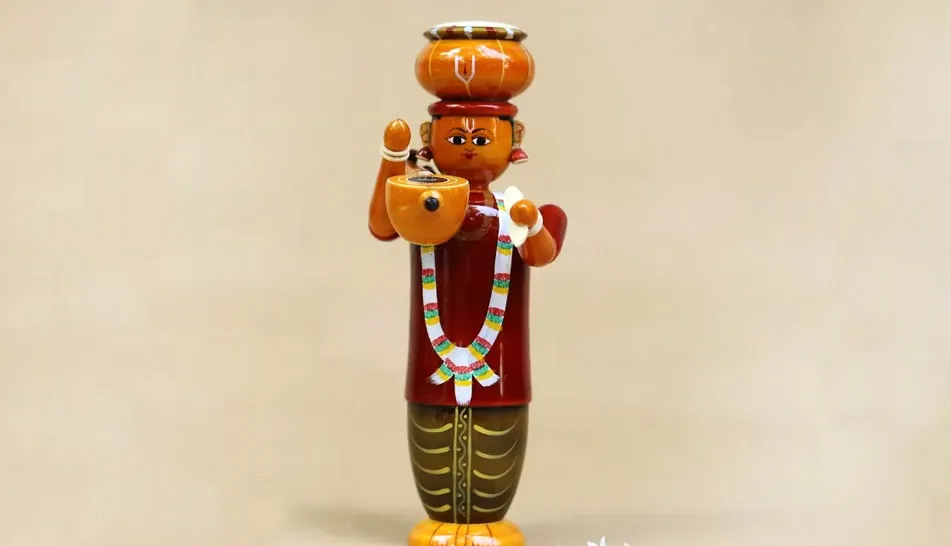
Background: The craft tradition of Etikoppaka is situated within the broader history of lacquerware production in the erstwhile combined state of Andhra. The Andhra Cultural Portal notes that the prevalence of place names carrying the root "Lakkavaram" or "Lakkavarapukota" across several Andhra districts points to a historically widespread lac industry in the region. The early centre of the turned wood lacquer craft is documented as the village of Laccapalli (present-day Nakkapalli), from which artisans subsequently migrated to Etikoppaka because of the forest resources available there.
The craft experienced a documented decline during and after the colonial period. Accounts recorded by the Asia InCH encyclopedia and the Craftmark India resource state that in the post-independence period, falling local demand and low prices drove artisan families to migrate to urban areas in search of employment. At its lowest point, documentation notes that of approximately 225 artisan families once associated with the craft, only one elderly artisan and his wife remained active in Etikoppaka.
The craft also suffered from an inadvertent shift in raw materials. Before approximately 1910, natural dyes were derived primarily from the Divi-Divi tree (Caesalpinia coriaria), which produced red tones of varying shades. According to records compiled in the Craftmark India resource and corroborated by C.V. Raju in interviews, this tree became locally extinct. After 1910, synthetic dyes entered the market. These required the addition of titanium dioxide as a binding agent in the lacquer formulation, which raised concerns about toxicity, particularly in toys intended for children. Post-1990, the European Union's commercial review of the product also raised questions about the safety of the resins and dyes then in use, contributing to an additional commercial setback.
The revival of the craft from the late 1980s onwards is documented in detail. Chintalapati Venkatapathi Raju, an agricultural graduate from a landowning family in Etikoppaka, began working with the craft when returns were at their lowest. He collaborated with the Andhra Pradesh Crafts Council, the Dastakar group, and subsequently with dye expert Shri K.V. Chandramouli, whom he met through Crafts Council of India workshops. These collaborations led to the development of more than twelve natural dye concentrates in a wide range of colours, including royal red and indigo, none requiring titanium dioxide as a binding agent. C.V. Raju also developed a technique to preserve natural dye concentrates in cake form to avoid the development of micro-toxins during storage. He established a cooperative society named Padmavati Associates to increase artisan incomes and ensure that natural dyes reached appropriate markets. He received the National Innovation Foundation's 2nd Biennial National Grassroots Innovation and Outstanding Traditional Knowledge Award in 2003. He received the UNESCO Seal of Excellence for Handicrafts, a Lifetime Achievement Award from INTACH, and the Padma Shri from the Government of India in 2023.
Culture and Societies: The Etikoppaka toy tradition has been embedded in the domestic culture of the surrounding region for generations. Historical accounts note that Etikoppaka boxes, specifically small lacquered wooden containers called Baranis, were a standard possession for newly married women in the region, used for storing vermillion (kumkum), turmeric, and other auspicious materials. The spinning top, locally produced in Etikoppaka, was a common childhood possession in households across the region. The craft thus served a dual domestic and cultural function, supplying both ritual containers and children's playthings to the local population. Accounts from Vikaspedia, a portal maintained by C-DAC under the Ministry of Electronics and Information Technology, describe the presence of these objects in the households of the local zamindars and the broader surrounding community.
With the entry of plastic toys into the Indian market in the post-independence period, Etikoppaka Toys faced sustained competition that reduced local demand. The subsequent GI certification and the efforts of state-level organisations have contributed to a documented increase in sales and a partial restoration of the craft's position in both domestic and export markets.
Religious Significance: Limited formal documentation exists on direct religious significance specifically tied to Etikoppaka toys as an art form. What is documented is that Baranis, the lidded wooden boxes made in Etikoppaka, have a recorded functional role in South Indian Hindu domestic rituals, serving as containers for vermillion and turmeric used in auspicious ceremonies. Deity figurines, including forms of Lord Ganesha and other mythological subjects, are among the documented product categories of Etikoppaka craft. Additionally, sources note that design inspirations for the craft have historically been drawn from South Indian temple pillars and traditional brass ritual utensils. However, no peer-reviewed academic documentation has been identified that establishes a formal or institutionalised religious association with the production or use of Etikoppaka Toys as a class of objects distinct from other regional crafts.
Understanding the Art
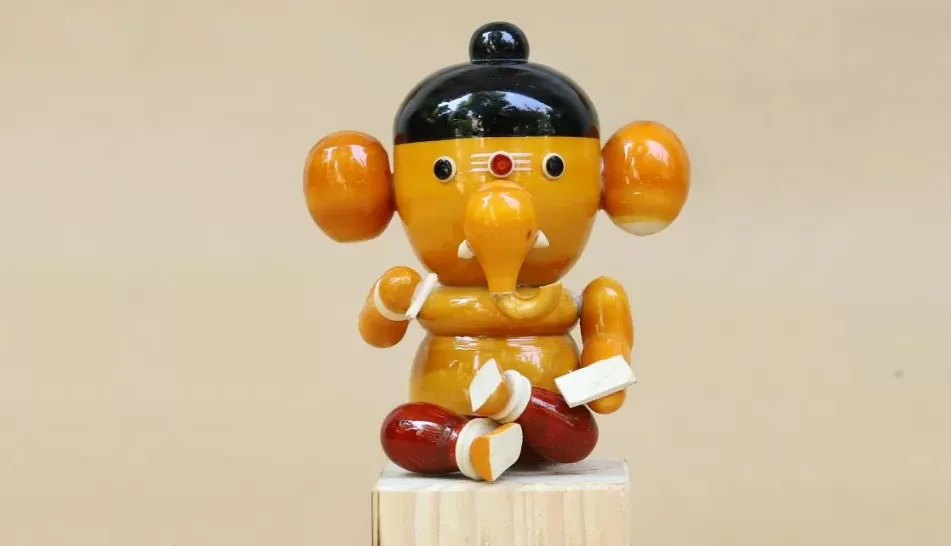
Style: The formal style of Etikoppaka Toys is defined by their lathe-turned cylindrical forms. Products are characterised by rounded contours with no sharp edges, smooth polished surfaces, and bold solid-colour lacquer application. The human figures produced in this tradition are noted for simplified, abstracted facial features, flared forms at the hip, and two-dimensional ornamentation. This combination of smooth geometry, vivid colour, and structural simplicity distinguishes Etikoppaka Toys from the more sculptural and narrative style of the related Kondapalli toy tradition from the same state, which is typically made from softer Tella Poniki wood (Strychnos nux-vomica) and relies more heavily on detailed painting rather than lathe-applied lacquer.
Central Motifs and Their Significance: The documented product range of Etikoppaka craft includes spinning tops, rattles, human figures such as bridal pairs, animal figures including elephants, horses, cows, and birds such as the peacock, deity representations including forms of Ganesha, miniature household cookware sets, jewellery boxes, and various utility items including bowls, jars, and oil containers. Spinning tops have functional and recreational significance as objects of play. Bridal pair figurines and animal figures reflect local cultural and everyday imagery. The peacock, as a common South Indian cultural symbol, appears as a recurring figurative subject. The Barani box holds documented domestic and ritual utility. Design inspirations have also been explicitly drawn from South Indian temple architecture and traditional metalware forms.
Process: The production of Etikoppaka Toys follows a multi-stage process, documented in the Craftmark India resource and through accounts of practicing artisans. The stages are as follows.
First, seasoning: The raw wood is stored and dried for a minimum of four to six months to reduce moisture content. This step is considered essential to prevent warping or cracking during and after shaping.
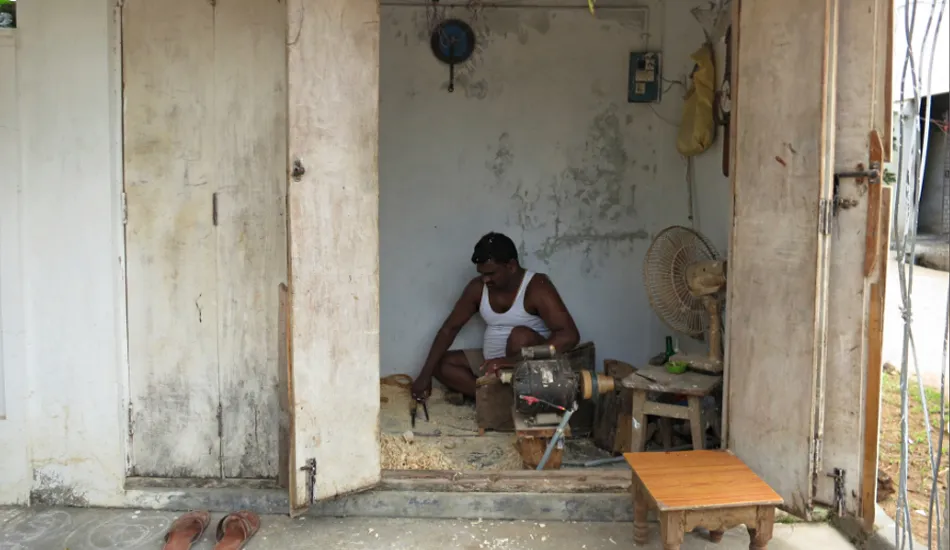
Second, lathe shaping: The seasoned wood is mounted on a hand-operated or electrically driven lathe and shaped using iron chisels of different types. Four primary chisel types are used - the Goruli, used for scalping and giving broad curves; the Monauli, for hollowing; the Lovuli and Hulli, for refining smaller forms and detailed carvings. Delicate items requiring precision are shaped on hand-operated lathes only.
Third, lacquering: While the shaped wooden object remains mounted on the spinning lathe, a stick of dry lac mixed with natural vegetable dye is pressed against the rotating surface. Frictional heat melts the lac, causing it to adhere directly to the wood in a technique referred to in the craft literature as the "lac turney method." Solid-colour lacquering is the documented preferred approach in this tradition.
Fourth, dye preparation: Natural dyes are sourced from locally available plant materials. Documented dye sources include turmeric for yellow tones, Jaffra seeds for reds and oranges, old jaggery, Myrobalan, bark, roots, and leaves of various plants. These dye concentrates are mixed with lac during the oxidation process, producing the coloured lacquer applied to the toys. The former primary red dye source, the Divi-Divi tree (Caesalpinia coriaria), is now locally extinct.
Fifth, quality inspection: Artisans inspect finished items for structural integrity and surface finish. Items failing inspection at the seasoning stage or during shaping are discarded.
Mediums Used: The primary wood used is Ankudu Karra (Wrightia tinctoria), a soft ivory wood that grows in forests located 30 to 40 kilometres from the village. Its ability to regenerate branches from cut points is documented as a factor in its sustainability as a raw material. For larger or heavier items, other soft wood varieties have also been used. Lac, a resinous secretion produced by lac insects, is the fundamental surface coating material. It functions both as the adhesive vehicle for colour and as the finishing medium. Documented natural dye sources include Jaffra seeds, turmeric, old jaggery, Myrobalan, and various plant roots, bark, and leaves. The primary iron chisels used include the Goruli, Monauli, Lovuli, and Hulli types. Both hand-operated and machine-driven lathes are in documented use, with hand lathes reserved for fine work.
New Outlook
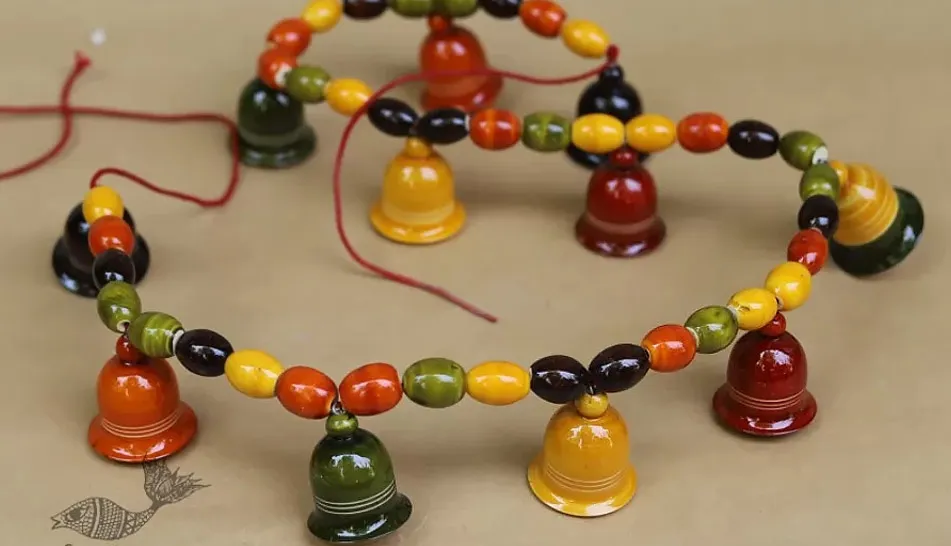
In recent decades, the scope of Etikoppaka craft has expanded beyond traditional toy forms. Currently documented product categories include jewellery and decorative items such as bangles and earrings, household utility objects including bowls, cups, jars, oil bottles, and table ware, photographic frames, candle stands, and storage boxes of various sizes. This product diversification has been documented as a deliberate strategy pursued through collaborations between individual artisans, state institutions including the Andhra Pradesh Handicrafts Development Corporation Limited, and design organisations including the National Institute of Design.
The GI tag obtained in 2017, facilitated by the Andhra Pradesh Handicrafts Development Corporation Limited, has had a documented effect on the craft's commercial standing. According to WIPO documentation, GI registration under the Geographical Indications of Goods Act provides legal protection against counterfeits and supports market recognition both within India and internationally. The registration was processed under the oversight of the Department for Promotion of Industry and Internal Trade (DPIIT). A notable structural shift in the producer community has also been documented by WIPO, which notes that as men from the village have sought employment in urban areas, women have taken on expanded roles in production, learning lathe operation and toy fabrication. As of recent documentation, approximately 140 women artisans are active in the trade, supported by cooperative associations. Cooperative models such as Padmavati Associates, established by C.V. Raju, have contributed to improving artisan incomes and securing markets for natural-dye products.
Challenges remaining in the sector include the inadequate supply of Ankudu wood, competition from cheaper non-original imitations, and the need to maintain the integrity of natural dye processes against the continued availability of synthetic alternatives.
Learn Etikopakka Toys
Bibliography
Text Sources
Moid, M.A. Crafts of Andhra Pradesh. Document prepared for Dastkari Haat Samiti, Dastkar Andhra, 2001.
Malladi, Venkateswara. "Etikoppaka: An Indian Village Perpetuating the Joy of Wood through the Tradition of Toy Art." ResearchGate, 2020, https://www.researchgate.net/publication/341147055.
Internet Sources (for Images) "Wooden Toys." Gaatha, gaatha.org/wp-content/uploads/wooden-toys.jpg. Accessed 4 Apr. 2026.
"Ganesh Ji." Gaatha, gaatha.org/wp-content/uploads/ganesh-ji.jpg. Accessed 4 Apr. 2026.
"History Craft 1." Gaatha, gaatha.org/wp-content/uploads/history-craft-1.jpg. Accessed 4 Apr. 2026.
"Toran." Gaatha, gaatha.org/wp-content/uploads/toran.jpg. Accessed 4 Apr. 2026.