

Dhokra - The Handicraft Tradition of West Bengal
Explore Dhokra craft, the handicraft tradition of West Bengal, and learn about its origins, techniques, cultural significance, and artistic heritage.
Introduction
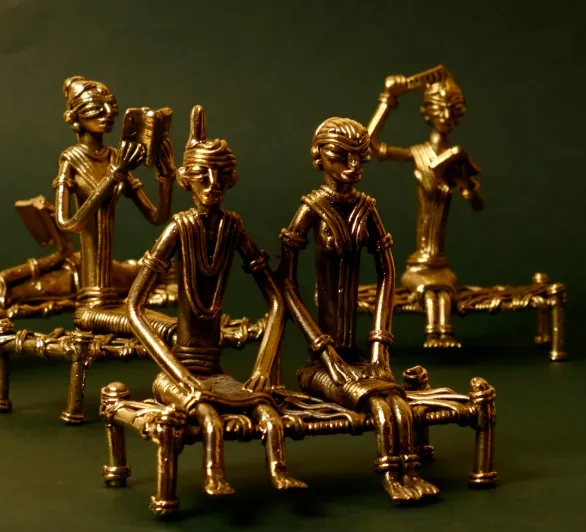
Dhokra is a traditional non-ferrous metal casting craft that employs the lost wax technique, known in French as 'cire perdue,' to produce figurines, ritual objects, jewelry, and utilitarian items from brass or bronze. The craft is named after the Dhokra Damar tribe, the traditional metalsmiths of West Bengal and Odisha. In West Bengal, the craft is practiced in the districts of Bankura, Bardhaman, Birbhum, Purulia, and Midnapore, with the Bikna village in Bankura and Dwariapur and Bikna areas identified as significant centers. The lost wax casting technique has been practiced in the Indian subcontinent since at least the Indus Valley Civilisation period, approximately 2500 BCE, and the dancing girl figurine from Mohenjo-Daro is cited across multiple sources as an example of the technique's antiquity.
Etymology The craft's name derives directly from the Dhokra Damar tribe. The term 'Dhokra Damar' identifies the tribal metalsmith community of West Bengal and Odisha after whom the technique is named. The technical designation for the casting system in scientific and art-historical literature is 'cire perdue,' French for 'lost wax,' referring to the process by which the wax model is destroyed during metal casting. The metal artisans of West Bengal are also locally known as Karmakars, Mals, Malhors, or Malars. In Chhattisgarh, the community associated with the craft is called Ghadwa or Gharua, a term said to derive from 'melting' or 'working with wax' and 'shaping and erecting.'
Origin The Dhokra Damar tribe were historically a nomadic community whose territory extended through central and eastern India. Their metalsmithing tradition is documented as having spread as far south as Tamil Nadu, as far north as Rajasthan, and across West Bengal, Odisha, Jharkhand, and Chhattisgarh. The MAP Academy entry on Dhokra notes that while the origins of the craft are unknown, it is likely that it was practiced by nomadic communities in central and eastern India and received patronage from rulers of the kingdom of Bastar. Ancient Indian texts including the Silparatna and Manasollasa contain references to the lost wax metal working technique.
Location Bankura, Bardhaman (Burdwan), Birbhum, Purulia, and Midnapore districts of West Bengal. Bikna village and Dwariapur in Bankura are specifically named craft centers. The craft is also practiced in Ranchi, Jharkhand; Bastar and Kondagaon, Chhattisgarh; Dhenkanal, Koraput, and Mayurbhanj, Odisha; and Adilabad, Telangana (which received a GI tag for Adilabad Dokra in 2018).
Community The Dhokra Damar tribes are the primary traditional metalsmith community. In West Bengal, artisans are also identified by local names including Mal, Malhor, Malar, and Karmakar. The MAP Academy notes that artisans of the Santhal community, known for their Jadupatua paintings, are also involved in Dhokra casting. Additional communities include the Ghontana, Chitraghasi, and Ghasi in Odisha; the Woj or Ojari community in Telangana; and the Bharewa community in Madhya Pradesh. Most craftsmen who formerly practiced the craft in West Bengal have left the trade, with only a few families remaining in active production.
Relevance Dhokra objects from West Bengal and Chhattisgarh have significant domestic and international market presence as collectible folk art objects. The craft's appeal, attributed in source documentation to its 'archaic plainness and enthralling folk motifs,' has generated substantial export demand. The Adilabad variant received a GI tag in 2018. Despite the craft's wide geographic distribution, the West Bengal tradition is endangered due to very few remaining practitioner families.
History
Background The oldest documented Dhokra artifact cited across multiple sources is the dancing girl figurine from Mohenjo-Daro, dated to approximately 2500 BCE, which demonstrates that the lost wax casting technique was practiced in the Indian subcontinent during the Indus Valley Civilisation. The ancient texts Silparatna and Manasollasa provide written descriptions of lost wax metal working, placing the technique within the documented classical Indian technical literature. The Gaatha craft documentation platform notes that historically, Dhokra Damar nomadic metalsmiths traveled from village to village repairing utensils and selling lost wax brass figurines, before eventually settling in specific districts of Bengal and neighboring states.
The MAP Academy's documentation states that the Dhokra Damar were initially nomadic and that their nomadic character contributed to the wide geographic distribution of the technique across India. Historians cited in Oak Lores documentation note that the craft migrated with the Dhokra Damar tribe to eastern India, primarily Bengal, Jharkhand, and Odisha. Craft documentation by MASH India specifically identifies the districts of Bankura, Midnapore, Purulia, Birbhum, and Burdwan as areas where Dhokra and Dheppon metalworkers settled.
Culture and Societies The Dhokra craft tradition in West Bengal developed as a community-embedded practice in which artisans produced both utilitarian and ritual objects for local populations. Traditional items for the Santhal community included measuring cutlery of different sizes (paikona) and anklets. The craft was initially oriented toward practical objects including utensils and their repair. Over time, the production of sculptural objects depicting mythological and religious themes became the primary output form, particularly as demand from urban and export markets developed. The craft has transitioned from a nomadic trade service into a settled workshop production model. Artisan families in Bankura and Midnapore are documented as struggling to source raw materials and to sustain viable incomes within the craft, a pattern that contributes to the endangered status of the West Bengal tradition. The Gaatha documentation platform, which conducted field documentation of Bankura artisans including craftsman Dilip, records the economic decline of the artisan community over the past century, noting that earnings have dropped significantly relative to historical levels.
Religious Significance Dhokra production includes objects of direct religious function. Artisans in West Bengal produce images of Hindu deities including Lakshmi, Durga, Shiva-Parvati flanked by Ganesh and Kartik, Saraswati, Ganesh, and Radha-Krishna. Ritual objects include the dhunuchi (ceremonial incense burner), pancha pradeep (five-light lamp), kalas (ceremonial finial pot mounted on a wooden pole for festivals), and anklets and ghunghrus used in ceremonial contexts. The paikona (measuring bowl) served utilitarian and ritual functions in Santhal cultural practice. Local deities including Jangubai, Bheemdev, and Persa Pen are also produced for use in the ritual practices of the communities from which the craft tradition originates. The Gaatha documentation specifically references 'Swami Narayan riding an elephant, Radha Krishna with their love gaze, Goddess Lakshmi' as frequently executed themes in Bankura Dhokra production.
Understanding the Art
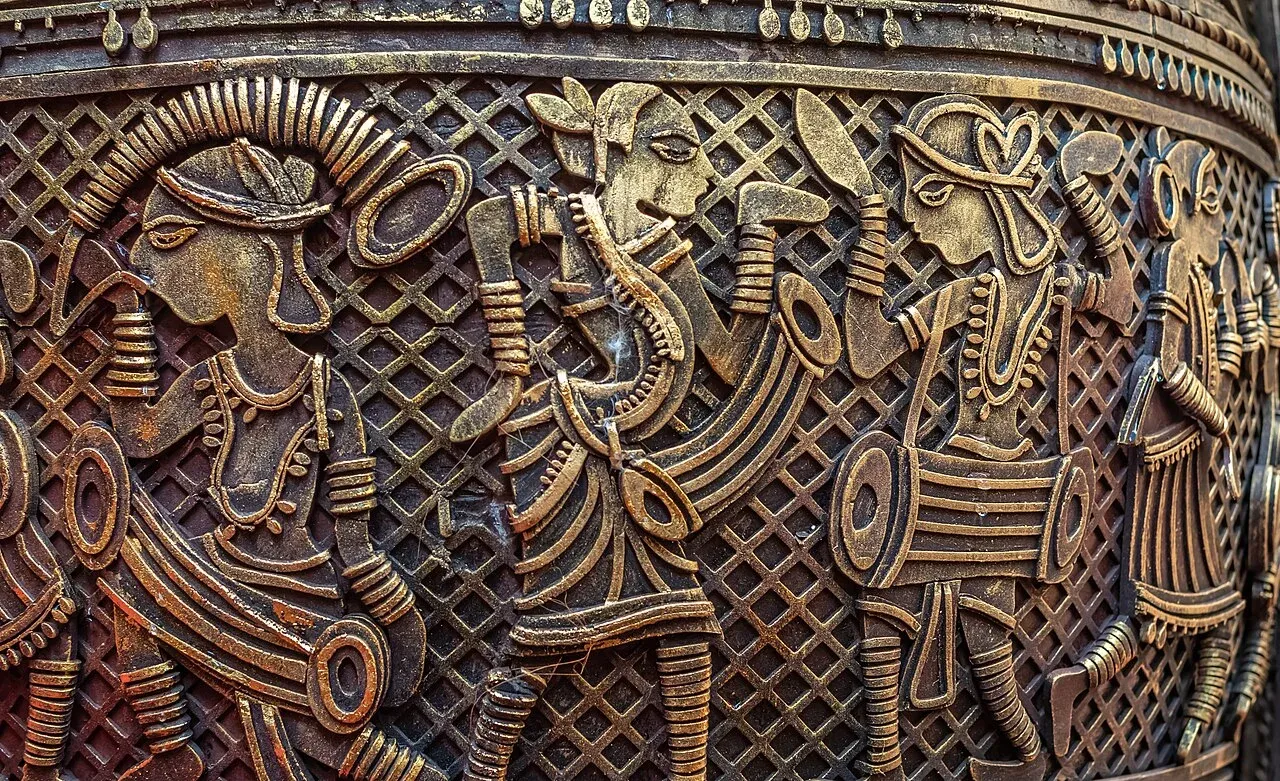
Style Dhokra objects are characterized by a textured surface that results from the coiling of wax threads over the clay core. This coiling technique produces a distinctive surface appearance that differentiates Dhokra objects from smoother cast metal objects. The MASH India documentation notes that 'the most arresting fact about Dhokra Craft is how, as a consequence of the oldest metal casting technique called lost wax, it does not follow the six principles of Shilpa shastra where the anatomy of a figure has a standard measurement. The artifacts are often inordinate.' This freedom from classical iconometric standards gives Dhokra figures their characteristic folk quality. Dhokra jewelry, including necklaces, pendants, anklets, and amulets, features twisted brass wire work that creates recognizable decorative patterns.
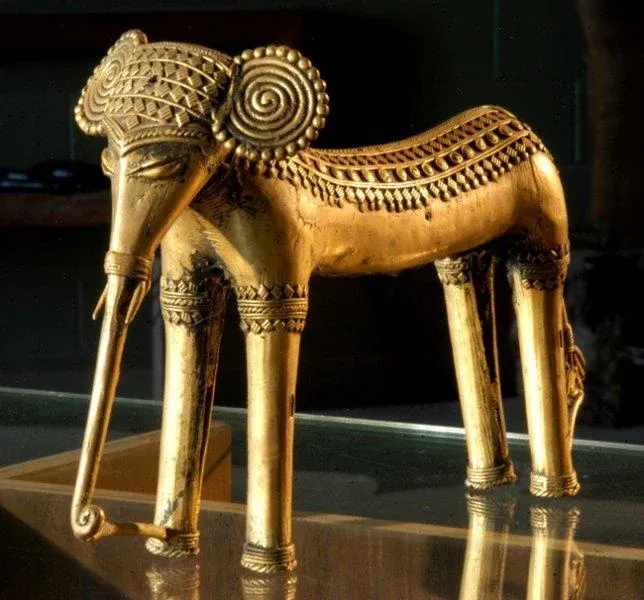
Central Motifs and Their Significance The dominant motifs in West Bengal Dhokra production are drawn from religious iconography, animal symbolism, and folk tradition. Hindu deity figures (Lakshmi, Durga, Shiva, Saraswati, Ganesha, Radha-Krishna) represent the largest production category. Animal motifs including horses, elephants, peacocks, owls, and cattle appear as both standalone figurines and as elements within more complex compositions. The sun motif is a primary element in Dhokra jewelry: it appears as a large round pendant or as multiple disc elements, symbolizing life, growth, and the solar veneration traditions of tribal communities. Everyday life scenes and anthropomorphic representations connected to tribal cultural practices also appear in the craft's figurative repertoire.
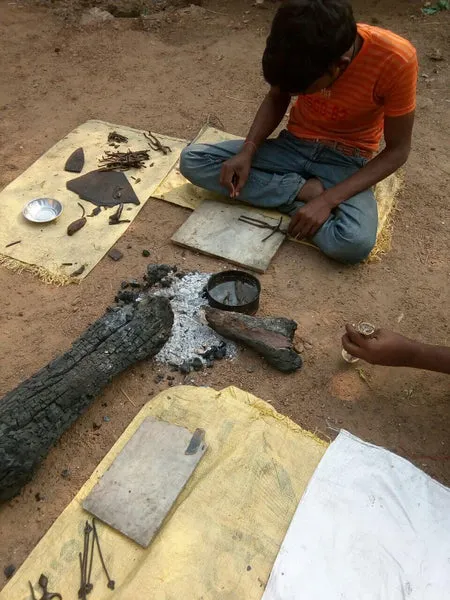
Process The lost wax process used in West Bengal Dhokra begins with the preparation of a clay core approximately matching the shape of the intended object. A mixture of beeswax, resin from the Damara orientalis tree (also described as Dhuna, the resinous gum of the Sal tree, Shorea robusta), and nut oil is prepared into a pliable dough, passed through sieves for uniform consistency, and rolled into long strands. These strands are coiled over the clay core to build up the full form of the object, and further ornamental detail is carved directly into the wax surface.
Two layers of clay slip are applied over the wax model. The first layer uses a fine mixture of riverbed soil and coal dust, which captures the surface texture of the wax precisely. The second coat uses a red soil and rice husk mixture for structural strength. Two small holes are made at one end of the mould, and wax sticks are inserted to provide channels for the escape of molten wax and air bubbles during firing. The prepared mould is sun-dried and then fired in the bhatti (traditional kiln). During firing, the wax melts and flows out through the pre-formed channels, leaving a precise cavity. Molten metal, primarily brass scrap, is then poured into the cavity through the same channels and allowed to cool and solidify. After cooling, the clay mould is chipped away to reveal the cast metal object. For large objects, sections are cast separately and then soldered together. In Jharkhand, tar from road works is used as a wax substitute. In the Mayurbhanj region of Odisha, artisans smear the wax model surface before clay application to achieve a smoother final surface than the standard textured Dhokra finish.
Mediums Used Metal: Brass scrap is the primary casting metal; bronze (tin and copper alloy) is also used. Mixed aluminium is used in some contemporary production for lower-cost items. Wax: Beeswax mixed with Damara orientalis or Sal (Shorea robusta) tree resin and nut oil; paraffin wax in contemporary practice. Clay: Coarse riverbed clay for the core; fine riverbed soil and coal dust for the inner mould layer; red soil mixed with rice husk for the outer structural layer. Tools: Hammers, chisels, files, pliers, knives, wire brush, wax thread extractor tool, and a bhatti (traditional kiln) for firing.
New Outlook
The Dhokra craft tradition in West Bengal is classified as endangered. The MAP Academy documentation notes that 'most of such craftsmen had left the craft leaving only a few families in the trade.' Economic pressures include the high cost and limited availability of brass scrap, declining artisan incomes relative to alternative employment, and the difficulty of skill transmission when the craft's viability is uncertain. The Gaatha documentation of Bankura artisans records that approximately a century ago, an average Dhokra craftsman's earnings were approximately half those of a skilled accountant, and current artisans struggle to source raw materials.
The Adilabad Dokra GI tag of 2018 demonstrates the institutional recognition being accorded to regional variants of the craft. Domestic and international market demand for Dhokra objects as decorative collectibles and gallery items has generated sustained commercial interest, and craft organizations including Contact Base (West Bengal) are documented as working with Dhokra artisans on innovation and market access. The craft's presence in museum collections, including the Museum of Art and Photography (MAP) in Bengaluru and the Victoria and Albert Museum in London, has contributed to international documentation and scholarly attention.
Learn Dhokra (West Bengal)
Bibliography
Sources
Asia InCH Encyclopedia of Intangible Cultural Heritage. “Dhokra / Lost Wax Metal Casting of West Bengal.” Asia InCH, asiainch.org.
Boase, T. S. R., editor. The Oxford History of English Art. Oxford University Press.
MAP Academy. “Dhokra.” MAP Academy, 2024, mapacademy.io.
MASH India. “The Living Metal Craft and Their Makers: West Bengal.” MASH India, mashindia.com.
“The Dhokra Artisans of Bankura and Dariapur, West Bengal: A Case Study and Knowledge Archive of Technological Change in Progress.” Academia.edu.
Image Sources
“Dhokra Art: A Timeless Tradition of India.” Rainbows and Hues, https://rainbowsandhues.com/dhokra-art-a-timeless-tradition-of-india/. Accessed on May 06, 2026.
“Dhokra Metalwork: 4,000 Years of Tradition in Your Living Room.” Trove Craft India, 26 Apr. 2025, https://trovecraftindia.com/blogs/the-trove-craft-blog/dhokra-metalwork-4-000-years-of-tradition-in-your-living-room. Accessed on May 06, 2026.
“Breathing Life into a 4,000-Year-Old Metallurgical Marvel: Dhokra.” The India Craft House, https://theindiacrafthouse.com/blogs/news/breathing-life-into-a-4000-year-old-metallurgical-marvel-dhokra. Accessed on May 06, 2026.