7% OFF
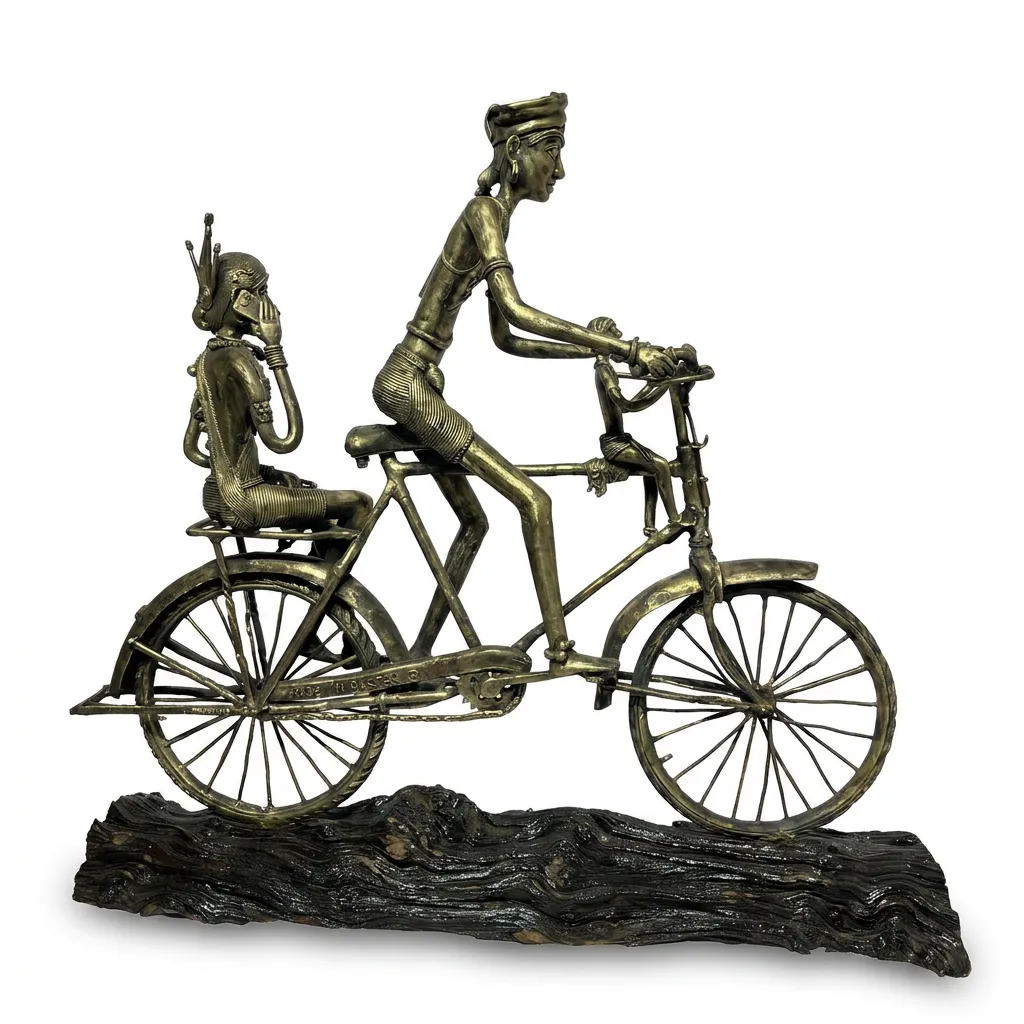
Dhokra Sculpture - A Family Rides
$ 1,889$ 2,039


Explore Dhokra, the handicraft tradition of Central India, and learn about its origins, techniques, cultural significance, and artistic heritage.
Dhokra is a non-ferrous metal casting craft of the tribal communities of central and eastern India, executed through the lost-wax technique known in French as cire perdue. In Chhattisgarh, the craft is practiced predominantly in the Bastar district by the Ghadwa community and is known as Bastar Dhokra, producing a range of figurative sculptures, ritual objects, ornaments, and domestic implements in brass and bell metal. The craft tradition is among the oldest documented continuous metal-casting practices in South Asia, with the lost-wax technique described in ancient Sanskrit treatises and associated by scholars with the same metallurgical process used to produce the Dancing Girl figurine of Mohenjo-daro, dated approximately 2500 BCE.
Etymology: The designation Dhokra derives from the name of the Dhokra Damar, a nomadic tribe of metal artisans from West Bengal and Odisha, who are identified in the academic literature as the original practitioners and the community that gave the craft its name. This is documented in the MAP Academy article on Dhokra, the Wikipedia entry on Dhokra, the Chitrolekha Journal article by R. Kochhar (2011), and the IJCRT academic paper "A Traditional Metal Craft Dhokra: A Case Study" (2024). The term Dokra is used as an alternate spelling in Bengali and Orissan contexts, including the GI registration for Bengal Dokra.
In Chhattisgarh, the craft practised by the Ghadwa community carries its own local designation. The term Ghadwa is documented in multiple sources including the Asia InCH Encyclopedia, the D'Source IIT Bombay field resource, and the Gulf News documentary feature on Jaidev Baghel. The Tribal Handcrafts and Oak Lores sources record a folk Etymology associating Ghadwa with the word ghalna, meaning to melt and work with wax, while the Asia InCH Encyclopedia states the term means shaping and creating. The MAP Academy notes that the craft is also known as gadwakam in the local Bastar context, a term used by practitioners including Jaidev Baghel to describe the bell metal casting technique specific to the Ghadwa community of Kondagaon. The broader term bell metal craft is used interchangeably with Dhokra in Chhattisgarh government and institutional documentation.
Origin: The precise founding date and originating community of the Dhokra tradition in Chhattisgarh cannot be established with certainty. The MAP Academy states that while the origins of the craft are unknown, it was likely practiced by nomadic communities in central and eastern India and received patronage from rulers of the kingdom of Bastar. The Incredible India government portal similarly notes that the exact origins remain unknown and that nomadic communities in eastern and central India popularised the practice. The closest archaeological association is with the lost-wax technique used to produce the Dancing Girl figurine from Mohenjo-daro, dated approximately 2500 BCE. This association is drawn by multiple academic sources including Agrawal (1971) cited in the IJCRT paper (2024), the Chitrolekha Journal article by Kochhar (2011), and the Peepul Tree/Live History India article by Akshata Mokashi (2021). The argument is that the technical process used at Mohenjo-daro and documented in the Sanskrit texts Silparatna, Manasollasa, Manasara, and Vishnusamhita is the same process still practiced today, placing the technique's recorded existence at approximately 4,500 years of continuous use, though the specific trajectory from the Harappan period to the tribal ironsmith communities of Bastar is not directly documented in the available literature. A folk tradition documented in the Tribal Handcrafts source, Gaatha.org, and the Peepul Tree/LHI article records that Bhan Chand, described as a ruler of Bastar, received a Dhokra necklace from a craftsman as a gift for his wife. So moved by the artistry, the ruler conferred the title Ghadwa upon the artisan. This narrative is documented as a folk account and is not independently verified as a historical event with a datable ruler.
The Gulf News feature on Jaidev Baghel records that the art was nearly lost for several hundred years and was revived during the early period of independent India's Dandakaranya development programme under Prime Minister Jawaharlal Nehru, which sought to promote the culture of Bastar.
Location: Bastar Dhokra is primarily concentrated in Kondagaon and Jagdalpur, the two main centres in the Bastar district of Chhattisgarh. The Asia InCH Encyclopedia states that Ghadwas are found all over the Bastar region, though concentrated in these two towns. The Gaatha.org field documentation describes Kondagaon as the "Craft City" of Chhattisgarh, with Dhokra as its principal associated craft alongside wrought iron work. The D'Source IIT Bombay field documentation identifies Bhelwapadrapara, an area of Kondagaon, as a significant production locality, and records Karanpur, a village approximately 40 kilometres from Kondagaon, as another active Ghadwa community location.
Across Chhattisgarh more broadly, the Asia InCH Encyclopedia records other communities practicing lost-wax casting: the Malars of Sarguja, the Jharas of Raigarh, Mahasamund, and Jashpur, the Bharewas of Betul, and the Swarnakars of Tikamgarh. The raw materials and proportions of wax mixtures vary by locality: only beeswax is used at Bastar, only the resin of saal or sarai at Sarguja, while artisans in Raigarh and Tikamgarh use mixed ratios of resin and beeswax, as documented in the Asia InCH Encyclopedia.
Beyond Chhattisgarh, the broader Dhokra craft tradition is documented at major centres in Ranchi in Jharkhand; Bankura, Birbhum, and Bardhaman in West Bengal; Dhenkanal, Koraput, and Mayurbhanj in Odisha; Adilabad in Telangana; and Betul in Madhya Pradesh, as catalogued by the MAP Academy.
Community: The Ghadwa community is the principal practitioner group of Bastar Dhokra. The term Ghadwa is documented as both a community designation and a craft title. The Asia InCH Encyclopedia states that the Ghadwas are a metal-working caste whose name signifies shaping and creating. The Chitrolekha Journal article by Kochhar (2011) notes that in the Bastar district the craft is done by a metal-working caste called Kaser, a name derived from kansa (bronze), or Ghadwa. Both designations appear in use across sources, reflecting an overlap between caste identity and professional designation.
The Shambhavi Creations documentation identifies the Jhara and Ghadwa tribes as the primary practitioners in Chhattisgarh, with the Ghadwa community concentrated in the Bastar region and the Jhara community present in Raigarh district. The MAP Academy notes that the craft was historically also practiced by the Malar and Kaser communities in central and eastern India, and that other communities including the Santhal (known for Jadupatua paintings) are also involved in Dhokra casting across the broader region.
The D'Source IIT Bombay People documentation records the practitioner Shabbir Nag, who lives in Bhelwapadrapara, Kondagaon, and came from a family that was not originally from the craft community but learned through interaction with the Ghadwa community. The Chitrolekha Journal notes that unlike pottery, where the turning wheel is traditionally reserved for men, all parts of Dhokra work can be done by either men or women, and that children learn the craft through imitation and instruction.
The Gulf News account records that over 10,000 families in Bastar depend on crafts for their living, with Dhokra or bell metal craft being one of the foremost styles. The same account notes that Jaidev Baghel maintained approximately twenty Ghadwa apprentices living and working with him at his facility centre in Kondagaon.
Relevance: Bastar Dhokra received a Geographical Indication tag in 2014, as documented by the MAP Academy. The Bengal Dokra and Adilabad Dokra subsequently received GI tags in 2018. The craft is represented at the National Crafts Museum and Hastkala Academy in New Delhi and at Bharat Bhavan in Bhopal, as noted in the MAP Academy documentation. The Museum of Art and Photography (MAP) in Bengaluru holds Bastar Dhokra sculptures by Jaidev Baghel in its collection, and the Victoria and Albert Museum in London holds a sculpture by Baghel: Jalengin Mata Devi on a Lion/Tiger (bell metal, cire perdue, c. 1980, 48 x 15 cm), as catalogued by the MAP Academy.
The DC (Handicrafts) Ministry of Textiles portal and the Incredible India government portal list Bastar Dhokra among the significant handicraft traditions of Chhattisgarh. The craft has been promoted through national and international Festivals of India since the 1960s, as documented by the MAP Academy. The National Handicraft Award was presented to Hirabai Jharekha Baghel, a Dhokra artisan from Sarangarh-Bilaigarh district of Chhattisgarh, by President Droupadi Murmu in December 2025, as reported by the Organiser. Bhupendra Baghel, son of Jaidev Baghel, is also a National Award winner, documented in the Gulf News feature.
Background: The history of Dhokra as a continuous technical practice begins with the earliest documented use of lost-wax casting in South Asia. The technique is described in the Sanskrit texts Silparatna, Manasollasa, Manasara, Somesvara, and Vishnusamhita, as cited in the IJCRT academic paper (2024, referencing Kar 1952, Agrawal 1971, Pal 1978, Sen 1994, Mukherjee 2016). The same technique is identified in the Dancing Girl copper alloy figurine from Mohenjo-daro, dated approximately 2500 BCE, which is held at the National Museum in New Delhi and catalogued by scholars as a lost-wax copper alloy casting (ResearchGate scientific diagram; Agrawal 1971).
The Chitrolekha Journal article by Kochhar (2011), the ARCJOURNALS paper "Dhokra: A Traditional Craft of Rural India" (Sinha et al., published in the International Journal of History and Cultural Studies), and the IJCRT paper (2024) all associate the geological formation of the Dhokra craft tract, encompassing Chhattisgarh, Jharkhand, and West Bengal, with the ancient Gondwana formation and Chota Nagpur Plateau, characterising the craft's presence in mineral-rich tribal regions as a continuity from Neolithic and Chalcolithic metalworking cultures. The ARCJOURNALS paper cites P.K. Mukherjee (2000) for the identification of this ancient land mass, and Wadia (1975) and Pasco (1975) for the geological context.
The specific history of Dhokra in the Bastar kingdom is underdated in available evidence. The MAP Academy notes that the craft was likely patronised by rulers of the kingdom of Bastar. The kingdom of Bastar was established in 1324 CE when Annama Deva, brother of the last Kakatiya king, settled in the region and founded the polity under the tutelage of the local goddess Dantheshwari, as documented in the Magik India source. The Postel and Cooper monograph Bastar Folk Art (1999) situates the region's cultural history within the Nagvanshi dynasty establishment from the tenth century and the subsequent Kakatiya influence. The Gulf News account records that Dhokra artefacts in the form of tribal utilities, jewellery, and musical instruments were historically bartered for household goods like poultry and farm produce, and that the art was revived during the Dandakaranya Programme of Nehru's government, which promoted Bastar's cultural heritage during the post-independence era.
Culture and Societies: Bastar Dhokra is embedded in the social and material life of the Ghadwa community and the broader tribal culture of the Bastar region. The Gaatha.org documentation records the oral traditions associated with Dhokra production: the story of Jhitku and Mitki, a pair of tribal deities of the Bastar region, is among the most frequently depicted narratives in Dhokra sculpture. The Gaatha.org and Tribal Handcrafts sources document that Jhitku and Mitki are venerated by tribal communities in Chhattisgarh as deities of wealth and prosperity, and that the story of their love and loss is carried through songs, fables, and oral traditions that persist alongside the sculptural tradition. Their figures produced by the Ghadwa community are thus simultaneously devotional objects and vehicles of oral narrative.
The Peepul Tree/LHI article by Mokashi (2021) documents that Dhokra makers historically travelled from village to village, repairing old and broken utensils and selling small Dhokra idols of Lakshmi and her mount the owl, Lakshmi Narayan, and Radha Krishna in exchange for food grains. These idols were considered auspicious and believed to bring prosperity when installed in household shrines, particularly for newly married couples. This itinerant practice is cited by Prabhas Sen in his book Crafts of West Bengal (1994). The MAP Museum feature on the Outside In exhibition (2025) documents that before the emergence of Jaidev Baghel and Meera Mukherjee as artists, the Dhokra technique was used by indigenous artisans primarily to make community deities for religious festivals and rituals, alongside jewellery and daily utility objects.
The formal distinction between the craft's functional and devotional dimensions and its status as fine art was significantly altered through Baghel's 1977 National Craftsman Award-winning work Dhankul Puja, a sculptural tableau of the annual New Moon ceremony for prosperity celebrated in Bastar. This work shifted the craft's documented use toward narrative autobiographical expression. Bharat Bhavan in Bhopal, founded under J. Swaminathan, was an important institutional venue for the promotion of Bastar Dhokra within the Indian art world, as documented in the ResearchGate paper on Dhokra art progression (Banerjee and Rani, ShodhKosh, 2024), which also cites Katherine Hacker's research on Swaminathan and Bharat Bhavan's role.
Religious Significance: Dhokra has documented and substantial religious significance across multiple dimensions of its production and use. The primary religious context in Bastar is the production of idols of local tribal deities including Jangubai, Bheemdev, and Persa Pen, used in ritual worship, as documented by the MAP Academy. The figure of Budha Dev mounted on a horse, while more associated with wrought iron craft in Bastar, also appears within the broader field of Bastar tribal metal arts. The Gaatha.org documentation records that Jhitku and Mitki are worshipped by tribal communities as deities of wealth and prosperity, and their Dhokra representations are devotional objects.
Hindu deities form a significant secondary category. The MAP Academy documents the production of idols of Hindu deities including Ganesha, as well as lamps, ritual measuring vessels (in varying sizes for ritual purposes), purses, nutcrackers, knives, amulets, anklets, pendants, bracelets, seed-holders, cattle-bells, and spoons for the local market. The Peepul Tree/LHI article by Mokashi (2021) documents that Dhokra artisans across Bengal made Lakshmi, Lakshmi Narayan, and Radha Krishna figurines considered auspicious for household shrines, particularly for newly married couples.
The Silparatna and Manasollasa Sanskrit texts, referenced in the IJCRT paper (2024) and in the Oak Lores and Tribal Handcrafts sources, contain descriptions of both solid and hollow wax casting processes, indicating that the production of sacred metal objects through the lost-wax method had formal textual recognition within the classical Hindu scholarly tradition. The religious function of Dhokra objects is thus documented in both folk practice and in classical Sanskrit literature.
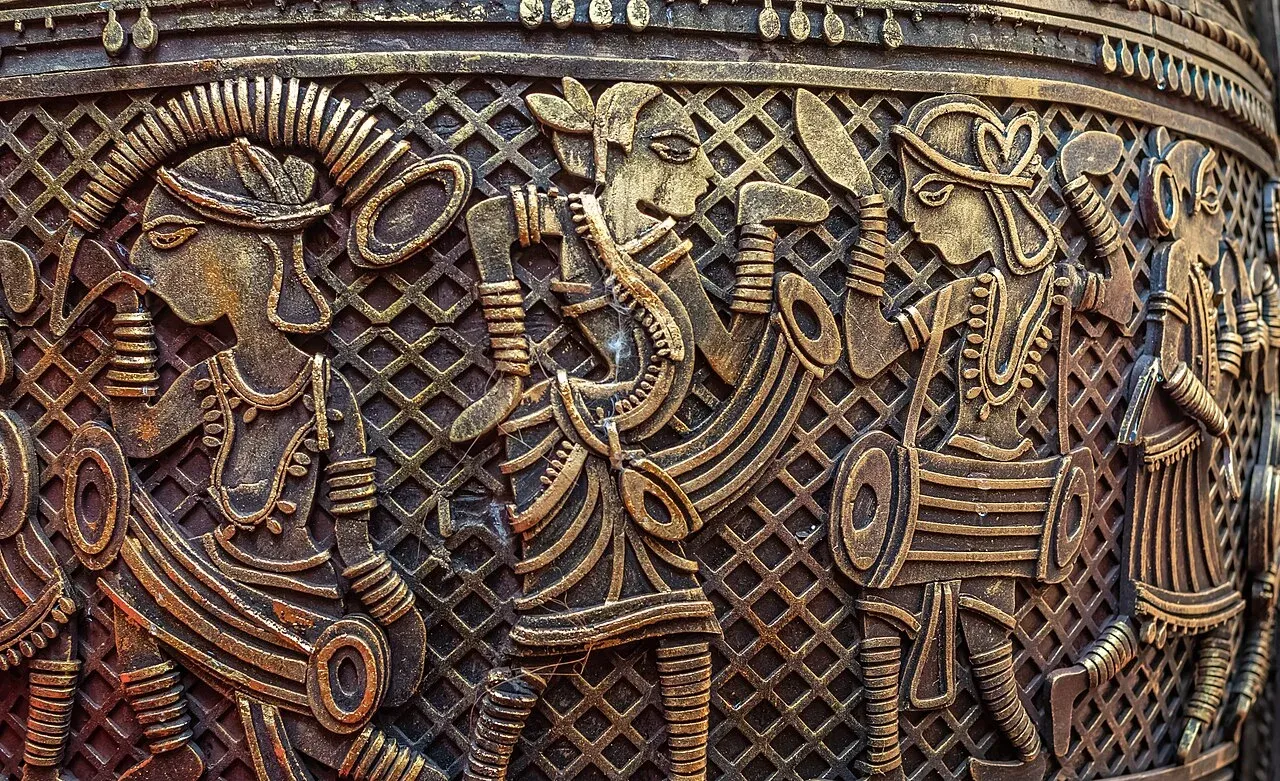
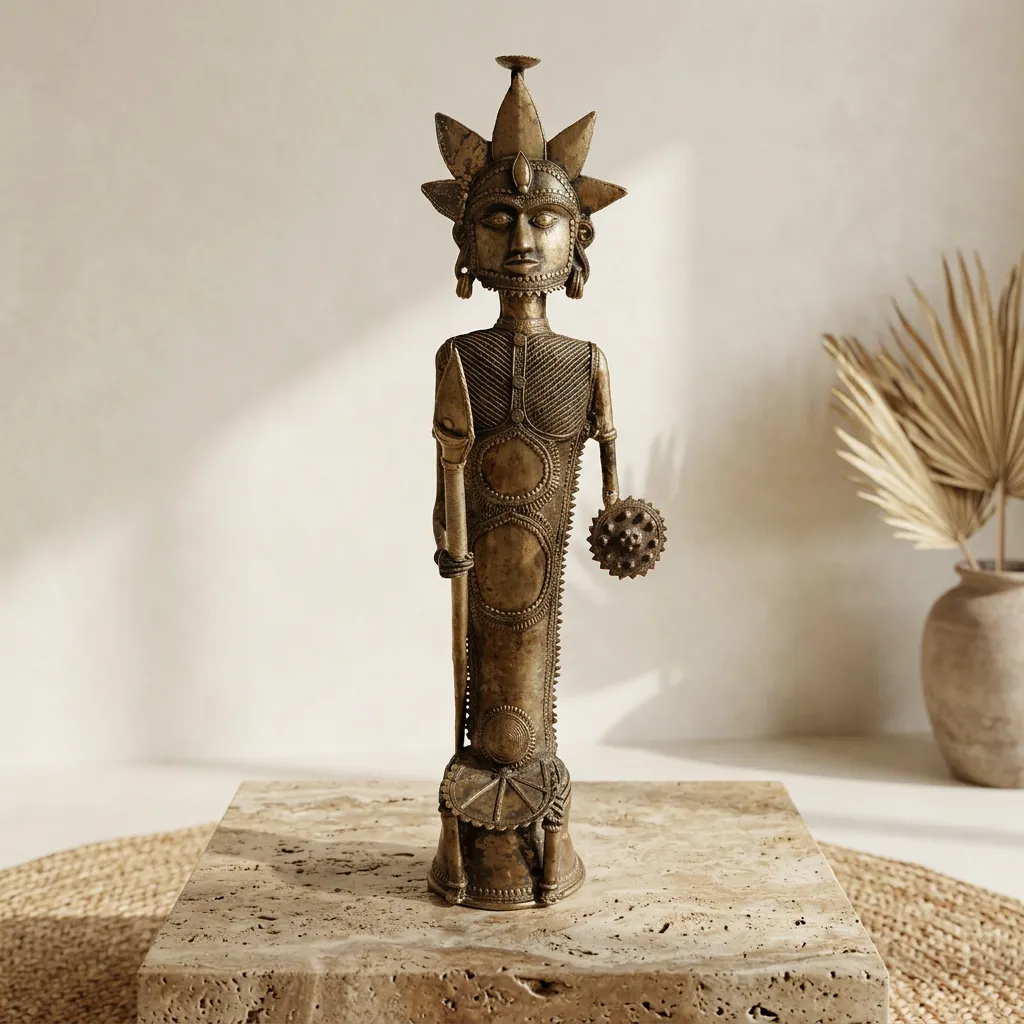
Style: Bastar Dhokra is characterised by a textured, non-smooth surface resulting from the visible wax thread work that forms decorative detail on the outer surface of each object. The Chitrolekha Journal article by Kochhar (2011) identifies this surface quality, produced by wrapping beeswax strings around the clay core, as the defining formal feature distinguishing Dhokra from smooth cast metal objects. Because each clay model is destroyed in the casting process, each Dhokra object is unique and cannot be repeated using the same mould.
The MAP Academy notes that Bastar Dhokra characteristically achieves a golden sheen, as described in the museum's analysis of Jaidev Baghel's works, a tone produced through the specific metal alloys used and the finishing process. Katherine Hacker's analysis, published in the Journal of Modern Craft (2016), documents Baghel's development of the wax thread technique toward narrative figuration, particularly in the elongation of torsos and limbs and the detailed embellishment of figures with jewellery and markers of adivasi identity.
Hollow casting predominates in Chhattisgarh and central and eastern India generally, producing objects with an interior cavity, while solid casting is the practice in Telangana, as documented by the Shambhavi Creations and Peepul Tree/LHI sources. In Chhattisgarh specifically, only beeswax is used at Bastar, while regions in Raigarh and Tikamgarh use mixed compositions, as documented by the Asia InCH Encyclopedia.
Central Motifs and Their Significance: The motif vocabulary of Bastar Dhokra draws from Gond and Ghadwa tribal cosmology, Hindu iconography, and the observed natural world of the Bastar forest region. The following categories are documented across institutional, academic, and government sources.
Tribal deities constitute the foundational subject matter. Jhitku and Mitki are the most distinctly Bastar-specific subject, produced as paired figures representing the folk deities of wealth and prosperity whose story forms part of tribal oral tradition (Gaatha.org, Tribal Handcrafts). Jangubai, Bheemdev, and Persa Pen are local deities documented by the MAP Academy and the Incredible India portal as subjects of ritual production for actual worship. The mother goddess (Mata) and female demi-goddesses (Devis), worshipped against poor harvest, epidemic, and drought, appear recurrently in Jaidev Baghel's documented oeuvre, as described in the Forms of Devotion biographical profile and the Gulf News feature.
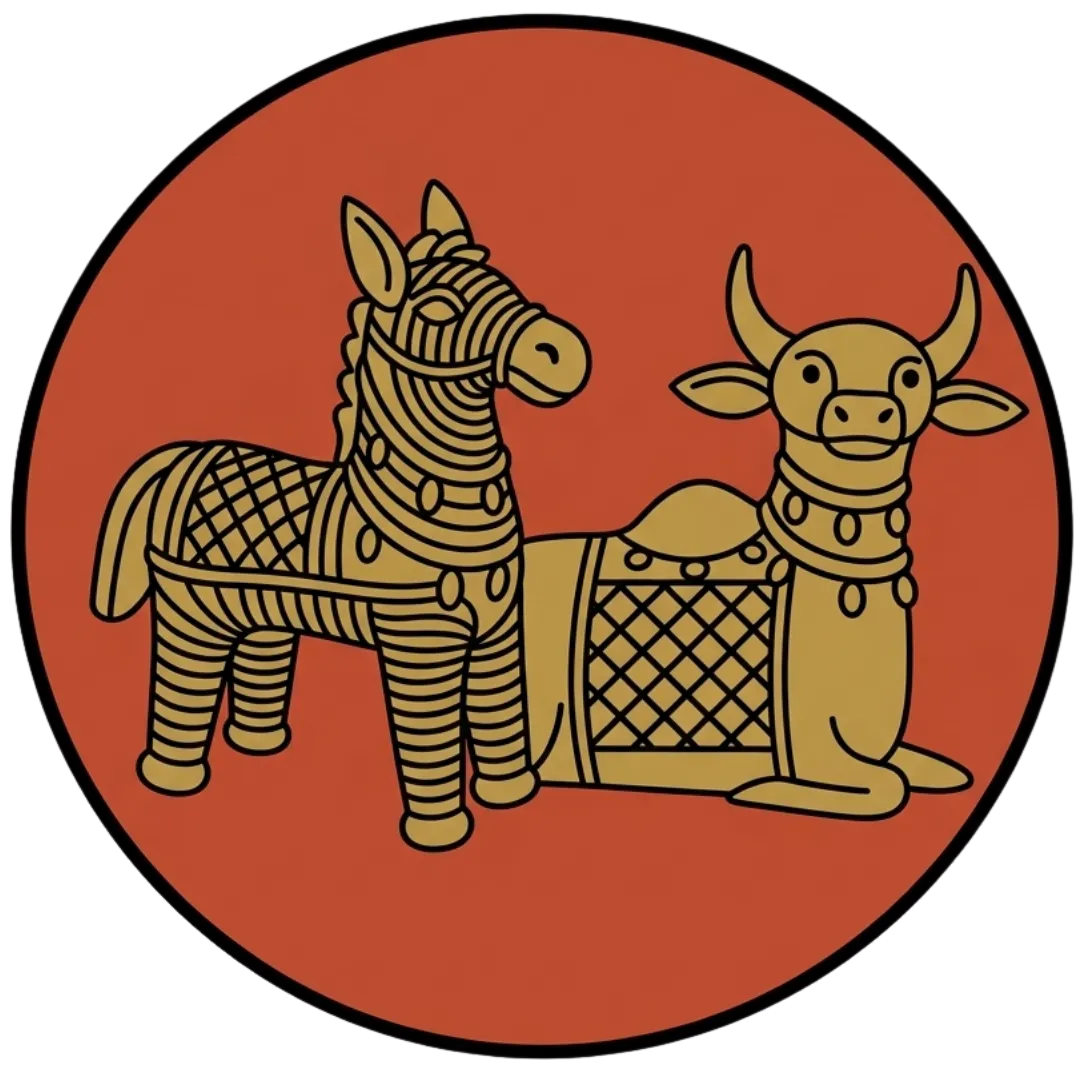
Animal figurines are the second major category and hold symbolic significance grounded in both tribal and Hindu belief systems. The Peepul Tree/LHI article by Mokashi (2021) documents the established symbolic values: the elephant represents wisdom and masculinity, the horse represents motion, the owl represents prosperity and also death, and the tortoise represents femininity and is further associated with the avatar of Lord Vishnu. Horses, elephants, peacocks, owls, and tortoises are listed as historically valued Dhokra objects in multiple sources. The Dhokra bull (Nandi) is identified as one of Bastar's signature artefacts by the Incredible India portal. Lions, fish, swans, and deer also appear as documented subjects.
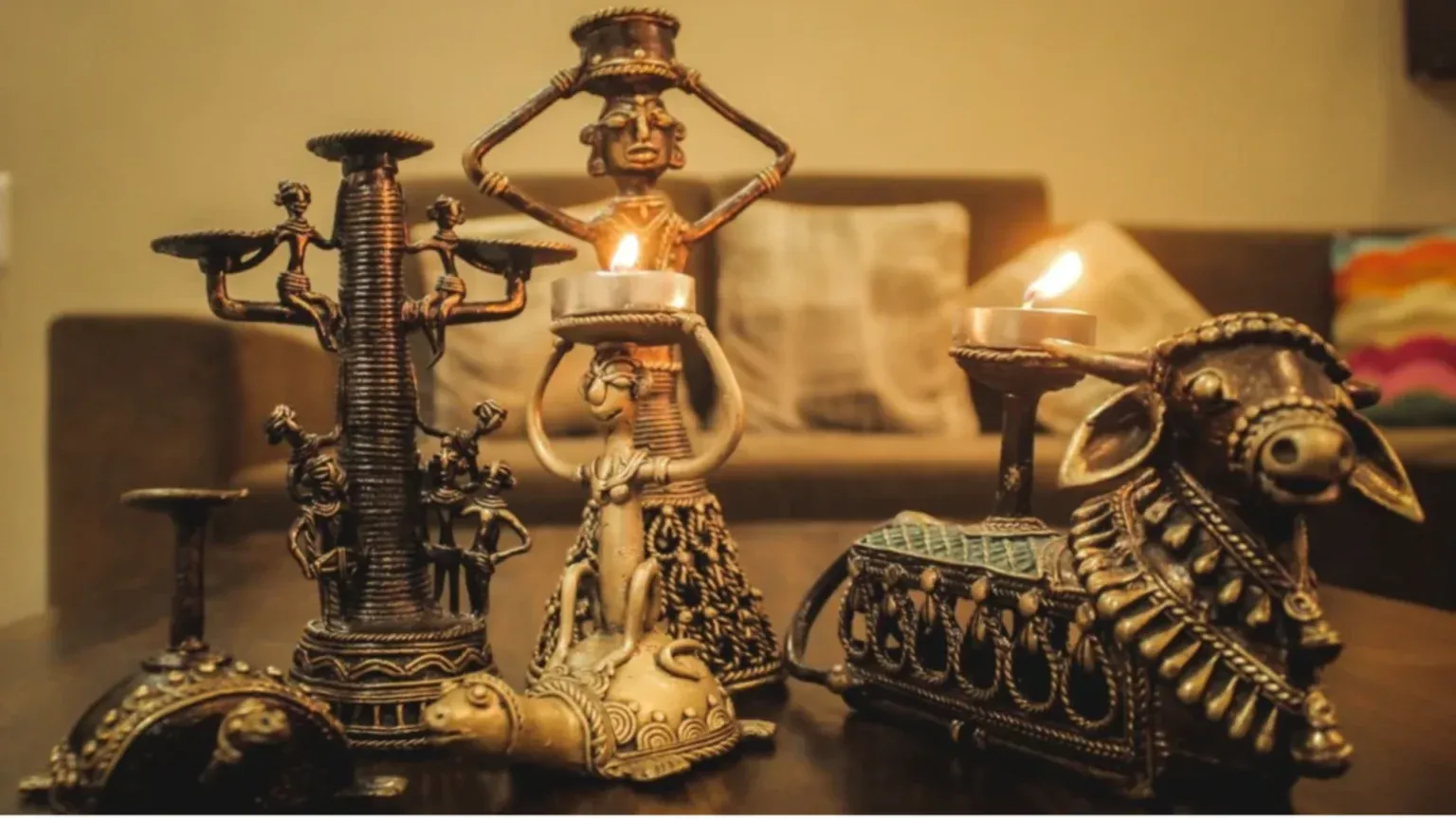
Ritual and domestic objects form a third category: measuring vessels in graduated sizes (used for ritual and commercial measurement), lamps, caskets, nutcrackers, spoons, and cattle-bells are documented by the MAP Academy. Jewellery including anklets, bracelets, pendants, and amulets constitutes a further category, with the sun as the most prevalent motif in Dhokra jewellery, presented as a round disc symbolising growth and positivity, as documented in the Oak Lores source.
Process: The Dhokra lost-wax casting process for hollow casting, as practiced in Bastar and documented across the Chitrolekha Journal (Kochhar 2011), MAP Academy, D'Source IIT Bombay, Shambhavi Creations, and Peepul Tree/LHI sources, proceeds through the following stages.
The first stage is the preparation of the clay core. A rough model vaguely resembling the final object is constructed from clay mixed with rice husk, coal dust, and water. In Bastar, riverbed soil or local soil is used. This core is hardened either by drying in the sun or by mild firing in an oven. The core is smaller than the intended final object.
The second stage is wax preparation and application. At Bastar, only beeswax is used, as specified by the Asia InCH Encyclopedia, with no addition of sal resin or other substances that are used in other regional variations. The beeswax is heated and formed into thin threads or strings using a press tool. In Chhattisgarh, the Shambhavi Creations documentation names this press tool as the Thassa, with the wax drawn through a sieve-like tool called Pichki to produce threads as thin as one millimetre in diameter. The MAP Academy identifies this as the most labour-intensive and artistically significant stage. The Chitrolekha Journal describes beeswax sometimes being mixed with dhuna, the resinous gum of the sal tree (Shorea robusta) boiled in mustard oil. The wax threads are wrapped around the clay core and built up into the detailed decorative surface of the object: figures, animals, jewellery details, geometric patterns, and narrative elements are all formed at this stage by hand, using the wax directly.
The third stage is the outer clay coating. The completed wax-covered model is coated with a very thin layer of fine wet clay, which takes an impression of all fine details of the wax surface. The MAP Academy and Bastar district Wikipedia article document that the materials used in Bastar include beeswax, cow dung, paddy husk, and red soil. Additional layers of coarser clay are then applied to form the full mould. In Bastar, the Abirpothi source records that clay from termite mounds is used for the fine inner layer.
The fourth stage is dewaxing. The mould is carefully heated so that the wax melts and drains away through small openings left in the mould, leaving a cavity in the exact form of the wax model. The Asia InCH Encyclopedia lists the tools used: farni, mutni, dhokna, chimta, sooja, hathawri, dhorkin, darga, pinachaku, and seikanta. These tools are made by local blacksmiths, carpenters, and the artisans themselves.
The fifth stage is casting. A pot or funnel containing pieces of scrap metal (brass or bell metal) is attached to the top opening of the mould, and the assembly is placed in a furnace. The metal melts and fills the cavity. Coal is the standard furnace fuel in Bastar. The mould is left to cool.
The sixth stage is demoulding and finishing. The outer clay mould is broken away to reveal the cast metal object, which is then cleaned and polished. The MAP Academy specifies the finishing tools as hammers, chisels, files, pliers, knives, and a wire brush.
Mediums Used: The primary casting metals in Bastar Dhokra are brass (copper and zinc alloy), bronze (copper and tin alloy), and bell metal (a high-tin bronze alloy). The Shambhavi Creations documentation identifies bell metal used in Chhattisgarh as an alloy of brass, nickel, and zinc oxide. Scrap metal sourced from utensil shops and household discards is the standard raw material, as documented by the MAP Academy. The wax medium is exclusively pure beeswax at Bastar, as specified by the Asia InCH Encyclopedia, distinguishing Bastar practice from other regional centers. Clay from riverbed soil, mixed with rice husk, coal dust, and in Bastar also with cow dung and paddy husk, forms the core and outer mould. Coal is the furnace fuel. The tools are iron tools made locally by blacksmiths or by the artisans themselves.
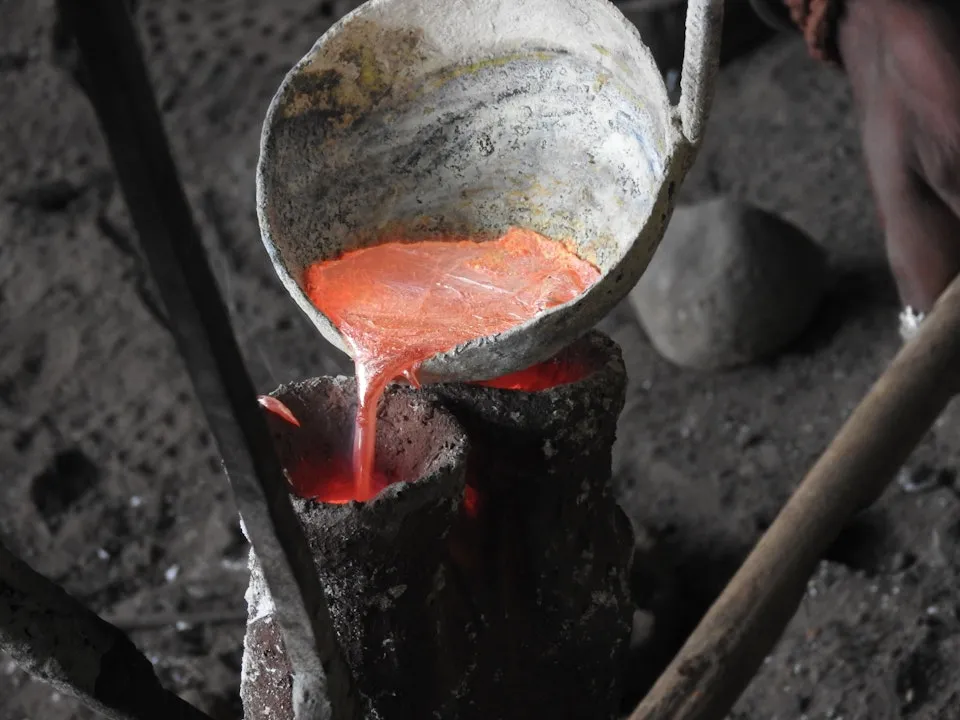
The MAP Academy documents that the economic effects of the COVID-19 pandemic led to rising procurement costs and higher prices for finished goods, and that there has been a marked decline in the number of active Dhokra artisans. The ResearchGate paper on Dhokra art progression (Banerjee and Rani, ShodhKosh, 2024) identifies the craft's evolution across four dimensions: changes in form and size, changes in material composition (including the adoption of paraffin wax in place of beeswax by some artisans), expansion of subject matter beyond traditional ritual objects, and the engagement of professional designers and urban markets.
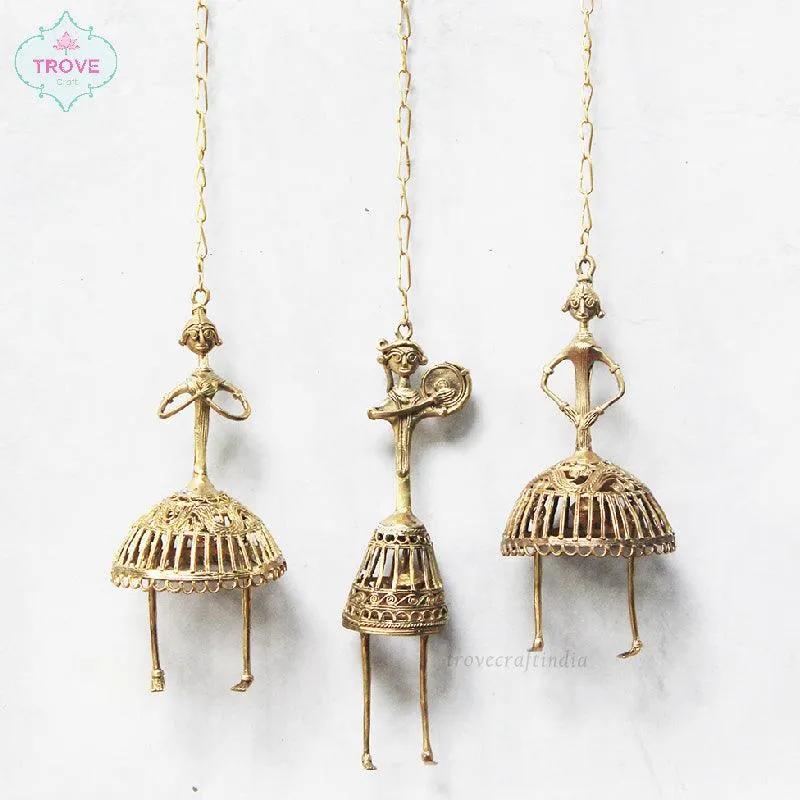
The craft has expanded from traditional ritual and domestic objects to include contemporary applications: wall hangings, pen stands, jewellery, photo frames, tea light candle holders, dining accessories, doorknobs and handles, and commissioned sculpture for public and institutional spaces. The Gulf News feature on Jaidev Baghel documents the export of large Dhokra sculptures to Western countries, and Baghel's work across exhibition venues in London, Moscow, Heidelberg, Stuttgart, Oxford, Rome, Paris, Switzerland, Los Angeles, Hong Kong, Japan, Thailand, and Singapore.
The involvement of sculptor and researcher Meera Mukherjee (1923 to 1998), who apprenticed with Bastar's Ghadwa community and produced the comprehensive academic work Metal Craftsmen in India (Anthropological Survey of India, 1978) alongside her sculptural practice, brought sustained academic and institutional documentation to the craft. Her research is cited in the MAP Academy's article on Dhokra and is part of the craft's institutional record.
The NISTADS-funded project at Bengal Engineering College, documented in the Peepul Tree/LHI article (2021), developed a fuel-efficient permanent furnace for Dhokra artisans, leading to the launch of a community furnace in Bankura by 2000, sparing artisans from open, traditional furnaces.
Bastar Dhokra's vulnerability is classified as high in craft documentation frameworks. The primary challenges documented across sources are poverty among artisans, limited market access, disinclination among younger generations to learn the craft, and the disruption to supply chains brought by the COVID-19 pandemic.
Text Sources
Hacker, Katherine. “Dismantling or Rehabilitating the Cult of the Craftsman Paradigm: Some Reflections on Jaidev Baghel’s Practice.” The Journal of Modern Craft, vol. 9, no. 2, 2016, pp. 139–159.
Mahawar, Niranjan. Bastar Bronzes, Tribal Religion and Art. Abhinav Publications, 2011.
Mukherjee, Meera. In Search of Viswakarma. 1994.
Mukherjee, Meera. Metal Craftsmen in India. Anthropological Survey of India, 1978.
Mukherjee, Meera. Metal Craft in India. Anthropological Survey of India, 1979.
Postel, Michel, and Zarine Cooper. Bastar Folk Art: Shrines, Figurines and Memorials. Project for Indian Cultural Studies, 1999.
Sen, Prabhas. Crafts of West Bengal. Mapin Publishing, 1994.
Internet Sources (for Images)
“Dhokra Art: A Timeless Tradition of India.” Rainbows and Hues, https://rainbowsandhues.com/dhokra-art-a-timeless-tradition-of-india/. Accessed on April 24, 2026.
“Dhokra Metalwork: 4,000 Years of Tradition in Your Living Room.” Trove Craft India, 26 Apr. 2025, https://trovecraftindia.com/blogs/the-trove-craft-blog/dhokra-metalwork-4-000-years-of-tradition-in-your-living-room. Accessed on April 24, 2026.
“Dhokra Art Wall Hangings.” Artline Creation, https://artlinecreation.in/dhokra-art-wall-hangings/. Accessed on April 24, 2026.
“Treasured Memories: Learning Dhokra Metal Art in Panchgani.” VAWAA, https://vawaa.com/blog/Treasured-Memories-Learning-Dhokra-Metal-Art-in-Panchgani. Accessed on April 24, 2026.