
Dandiya Raas - The Folk Dance Tradition of Gujarat
From devotional rituals to festive gatherings, explore the evolution and cultural legacy of Dandiya Raas in Gujarat.
Introduction
Dandiya Raas is a socio-religious folk dance of Gujarat, performed primarily during the nine-night Navaratri festival. It is characterized by the use of dandiya, pairs of decorated wooden sticks, which performers strike against each other or against a partner's sticks in rhythmic patterns while executing footwork and rotational movement. The form is practiced across Gujarat and by Gujarati communities worldwide, and has developed both as a devotional practice within Navaratri celebrations and as a competitive collegiate art form in the Indian diaspora. Dandiya Raas is associated with the story of Goddess Durga's battle with the demon Mahishasura, and its sticks are understood to represent the Goddess's sword.
Etymology
The name combines two Sanskrit-derived terms: 'dandiya,' meaning small wooden sticks, and 'raas,' derived from the Sanskrit 'rasa,' meaning juice or essence, and by extension referring to the circular folk dance performed by Krishna with the gopis in Vrindavan (Raas Lila). The compound term thus means the circular stick dance. In classical texts and in the Harivamsa Purana, comparable stick-dance forms are referred to as 'Hallisaka' with subtypes including 'Tal Raaska' and 'Dand Raaska,' the latter being the closest antecedent to Dandiya Raas.
Origin Dandiya Raas is associated with the migration of Yadava communities from the Mathura-Vrindavan region to the Saurashtra and Kathiawar regions of Gujarat, estimated to have occurred approximately 1500 BCE according to traditions linking the Yadava settlement to the city of Dwaraka. The Sahapedia documentation of Raas traditions in Gujarat situates Dandiya Raas within the longer history of agricultural and occupational dances of the Saurashtra region, describing it as originally a dance common to all communities of Saurashtra that gained wider popularity after the merger of Saurashtra with the State of Gujarat in 1960. The Harivamsa Purana mentions circular stick-dance forms in connection with Krishna, providing a textual anchor for the tradition's self-understanding.
Location
Dandiya Raas originated in Saurashtra and Kathiawar, the western peninsula of Gujarat, and spread to become a statewide tradition after 1960. It is now practiced across all regions of Gujarat, with particularly large festival events in Ahmedabad, Vadodara, Surat, and Rajkot. Regional variations exist: the Kanabi Raas is associated with farming communities, and the Maniaro Raas is specific to the Mer community of Saurashtra. Internationally, the form is practiced by Gujarati diaspora communities in the United Kingdom, the United States, Canada, East Africa, and Australia.
Community
Dandiya Raas was historically practiced by the farming and pastoral communities of Saurashtra. Over the course of the twentieth century, it became a broadly shared Gujarati folk practice, performed by communities across caste and occupational lines during Navaratri. In diaspora contexts, it serves as a marker of Gujarati cultural identity. The competitive collegiate form of Dandiya Raas, which emerged in the early 2000s, was formalized by organizations such as Raas All-Stars (RAS), which began holding competitions in 2009.
Relevance
Dandiya Raas is among the most recognizable folk dances of India and is performed at large-scale events attended by thousands during Navaratri. It has been adopted into national cultural programming and is included in Republic Day and state cultural presentations. Its global spread through the Gujarati diaspora has made it one of the Indian folk forms with the widest international footprint. Within Gujarat, it is integrated with the Garba tradition during Navaratri, with the two forms often performed at the same events.
History
The textual tradition linking Dandiya Raas to the Yadavas and to Krishna's Raas Lila appears in the Harivamsa Purana and in medieval Gujarati devotional literature. The form as practiced today is shaped by both the regional Saurashtra agricultural tradition and the devotional Vaishnava tradition. The Sahapedia documentation notes that prior to 1960, Dandiya Raas was concentrated in Saurashtra, and its spread to the rest of Gujarat was catalyzed by the state's political unification. The form was further popularized through Bollywood films in the 1980s and 1990s, which incorporated Dandiya Raas sequences and introduced the form to audiences beyond Gujarat.
Culture and Societies
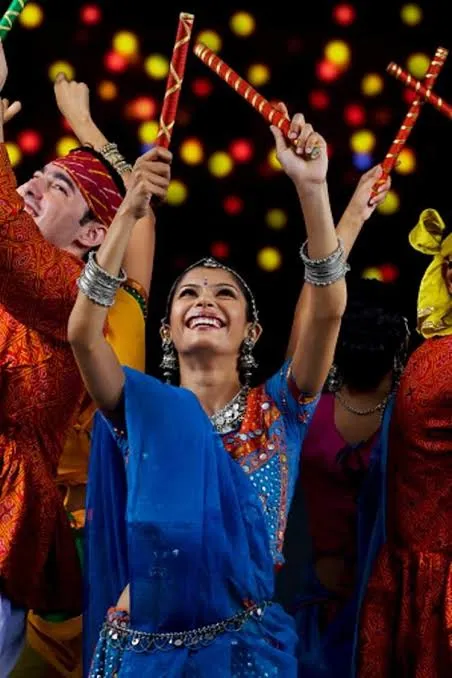
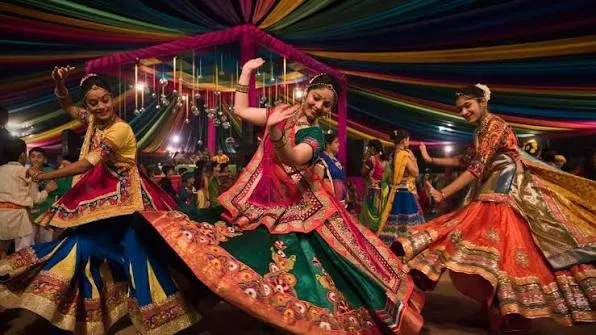
During Navaratri, Dandiya Raas is performed every evening for nine consecutive nights. Large public events, organized by temples, community groups, and municipal authorities, draw hundreds to thousands of participants. The sticks (dandiya) are purchased or made fresh each season, decorated with paint, foil, and ribbons. The performance proceeds in circular formations with partners changing at intervals, creating an inclusive and participatory structure. The competitive collegiate Dandiya Raas tradition, developed in the Indian diaspora, has introduced formal choreography, musical arrangement, costuming, and judging criteria into what was originally an informal communal practice.
Religious Significance
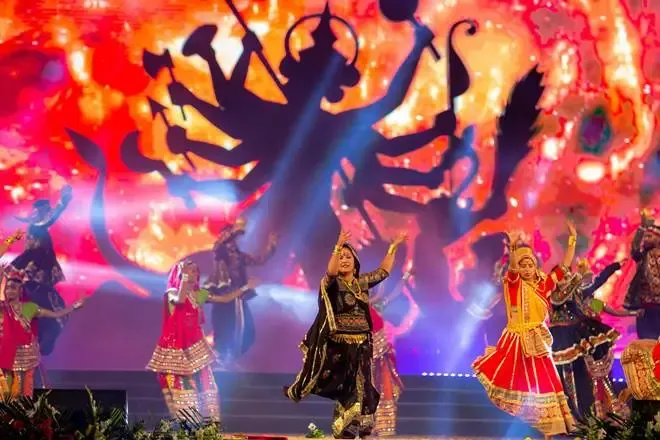
Dandiya Raas is performed in honor of Goddess Durga during Navaratri and specifically enacts the battle between the Goddess and the demon Mahishasura. The sticks represent the Goddess's sword (khadga), and the striking of stick against stick represents combat. The nine nights of Navaratri are nine nights of battle leading to the Goddess's victory, which is celebrated on Dussehra (the tenth day). The devotional dimension of the performance is emphasized through the singing of bhajans and the presence of an icon of the Goddess at the performance site.
Understanding the Art
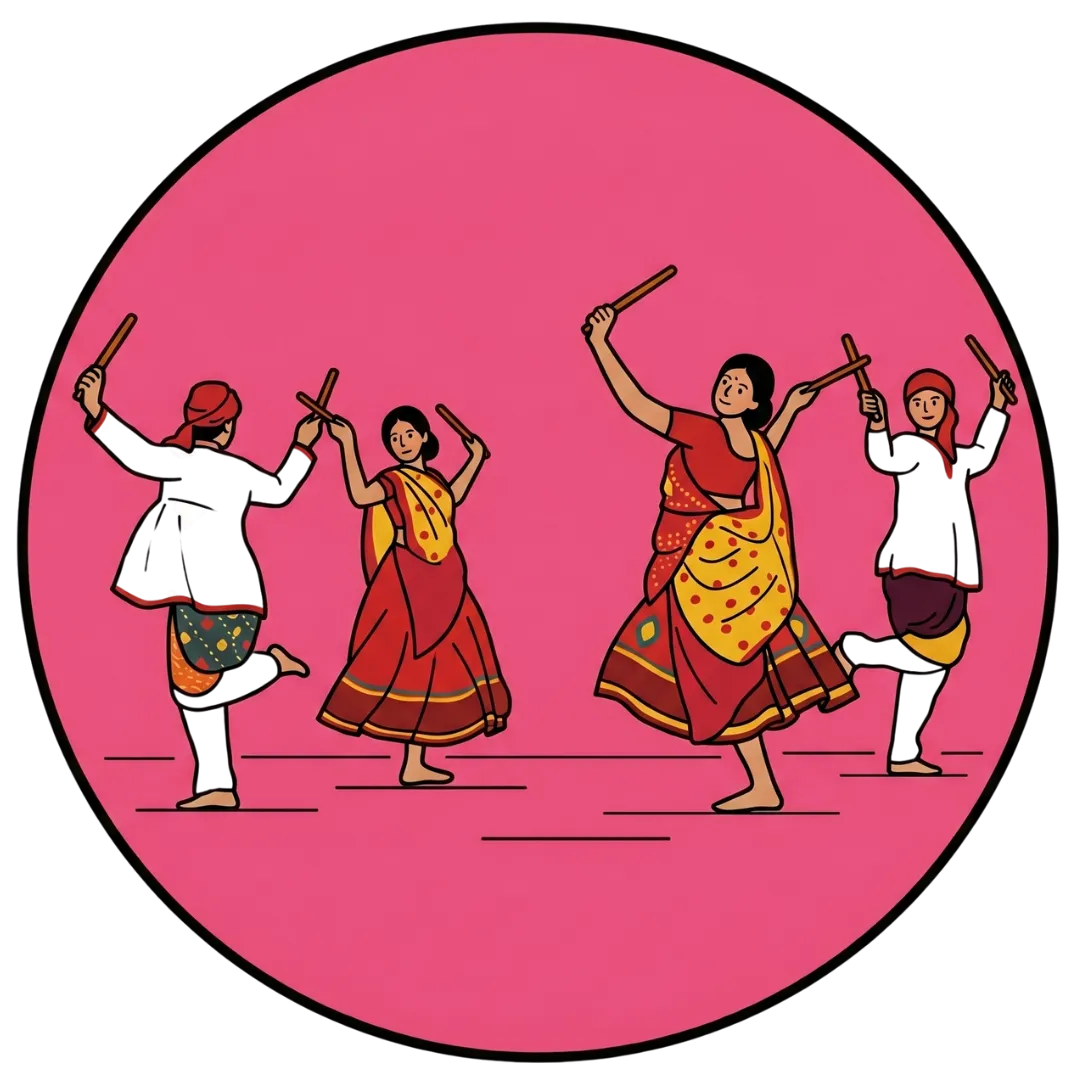
Dandiya Raas is performed in pairs or groups arranged in two concentric circles moving in opposite directions, or in two lines facing each other. The basic movement cycle involves striking one's own sticks together, then striking the partner's sticks, while executing footwork in an eight-beat time cycle called Kaherva. As skill increases, the striking patterns become more complex: participants perform behind-the-back strikes, cross-body strikes, and multi-partner sequences. The tempo increases progressively through the performance. The form is accompanied by dhol, dholak, shehnai, and cymbals in traditional settings; electric instruments and Bollywood music are common in contemporary urban events.
Central Motifs and Their Significance The central motif is the dandiya stick pair, which encodes the narrative of divine combat and the ritual reenactment of Durga's victory. The circular formation of the dance reflects the Raas Lila tradition, the cosmic circle of divine and human participation. The progressive increase in tempo through the nine nights of Navaratri corresponds to the escalating battle. Specific regional variations, such as the Maniaro Raas of the Mer community, incorporate stick techniques distinctive to that community's martial and pastoral heritage.
Process
Performers purchase or prepare dandiya sticks before the festival season. At performance events, participants arrange themselves in circles or lines, sticks in hand. A lead musician or DJ sets the tempo, which begins at a moderate pace and accelerates through the evening. The striking sequences are learned informally through participation and observation. In competitive collegiate settings, choreography is formally developed and rehearsed over weeks or months before competition. Traditional instruments include dhol and dholak; contemporary performances incorporate electronic amplification and popular music.
Mediums Used
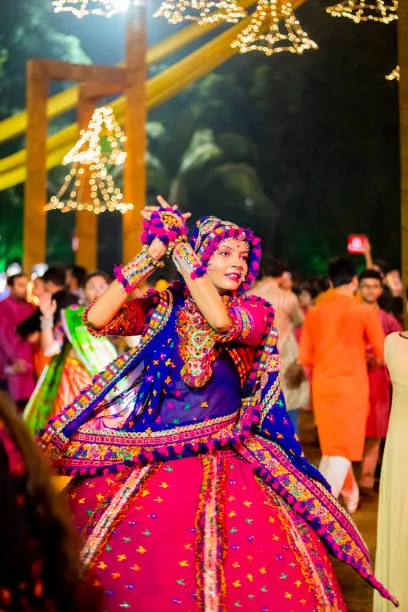
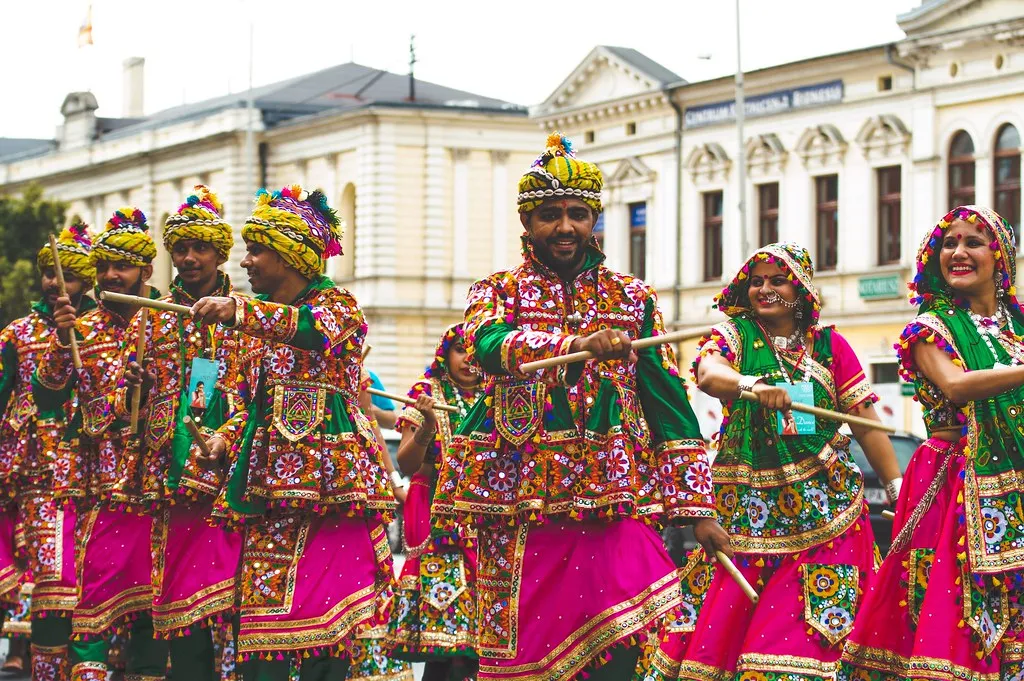
Dandiya sticks are the defining material objects of the form: typically thirty to forty-five centimeters in length, made of light wood, and decorated according to the aesthetic preferences of the performer. Traditional costumes for women include chaniya choli (three-piece dress of long flared skirt, blouse, and dupatta) with mirror embroidery and traditional Gujarati jewelry. Men wear kafni pyjamas with a ghagra (short round kurta), pagadi (turban), and traditional footwear. Musical instruments in traditional performances are dhol, dholak, shehnai, and cymbals.
New Outlook
Dandiya Raas is thriving both in Gujarat and in the Gujarati diaspora. Its institutional presence is strong: it is featured in state and national cultural festivals, included in school and college curricula in Gujarat, and promoted by the Gujarat Tourism and Culture Department as a flagship cultural product. The competitive Dandiya Raas tradition organized by diaspora institutions in North America and the United Kingdom has generated significant community engagement and has introduced new aesthetics and choreographic vocabularies into the form. Challenges include the commercialization of Navaratri events, which in large urban settings can reduce the devotional character of the tradition to entertainment, and the risk of the form losing its connection to the specific regional variations and community contexts from which it emerged.
Learn Dandiya Raas
Bibliography
Sources
Doshi, Saryu, editor. Dances of Gujarat. Marg Publications, 1971.
Kothari, Sunil. Folk Dances of India. Marg Publications, 1994.
Misra, Susheela. Some Immortal Indian Dances. Harnam Publications, 1981.
Sahapedia. “Raas Traditions of Gujarat.” Sahapedia, https://www.sahapedia.org/.
Vyas, Rasiklal. Folk Dances of Gujarat. Gujarat Vidyapith, various editions.
Image Sources
“Dance Forms of India.” The Times of India Photo Gallery, https://photogallery.indiatimes.com/news/india/dance-forms-of-india/articleshow/51616052.cms. Accessed 4 July 2026.
“Dandiya Raas.” iStock, https://www.istockphoto.com/photos/dandiya-raas. Accessed 4 July 2026.
“Dandiya Raas in Gujarat: Best Places to Witness Navratri Celebrations.” Adotrip, https://www.adotrip.com/blog/navratri-2019-places-to-witness-the-best-dandiya-raas-in-gujarat?srsltid=AfmBOoq5WVLa882wWAtYlSlstNh8s0JzBjoi_YacPwt3qLJd3u_jTwpt. Accessed 4 July 2026.
“Navratri 2019: With Colourful Dresses, Garba and Dandiya Raas, Gujarat Begins Festival Season.” The Financial Express, https://www.financialexpress.com/life/lifestyle-navratri-2019-with-colourful-dresses-garba-and-dandiya-raas-gujarat-begins-festival-season-1723298/. Accessed 4 July 2026.
Surtaal Performing Arts. “Dandiya Raas.” Flickr, https://www.flickr.com/photos/surtaalperformingart/40895706973. Accessed 4 July 2026.