


Conch Shell Craft/ Shankha Shilpa - Handicraft Tradition
Explore Conch Shell Craft or Shankha Shilpa tradition of West Bengal, and learn about its origins, techniques, cultural significance, and artistic heritage.
Introduction
Shankha Shilpa, also referred to as conch shell craft, is a traditional craft practiced primarily in West Bengal in which artisans process and carve the shells of the marine gastropod Turbinella pyrum into bangles, decorative objects, religious instruments, and jewelry. The craft is particularly associated with the production of shakha, the white conch shell bangles worn by married Hindu Bengali women as a symbol of marital status. Major craft centers are located in Bishnupur and Hatgram in Bankura district, and in the Sankha Banik Colony and Baghbazar and Barrackpore areas of Kolkata. The craft has been documented in scholarly sources as far back as T. N. Mukharji's Art Manufactures of India (1888), and James Hornell's 1914 survey confirmed large-scale production in Bankura district.
Etymology The Sanskrit word 'shankha' refers to the conch shell and is deeply embedded in Hindu religious vocabulary. 'Shilpa' means craft or art in Sanskrit, making 'Shankha Shilpa' directly translatable as 'conch shell craft.' The artisan community is known as 'Shankhakar' or 'Shankhari,' and traders in the shell products are called 'Sankha Banik.' The tool historically used to cut conch shells, the 'Kush Karat' (a heavy crescent-shaped steel saw), has its own mythological naming derivation: the Kush is a type of sacred grass associated with the sage Agastha, who according to local tradition cut the sea demon Shankhasur with such a blade.
Origin The use of conch shells in the Indian subcontinent has been documented since at least the fourth millennium BCE. The Mahabharata contains references to the conch shell, including Lord Krishna's conch Panchyajanya. The Bengal tradition of conch shell craft is historically rooted in the pre-Partition geography of greater Bengal, with major pre-1947 centers in Dhaka, Barisal, Dinajpur, Rangpur, and Sylhet (now in Bangladesh). Following the Partition of India in 1947, large numbers of Shankhakar artisans migrated to West Bengal, particularly to Kolkata. An earlier migration wave brought Shola craftsmen from Chittagong to Bardhaman before the first Partition of Bengal in 1905, suggesting sustained craft-community mobility across the Bengal region in the colonial period.
Location Primary centers: Bishnupur and Hatgram, Bankura district; Sankha Banik Colony, Lalkuti, Baghbazar, and Barrackpore in Kolkata; North 24-Parganas, Purba Medinipur, and Paschim Medinipur. Research by Paul (2014, ResearchGate) surveyed 240 conch shell craft households across four West Bengal districts.
Community The Shankhakar community, which holds hereditary specialist status in conch shell working, is divided into two functional groups: Sankharis (makers of sankhas and other objects) and Sankha Baniks (traders in shell products). Sankharis hold Brahmanical gotras and observe social customs historically associated with upper caste Hindu practice, including restrictions on widow remarriage. Nearly all Shankharis belong to the Vaishnava sect. The craft is transmitted intergenerationally within families. Skilled finishing work including engraving and design is performed exclusively by Shankhakar community members; unskilled labor for rough cutting and polishing is drawn from other communities.
Relevance The conch shell bangle (shakha) remains a central element of Hindu Bengali marriage ritual. The shakha is worn along with the red pola (coral bangle) and loha (iron bangle) as mandatory markers of married status for Hindu Bengali women. The shell is considered inauspicious to break during the first year of marriage. Beyond bangles, conch shells have documented uses as ritual instruments (blown to mark the beginning of puja or to dispel negative forces), and as decorative and sculptural objects. Shankha products are exported to Assam, Tripura, Bangladesh, and international markets.
History
Background The most detailed early documentation of the craft appears in T. N. Mukharji's Art Manufactures of India (1888), which records conch shell manufacture among Bengal's significant craft traditions. James Hornell's 1914 survey, cited in subsequent academic literature, confirmed that the craft was practiced on a very large scale in Bankura district. Banglapedia (the national encyclopedia of Bangladesh) documents that in the pre-Partition period, the primary centers of Shankha craft were located in Dhaka, Barisal, Dinajpur, Rangpur, and Sylhet, with 'Shankhari Patti' in old Dhaka as the most concentrated production site.
The craft suffered significant disruption following the Government of India's imposition of a ban on marine species including many molluscs and shells under the Wildlife Protection Act of 1972. Under pressure from organizations including the 'Shankha Shilpa Bachao Committee,' the government revoked the ban specifically for Turbinella pyrum, the species used in craft production, as it holds auspicious status in Hindu religious practice. The 2004 Sumatra tsunami also impacted the supply chains, as documented by Banerjee (2012) in 'An Overview of Conchshell Industry of Bishnupur, Bankura District, after Sumatra Tsunami.'
The innovation of carved decorative objects beyond bangles is attributed to the late Dukhiram Ostad of Bishnupur, who is credited with initiating the production of rings, pendants, necklaces, showpieces, incense stick stands, pen stands, and vermillion containers from conch shells. Haripada Kundu, a master craftsman from Hatgram, is documented as producing sculptural works of exceptional quality that received recognition from figures including Mahatma Gandhi, Jawaharlal Nehru, Bidhan Chandra Roy, and Prafulla Sen. The artisan Gopal Nandy received the President's Prize in 1988 for outstanding work on coconut shell, demonstrating the broader skill and innovation within the regional craft community.
Culture and Societies The shankha bangle is one of the most socially significant objects in the material culture of Hindu Bengali marriage. Its wearing is mandatory for married women, and widows are traditionally prohibited from wearing it. The bangle is considered a marker of the husband's wellbeing: its breakage during the first year of marriage is considered inauspicious. The craft community recognizes five grades of conch shell quality for bangle production: Titkutti (perfect white, hard, fine-grained), Jadki (slightly inferior with a small worm hole), Patti, and two lower grades. This grading system reflects the technical demands of producing bangles of consistent circumference from a naturally variable organic material. Pre-Partition Dhaka-origin artisans use the term 'Dhakai shankha' to designate both the product type and the artisanal identity of their community. The migration history of the Shankhakar community after 1947 is a significant aspect of its cultural memory, and artisan families in North Kolkata trace their workshop traditions to specific locations in pre-Partition Dhaka.
The mythological narrative surrounding the Kush Karat tool is observed in practice: for the last four days of the month of Bhadra in the Bengali calendar, all Shankhakars traditionally cease work in honor of the sage Agastha. The Kush Karat has been replaced by electric cutting machines for more than five decades, but it remains a cultural symbol of the craft.
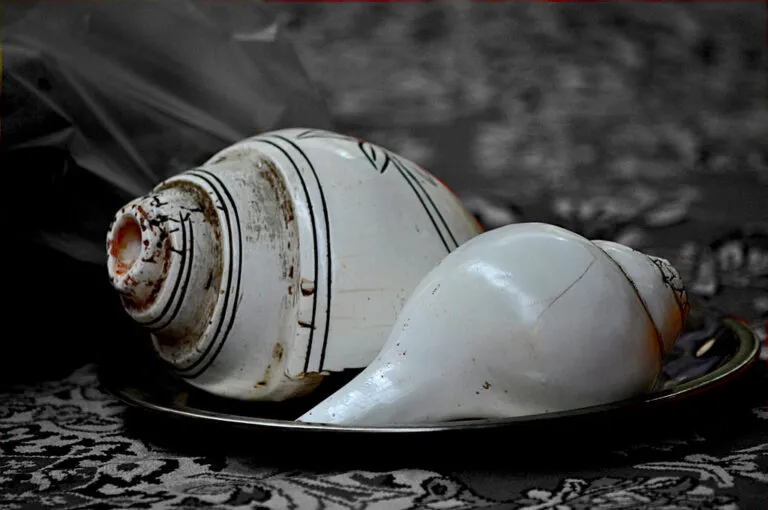
Religious Significance The conch shell occupies a position of fundamental importance in Hindu religious practice. The blowing of the shankha marks the beginning of puja, the commencement of auspicious events, and the announcement of victories. In Hindu iconography, the shankha is one of the four primary attributes of Lord Vishnu, alongside the chakra, gada, and padma. Lord Krishna's conch Panchyajanya is described in the Mahabharata. The Vedic association of the conch with cosmic sound and divine communication has sustained the shell's ritual use across millennia.
The shankha bangle worn by married Bengali Hindu women is specifically associated with the long life and wellbeing of the husband. The shell's white color is symbolically linked to purity and auspiciousness. Astrological practice also ascribes significance to conch shell objects: they are prescribed to satisfy the Moon (Chandra) and are associated with reducing ailments including chronic cold and enteric disorders. The sacred status of Turbinella pyrum was the basis on which the artisan community successfully petitioned for the revocation of the Wildlife Protection Act ban.
Understanding the Art
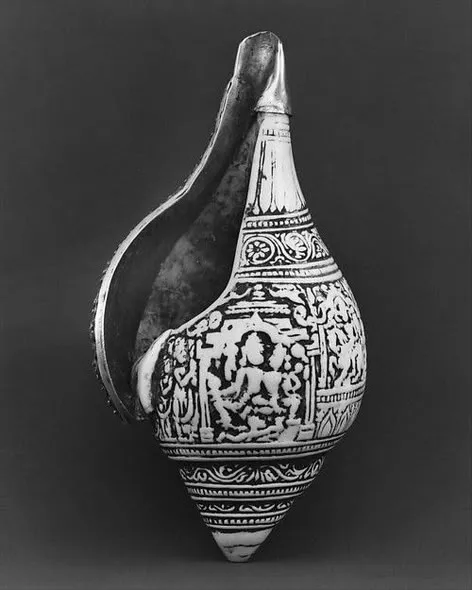
Style The production output of Shankha Shilpa falls into two primary categories. The first is functional production centered on shakha bangles, which are uniform in their basic circular form but each unique in circumference due to the variable geometry of the conch shell. The second category encompasses decorative and sculptural production, which includes carved conch shells featuring mythological scenes and divine figures, jewelry items such as rings, pendants, and necklaces, and household objects such as incense stick stands and pen stands. The sculptural register, associated with masters like Haripada Kundu and Subodh Dutta, represents a fine art dimension of the craft that goes beyond functional production.
Central Motifs and Their Significance Engraved and carved decorative conch shells feature mythological subjects derived from Hindu epic and Puranic sources. Scenes from the Ramayana and Mahabharata, figures of deities, and devotional imagery are the primary motifs. The 'Maya' design, executed on plain surfaces using a bamboo pen and colored patterns, appears in traditional bangle decoration. The decorative conch shells produced at Bishnupur and Hatgram incorporate scenes of increasing narrative and figurative complexity, with master craftsmen known for multi-figure compositions. Contemporary production also includes abstract and geometric motifs adapted for export and decorative markets.
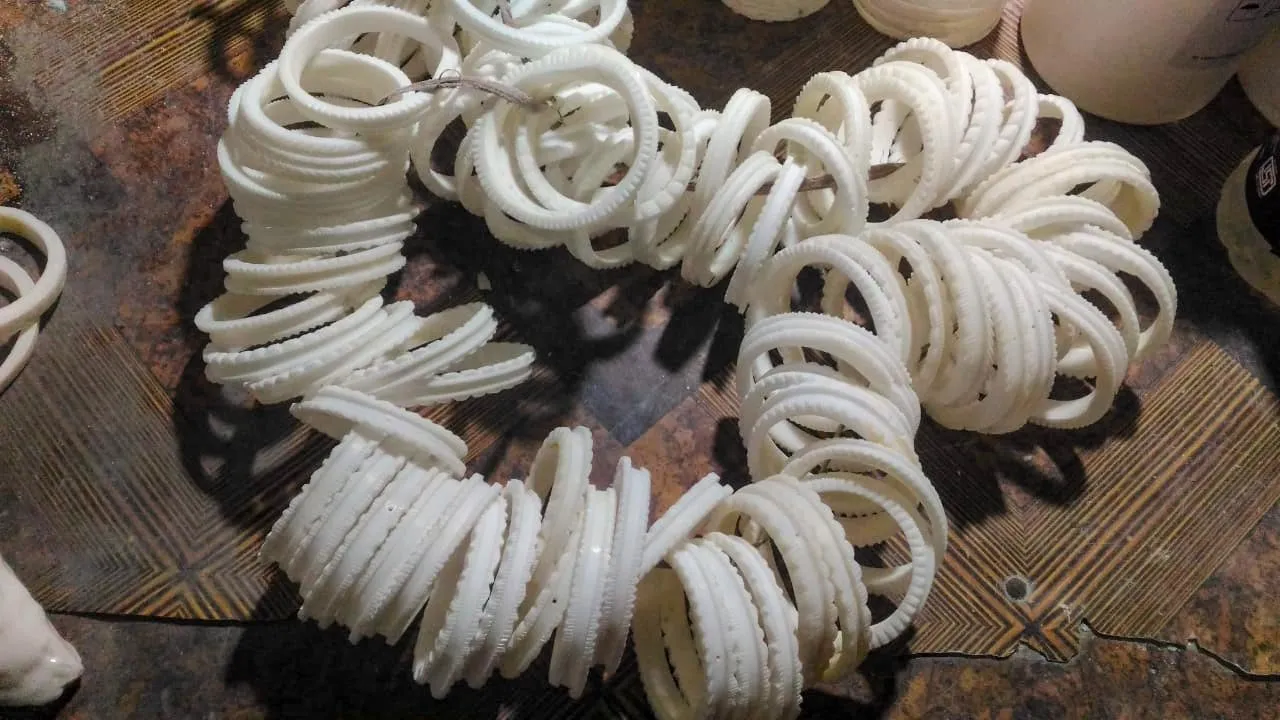
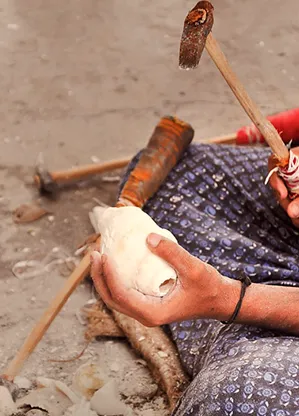
Process Raw conch shells are sourced from Rameswaram and Thoothukudi (formerly Tuticorin) in Tamil Nadu, where Turbinella pyrum is cultivated, and from Sri Lanka. Shells arrive in containers packed in gunny bags of approximately 200 shells each. The pointed top and tail of the shell are first removed. A hole is made in the inner shell, following which the shell is left submerged in water for cleaning and softening. After sun-drying, the shell is broken into two approximately round halves from the middle. These halves are then smoothed on a grinding machine and sliced into four to five bangles per half. A chisel is used to engrave designs and patterns on the bangle surface. Each finished pair of bangles requires approximately 12 to 16 hours of skilled labor from cutting through polishing.
For decorative sculptural objects, the whole shell is cleaned, sometimes using acid for a brightened white finish, and then carved using chisels, hammers, grinders, and hand files. Lacquering and polishing provide durability. The traditional cutting tool, the Kush Karat, has been replaced by electric cutting machines fitted with circular saws for more than five decades. Bangle production involves two processes described by historical Banglapedia documentation: 'samata' (cutting with a sharp-edged instrument), 'majar deya' (reducing the front edge with a sharp saw), and 'jhapani' (making the shell rounded and plain). Smoothing the inner portion uses a saucer containing sand, incense, and mustard oil.
Mediums Used Primary Material: Turbinella pyrum (sacred conch shell), sourced from Tamil Nadu coasts (Rameswaram, Thoothukudi) and Sri Lanka. Alternative Materials: Coconut shell and bamboo have been adopted by some artisans following supply disruptions. Cleaning Agents: Water (for softening), acid solution (for brightening surface finish in decorative production). Finishing Materials: Lacquer and polish for durability and sheen. Tools: Kush Karat (historically), electric cutting machines with circular saws, chisels, hammers, grinders, hand files, bamboo pens (for Maya design work).
New Outlook
Shankha Shilpa is classified as vulnerable. The primary challenges are documented in both academic research (Paul 2014, ShodhKosh 2023, 30 Stades 2021) and artisan testimonies. The supply of naturally grown Turbinella pyrum from the deep sea has declined significantly over the past two decades. Artisans now depend primarily on cultured conches produced in controlled coastal environments in South India, which are described as mediocre in quality compared to wild-caught shells. The Wildlife Protection Act disruptions of the 1970s altered supply chains permanently, and the 2004 Sumatra tsunami caused further supply disruption.
Market pressures include competition from machine-made plastic bangles, declining observance of traditional shakha-wearing practices among younger urban Bengali women, and low artisan wages (reported at approximately Rs. 300 per day for bangle artisans in the early 2020s, producing approximately 400 pairs per month). The craft continues to have an active market within Bengal and supply chains extending to Assam, Tripura, and Bangladesh, with some export to global Indian diaspora communities. Government support through Biswa Bangla and Bangasree retail initiatives has provided institutional market access. Artisan families in Baghbazar's Sankha Banik Colony are adapting by diversifying their product range to include rings, pendants, and home decor items, including those made from alternative materials.
Learn Conch Shell Craft
Bibliography
Sources
“An Exploratory Study: Conch Shell Carving in Bishnupur, India.” ShodhKosh: Journal of Visual and Performing Arts, vol. 4, no. 2SE, 2023.
Bain, W. K. “Bishnupur: A Town of Cultural Excellence.” Journal of the Anthropological Survey of India, 2016.
Banerjee, R. “An Overview of Conchshell Industry of Bishnupur, Bankura District, after Sumatra Tsunami (2004).” 2012.
Das, Sanjay Prasad, and Abhijit Das. “Sankha Shilpa (Conch Shell Industry) in an Urban Area of West Bengal: An Ethnographic Study.” International Journal of Innovative Studies in Sociology and Humanities, vol. 4, no. 7, 2019.
Mukharji, T. N. Art Manufactures of India. Calcutta, 1888.
Paul, Prasun. “Economics of Conch Shell Industry: A Study in West Bengal.” ResearchGate, 2014.
“Shankhari.” Banglapedia: National Encyclopedia of Bangladesh, Asiatic Society of Bangladesh, Dhaka.
Image Sources
“A Shell of Devotion: Exploring Bishnupur’s Conch Tradition.” Oaklores, 27 Feb. 2025, https://oaklores.com/2025/02/27/a-shell-of-devotion-exploring-bishnupurs-conch-tradition/. Accessed on May 06, 2026.
“An Exploratory Study: Conch Shell Carving in Bishnupur, India.” People’s Archive of Rural India, https://wagtail.ruralindiaonline.org/en/articles/the-conch-artisans-of-barrackpore-west-bengal/. Accessed on May 06, 2026.
Biswas, Shreedipta. “The Conch Chronicles: From Ocean to Ornaments.” Oaklores, 10 Apr. 2025, https://oaklores.com/2025/04/10/the-conch-cronicles-from-ocean-to-ornaments/. Accessed on May 06, 2026.
“The Living Legacy of Shankha Art: The Intricate Conch Carving Tradition of Bengal.” Facebook, Art Family, https://www.facebook.com/artfamily2020/posts/the-living-legacy-of-shankha-art-the-intricate-conch-carving-tradition-of-bengal/1262328615898622/. Accessed on May 06, 2026.