


Chhau Mask Making - The Handicraft Tradition of West Bengal
Explore Chhau Mask Making, the handicraft tradition of West Bengal, and learn about its origins, techniques, cultural significance, and artistic heritage.
Introduction
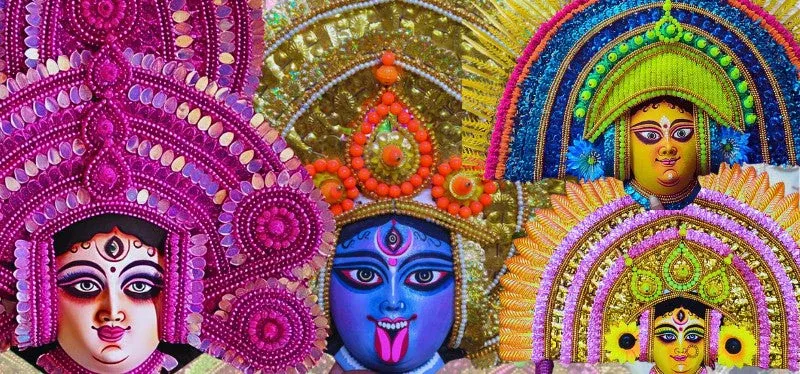
Chhau mask making is a traditional craft practiced primarily in the village of Charida in the Baghmundi block of Purulia district, West Bengal, in which artisans create large, elaborately decorated masks used in the Chhau dance. The masks are made from clay, paper pulp, cloth, and natural and synthetic pigments, and serve as defining visual elements of the Purulia style of Chhau dance. The Purulia Chhau mask received the Geographical Indication tag in 2018. The Chhau dance itself, including its associated mask and costume traditions, was inscribed on the UNESCO Representative List of the Intangible Cultural Heritage of Humanity in 2010.
Etymology The word 'Chhau' is subject to two documented interpretations. In the Bengali language, 'Chhau' ordinarily means a mask, reflecting the fact that the dance is performed using masks. An alternative scholarly interpretation derives the term from the Sanskrit word 'Chaya,' meaning image or shadow, suggesting a connection to shadow or image-based performance traditions. Neither derivation has been conclusively established as the single correct Etymology in academic literature.
Origin The tradition of Chhau mask making in Charida is documented as having begun approximately 150 years ago, during the reign of King Madan Mohan Singh Deo of Baghmundi. The first mask maker of Charida is venerated as Buddeshwar, who is credited with creating the first male and female masks, known as Kirat and Kiratni, representing forms of Shiva and Parvati respectively. A statue of Buddeshwar is located in Charida. One scholarly paper notes that the Purulia Chhau mask in its current form was first introduced by Jeepa Singh and Babulal Mistri.
Location Charida village, Baghmundi block, Purulia district, West Bengal. Charida is also known as Mukhosh Gram, literally 'mask village.' The West Bengal government's Department of Micro, Small and Medium Enterprises and Textiles, in association with UNESCO, has designated Charida as a recognized craft hub. A museum in Charida documents the history of Purulia Chhau mask making.
Community Masks are made by artisans from the Sutradhar community, also referred to in some sources as the Sutradhaar community. Approximately 300 individuals from 115 families are engaged in mask making in Charida. The skill is transmitted within families, and even young children participate in parts of the craft process. The Sutradhar community has historically been associated with the making of images and structures for theatrical and ritual purposes across Bengal.
Relevance The Purulia Chhau mask is both a functional object used in performance and a recognized cultural artifact sold as a souvenir, wall decoration, and export product. Dancers from Odisha travel to Charida to purchase masks for their performances. Airports and large retail spaces across India stock Purulia Chhau masks as representative craft objects of West Bengal. Despite the craft's endangered status, the GI tag awarded in 2018 has contributed to increased artisan awareness of intellectual property rights and improved market conditions.
History
Background The formal history of Chhau mask making in its current form dates to approximately the mid-19th century, placed within the reign of King Madan Mohan Singh Deo of Baghmundi. The Purulia Chhau dance itself has roots in martial arts traditions of the Chota Nagpur Plateau region, incorporating stylized combat sequences, animal movements, and movements derived from everyday village activities. Scholarly sources including the Heritage Journal of Multidisciplinary Studies in Archaeology (2023-24) document that the Purulia form of Chhau mask making has connections to the Natyashastra's aesthetic principles, and that its masks do not follow standard iconographic measurement rules found in classical Shilpa Shastra traditions.
Gambhir Singh Mura (1930-2002), the son of Jeepa Singh, received the Padma Shri award from the Government of India in 1981 for his contributions to the Purulia Chhau form. His work was instrumental in bringing international recognition to the dance and its masks. His statue is also located in Charida. A Chhau mask festival is held in Charida annually during January and February.
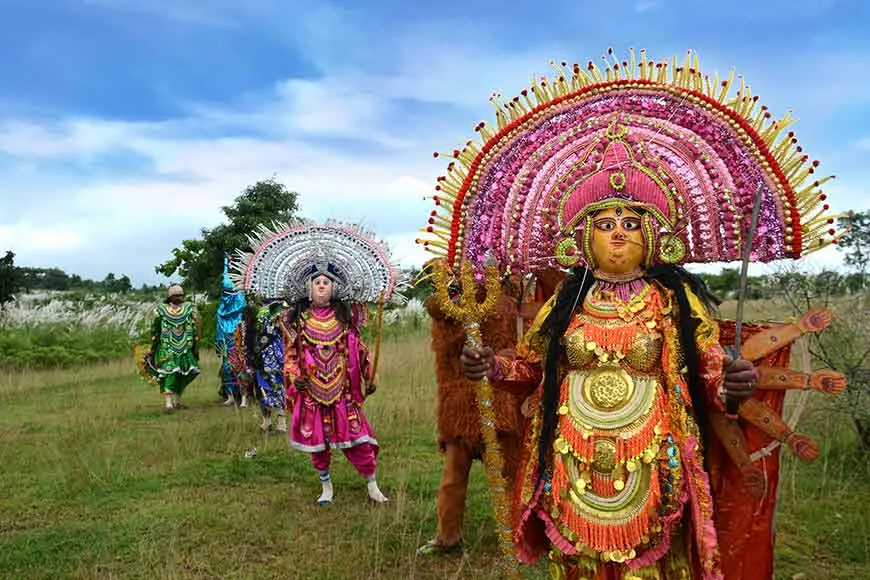
Culture and Societies The Purulia Chhau dance and its associated masks are performed during specific festivals. The primary performance occasion is Chaitra Parva, the spring festival that marks the transition between agricultural cycles, and the Gajan festival, which honors Lord Shiva. The Purulia Chhau dance is also performed during the Sun festival celebrated in the district. The dance has historically been an all-male performance, though its patronage structure in Purulia differed from the Seraikella style: unlike the Seraikella Chhau, which was developed by and associated with the regional nobility, the Purulia Chhau retained a vigorous folk character independent of royal patronage.
Mask making in Charida is a family-based industry. Multiple workshops line the village roads, with masks displayed on exterior walls serving simultaneously as advertisement and craft demonstration. The community hosts a museum and has received government and UNESCO attention as part of rural craft hub documentation programs conducted by the West Bengal Department of Micro, Small and Medium Enterprises and Textiles.
Religious Significance The Chhau mask tradition is directly connected to Hindu religious observance. Masks represent deities and figures from Hindu epic literature including the Ramayana and Mahabharata, as well as Puranic narratives. The principal deity masks produced in Charida include Durga, Kali, Ganesha, Shiva, and Skanda. Demon figures including Mahishasura are standard production types. The mask of Narasimha, the half-man half-lion avatar of Vishnu, requires specific iconographic rendering. Shiva's mask incorporates serpents and matted hair in accordance with his iconographic attributes. Ganesha's mask is in elephant form. Color coding reinforces religious hierarchy: heroic characters and deities are rendered in dark yellow or bright orange, while demon masks use vivid red or green. The first masks created by Buddeshwar represented Kirat and Kiratni, forms of Shiva and Parvati, establishing the craft's foundation in Shaiva devotional practice. Masks are used during Gajan, the festival directly associated with Shiva worship.
Understanding the Art
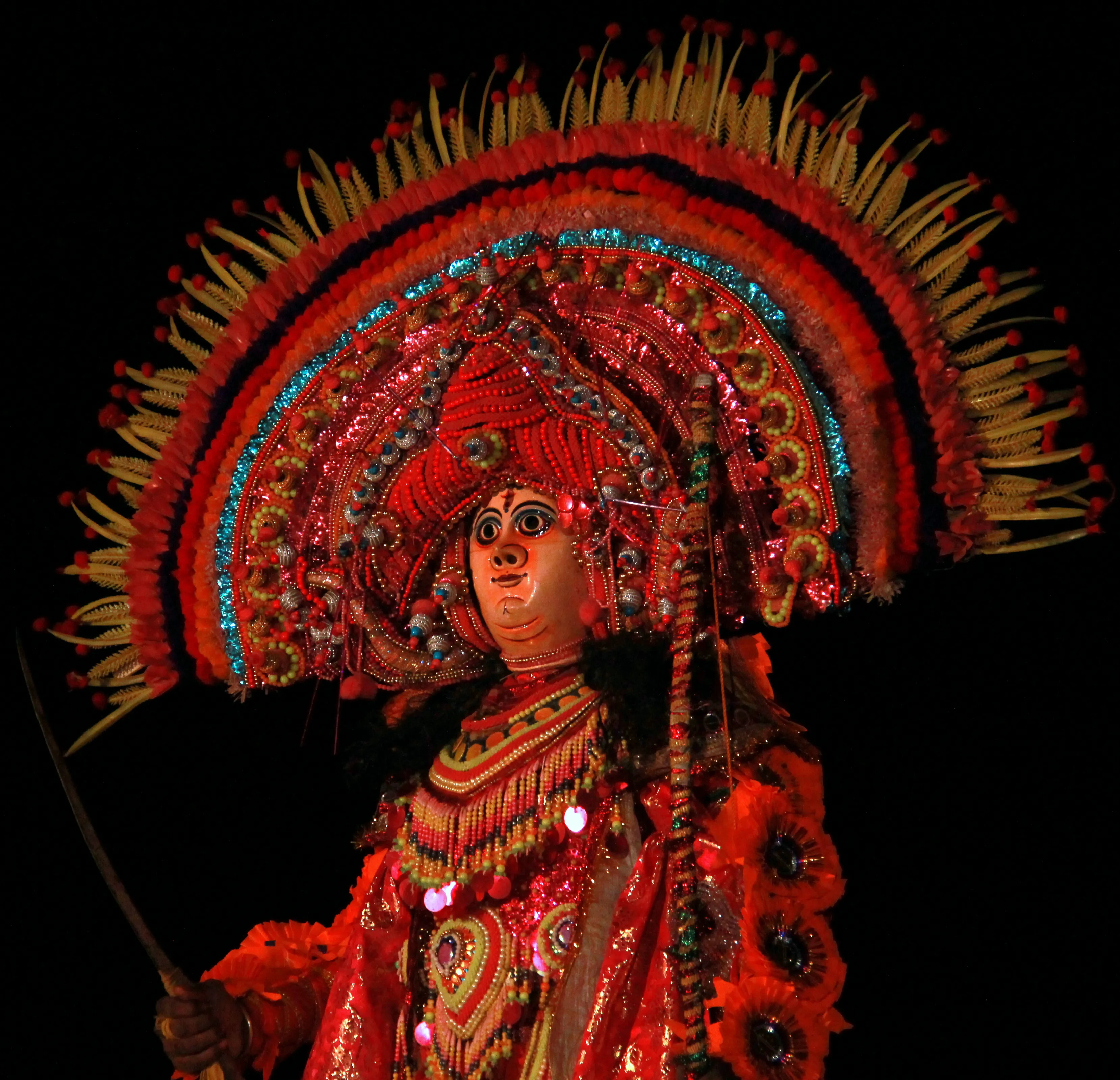
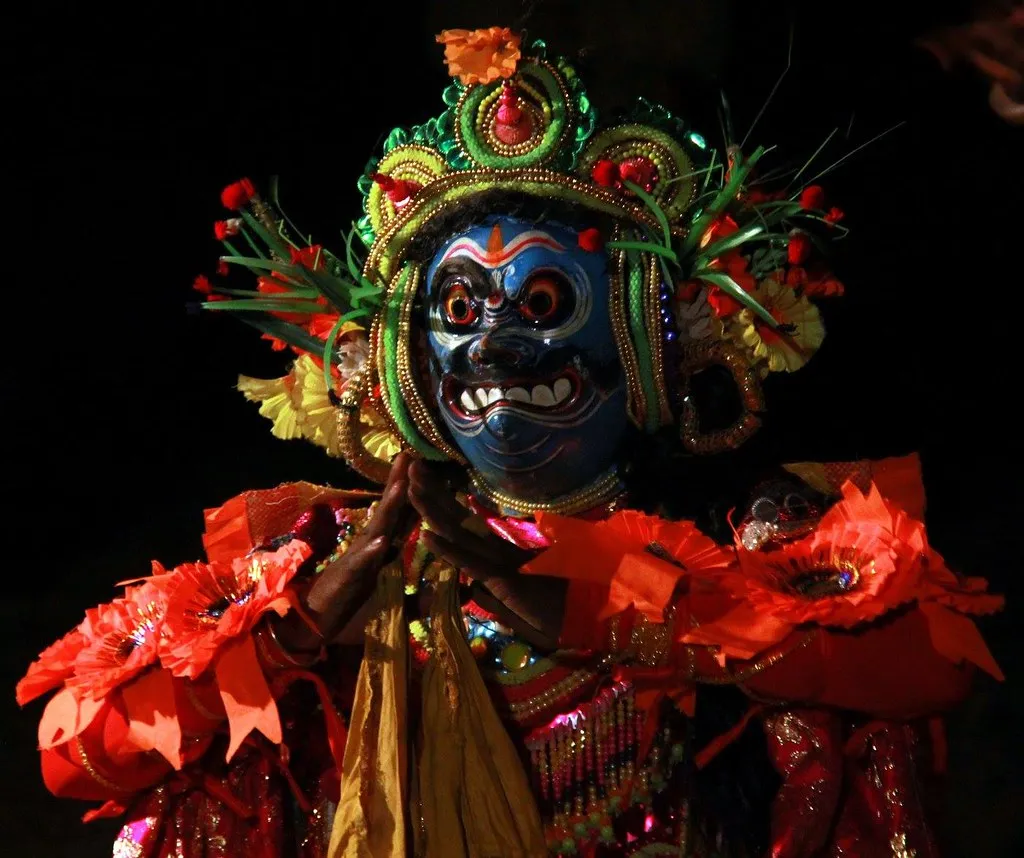
Style Purulia Chhau masks are distinguished by their large size, elaborate headdresses, and vivid color treatment. Heroic characters wear headdresses that form part of the mask structure, decorated with feathers, silver beads, and yarn. Demon masks are characterized by features including blood-shot eyes, wide dilated nostrils, wrinkled skin, open mouths with visible fangs, and unkempt hair and beards rendered in black. Animal masks such as the deer and lion are produced for specific dance scenes, including the golden deer sequence from the Ramayana. The masks have a glossy finish achieved through lacquering. Contemporary production also includes smaller decorative masks designed for wall display and export, which represent a diversification from the large performance masks for which Charida is historically known.
Central Motifs and Their Significance Masks represent three broad categories of characters: deities, demons, and animals. Deity masks follow specific color and iconographic conventions: Rama is characterized by a green mask, Krishna by blue, and heroic human figures by pink faces with black moustaches. Durga's mask represents the divine feminine in her martial aspect. Mahishasura, the buffalo-demon defeated by Durga, is depicted with fierce features. The golden deer mask references the episode in the Ramayana in which the demon Maricha assumes the form of a golden deer to approach Sita. Animal masks including lions, peacocks, deer, and cows are produced for specific narrative sequences. Contemporary production has extended the range to include secular and political figures, reflecting the craft's adaptation to a souvenir and decorative market.
Process The mask-making process begins with the preparation of a clay mould. A clay model of the mask is constructed, incorporating the desired facial expression and basic form. The completed clay mould is dusted with fine ash powder or talcum powder to prevent adhesion of subsequent layers. Eight to ten layers of soft paper immersed in diluted adhesive (gum solution) are then applied one at a time over the mould. A thin layer of clay is applied over the paper layers, and pieces of old cloth are pasted on top. This composite layer is then sun-dried. After drying, the mould is polished and sun-dried a second time before the layers of paper and cloth are carefully separated from the clay mould beneath, producing a hollow shell form. Holes for the eyes and nose are drilled after separation.
The separated mask shell is then painted. Facial features and expressions are rendered using pigments. Final decoration involves the attachment of wire halos, tinsel, glass beads, zari, plastic flowers, feathers, and strips of colored jute for hair. Clay sourced from the Marangburu river is noted for its suitability for mask production, and the hot, arid climate of Purulia facilitates effective sun-drying of the clay moulds.
Mediums Used Clay: Locally sourced from the Marangburu river area; used for mould construction and intermediate layers. Paper: Soft paper immersed in diluted gum solution; applied in 8-10 layers over the clay mould as the primary structural material. Cloth: Old cloth pieces pasted over the paper layers to add structural strength. Adhesive: Diluted gum solution used to bind paper layers. Pigments: Traditionally natural dyes; contemporary production uses synthetic pigments for vivid color effects. Decorative Materials: Tinsel, glass beads, zari, plastic flowers, feathers, colored jute for hair, and wire armatures for headdresses and halos.
New Outlook
The Purulia Chhau mask craft is classified as endangered. The primary challenges facing the craft include economic pressure from declining performance commissions, competition from mass-produced decorative objects, and the concentrated skill base in a small number of families in Charida. The 2018 GI tag has provided legal recognition, and the UNESCO inscription of Chhau dance in 2010 has brought sustained international attention. The masks have expanded into decorative, souvenir, and airport retail markets, which provide income beyond performance commissions. Government support through the West Bengal MSME Department's Rural Craft Hubs program (documented in 2015 and 2018 reports) and international cultural engagement facilitated by UNESCO and the Eastern Zonal Cultural Centre in Kolkata have contributed to the craft's visibility. However, the concentration of skilled production in Charida, combined with limited economic incentives for younger artisans, continues to place the tradition at risk.
Learn Chhau Mask Making
Bibliography
Sources|
Cardinale, S. “Intangible Cultural Heritage Revitalization for Development and Tourism: The Case of Purulia Chhau Dance.” Material Culture Review, 2015.
Cardinale, S. Intangible Heritage and Livelihoods: A Case Study on the Heritage of Purulia Chhau Dance. Doctoral thesis, London Metropolitan University, 2019.
Chatterjee, D. “Masks and Costumes of Purulia Chhau.” Asian Theatre Journal, vol. 36, no. 1, 2019.
Department of Micro, Small and Medium Enterprises and Textiles. Rural Craft Hubs of West Bengal. Government of West Bengal, 2015, 2018.
Sarkar, Ayanika, and Biswaranjan Mistri. “Evolution of Purulia Chhau: A Spatio-temporal Analysis.” Heritage: Journal of Multidisciplinary Studies in Archaeology, vol. 11, no. 1, 2024.
Image Sources
“Chhau Mask Makers of Charida, Flag Bearers of a Rich Tradition.” West Bengal Tourism Blog, 11 May 2022, https://wbtourismdotblog.wordpress.com/2022/05/11/chhau-mask-makers-of-charida-flag-bearers-of-a-rich-tradition/. Accessed on May 06, 2026.
“Maverickbird.” “Purulia Chhau Mask Dance Guide with Traditions and Culture.” Maverickbird, 13 Feb. 2026, https://maverickbird.com/travel-extras/purulia-chhau-mask-dance/. Accessed on May 06, 2026.
“Purulia Chhau Mask – A Living Heritage of Charida’s Mask Village.” Karukarjo, 17 July 2025, https://karukarjo.in/blogs/news/purulia-chhau-mask-a-living-heritage-of-charidas-mask-village. Accessed on May 06, 2026.