

Channapatna Toys - The Handicraft Tradition of Karnataka
Explore Channapatna Toys, the handicraft tradition of Karnataka, and learn about its origins, techniques, cultural significance, and artistic heritage.
Introduction
Channapatna toys are a form of wooden handicraft produced in Channapatna, a town in the Ramanagaram district of Karnataka, India. The toys and other wooden objects are made primarily from ivory wood (Wrightia tinctoria, locally known as alae mara in Kannada) and finished with non-toxic, non-chemical colours derived from shellac. Channapatna holds a Geographical Indication tag for these products and is commonly referred to as the 'Land of Toys.' The craft has a documented history of over two centuries and continues to be produced in both manual and mechanised units.
Etymology: The name Channapatna derives from the town where the craft originated and is exclusively produced. The craft is identified by its place of origin. The Kannada word for ivory wood, alae mara, refers to the primary raw material, though the craft itself does not carry a separate traditional name apart from the geographic designation.
Origin: The craft's modern commercial development is historically linked to Tipu Sultan, ruler of Mysore from 1782 to 1799. According to multiple accounts gathered by Sahapedia researchers, Tipu Sultan promoted the export of Channapatna toys to Persian, Egyptian,Iranian, Chinese, and Turkish markets. There are two documented interpretations of his specific role: one account states that he brought Persian artisans to Channapatna to train local craftsmen; another, supported by Sahebzade Syed Mansoor Ali, seventh-generation descendant of Tipu Sultan, states that he promoted export trade and provided land to approximately 250-300 artisans rather than importing foreign craftsmen. Tipu Sultan's administrative records were kept in Persian, and he created the Daria Daulat Bagh specifically for meetings with overseas traders.
In the early 20th century, Syed Bawa Saheb Miyan (known as 'Master' Bawas Miyan) travelled to Japan in 1904 and 1909 to study lacquer and toy-making processes, subsequently establishing a training school in Channapatna for unemployed youth. His son-in-law Syed Yeddulla later introduced lathes to the production process, which mechanised and scaled up the craft.
Location: Channapatna is located approximately halfway between Bengaluru and Mysuru on the Bengaluru-Mysuru highway, in Ramanagaram district, Karnataka. The hamlet of Neelasandra, approximately six kilometres from the main township, is documented as the remaining site where toys are made entirely by hand. The main town contains numerous mechanised units, a Channapatna Crafts Park with a Common Facility Service Centre, and showrooms along the highway.
Community: The craft is produced by artisan families in Channapatna and Neelasandra. Production has historically involved multiple generations of the same family, with skills transmitted through direct observation and practice rather than formalised instruction alone. Organisations including Shilpa Trust (established 1988 by Mr. Madhvacharya, registered 1993) and Maya Organic provide training, particularly to women artisans, and support marketing for registered artisan members. As of reporting by Sahapedia, approximately 1,200 people were engaged in the craft, a significant decline from an earlier estimated 5,000 to 6,000 workers.
Relevance: Channapatna toys hold a GI tag from the World Trade Organization and the Government of India. The craft has received international attention, including being gifted to former US President Barack Obama during his visit to India and to the royal family of Bhutan. Microsoft and other multinational corporations have sourced Channapatna puzzles for corporate use. Export markets have included Australia, Switzerland, and other countries.
History
Background: The craft's documented origins predate Tipu Sultan's era, with local accounts suggesting woodcraft had been practised in Channapatna from a considerable period prior. What changed under Tipu Sultan's administration was the scale and export orientation of the craft. The modern production system, including the use of lathes and the preparation of standardised non-toxic colours, was formalised in the early 20th century by Master Bawas Miyan and his son-in-law.
Following independence, the Karnataka government and various development agencies supported the craft through design programmes, training schemes, and the establishment of the Channapatna Crafts Park. The craft survived competitive challenges from Chinese plastic toys and continues to hold a market position based on its safety, eco-friendliness, and GI-protected origin.
Culture and Societies: Channapatna toys have long held a ceremonial role in the Dasara festival tradition, during which display of these toys is documented as a practice continuing from the period of the Mysore kings. The craft also functions as a livelihood for artisan households, with many families in Neelasandra relying on it as their primary source of income. The production involves both male and female family members, with women often working from home on certain stages of production.
Religious Significance: No specific religious significance has been documented for Channapatna toys as a craft tradition. Their historical use in Dasara festival displays is cultural and ceremonial rather than associated with a specific religious ritual function.
Understanding the Art
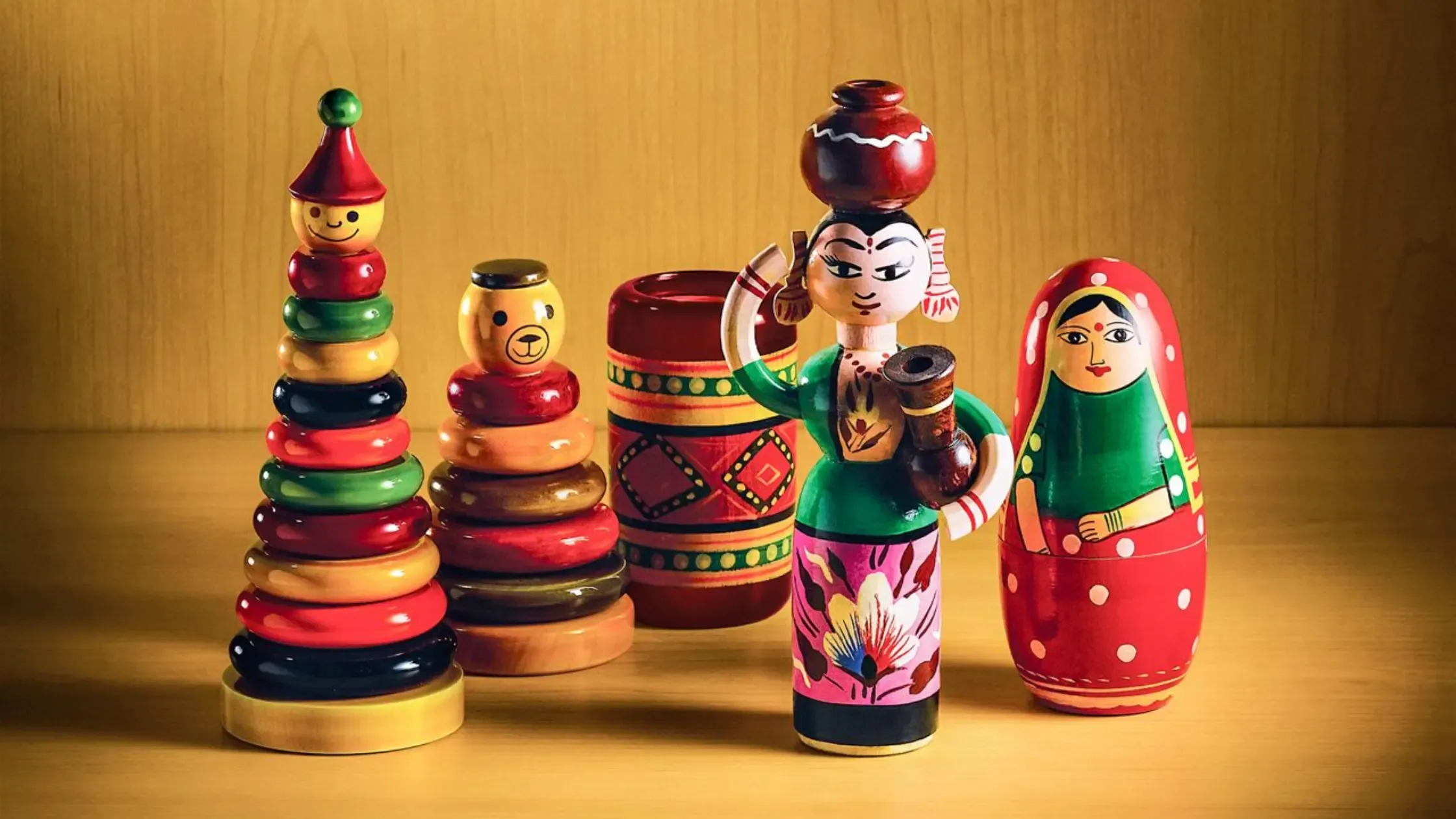
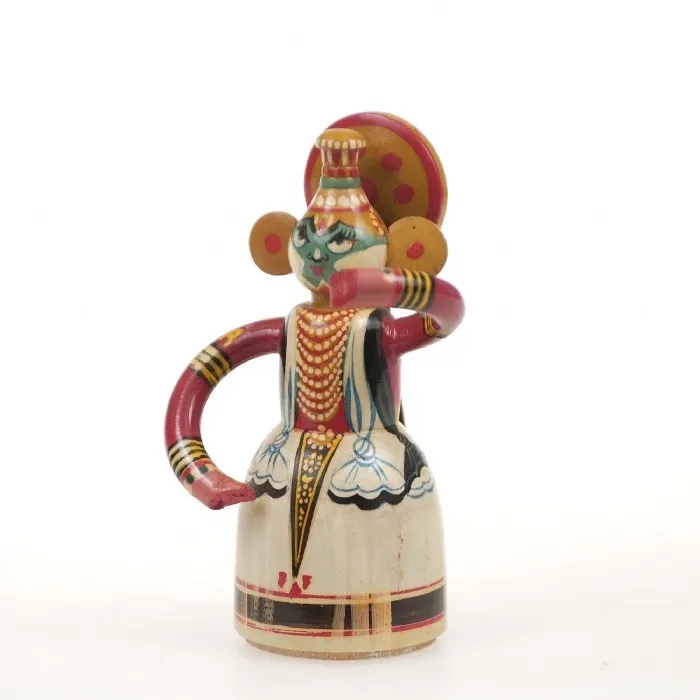
Style: Channapatna toys are characterised by smooth, lathe-turned forms in bright, translucent colours. The visual identity is defined by the vivid coloured finish over the pale ivory wood grain, which is often visible through the colour. Common forms include animals (particularly elephants), dolls, tops, kitchen utensils, puzzles, and decorative objects.
Central Motifs and Their Significance: The forms of Channapatna toys are predominantly representational, depicting animals, human figures, and functional objects rather than abstract or symbolic motifs. The brown elephant in various sizes is among the most recognised forms. Traditional toys made during festival periods include forms associated with Dasara celebrations. Contemporary production has expanded to geometric puzzles and abstract shapes in response to market demand.
Process: The production process involves the following stages: logs of ivory wood (Wrightia tinctoria) are cut and shaped on lathes into the required component forms; components are assembled and further chiselled as needed; the surface is polished using dried cactus leaves; colour is applied by holding a shellac-based colour stick against the rotating object on the lathe, with friction melting the colour stick and depositing an even coat; multiple colours are applied in sequence. The wood is noted for producing no harmful sawdust and for having no adverse health effects on workers over extended periods of exposure.
Mediums Used: The primary medium is ivory wood (Wrightia tinctoria), which grows naturally in the forests of Karnataka and cannot be cultivated by seed sowing with comparable results. The wood is noted for its softness, suitability for lathe work, and safety in terms of sawdust. Colours are made from shellac (locally called aargu in Kannada), an animal-derived product processed locally, sourced originally from Bengal. Shellac produces non-toxic, non-chemical colours compliant with child safety standards. Some artisans in Neelasandra continue hand production using traditional chisels without lathes.
New Outlook
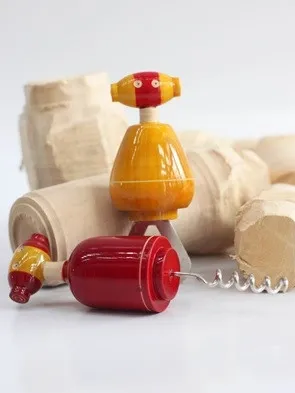
Contemporary production includes non-traditional forms such as puzzles, kitchen utensils with medicinal properties attributed to the wood, and corporate gift items. Export markets are being actively revived after a decline attributed to quality compromises by some exporters in the past. The Channapatna Crafts Park provides artisans with state-of-the-art machinery and a common production facility. Training programmes supported by the government and NGOs have broadened participation, particularly for women artisans.
Learn Channapatna Toys

Bibliography
Sources
Dastkari Haat Samiti. “How to Make a Channapatna Toy.” Google Arts & Culture, artsandculture.google.com.
Gowda, Manasa, and Ram Raj D. “Channapatna Wooden Toys.” Sahapedia, www.sahapedia.org
Image Sources
“Channapatna Toys – The Wooden Toy Story.” Thrilling Travel, 6 Aug. 2021, thrillingtravel.in/channapatna-toys-karnataka.html. Accessed on May 01, 2026.
“Channapatna Toys.” Trailblazers India, www.trailblazersindia.com/blogs/29. Accessed on May 01, 2026.
“Ethnographic Objects or Design? Taking Stock: Channapatna Toy.” Material Culture NL, www.materialculture.nl/en/open-space/ethnographic-objects-or-design-taking-stock-channapatna-toy. Accessed on May 01, 2026.