

Chamba Rumal - The Handicraft Tradition of Himachal Pradesh
Explore Chamba Rumal, the handicraft tradition of Himachal Pradesh, and learn about its origins, techniques, cultural significance, and artistic heritage.
Introduction
Chamba Rumal is a tradition of pictorial hand embroidery originating in the Chamba region of present-day Himachal Pradesh, India, in which silk thread is worked in a double satin stitch onto handwoven cotton or muslin cloth, producing compositions derived from the Pahari miniature painting tradition. The defining technical characteristic of the craft is the do-rukha stitch, a double-sided satin technique in which the embroidery appears identical on both faces of the fabric, with no visible knots on either side. Chamba Rumal is currently classified as an endangered craft, with active practitioner numbers reduced significantly following the withdrawal of royal patronage in the early twentieth century.
Etymology: The name Chamba Rumal is a compound of two terms. Chamba designates the former princely state and present-day district in Himachal Pradesh from which the tradition derives its identity and with which it has been exclusively associated due to the sustained patronage of that region's rulers. Rumal derives from the Persian word for kerchief or square piece of cloth worn on the head or around the neck, a term that entered the languages of the Indian subcontinent through Persian influence. The Lancashire Textile Gallery documentation confirms this Persian derivation, noting that rumal can be translated as handkerchief, covering, or coverlet. The Wikipedia article on Chamba Rumal, the Sahapedia documentation, and the Asia InCH Encyclopedia of Intangible Cultural Heritage all use these two terms as they are established in institutional and academic usage. The embroidery is also referred to as Chamba kasidakari or Chamba kadhai, using the Hindi and Pahari terms for embroidery, as documented in the Sahapedia entry on the craft.
Origin: The documented history of Chamba Rumal as a distinctive court-associated craft form begins in the seventeenth century, though the Asia InCH Encyclopedia notes that a pre-existing folk embroidery tradition in the region preceded the court style and provided its foundation. The Asia InCH documentation states that the craft came into its own as a court tradition during the reign of Raja Umed Singh of Chamba (1748 to 1768), who patronised miniature artists who had fled the declining Mughal courts following the death of the Mughal Emperor Aurangzeb in 1707. The Wikipedia article and the Asia InCH Encyclopedia both confirm this sequence: the Mughal court's decline after Aurangzeb led to a dispersal of court artists into the hill states, and Raja Umed Singh's patronage of these artists created the conditions under which artists trained in the Pahari miniature tradition began drawing the outlines and prescribing the colour palettes for Chamba Rumal embroideries.
The oldest documented example of a Chamba Rumal is a piece attributed to Bebe Nanaki, the sister of Guru Nanak, the founder of the Sikh faith, reportedly made in the sixteenth century. The Asia InCH Encyclopedia records that this rumal is preserved in a Sikh shrine in Gurdaspur, Punjab. The Wikipedia article states the location as the Gurudwara at Hoshiarpur, while the Asia InCH entry specifies Gurdaspur: these two institutions record differing locations for the same piece, and neither has been independently confirmed by museum catalogue documentation in the sources available. The two accounts are presented here without resolution, as neither can be verified with further certainty from available sources.
A second early documented piece is the rumal depicting the battle of Kurukshetra from the Mahabharata, held at the Victoria and Albert Museum, London. The Asia InCH Encyclopedia records that this oblong piece was presented by Raja Gopal Singh of Chamba to the British in 1833, while the Wikipedia article records the date of the gift as 1883. The discrepancy between 1833 and 1883 is present in the sourced documentation and cannot be resolved from available institutional records without direct museum catalogue access. Both dates are noted here, with the caution that they represent differing institutional accounts.
Location: Chamba Rumal takes its name from Chamba, a district and town in the western Himalayas of present-day Himachal Pradesh, situated on the river Ravi. The Sahapedia documentation records that Chamba lies at a crossroads with several centres of art in the western Himalayas, directly connected to Basohli, Kangra, and Nurpur, which interacted over time as rulers encouraged the development of Pahari arts. The Asia InCH Encyclopedia notes that while the embroidery has been practiced across Himachal Pradesh, it is associated specifically with Chamba owing to the patronage of the rulers of that state.
The craft was also historically practiced in regions beyond Chamba itself. The Utsavpedia documentation notes that the tradition of Chamba Rumal was practiced in parts of Himachal Pradesh and Jammu that were among the important centres of Pahari painting, and the Wikipedia article indicates that women of the erstwhile princely state of Chamba, including royal family members, practiced the art as part of a broader Pahari material culture. The academic paper by Rohini Arora, Embroidered Narratives of Pahari Embroidery, whose research origin was documented in the Academia.edu entry, confirms that both double-sided and single-sided embroidery styles were practiced across the western Himalayan region, with double-sided Chamba rumals constituting the more specifically localised tradition.
Community: Chamba Rumal embroidery was practiced by women across all social strata of Pahari society, though the Asia InCH Encyclopedia documents a clear distinction between two traditions: the folk style, practiced by women of all levels, and the court style, embroidered by women of the upper classes and royalty. These two styles differed in colour palette, subject matter, and technical precision, with the court tradition using subdued, coordinated shades derived from Pahari miniature painting, and the folk tradition employing more primary and contrasting colours. The court tradition required the assistance of trained miniature artists who drew the outlines and specified colour palettes before the women executed the embroidery.
The Asia InCH Encyclopedia and Wikipedia both document that the craft was practiced by women of the royal household of Chamba, and the Live History India article records that in 1907, Raja Bhuri Singh of Chamba established training centres for women in which they were paid a silver coin per day as wages for embroidering rumals. The Wikipedia article confirms that artisans including Maheshi Devi, Lalita Vakil, and Chhimbi Devi received National Awards for their embroidery work, demonstrating the continuity of individual practitioner recognition. Lalita Vakil received the Nari Shakti Puraskar award in 2018, presented by the President of India, for her work in organising courses to preserve and transmit the craft.
The Sahapedia entry documents a contemporary shift in which practitioners such as Indu Sharma and Heena have begun using social media platforms to establish direct contact with buyers, bypassing intermediaries, and are expanding into new product categories such as bookmarks and jewellery.
Relevance: Chamba Rumal was granted Geographical Indication status under the GI Act 1999 of the Government of India. The Wikipedia article records the specific details: on 22 January 2007, it was listed as Chamba Rumal under GI Act 1999, with registration confirmed by the Controller General of Patents Designs and Trademarks under Classes 24 as Textile and Textile Goods, vide application number 79. This registration provides legal protection against the sale of inauthentic imitations, which had proliferated following the decline of court patronage.
The craft has significant museum holdings across multiple institutions. The Asia InCH Encyclopedia documents that Chamba Rumal pieces are held in the Bhuri Singh Museum, Chamba; the Crafts Museum, New Delhi; the Government Museum, Shimla; the Indian Museum, Kolkata; the National Museum, New Delhi; and the Victoria and Albert Museum, London. The Bhuri Singh Museum, established in 1908 through the initiative of the Dutch Indologist J.Ph. Vogel and the patronage of Raja Bhuri Singh, holds the principal regional collection and is described in The Tribune (Chandigarh) as containing Chamba rumals, pahari miniature paintings, and inscriptions constituting the historical record of the Chamba state.
The Delhi Crafts Council has been the principal institutional actor in the post-independence revival of the court tradition of Chamba Rumal. The Better India documentation records that the Delhi Crafts Council intervened from 1992 onward and held its first revival exhibition in 1999. The Asia InCH Encyclopedia records that in March 2002, the Delhi Crafts Council established a small training centre named CHARU in Chamba for training in Chamba embroidery and the production of rumals. The Council also organised an exhibition displaying the work of seven women artisans: thirteen rumals that were reproductions of ancient counterparts held in museums in Chamba, Delhi, Kolkata, and Ahmedabad.
The EBNW Story documentation records that in the late 1970s, under the initiative of Usha Bhagat, original designs were located in museums and collections, and women artists were trained to recreate them, resulting in sixteen designs being successfully documented and reproduced.
History
Background: Chamba Rumal developed in two overlapping phases. The folk embroidery tradition in the Chamba region and broader western Himalayan area predates the court-associated style by an undetermined period. The Rohini Arora academic documentation notes that before 1948, the hill states of Punjab were known for a tradition of embroidered coverlets and hangings known as dhkanu (square coverlets) and chhabu (circular coverlets) used to cover ceremonial gifts and offerings both for deities and rulers.
The development of the distinctive court tradition is linked to the political reorganisation of the northern Indian subcontinent following the decline of Mughal authority. The Asia InCH Encyclopedia documents in detail how the death of Aurangzeb in 1707 triggered a dispersal of Mughal court artists who sought patronage from regional rulers gaining prominence as Mughal centralised power fragmented. Raja Umed Singh of Chamba (1748 to 1768) patronised these displaced miniature artists, who began providing design drawings for women embroiderers. This patronage continued under his successors Raj Singh (1764 to 1794) and Charat Singh (1794 to 1808), as documented in the Asia InCH Encyclopedia.
The Wikipedia article records that in the early nineteenth century, when Maharaja Ranjit Singh of the Punjab ruled the Punjab Hill States, Sikh stylistic influences also entered the Chamba Rumal tradition. The EBNW Story documentation records that following Indian independence, the craft lost its royal patronage and quality deteriorated due to commercialisation, with cheaper varieties including tablecloths, cushion covers, and machine-made items appearing to compete in the market with the authentic hand-embroidered tradition.
Culture and Societies: The Chamba Rumal was embedded in the social life of the Chamba region through its use as a ceremonial covering. The Asia InCH Encyclopedia documents the range of occasions on which rumals were used: to cover gifts exchanged between the families of the bride and groom at weddings; to cover offerings to deities during religious ceremonies and rituals; and as decorative covers for ceremonial trays bearing gifts to rulers and high officials. The Sahapedia documentation confirms that Pahari miniature paintings in existence depict gifts covered with embroidered rumals, providing pictorial evidence of the object's ceremonial function. Gifting embroidered rumals at a girl's wedding was customary in the hill regions of Himachal Pradesh and the rumal formed an essential part of the bride's dowry, as documented in the Utsavpedia entry.
Specialist circular and rectangular forms of the rumal existed alongside the standard square format. The Live History India article documents that a circular rumal called the chhabru is hung behind a deity in temple settings, and a rectangular wall hanging called the chandoa is draped behind idols, indicating that the rumal served both domestic and temple ceremonial functions. The Sahapedia documentation records that thematic subjects on rumals also depicted local cultural practices, including the Minjar Mela Jalus, the monsoon festival of Chamba where tassels are thrown in the river Ravi; the Manimahesh Yatra, an annual Shiva pilgrimage; the Gaddi Gaddan (men and women of the shepherding Gaddi tribe); the Til Chauli ceremony at Chamba weddings; and folk tales such as the love story of Sassi Punnu, indicating that Chamba Rumal functioned as a medium for representing local cultural identity alongside its use of pan-Hindu mythological themes.
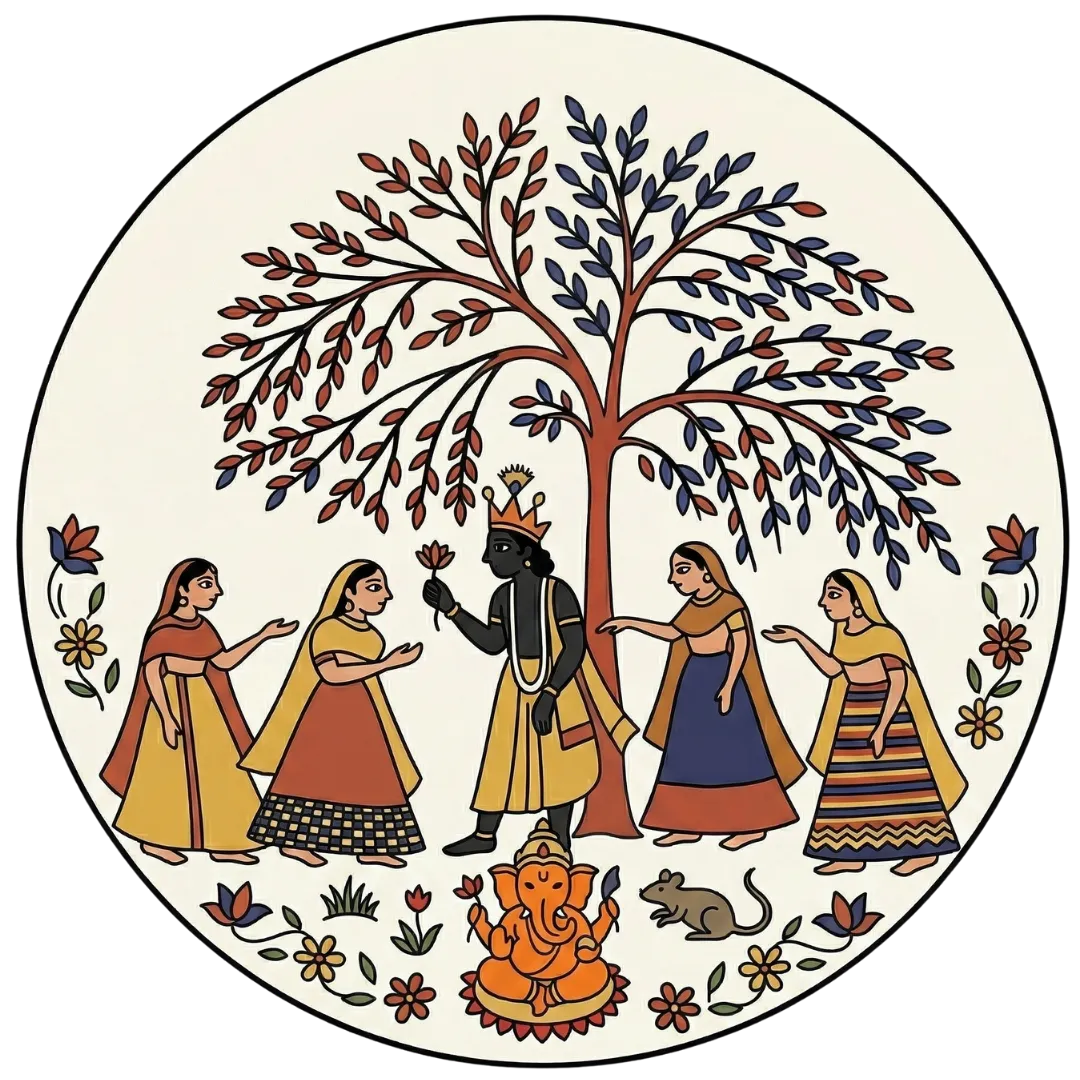
Religious Significance: Chamba Rumal has a well-documented connection to Hindu Vaishnava religious themes. The Asia InCH Encyclopedia records that the subject matter of the embroideries ranged from religious themes embodying the strong Vaishnava fervour of the Pahari regions to scenes from the Ramayana and the Mahabharata. Krishna as an incarnation of Vishnu is the dominant religious figure: the raslila, or tales from Krishna's life, formed the core of several compositions. Specific documented themes include the Radha-Krishna dalliance, Rukmini Haran (the abduction of Rukmini), Kaliya Damana (Krishna slaying the Kaliya serpent), events from the Gita Govinda, and scenes from the Bhagavata Purana. The Ashtanayika, representing the eight moods of the heroine (nayika) drawn from classical Sanskrit poetic theory, is also a documented subject.
The Asia InCH Encyclopedia documentation of the Delhi Crafts Council's 2002 revival exhibition lists the specific museum source pieces for reproduced rumals including a Ganesha composition from the Indian Museum, Kolkata; a Jagannath composition from the Bhuri Singh Museum, Chamba; and a Parijata Hara (theft of the divine tree) composition from the Crafts Museum, New Delhi, confirming the sustained centrality of Vaishnava and broader Hindu iconography in the tradition.
Beyond Hindu iconography, the rumal also functioned as a temple object. The Live History India documentation records that rumals are used in contemporary Chamba temples as covers for offerings and as the chhabru hung behind deities and the chandoa draped behind idols.
Understanding the Art
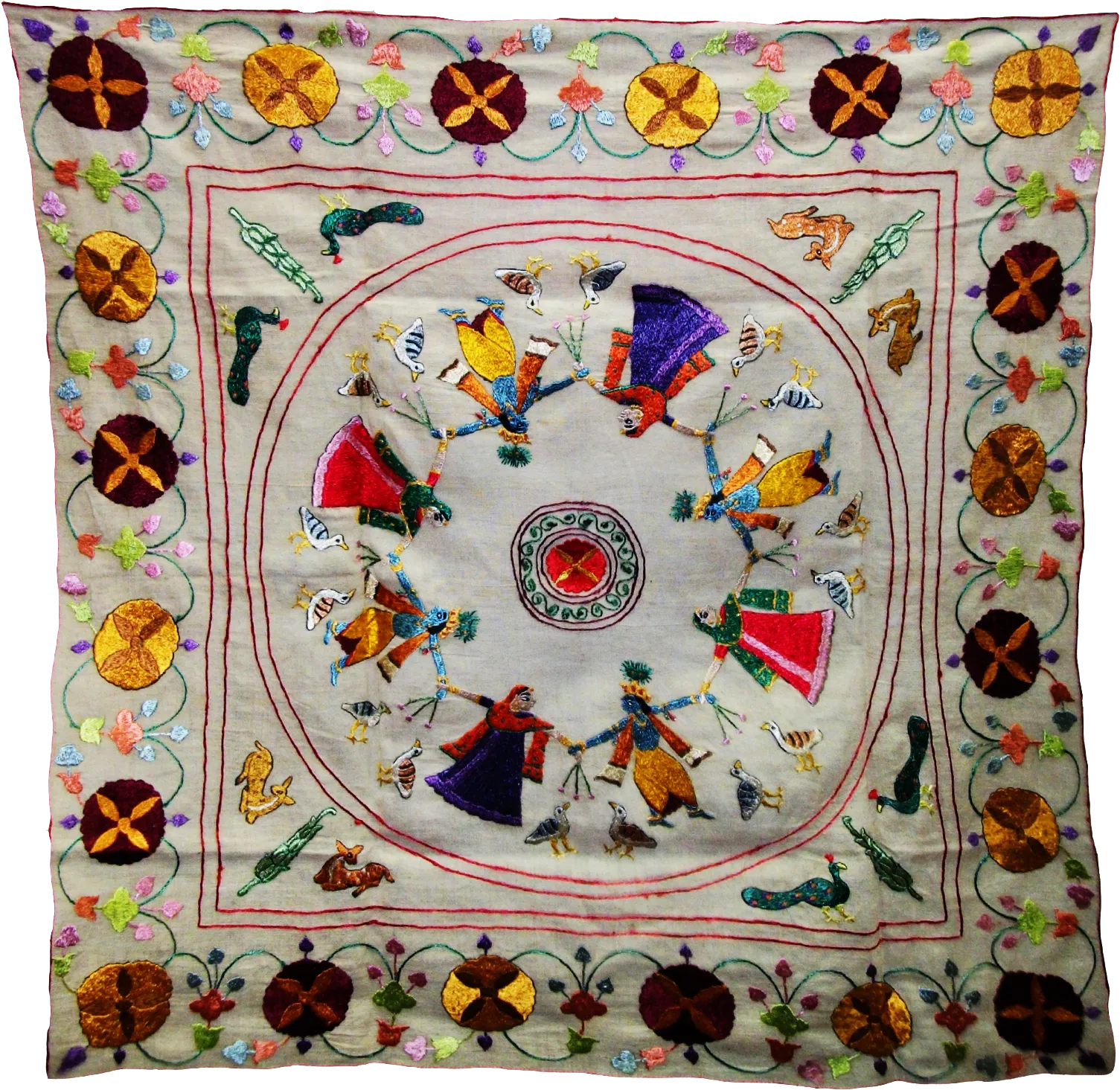
Style: Chamba Rumal is described in the Asia InCH Encyclopedia as paintings in embroidery, a phrase that captures the direct derivation of its visual conventions from the Pahari miniature tradition. The compositions are figural and narrative, arranged within pictorial fields that follow the spatial conventions of miniature painting, with figures depicted in profile or three-quarter view, their costumes and ornaments rendered with detailed attention consistent with the miniature style. The Asia InCH Encyclopedia documents that the figures are made with painstaking care and decorated minutely in the style of classical miniature paintings. Floral and animal motifs are interspersed among the main pictorial elements, and borders on all four sides are composed of floral and geometrical patterns, typically depicting floral elements within parallel lines and squares that frame the central composition.
Two distinct stylistic registers coexisted within the tradition. The court style, associated with upper-class and royal women working from designs provided by trained miniature artists, used subdued and coordinated colour combinations. The folk style used more primary and contrasting colours, including pink, yellow, lemon, purple, and green, and employed somewhat bolder compositional approaches. The Asia InCH Encyclopedia is explicit that the court style has come to be exclusively associated with the craft in contemporary cultural understanding, while the folk tradition has largely disappeared from institutional attention. The Lancashire Textile Gallery documentation, drawing on Dr. Rohini Arora's analysis of two rumals in the Gawthorpe Textiles Collection, notes that both long and short stitches and varying stitch directions within individual motifs were used to create textural contrast, as seen in the depiction of a tiger's fur in the Krishna rumal.
Central Motifs and Their Significance: The dominant subject and motif complex of traditional Chamba Rumal is the life of Krishna drawn from the Bhagavata Purana and related Vaishnava literature. The Asia InCH Encyclopedia documents the central compositions as including: the Rasamandala, depicting Krishna dancing with gopis; the Godhuli, showing Krishna and his cowherd companions returning with cattle at dusk; the Ashtanayika, representing eight emotional states of the heroine as defined in Sanskrit poetics; and the Radha-Krishna depiction in pavilion settings. The Raasmandala with Lakshmi-Narayana, which combines the dance of Krishna with the iconography of Vishnu-Lakshmi, is documented as a distinct compositional type.
Scenes from the two Sanskrit epics are also documented. The Kurukshetra battle from the Mahabharata is represented by the piece at the Victoria and Albert Museum, London. Royal court scenes including shikargah (hunting), chaupad (the game of dice played on a cross-shaped board), and wedding processions are documented by the Asia InCH Encyclopedia as recurring subjects.
Colourful fauna including peacocks, horses, elephants, snakes, monkeys, deer, parrots, and fish are interspersed within compositions as subsidiary motifs. Floral elements including the lotus, banana, and general flowering shrubs constitute the landscape settings. Local festival imagery including the Minjar Mela Jalus and the Manimahesh Yatra and tribal representations of the Gaddi community are documented in the Sahapedia entry as a parallel folk-derived strand of the tradition.
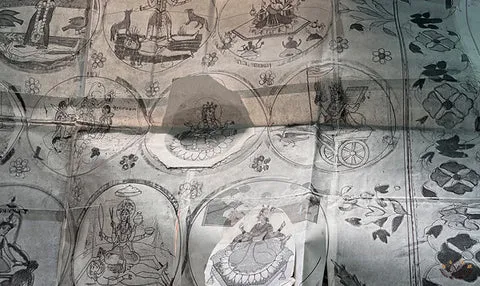
Process: The process of creating a Chamba Rumal involved a sequence of stages documented in detail in the Asia InCH Encyclopedia. The first stage was the visualisation of the theme by the embroiderer or the patron, after which a trained miniature artist drew the outlines of the composition in fine charcoal or brush directly on the cloth. The Asia InCH Encyclopedia documents that the miniature artist also predetermined the colour palette to be used, providing a complete chromatic scheme for the embroiderer to follow. The embroidery was then executed by the women along the charcoal-drawn outlines, following the specified palette.
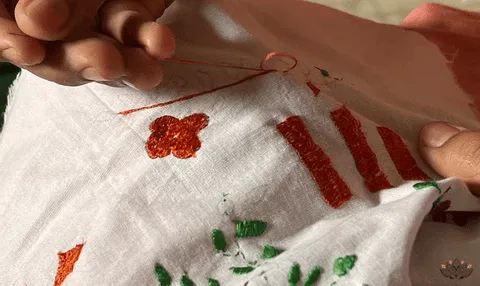
The do-rukha stitch, also called the double satin stitch, is the defining technique of Chamba Rumal. The Asia InCH Encyclopedia explains that the stitch is carried both backward and forward and covers both sides of the cloth, producing a smooth, flat finish resembling colours filled into a miniature painting. No knots are visible, making the rumal reversible and readable from either face. A simple stem stitch using black silk thread outlines the figures. The Asia InCH Encyclopedia also notes occasional use of other stitches including the cross stitch, the button-hole stitch, the long and short stitch, the herring-bone stitch, and pattern darning. The Satyam Fashion Institute documentation notes that chain stitch was observed in some older wall hangings, though not on the rumals themselves.
The Wikipedia article documents the current production process: charcoal or a fine brush is used to draw outlines on the fabric, after which both faces of the cloth are stitched simultaneously using a forward and backward technique to maintain uniformity on both sides. After the embroidery is complete, a border of approximately two to four inches is stitched on all sides of the rumal.
Mediums Used: The base fabric for traditional Chamba Rumal was handspun or handwoven unbleached thin muslin or malmal, as documented in the Asia InCH Encyclopedia. Khaddar, a rougher and more durable hand-woven cotton, was also used. The Wikipedia article confirms that the current production continues to use muslin, malmal, and khaddar. Fine handmade silk obtained from Punjab, or muslin from Bengal, was used for the more refined court-style pieces, as documented in the Wikipedia article.
The embroidery thread is untwisted silk yarn, referred to as do-rukha thread in the context of its use for the double satin stitch. The Asia InCH Encyclopedia records that the silk thread used in Chamba Rumal was the same as that used in the Phulkari embroidery of Punjab, and was typically made in Sialkot (in present-day Pakistan), Amritsar, and Ludhiana. The Academia.edu paper on Rohini Arora's Embroidered Narratives of Pahari Embroidery confirms that naturally dyed untwisted silk thread continues to be used in contemporary revival productions, as seen in the pieces made at CHARU, the Delhi Crafts Council training centre. The colour range documented in the Utsavpedia entry includes ultramarine, Persian blue, carmine, parrot green, deep red, pink, brown, black, white, lemon, deep yellow, brilliant pink, and purple.
New Outlook
The contemporary state of Chamba Rumal is one of endangered persistence. The withdrawal of royal patronage after Indian Independence, combined with competition from cheaper commercial embroideries, reduced the active practice of the court tradition substantially. The Asia InCH Encyclopedia notes that the folk tradition also declined, leaving the court version as the principal focus of institutional revival efforts.
The Delhi Crafts Council has been the most sustained institutional actor in revival since 1992, establishing the CHARU training centre in Chamba in 2002, training women artisans, and organising exhibitions of reproductions based on originals held in national museum collections. The GI registration in 2007 provided a formal legal mechanism to protect the designation against inauthentic commercial imitations.
The Himachal Pradesh government's Handicrafts Department has used parts of the former Rang Mahal palace in Chamba as workshops for rumal production, as documented in the NIFT documentation, though the same source notes that several wall paintings from the Rang Mahal have been removed to the National Museum in Delhi, raising questions about the management of the heritage site most directly associated with the craft's court history.
Individual artisans identified in the Sahapedia entry are adapting to contemporary market conditions through social media sales channels and expanded product ranges. The ResearchGate academic paper on Chamba Rumal (2024) notes that the craft faces ongoing challenges in preservation and modern adaptation and that the commercialisation of embroidery design through middlemen who acquire works at low prices from artisans and resell at high margins remains a structural problem affecting practitioner livelihoods. Dr. Rohini Arora's documentation project, initiated in 2009 and resulting in the publication Embroidered Narratives of Pahari Embroidery, addresses the gap in design documentation that the Academia.edu paper identifies as a core challenge: many current embroiderers lack access to traditional motif sets and resort to calendars or drawing books as design references rather than the canonical sources of Pahari miniature painting.
Learn Chamba Rumal
Bibliography
Text Sources
Arora, Rohini. Embroidered Narratives of Pahari Embroidery: Design Directory of Traditional Motifs. 2009.
Bhattacharya, A. A Pictorial Handicraft of Himachal Pradesh. Indian Museum.
Sharma, Vijay. Documentation of Decorative Motifs and Design in Hill Embroidery: Especially in Context of Chamba Rumal and Backless Cholis. 2005.
Subhashini. Folk Embroidery of Western Himalaya.
Watt, George. Indian Art at Delhi, 1903. Superintendent of Government Printing, 1903.
Internet Sources (for images)
“Chamba Rumal.” NIFT Craft Documentation (NIFTCD), https://niftcd.wordpress.com/chamba-rumal/. Accessed on April 24, 2026.
“Chamba Rumal: Timeless Embroidery Art.” Amounee, 31 Aug. 2024, https://amounee.com/blogs/news/chamba-rumal-timeless-embroidery-art. Accessed on April 24, 2026.
Jafa, Navina. “Chamba Rumal – Textile Heritage of Himachal Pradesh.” Navina Jafa (WordPress), 11 Aug. 2021, https://navinajafa.wordpress.com/2021/08/11/chamba-rumal-textile-heritage-of-himachal-pradesh-dr-navina-jafa/. Accessed on April 24, 2026.