

Cane Furniture - The Handicraft Tradition of Assam
Explore Cane Furniture, the handicraft tradition of Assam, and learn about its origins, techniques, cultural significance, and artistic heritage.
Introduction
Cane furniture is a craft tradition of Assam, northeastern India, in which processed stems of rattan palm species, primarily of the genus Calamus, are fashioned and woven into furniture forms including chairs, stools, sofas, tables, cradles, shelves, and related domestic objects. The craft is practiced as a household and small-scale commercial industry distributed across multiple districts of Assam, with the undivided Cachar district historically identified as the centre of concentrated skill in furniture-grade cane work. It is distinct from the broader bamboo basketry tradition with which it shares raw material, community, and ecological context, but requires a higher level of technical skill, particularly in the bending, framing, and fine weaving required for structural furniture production.
Etymology: The term cane refers to the processed outer bark or the split core of rattan palm stems, derived from the Malay word rotan via Portuguese and Dutch trade terminology. In Assamese craft contexts, the specific species used are identified by local names: Jati (Calamus tenuis), Tita (Calamus leptesadix), and Lejai (Calamus floribundus) are the three commercially exploited species, as documented by the Indira Gandhi National Centre for the Arts (IGNCA). Secondary species include Sundi (Calamus garuba) and Raidang (Calamus flagellum). The process of weaving cane into furniture and other objects is referred to as caning in standard craft documentation. The resulting furniture object, particularly the low round cane stool, is known locally as murrha or murrahs.
Origin: No definite historical records establish the precise antiquity, origin, or founding period of cane furniture-making as a distinct craft in Assam, as stated explicitly by the IGNCA. However, the IGNCA documentation notes that it can be assumed the craft was practiced from early periods given the abundance and cultural integration of cane and bamboo in Assamese daily life. The earliest verifiable textual reference to the use of cane objects in the region comes from the seventh-century CE Sanskrit biographical text Harshacharita, authored by Banabhatta. In this text, Banabhatta records that Bhaskara Varman, the king of Assam in the early seventh century CE, sent gifts to Emperor Harsha that included baskets of variously coloured reeds, thick bamboo tubes, and birds in bamboo cages, establishing that cane and bamboo craft was developed to a high degree in Assam by this period. The geographer Ptolemy, in his second-century CE writings, mentions marshy cane-forested regions in the area corresponding to Assam, a reference cited in IGNCA documentation as circumstantial evidence of cane's long presence as a material resource.
Cane and bamboo crafts gained formal institutional visibility and developed commercially during the medieval period following the establishment of Ahom rule in Assam from the thirteenth century CE onward. The IOSR Journal of Humanities and Social Science paper on bamboo crafts history (Hazarika, 2020) documents that after the thirteenth century, handicrafts reached high levels of refinement under Ahom royal patronage, and that cane and bamboo crafts became prominent among the various ethnic communities of the region during this era.
Location: Cane furniture production is distributed across Assam, with commercial production documented in nearly all major urban areas of the state, as recorded by the Assam State Portal. The undivided Cachar district, encompassing what are now the districts of Cachar, Hailakandi, and Karimganj in the southern Barak Valley region of Assam, is specifically identified by both the IGNCA and the Assam State Portal as the area with the highest concentration of skilled cane furniture artisans. Additional areas with significant cane and bamboo craft production include the districts of Mizo Hills, Mikir Hills, North Cachar Hills, Nagaon, and Lakhimpur. Guwahati, the principal city of Assam, has established urban commercial markets for cane furniture. The Asia InCH Encyclopedia of Intangible Cultural Heritage identifies cane and bamboo crafts as integral to communities across the Brahmaputra Valley and the hill districts of the state.
Community: The IGNCA states explicitly that there is no particular caste or community in the Assam Valley that is exclusively or hereditarily connected with cane furniture-making. The craft is instead generally practiced by the peasant population irrespective of caste, community, or religious affiliation. Multiple ethnic communities maintain their own traditions within the broader cane and bamboo craft complex, including the Ahom, Kachari, Koch, Bodo, Mikir (Karbi), and Miri communities, each of which is documented to have distinct sub-traditions in bamboo and cane object-making, as recorded in the IOSR Journal academic paper (Hazarika, 2020). The Karbi people of the Karbi Anglong region are specifically documented by design researcher Nilanjan Roy (2020) as among the most prolific cane and bamboo craft practitioners, using the material not only for objects but for house construction, rope-making, and ritual contexts. Furniture-grade cane work requiring commercial skill is the domain of full-time professional artisans, who co-exist with part-time rural practitioners who produce lower-grade domestic items for household use.
Relevance: Cane furniture production constitutes a documented component of Assam's handicraft economy. The Assam State Portal records that 480 units undertaking cane and bamboo work operate across 26 districts of Assam, employing 2,212 people with an investment of approximately Rs. 371.34 lakh. The industry has received government support through the Cane and Bamboo Technology Centre (CBTC) in Guwahati, which functions as a technical support group under India's National Bamboo Mission of the Ministry of Agriculture. A Bamboo Park at Chayagaon was also under construction under the National Mission on Bamboo Applications (NMBA), as documented in the IGNCA and Assam State Portal. As of the period covered by available documentation, the tradition faces vulnerability due to generational decline in full-time artisan numbers, competition from machine-made alternatives, and raw material access constraints. Assam holds one of India's most concentrated cane and bamboo forest resources, with 51 documented bamboo species and multiple commercially viable cane species, giving the state a natural production advantage that continues to underpin the craft's viability.
History
Background: The history of cane furniture-making in Assam as a discrete commercial and skilled craft is inseparable from the broader history of cane and bamboo use in the region, which extends to at least the seventh century CE based on the Harshacharita reference cited above. Under Ahom rule, which began in 1228 CE with the arrival of the Tai-Ahom king Sukapha and continued until Burmese invasion in the late eighteenth century and British annexation in 1826, the various handicraft traditions of Assam, including cane and bamboo crafts, were organized as part of a structured economy based on service obligations called the paik system. Artisan communities provided their craft skills in lieu of tax payment to the royal household, as documented in the IOSR academic paper. The Ahom economy, characterized by the IOSR paper as largely closed and non-commercial in orientation, meant that craft production was primarily oriented toward local consumption and royal service rather than market trade during this period . The medieval Satra institution, which refers to the Vaishnavite monastery-schools established under the influence of sixteenth-century spiritual reformer Shankaradeva, played a documented role in the development of various indigenous crafts in Assam. The IOSR paper (Hazarika, 2020) notes that these Satras contributed to the development of cane and bamboo crafts among other art forms during the medieval period. With the colonial period and the opening of Assam to the broader British Indian economy in the nineteenth century, cane furniture began to acquire commercial value beyond subsistence production.
Culture and Societies: Cane furniture and related cane objects occupy a fundamental position in Assamese material culture across both plains and hill communities. The Asia InCH Encyclopedia of Intangible Cultural Heritage documents cane and bamboo as the two most commonly used materials in daily life in Assam, with products ranging from household implements and house construction materials to weaving accessories, musical instruments, and furniture. The IGNCA documentation records the broad range of objects produced within this tradition: measuring baskets (doon and dhol), winnowing fans (kula), sieves (chalani), fishing implements (jakoi, khaloi, polo, and others), carrying baskets in conical and square forms, the ceremonial headgear Japi, floor mats, and furniture items including the murrha stool, cradles, chairs, and sofas.
Different communities within Assam maintain distinct craft specialisations. The Bodo and Karbi communities are documented in IGNCA photography archives and descriptive records as basket producers with community-specific basket forms. Among the Sonowal Kacharis, documented products include pasi, kharahi, duli, dala, salani, and kula, as well as agricultural and weaving tools. In the Cachar district, the highest skill concentration for furniture-grade cane work is documented by both the IGNCA and Assam State Portal, with skilled artisans capable of bending round cane using iron rods and weaving fine slips for the coiling and plaiting required for structural furniture.
Religious Significance: No formal or institutionally documented religious significance is specifically established for cane furniture as a craft category in Assam. However, the IGNCA records a general cultural belief that bamboo, which shares its production context with cane, possesses auspicious character in Assamese cultural life, and that it is considered inauspicious to cut bamboo on certain holy days. Additionally, cane and bamboo are documented as materials used in the construction of objects for Satra institutions, namghars (congregational prayer houses), and festival installations. These associations are contextual and cultural rather than theological requirements for the furniture craft specifically. The Karbi communities of Assam documented by Nilanjan Roy (2020) use bamboo and cane in ritual contexts and as medicine, but this applies to the broader material culture of those communities rather than to furniture-making as a form.

Understanding the Art
Style: Cane furniture produced in Assam follows the material properties of rattan: the finished surfaces retain the natural colour, lustre, and texture of the cane, which the IGNCA and Assam State Portal both note is available primarily in its natural colour. A coat of lacquer is applied to finished furniture products to seal the surface and protect it against parasites and weathering, as documented in Indian Mirror's overview of the craft. The structural aesthetic of cane furniture is determined by the interplay of the round whole-cane frame, which provides rigidity and visible structural lines, and the woven fine-cane coiling that fills the frame panels and surfaces. The resulting visual character is open, geometric, and textured, with the weave pattern providing a regular grid-like surface that is both functional and decorative. No painted or dyed ornamentation is standard in documented furniture production, though related basket and mat traditions within the same craft complex employ twill and criss-cross weave patterns that create geometric decorative effects in the surface.
Central Motifs and Their Significance: The cane furniture tradition of Assam is primarily utilitarian in orientation and has not developed a documented tradition of symbolic or narrative motifs in the way that textile weaving or wood carving have in the same region. The decorative quality of the craft derives from the weave structure itself: the fineness of the cane slips used in coiling and plaiting, and the regularity and tightness of the weave, are the primary indicators of craft quality and skill, as the IGNCA states. The finer the slips an artisan can produce and work with, the higher the quality attributed to the piece. In related traditions, such as the Japi ceremonial headgear and the ornamented cane basket forms produced by Kukis, Mikirs, and Mizos for keeping ornaments and clothes with locking arrangements, decorative and social significance are documented by the IGNCA. For furniture specifically, formal motif traditions are not documented in available sources.
Process: The process of cane furniture manufacture is documented across the IGNCA, Assam State Portal, and the Indian Mirror overview of Assam cane production. Raw material procurement: cane is harvested from forests under lease arrangements granted by the Assam forest authorities to licensed Mahaldars, who then supply cane to artisans and industries. The three primary commercial species are Jati (Calamus tenuis), Tita (Calamus leptesadix), and Lejai (Calamus floribundus). After harvest, thorns and leaf sheaths are removed and the stalk is processed: the outer bark (skin) and the inner core are separated for different uses. The outer skin is used for fine weaving and chair seats. The core material is used for structural framing and heavier furniture components.
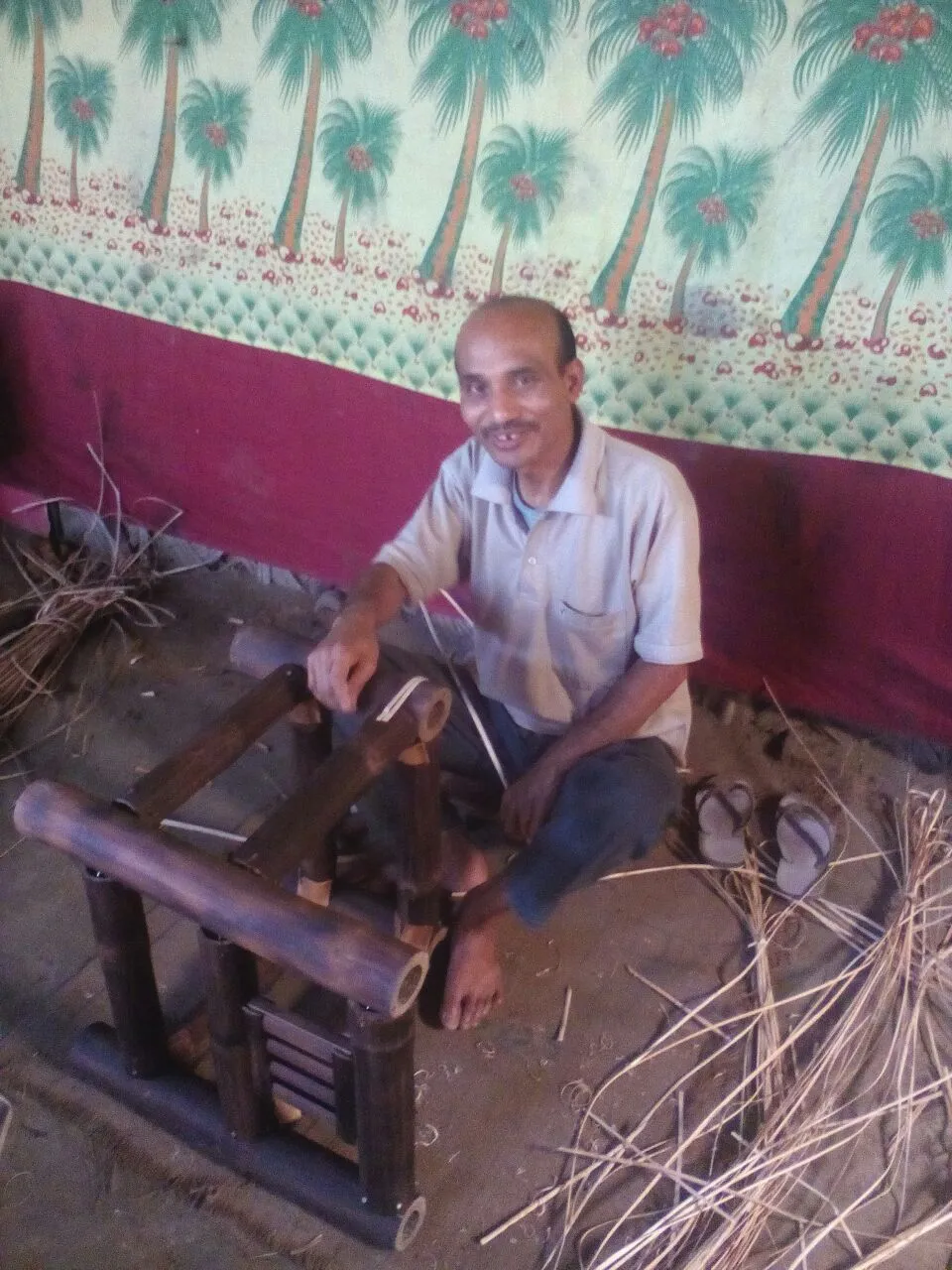
Frame construction: the artisan prepares the structural frame of the furniture piece by sizing thick cane or bamboo poles to the required dimensions and joining them using nails. For curved or rounded frame elements, thin iron rods are heated and used to bend round cane to the required shape. The basic skeleton of the furniture piece is assembled at this stage using hammers and pliers, tools used specifically at this stage of furniture production as distinct from simpler cane and bamboo work.
Weaving and coiling: once the frame is assembled, the artisan wraps and coils it with fine slips of flexible cane. The Assam State Portal and IGNCA both note that the quality of the final product depends entirely on the artisan's ability to produce fine, uniform cane slips and weave them consistently. Slips are split from prepared cane using a dao (bill-hook) fixed on a jak (a V-shaped wooden frame), which is the standard splitting tool for this tradition. Varieties of bamboo locally known as sundi, barjali, harua, and golla are also used at this stage alongside cane species.
Finishing: after weaving is complete, a coat of lacquer is applied to the finished object. Some commercial furniture producers also treat the cane against parasitic infestation, as documented in the Indian Mirror overview. The entire production process requires no mechanical devices: it is carried out using hand tools, and both the IGNCA and Asia InCH Encyclopedia explicitly state that no mechanical devices are used in the craft.
Mediums Used: The primary medium is processed rattan cane, specifically the commercially dominant species Jati (Calamus tenuis), Tita (Calamus leptesadix), and Lejai (Calamus floribundus), with secondary contributions from Sundi (Calamus garuba) and Raidang (Calamus flagellum). Bamboo varieties including Muli (Melocanna bambusoides), Dalu (Teinostachyum dalloa), and locally named varieties such as Mrithinga and Bethua are used structurally in furniture frames. Iron rods are used for bending round cane sections of frames. Nails, hammers, and pliers are used in structural assembly. The dao (bill-hook) and jak (V-shaped wooden splitting frame) are the primary splitting tools. Lacquer is applied as a final surface coat. No chemical dyes or paints are documented as standard components of the traditional cane furniture process.
New Outlook
The cane furniture craft of Assam has faced sustained pressure since the late twentieth century from competition with machine-manufactured alternatives. The number of full-time professional artisans engaged in furniture-grade cane work has declined, with the craft increasingly being practiced part-time alongside agricultural labour rather than as a sole occupation. The specific skill base required for high-quality furniture production, concentrated historically in the Cachar district, is at risk due to generational succession gaps.
Institutional responses have included the establishment of the Cane and Bamboo Technology Centre (CBTC) in Guwahati as a technical support body under the National Bamboo Mission, and the National Mission on Bamboo Applications' focus on plantation development, anti-erosion bamboo planting, and tissue culture programmes for new bamboo cultivation. The Bamboo Park at Chayagaon was under development with an investment of Rs. 62.28 crore as documented in available government portal records, aimed at creating integrated infrastructure for bamboo-based industries.
Contemporary cane furniture production increasingly incorporates design inputs from external designers and government-supported training workshops, adapting traditional forms to meet urban domestic market preferences. Producers sell through roadside workshops in Guwahati and other urban centres, through craft exhibitions and fairs, and increasingly through online retail platforms. The Assam State Portal identifies demand for cane products both within and outside Assam, noting export potential, though no specific export volume data is available in the documented sources consulted.
Learn Cane Furniture from Assam










Bibliography
Text Sources
Banabhatta. Harshacharita. 7th century CE. Asiatic Society of Bengal ed.
Baruah, B. K.. A Cultural History of Assam (Early Period). Vol. 1, 2nd ed., Bina Library, 1969.
Baruah, S. L.. A Comprehensive History of Assam. Manohar Publishers, 1985.
Dhar, P. K.. The Economy of Assam (Including Economy of Northeast India). 1987. Reprint, 2018.
Goswami, P. C.. The Economic Development of Assam. Kalyani Publications, 1981.
Hazarika, Kabyashree. “Bamboo: An Agro-Based Industry: History of Bamboo Crafts and Its Importance in Our Day to Day Life.” IOSR Journal of Humanities and Social Science, vol. 25, no. 11, ser. 8, 2020, pp. 26–30.
Internet Sources (for images)*
“Bamboo Cane Furniture.” Assam Kenwood Furniture, https://assamkenwoodfurniture.com/bamboo-cane-furniture/
“Assam Cane Bamboo.” Assam Cane Bamboo Blog, 2016, https://assamcanebamboo.blogspot.com/2016/