

Blue Pottery - The Handicraft Tradition of Rajasthan
Explore Blue Pottery, the handicraft tradition of Rajasthan, and learn about its origins, techniques, cultural significance, and artistic heritage.
Introduction
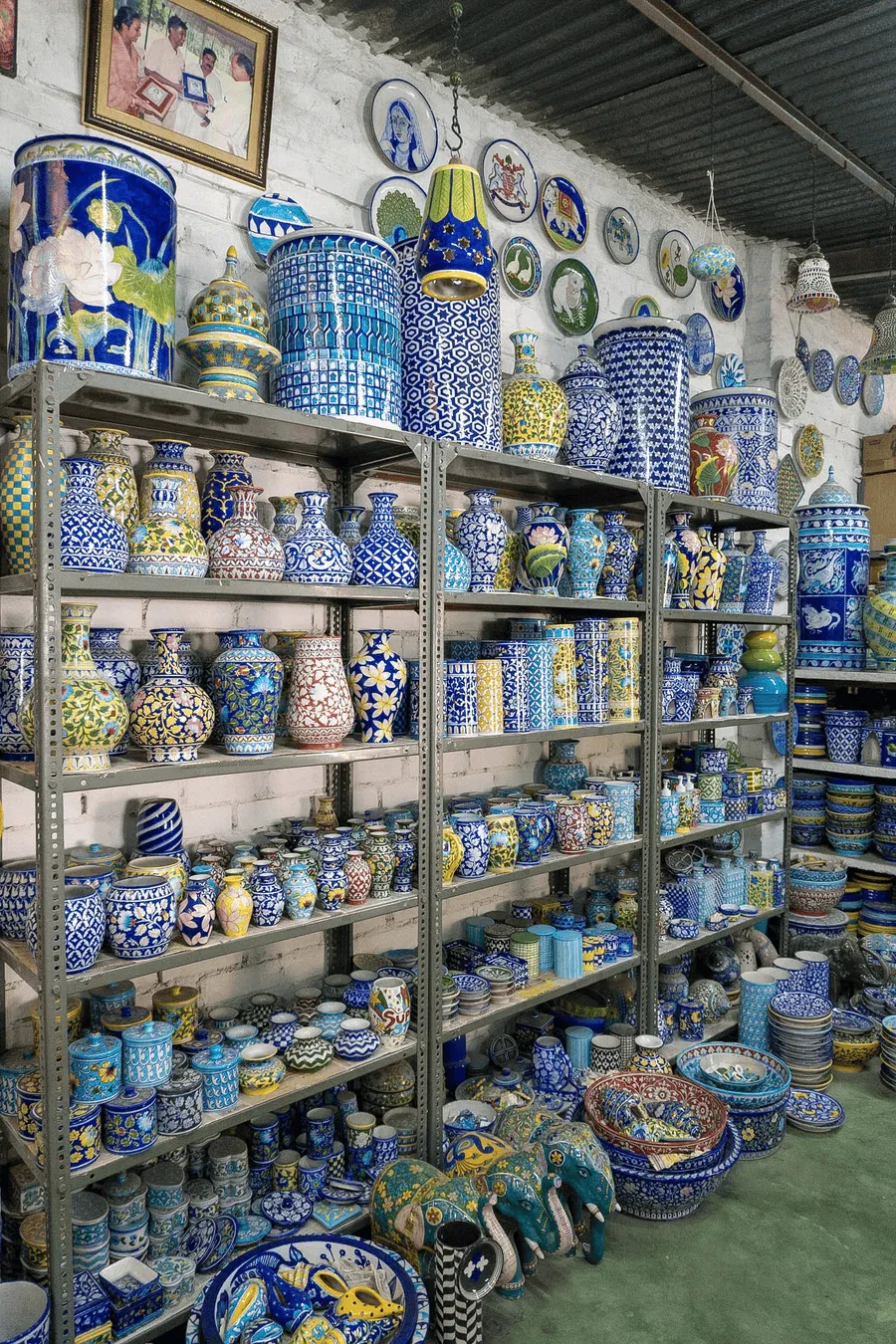
Blue Pottery is a distinctive ceramic craft associated with Jaipur, Rajasthan. Unlike most ceramics, Jaipur Blue Pottery is not made from clay; it is produced from a dough of quartz stone powder, powdered glass, Multani mitti (Fuller's earth), borax, gum, and water. The finished objects are glazed in a characteristic blue-white glaze and decorated with blue cobalt oxide-based colours and floral or geometric patterns. The craft holds GI tag status and is documented by the Development Commissioner (Handicrafts), Ministry of Textiles, Government of India.
Etymology The name Blue Pottery directly references the dominant colour of the craft's glaze and painted decoration, which uses cobalt oxide to produce shades of blue on a white ground. The pottery designation refers to the fired ceramic objects produced, though the material base is unusual compared to conventional pottery.
Origin The origin of Blue Pottery in Jaipur is connected to the Persian and Central Asian glazed tile and ceramic tradition, transmitted to India through the Mughal court. The Dsource.in documentation (IIT Bombay) records that the craft was brought to Jaipur from Delhi in the 19th century under the patronage of the Jaipur royal family, specifically Raja Ram Singh II. The technique itself has Persian origins, characterised by the tin-oxide glaze and cobalt blue decoration that developed in the Islamic world and reached India through the Mughal connection.
Location Jaipur, Rajasthan, is the primary and GI-protected centre of Blue Pottery production. Artisans are concentrated in specific neighbourhoods of Jaipur city.
Community Blue Pottery in Jaipur is produced by a small community of specialised artisans, many of whom were trained through institutional programmes including those associated with craft revivalists such as Kripal Singh Shekhawat, who is credited with reviving and innovating the craft in the mid-20th century. The craft is not a traditional hereditary trade in the same way as many other Indian crafts; it was revived as a craft industry in Jaipur.
Relevance Blue Pottery holds GI tag status. It is one of the most internationally recognised traditional crafts of Rajasthan and is a prominent product in Jaipur's craft economy. The Handicrafts Development Commissioner, national craft exhibition networks, and tourism promotion of Rajasthan all support Blue Pottery's visibility.
History
Background Blue Pottery was introduced to Jaipur in the 19th century under the patronage of Maharaja Ram Singh II (reigned 1835-1880), who brought craftsmen from Delhi to teach the technique to Jaipur artisans. The craft subsequently declined and was revived in the 20th century, most notably through the work of Kripal Singh Shekhawat, who learned the craft and trained new artisans. The Folkstorys and Rudhigat blog documentation records this revival history. The craft received GI protection in the post-independence period as part of efforts to protect and promote traditional Rajasthan crafts.
Culture and Societies Blue Pottery is closely associated with Jaipur's identity as a heritage city and craft centre. It is among the most prominent crafts promoted through Jaipur's tourism and export industries. The craft's Persian-Mughal aesthetic heritage gives it a distinctive character within Rajasthan's predominantly Hindu craft traditions.
Religious Significance No specific religious significance has been documented for Blue Pottery. The craft is secular in its production and use, serving decorative and utilitarian purposes.
Understanding the Art
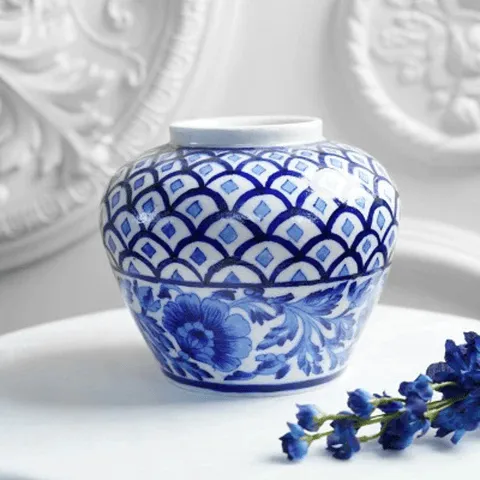
Style Blue Pottery is characterised by the white-blue glazed surface and the characteristic cobalt blue floral and geometric painted decoration. The glaze produces a translucent, semi-glossy surface. The objects produced include tiles, vases, bowls, cups, plates, and decorative objects. The characteristic designs are largely derived from Persian and Central Asian glazed ceramic traditions, featuring lotus, fish, birds, and geometric patterns.
Central Motifs and Their Significance Primary motifs include lotus flowers, fish (matsya), birds (particularly parrots and peacocks), deer, geometric borders, and stylised floral scrolls. These motifs carry no specific symbolic religious meaning in the Jaipur Blue Pottery context; they are primarily decorative, drawn from the broader repertoire of Persian-Mughal decorative arts. The lotus is common to both Hindu and Persian-Islamic decorative traditions and functions aesthetically rather than symbolically in this craft.
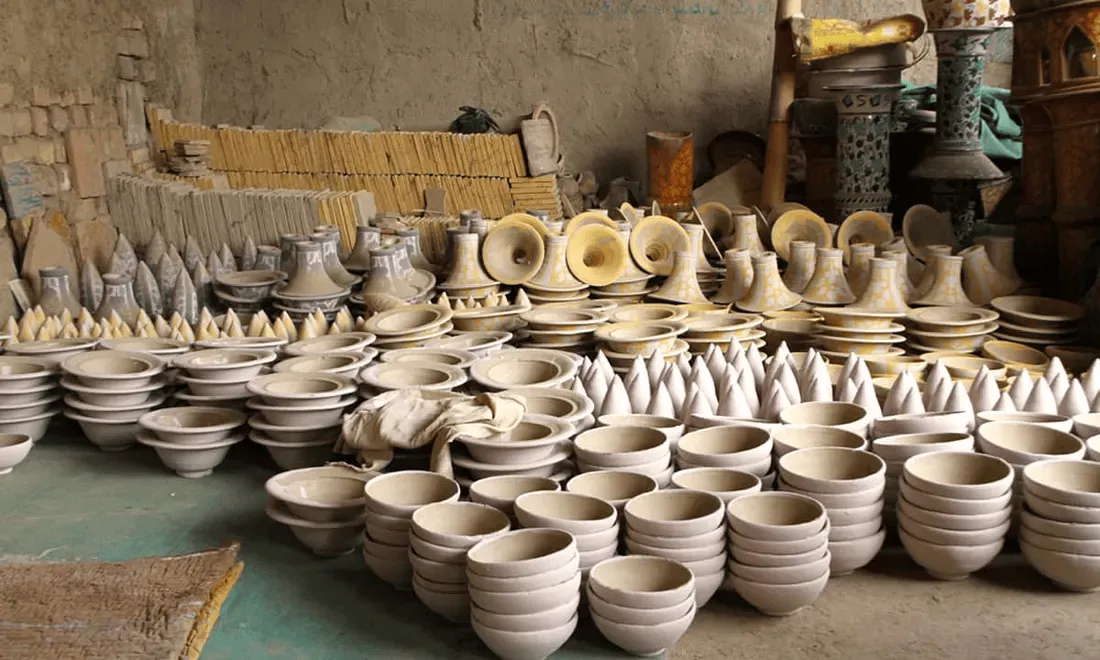
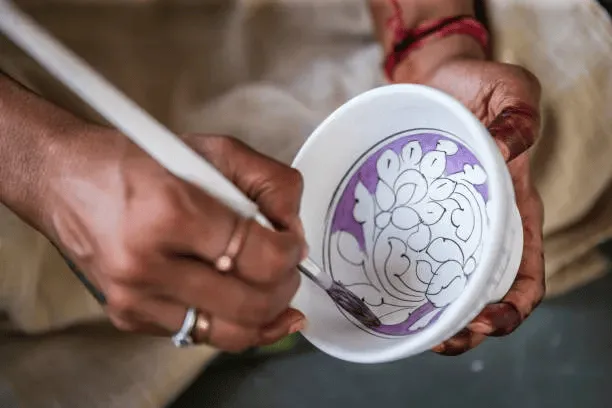
Process The material preparation involves mixing quartz stone powder, powdered glass, Multani mitti, borax, gum (gond), and water into a workable dough. The dough is rolled out, shaped over plaster of Paris moulds into the required form (plate, bowl, vase, tile), and then dried. Decoration is painted onto the dried but unfired object using cobalt oxide for blue and other metal oxides for yellow, green, and brown. A glaze of ground glass and other minerals is applied over the painted surface. The object is fired at approximately 800 degrees Celsius. The low firing temperature and glass-based glaze are characteristic of this tradition.
Mediums Used The primary medium is a quartz-glass-earth composite: quartz stone powder (silica), powdered glass, Multani mitti (Fuller's earth), borax, and gum. No conventional clay is used. Colours are metal oxide pigments: cobalt oxide (blue), copper oxide (green), iron oxide (brown), and manganese oxide (black). The glaze is also silica-based.
New Outlook
Blue Pottery has maintained strong market presence as a Jaipur heritage craft. Contemporary artisans have expanded the product range and motif vocabulary while retaining the traditional material and technique. Export markets in Europe, North America, and Southeast Asia are established. The craft faces challenges in artisan succession and in competing with machine-made ceramic imitations. GI protection provides legal tools against imitation.
Learn Blue Pottery
Bibliography
Sources
“Blue Pottery Jaipur.” D-Source, Indian Institute of Technology Bombay, dsource.in.
“Blue Pottery.” Development Commissioner (Handicrafts), Ministry of Textiles, Government of India, handicrafts.nic.in.
Image Sources
Falconer, Rosanna. “Jaipur Blue Pottery Class.” Rosanna Falconer, 3 Mar. 2026, https://www.rosannafalconer.com/blogs/journal/jaipur-blue-pottery-class. Accessed on May 02, 2026.
Rodrigues, Zilpha. “Mould, Paint and Flame: A Journey of Jaipur’s Blue Pottery.” Medium, 27 Sept. 2023, https://medium.com/@zilpha.rodrigues/mould-paint-and-flame-a-journey-of-jaipurs-blue-pottery-1869bffb0d13. Accessed on May 02, 2026.
“The Art of Blue Pottery.” Folkstorys, 28 Oct. 2022, https://www.folkstorys.com/blogs/news/the-art-of-blue-pottery. Accessed on May 02, 2026.